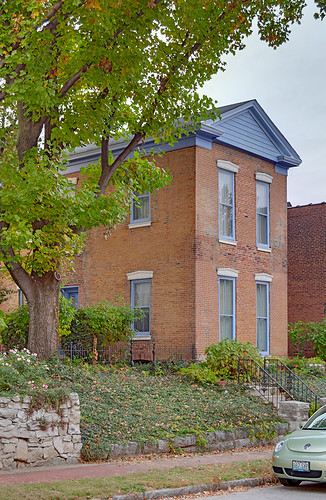
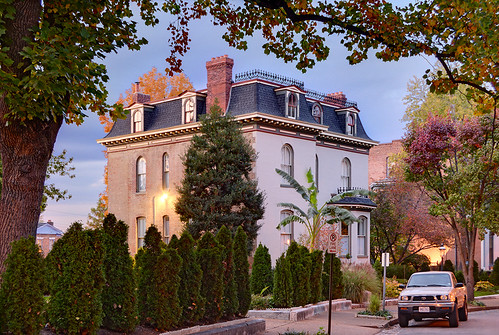
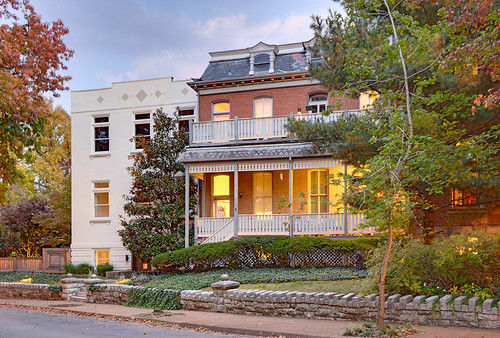
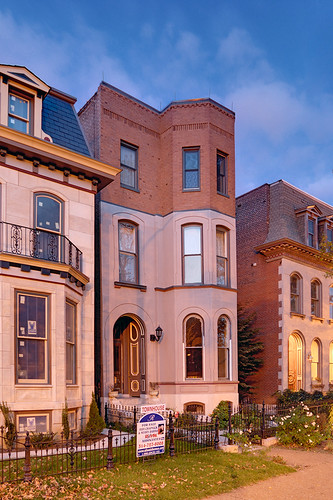
LAFAYETTE SQUARE contains perhaps the finest surviving Victorian architecture in the United States. This neighborhood, located south of downtown Saint Louis, Missouri, surrounds the 30-acre
Lafayette Park.
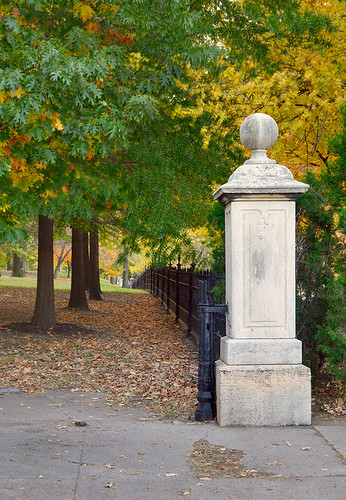
An entrance to the park, designed by Francis Tunica. These photos were taken on November 1st, All Saints Day, at the peak of Autumn color.
According to a
history of the neighborhood:
Since Saint Louis’s beginning as a French village in 1764, the land which is now Lafayette Square had been a common pasture for village livestock and had never been privately owned. These commons became encampments for bands of criminals who would attack and rob area travelers. In 1835, now under American rule, Mayor Darby gained permission from the state legislature to begin selling the commons to drive the criminals out. When the city began to sell the common pasture, the Board of Aldermen set aside about thirty acres for community recreation. The square park was bordered by a street on each side, with the southern street called Lafayette in honor of General Marie-Joseph-Paul-Roch-Yves-Gilbert du Motier, Marquis de La Fayette, who had visited Saint Louis a few years previous.
In 1837 a real estate panic forced many who had bought land surrounding the Square to cease their payments causing the land to revert to the City. In the early 1850s, after courts had adjudicated the ownership of these properties, several prominent Saint Louisans bought most of the land bordering the southern end of the Park. These families built expensive homes along on Lafayette Avenue and secured state legislation preventing “any nuisance within a distance of 600 feet from the Park.” On November 12, 1851, the park was dedicated as “Lafayette Square” by City Ordinance 2741. By 1856, real estate developers had begun to sell lots on the western edge of the park—along Missouri Avenue—and by 1858 lots on the east side—Mississippi Avenue—were being sold. On Park Avenue—running along the north edge of the Square—the lots were developed by the 1870s.
Natural disaster began this neighborhood's period of decline:
On May 27, 1896, Lafayette Square was largely destroyed by a tornado. The tornado did millions of dollars worth of damage, and killed many. The tornado uprooted nearly all of the trees in the Park as well as the trees on Benton Place, damaged the fence, destroyed the bandstand, destroyed the Union Club and the Methodist church at Jefferson and Lafayette Avenues, crippled the Presbyterian and Methodist churches, tore the roof off the Unitarian church, and crippled or destroyed many homes on the Square. Although some residents gave up on the neighborhood and moved away, others began to rebuild and by 1904 the Square had improved enough “to earn special commendation from foreign landscape architects who were visiting the World’s Fair.”
In 1923, the Missouri Supreme Court declared the 1918 residential zoning ordinance unconstitutional (see City of St. Louis v. Evraiff, 256 S.W. 489 (Mo. 1923)) and businesses began to purchase lots in the area. What the tornado of 1896 had begun, and the encroachment of gas stations and grocery stores continued, the Great Depression accelerated. By the end of World War II, the Square’s half-century of decline was complete. At this time, the neighborhood that was once the jewel of St. Louis had reached the low point in its history by becoming “a pocket ghetto of the unfortunate and poor,” known as “Slum D.”
The fortunes of this area reversed in the late 1960s, when dedicated restorationists moved into the neighborhood. Less than a decade earlier, Victorian architecture was despised and vast numbers of buildings of that era were being destroyed on an scale unprecedented outside of warfare. These urban pioneers often relied on their own labor to restore the buildings, which were then in great disrepair and available at extremely low cost; they are now quite valuable.
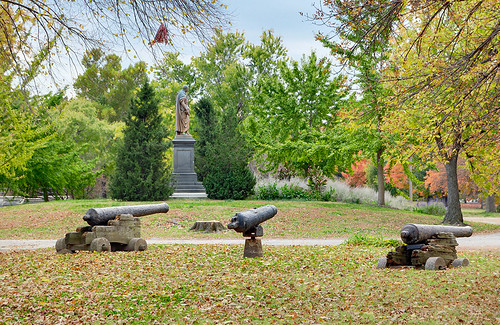
These cannons are from the British warship Acteon, which sank while attacking Fort Moultrie during the Revolutionary War.
Statue of
Thomas Hart Benton (1782 - 1858), a Democrat and United States Senator from 1821, the year Missouri gained Statehood, to 1851, when he lost support due to the slavery controversy. He was one of the chief architects of the policy that became known as "
Manifest Destiny": that the United States was to become a vast, continental power. On the pedestal of this statue is a phrase he used during his stump speeches: "There is the East. There is India," as he pointed to the west. He was a proponent of
Jeffersonian Democracy, gold specie money (as opposed to paper currency and bank debt), and although a slave owner, he opposed its expansion into the new territories; this opposition, and that he was also a staunch Unionist, ended his career in the Senate.
This statue was erected in 1868 and is by
Harriet Goodhue Hosmer, who studied anatomy at the Saint Louis Medical College, and was a member of a women's group of neoclassical sculptors in Rome, Italy.
Trade through Saint Louis in the early part of the century exchanged manufactured goods from Britain and New England for bartered furs from the Indians and hard money from Mexico. Not relying on banks and especially debt, the prosperity of Saint Louis had a steady character.
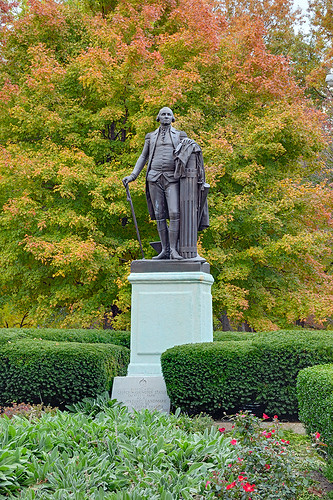
A statue of
George Washington (1732-1799), first President of the United States, installed in 1869. This is one of six copies of the statue by
Jean-Antoine Houdon (1741 -1828), a French neoclassical sculptor known for his portraits of Enlightenment figures. Houdon was a member of
Les Neuf Sœurs, a Grand Orient masonic lodge in France organized in 1776 to support the American Revolution; he was persuaded by Benjamin Franklin, master of the lodge, and Thomas Jefferson, envoy to the lodge, to come to America. Washington sat for Houdon in 1785, which included plaster and clay masks from life; Houdon also made casts of Jefferson and Franklin, which led to other famous sculptures.
Washington is shown here next to the
fasces lictoriae, a symbol of power and unity in Ancient Rome, much used in governmental architecture in the United States.
As a Federalist, Washington supported a strong central government with extensive powers of taxation and a central bank. He promoted national civic virtue, and warned against sectionalism, partisanship, and involvement in foreign wars.
Lafayette, after whom this neighborhood is named, served with distinction under Washington during the Revolutionary War.
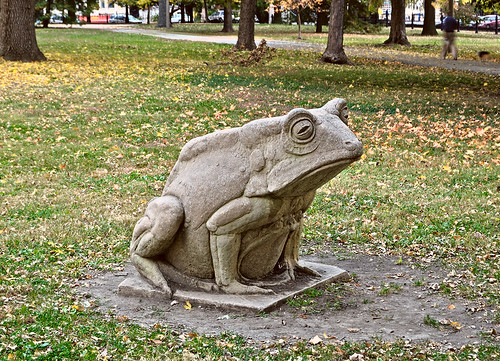
A frog sculpture in the children's playground, by Robert Cassilly, who also founded the City Museum in downtown.
A swan house on an island in the park's lake.
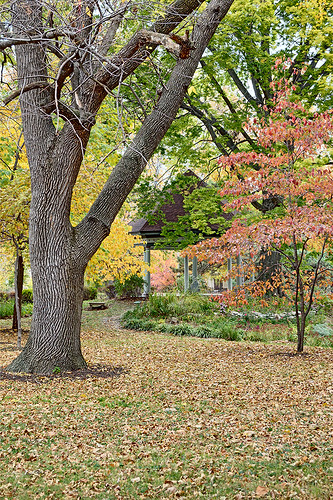
A gazebo, the third to sit on this spot. It can be rented for events.
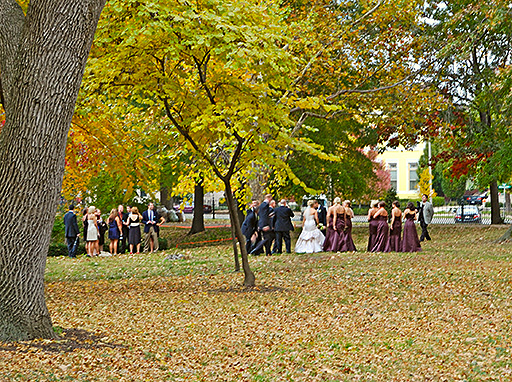
A low-quality photo of an elegant wedding party being photographed in the park.
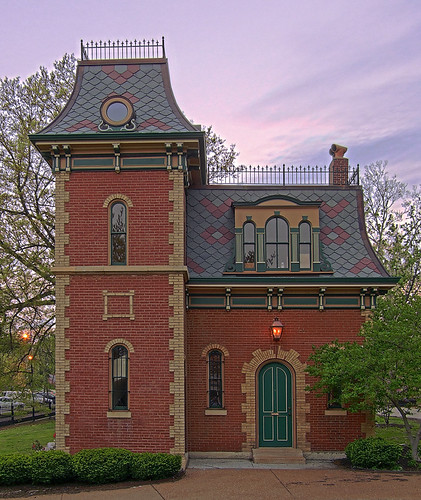
This photo of an old police station in Lafayette Park dates from April of this year. I was unable to take a fresh photo, because
another wedding party was being photographed here. Known as the Park House, this was built in 1867 and expanded in 1870. The building is smaller than it appears, since it incorporates detail on a scale which perhaps is more properly found on a larger structure.
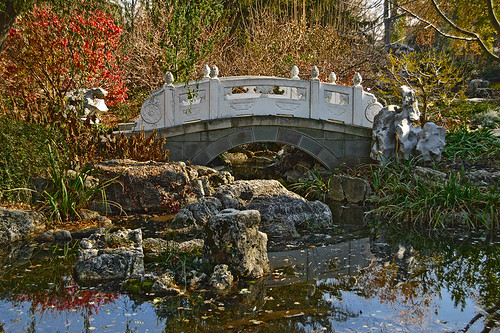
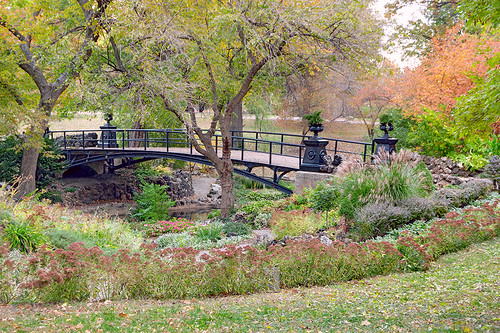
This part of the park is the Rockery, with an iron bridge spanning a small lake. The wedding party shown above was photographed at this bridge.
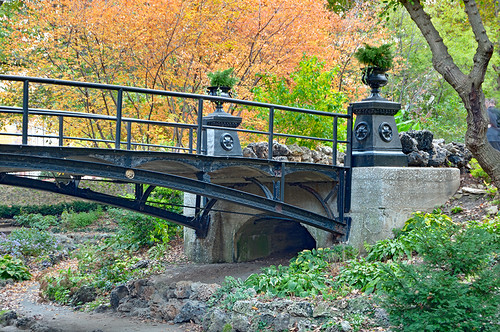
A close-up of the bridge, with a blurry glimpse of the groom on the right.
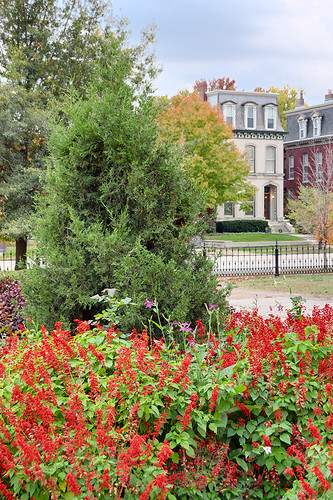
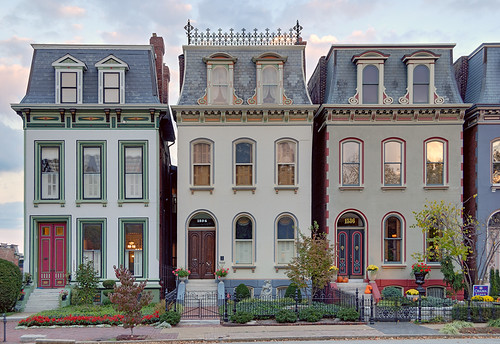
A nice planter. In the background is seen a section of the wrought-iron fence around the park, installed in 1869. At one time, this kind of fencing was very common in Saint Louis, but much of it was scrapped during World War II. Local residents fought hard to preserve this fence during that time. Behind the fence are homes in the Second Empire style (I think. Corrections appreciated).
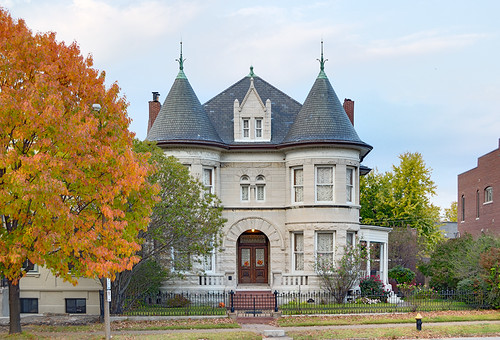
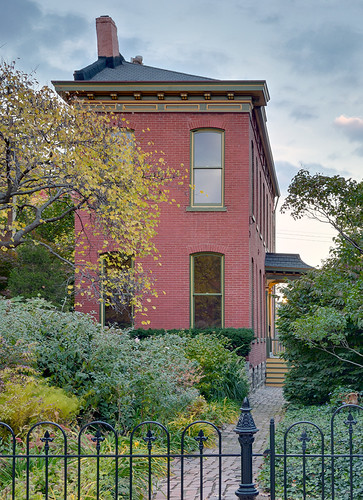
On Park Avenue is a grand mansion, facing the north side of the park.
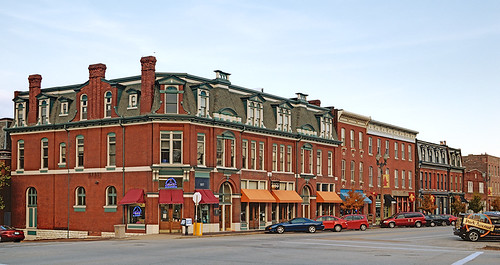
A row of businesses, northeast of the park.
Nicely-restored townhouses along Mississippi Avenue, facing the park from the east.
Residents of this neighborhood tend to be politically liberal, and they reflect in some ways the attitudes of the founders of Lafayette Square, who were mainly wealthy and fashionable mainstream Protestants or freethinkers.
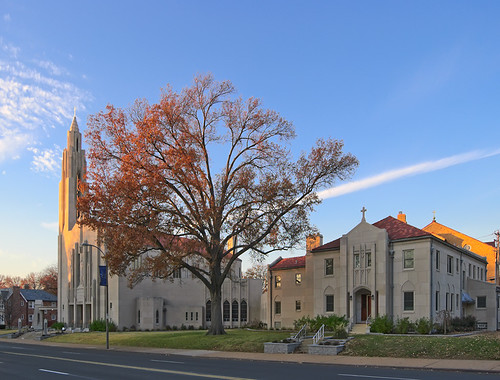
There is no Catholic church in this neighborhood, nor did any exist here during the neighborhood's heyday.
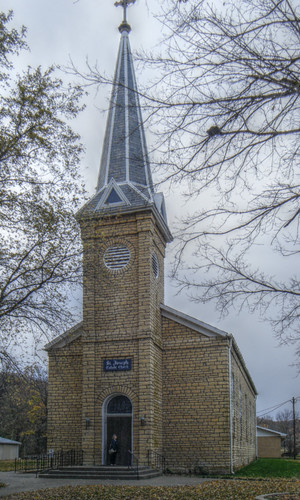
Saint Joseph (Lithuanian) Catholic church was here from 1915 to 1970, a period when this neighborhood was in sharp decline and impoverished. The church and rectory still exist, and are for sale; I did not take a photo of it because I didn't know of its history at the time. The nearest existing Catholic church in the area is
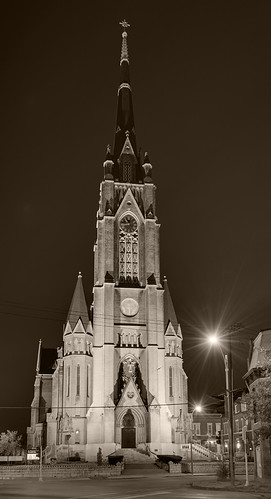
Saint John Nepomuk, located about half a mile to the east of the park.
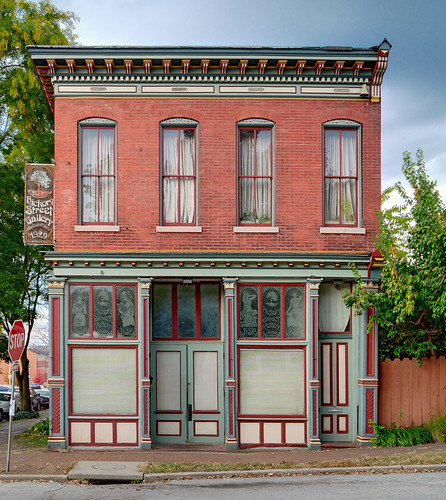
[Update: Click here for my photos of the old Saint Joseph Church; this neighborhood does have a chapel of the Society of Saint Pius X, a group currently in imperfect communion with the Holy See.]This is a "half-flounder" style building, an unusual type found primarily in Saint Louis and Alexandria, Virginia.
A shop, on the corner of Hickory Street and Mississippi Avenue.
Saint Louisians were incredulous about moving to Lafayette Square during its initial development. For this area was separated from the existing city, being south of the Mill Creek Valley and
Chouteau's Pond, and so was quite inconvenient to the rest of town.
Disasters changed public opinion. In 1849, a
cholera epidemic wiped out 10% of the city's population, and a steamboat explosion and subsequent
fire destroyed much of the older part of town. Obviously, having too large of a population living in close confines increased the risk of such disasters happening again.
In response, new neighborhoods sprang up, including Lucas Place (now destroyed) and Lafayette Square. New horse-drawn omnibus lines served as transportation into downtown, and some of the nation's earliest sewer and water systems were developed as public health measures. Cemeteries were also relocated to outlying areas.
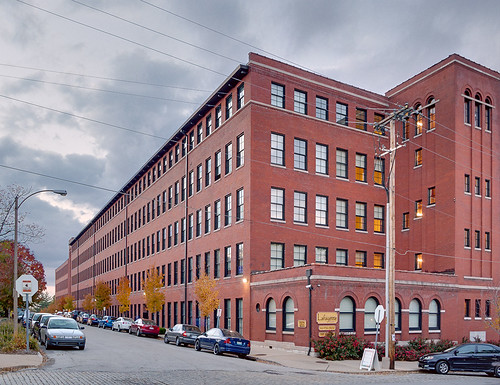
A former shoe factory, two blocks north of the park, is now an apartment building.
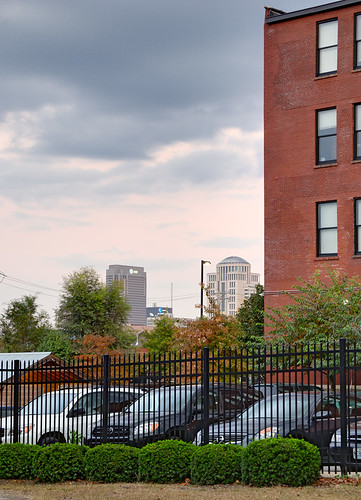
At the far end of that building, a view of downtown Saint Louis.
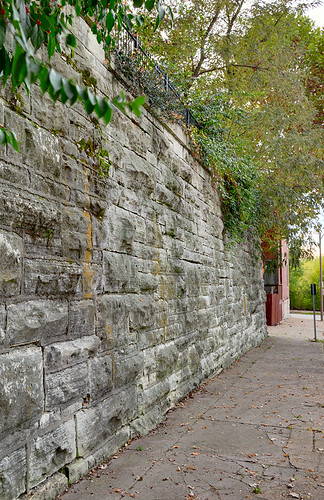
Lafayette Park sits above the Mill Creek Valley, and roads leading down to Chouteau Avenue are somewhat steep; this large retaining wall shores up the Benton Place development above. Somewhat mysteriously, there is a
door in this wall, now cemented shut.
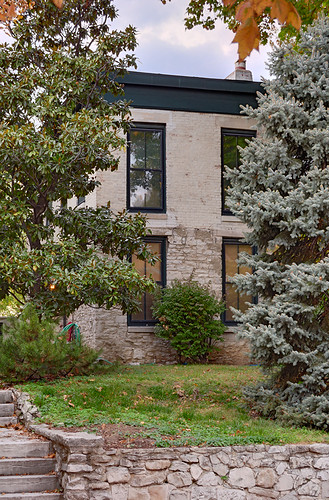
If I recall properly, the lower part of this building dates from the colonial period.
Next door.
The old Desloge mansion on Benton Place, the first private street in Saint Louis. This block is one of my sister-in-law's favorites.
Other homes on Benton Place.
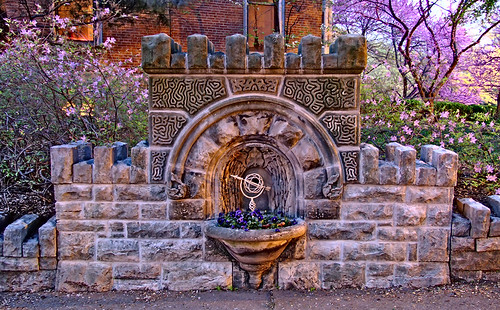
This fountain, now a planter, is also on Benton Place. This photo is from April of this year.
For sale.