THIS TERRIFYING CREATURE is the Piasa Bird, painted on the river bluffs upstream from Alton, Illinois.
This is a loose, modern interpretation of original paintings mentioned by Fr. Jacques Marquette, S.J., who explored this area with Louis Joliet in 1673. From his journal:
“While Skirting some rocks, which by Their height and Length inspired awe, We saw upon one of them two painted monsters which at first made Us afraid, and upon Which the boldest savages dare not Long rest their eyes. They are as large As a calf; they have Horns on their heads Like those of deer, a horrible look, red eyes, a beard Like a tiger’s, a face somewhat like a man’s, a body Covered with scales, and so Long A tail that it winds all around the Body, passing above the head and going back between the legs, ending in a Fish’s tail. Green, red, and black are the three Colors composing the Picture. Moreover, these 2 monsters are so well painted that we cannot believe that any savage is their author; for good painters in france would find it difficult to paint so well, — and, besides, they are so high up on the rock that it is difficult to reach that place Conveniently to paint them.”
We are told that ‘piasa’ means man-eater. A legend of the Piasa bird was written by a classics professor from Alton, John Russell, in about 1836, which can be read in its entirety here:
“…Each morning and afternoon thereafter, the Piasa Bird came, shattering the peace of the village with its blood-chilling screams and the thunderous beat of its wings. More often than not, it returned to its lair with a victim.
“The Illini looked to their chief, Ouatoga, for a solution to this menace. Time and time again he had led them through the trials of famine, illness, and the threat of warlike tribes. But Ouatoga felt helpless before this danger and the years weighed heavily upon him. The beast seemed invulnerable. His body was covered with scales, like a coat-of-mail. The best efforts of Tera-hi-on-a-wa-ka, the arrow maker, and the tribe’s finest archers were to no avail.
“Then Ouatoga appealed to the Great Spirit. For nearly a full moon he prayed and fasted. Then in a dream he found the answer. The body of the Piasa Bird was not protected under the wings. After offering thanks to the Great Spirit, Ouatoga called the tribe together and devised a plan that could destroy the Piasa Bird…”
Miguel de Cervantes, the great Spanish writer, served as a Marine under the chivalric Don Juan of Austria, in the Holy League’s fleet during the Battle of Lepanto. This great naval battle, which took place on October 7th, 1571, defeated the plans of the Ottoman Empire to further the spread of Islam into Europe. Cervantes, although he was ill before battle, managed to fight with distinction, and suffered three gunshot wounds, one of which left his left arm useless — but as he later wrote, he “had lost the movement of the left hand for the glory of the right,” since he was proud of his military service while gaining fame from his writing.
The Church, in commemoration of this great battle, instituted the feast of Our Lady of Victories, now called the Feast of the Most Holy Rosary of the Blessed Virgin Mary.
Cervantes is most famous for his book El ingenioso hidalgo don Quijote de la Mancha (The Ingenious Gentleman Don Quixote of La Mancha), better known as simply Don Quixote. According the book’s article on Wikipedia, “It follows the adventures of Alonso Quijano, an hidalgo who reads so many chivalric novels that he decides to set out to revive chivalry, under the name Don Quixote. He recruits a simple farmer, Sancho Panza, as his squire, who often employs a unique, earthly wit in dealing with Don Quixote’s rhetorical orations on antiquated knighthood.”
Cervantes’ novel, at the time of its publication, was widely celebrated as a comedy, and it became so familiar that the book became the model for the modern Spanish language, giving it a place similar to Luther’s translation of the Bible into German, or the influence of Dante’s Divine Comedy on Italian. He was a contemporary of William Shakespeare, and their works show a number of similarities.
Don Quixote is widely considered to be the first modern novel; it rejects the symbolism of Medieval fiction and its serious martial themes, and instead concentrates on psychology and everyday life in a humorous manner.
However, by the time of the French Revolution, the book became interpreted romantically, where the foolish main character of the book was depicted as an idealistic dreamer who is rejected by society. We see this romanticism in the song The Impossible Dream (or Don Quixote’s Quest) from the popular 1965 Broadway play Man of La Mancha, here performed by Ed Ames on October 4th, 2008:
Don Quixote is perhaps responsible for killing an entire genre of literature—and it was a Christian genre. In reading stories of noble knights and kings, we are reminded that the lowliest Christian peasant is a solider doing spiritual battle, and has the high dignity of being a member of the Body of Christ and the Royal Priesthood of the faithful, and that even the greatest of Kings also must serve a higher power. The modernist novel reduces everyone to the lowest common materialist denominator.
Don Quixote parodies many ancient Spanish poems, and as it is our goal to re-evaluate Modernism, let’s revisit some of these poems to discover their true value. These were translated into English by John Gibson Lockhart, and published in his book Ancient Spanish Ballads: Historical and Romantic. The illustrations here come from an edition of the book made by several artists including Owen Jones, the famed Welsh art theorist I wrote about here.
King Rodrigo was the last Visigothic ruler in Hispania, whose Christian realm was taken by the Moors.
The Lamentation of Don Roderick.
I. THE hosts of Don Rodrigo were scatter'd in dismay,
When lost was the eighth battle, nor heart nor hope had they ;
He, when he saw that field was lost, and all his hope was flown,
He turn'd him from his flying host, and took his way alone.
II. His horse was bleeding, blind, and lame he could no farther go ;
Dismounted, without path or aim, the King stepp'd to and fro ;
It was a sight of pity to look on Roderick,
For, sore athirst and hungry, he stagger'd faint and sick.
III. All stain'd and strew'd with dust and blood, like to some smouldering brand
Pluck'd from the flame Rodrigo shew'd : his sword was in his hand,
But it was hack'd into a saw of dark and purple tint ;
His jewell'd mail had many a flaw, his helmet many a dint.
IV. He climb'd unto a hill top, the highest he could see,
Thence all about of that wide route his last long look took he ;
He saw his royal banners, where they lay drench'd and torn,
He heard the cry of victory, the Arab's shout of scorn.
V. He look'd for the brave captains that had led the hosts of Spain,
But all were fled except the dead, and who could count the slain !
Where'er his eye could wander, all bloody was the plain,
And while thus he said, the tears he shed run down his cheeks like rain
VI. “Last night I was the King of Spain to-day no king am I ;
Last night fair castles held my train, to-night where shall I lie ?
Last night a hundred pages did serve me on the knee
To-night not one I call mine own : not one pertains to me.
VII. “O luckless, luckless was the hour, and cursed was the day,
When I was born to have the power of this great signiory !
Unhappy me, that I should see the sun go down to-night !
O Death, why now so slow art thou, why fearest thou to smite ?”
We often forget the Germanic history of Spain, but in this lament, perhaps we can see the melancholy often found in the ancient poems of the North, mourning for the loss of the good things in life, as found in the Anglo-Saxon poem The Wanderer. But laments are also found in Sacred scripture, making up a large part of the book of Psalms. These are an embarrassment to modernist religionists who are always optimistic about human progress.
After the King's great military loss, he needed an extreme penance, for aren't the sins of the great worthy of far more reparation than the sins of the multitude? Unfortunately, the translator Lockhart, in his notes on this poem, is rather dismissive as he is with many of the poems. Rather, in this story, the defeated King shows true humility and sorrow for his wrongdoing.
The Penitence of Don Roderick.
I. IT was when the King Rodrigo had lost his realm of Spain,
In doleful plight he held his flight o'er Guadalete's plain ;
Afar from the fierce Moslem he fain would hide his wo,
And up among the wilderness of mountains he would go.
II. There lay a shepherd by the rill, with all his flock beside him ;
He ask'd him where upon his hill a weary man might hide him.
“Not far” quoth he, “within the wood dwells our old Eremite ;
He in his holy solitude will hide ye all the night.”
III. “Good friend,” quoth he, “I hunger.”—“Alas !” the shepherd said, -
“My scrip no more containeth but one little loaf of bread.”
The weary King was thankful, the poor man's loaf he took ;
He by him sate, and while he ate, his tears fell in the brook.
IV. From underneath his garment the King unlock'd his chain,
A golden chain with many a link, and the royal ring of Spain ;
He gave them to the wondering man, and with heavy steps and slow
He up the wild his way began, to the hermitage to go.
V. The sun had just descended into the western sea,
And the holy man was sitting in the breeze beneath his tree ;
“I come, I come, good father, to beg a boon from thee :
This night within thy hermitage give shelter unto me.”
VI. The old man look'd upon the King, he scann'd him o'er and o'er ;
He look'd with looks of wondering, he marvell'd more and more ;
With blood and dust distained was the garment that he wore,
And yet in utmost misery a kingly look he bore.
VII. “Who art thou, weary stranger ? This path why hast thou ta’en ?”
“I am Rodrigo ; yesterday men call'd me King of Spain ;
I come to make my penitence within this lonely place ;
Good father, take thou no offense, for God and Mary’s grace.”
VIII. The hermit look'd with fearful eye upon Rodrigo's face,
“Son, mercy dwells with the Most High not hopeless is thy case ;
Thus far thou well hast chosen, I to the Lord will pray,
He will reveal what penance may wash thy sin away.”
IX. Now, God us shield ! it was reveal'd that he his bed must make
Within a tomb, and share its gloom with a black and living snake.
Rodrigo bow'd his humbled head when God's command he heard,
And with the snake prepared his bed, according to the word.
X. The holy Hermit waited till the third day was gone,
Then knock'd he with his finger upon the cold tombstone ;
“Good king, good king,” the Hermit said, “now an answer give to me,
How fares it with thy darksome bed and dismal company ?”
XI. “Good father,” said Rodrigo, “the snake hath touch'd me not,
Pray for me, holy Hermit, I need thy prayers, God wot ;
Because the Lord his anger keeps, I lie unharmed here ;
The sting of earthly vengeance sleeps ; a worser pain I fear.”
XII. The Eremite his breast did smite when thus he heard him say,
He turn'd him to his cell, that night he loud and long did pray ;
At morning hour he came again, then doleful moans heard he,
From out the tomb the cry did come of gnawing misery.
XIII. He spake, and heard Rodrigo’s voice ; “O Father Eremite,
He eats me now, he eats me now, I feel the adder's bite ;
The part that was most sinning my bed-fellow doth rend,
There had my curse beginning, God grant it there may end !”
XIV. The holy man made answer in words of hopeful strain,
He bade him trust the body's pang would save the spirit's pain.
Thus died the good Rodrigo, thus died the King of Spain ;
Wash'd from offence his spirit hence to God its flight hath ta'en.
The Moorish King demanded an odious tribute from his Christian vassals, that of one hundred virgins per annum. The curious modern notions about women are hardly to be found in the medieval literature, and so the role of women found in that literature is far richer than one might suspect. Here we find a young maiden demanding that her King act like a man, and not pay the tribute:
The Maiden Tribute.
I. THE noble King Ramiro within the chamber sate,
One day, with all his barons, in council and debate,
When, without leave or guidance of usher or of groom,
There came a comely maiden into the council-room.
II. She was a comely maiden she was surpassing fair.
All loose upon her shoulders hung down her golden hair ;
From head to foot her garments were white as white may be ;
And while they gazed in silence, thus in the midst spake she.
III. “Sir King, I crave your pardon, if I have done amiss
In venturing before ye, at such an hour as this ;
But I will tell my story, and when my words ye hear,
I look for praise and honour, and no rebuke I fear.
IV. “I know not if I'm bounden to call thee by the name
Of Christian, King Ramiro ; for though thou dost not claim
A heathen realm's allegiance, a heathen sure thou art,
Beneath a Spaniard's mantle thou hidest a Moorish heart.
V. “For he who gives the Moor-King a hundred maids of Spain,
Each year when in its season the day comes round again ;
If he be not a heathen, he swells the heathen's train
'Twere better burn a kingdom than suffer such disdain.
VI. “If the Moslem must have tribute, make men your tribute-money,
Send idle drones to teaze them within their hives of honey ;
For when 'tis paid with maidens, from every maid there spring
Some five or six strong soldiers, to serve the Moorish King.
VII. “It is but little wisdom to keep our men at home,
They serve but to get damsels, who, when their day is come,
Must go, like all the others, the proud Moor's bed to sleep in
In all the rest they're useless, and nowise worth the keeping.
VIII. “And if 'tis fear of battle that makes ye bow so low,
And suffer such dishonour from God our Saviour's foe,
I pray you, sirs, take warning, ye'll have as good a fright,
If e'er the Spanish damsels arise themselves to right.
IX. “'Tis we have manly courage, within the breasts of women,
But ye are all hare-hearted, both gentlemen and yeomen.”
Thus spake that fearless maiden ; I wot when she was done,
Uprose the King Ramiro and his nobles every one.
X. The King call'd God to witness, that, come there weal or woe,
Thenceforth no maiden-tribute from out Castile should go ;
“At least I will do battle on God our Saviour's foe,
And die beneath my banner before I see it so.”
XI. A cry went through the mountains when the proud Moor drew near,
And trooping to Ramiro came every Christian spear ;
The blessed Saint lago, they called upon his name ;
That day began our freedom, and wiped away our shame.
The Christians, in avoiding the tribute, did battle with the Moors; according to legend, nearing the point of defeat, Saint James the Apostle—Santiago—appeared in full battle armor and routed the Moors. No more was the tribute paid, the tide had turned, and the long reconquest of Spain commenced.
It is such a strange stratagem
That our leaders now pursue;
They court the violent Moslem,
And hold Christ in deep distain.
Unlike good King Ramiro,
They scrape and bow with shame;
Will they undo with cunning,
What Iago did obtain?
It is difficult living under Dhimmitude. Christians must always make compromises:
The Wedding of the Lady Theresa.
I. 'TWAS when the fifth Alphonso in Leon held his sway,
King Abdalla of Toledo an embassy did send ;
He ask'd his sister for a wife, and in an evil day
Alphonso sent her, for he fear'd Abdalla to offend ;
He fear'd to move his anger, for many times before
He had received in danger much succour from that Moor.
II. Sad heart had fair Theresa when she their paction knew,
With streaming tears she heard them tell she 'mong the Moors must go,
That she, a Christian damosell, a Christian firm and true,
Must wed a Moorish husband, it well might cause her wo ;
But all her tears and all her prayers they are of small avail ;
At length she for her fate prepares, a victim sad and pale.
III. The King hath sent his sister to fair Toledo town,
Where then the Moor Abdalla his royal state did keep ;
When she drew near, the Moslem, from his golden throne, came down
And courteously received her, and bade her cease to weep ;
With loving words he press'd her, to come his bower within,
With kisses he caress'd her, but still she fear'd the sin.
IV. “Sir King, Sir King, I pray thee,” 'twas thus Theresa spake,
“I pray thee have compassion, and do to me no wrong ;
For sleep with thee I may not, unless the vows I break
Whereby I to the holy Church of Christ my Lord belong ;
But thou hast sworn to serve Mahoun, and if this thing should be,
The curse of God it must bring down upon thy realm and thee.
V. “The angel of Christ Jesu, to whom my heavenly Lord
Hath given my soul in keeping, is ever by my side ;
If thou dost me dishonour, he will unsheath his sword,
And smite thy body fiercely, at the crying of thy bride.
Invisible he standeth ; his sword, like fiery flame,
Will penetrate thy bosom, the hour that sees my shame.”
VI. The Moslem heard her with a smile ; the earnest words she said,
He took for bashful maiden's wile, and drew her to his bower.
In vain Theresa pray'd and strove she press'd Abdalla's bed,
Perforce received his kiss of love, and lost her maiden flower.
A woeful Woman there she lay, a loving lord beside,
And earnestly to God did pray her succour to provide.
VII. The Angel of Christ Jesu her sore complaint did hear,
And pluck'd his heavenly weapon from out its sheath unseen,
He waved the brand in his right hand, and to the King came near,
And drew the point o'er limb and joint, beside the weeping Queen.
A mortal weakness from the stroke upon the King did fall,
He could not stand when daylight broke, but on his knees must crawl.
VIII. Abdalla shudder'd inly, when he this sickness felt,
And call'd upon his Barons, his pillow to come nigh ;
“Rise up,” he said, “my liegemen,” as round his bed they knelt,
“And take this Christian lady, else certainly I die;
Let gold be in your girdles, and precious stones beside,
And swiftly ride to Leon, and render up my bride.”
IX. When they were come to Leon, Theresa would not go
Into her brother's dwelling, where her maiden years were spent ;
But o'er her downcast visage a white veil she did throw,
And to the ancient nunnery of Saint Pelagius went.
There long, from worldly eyes retired, a holy life she led ;
There she, an aged saint, expired—there sleeps she with the dead.
El Cid—Rodrigo Díaz de Bivar—is a great national hero of Spain. He served several rulers, and gained the admiration of all, being called El Cid—the Lord—by the Moors and El Campeador—the battle master—by the Christians.
The Cid and the Five Moorish Kings.
I. WITH fire and desolation the Moors are in Castille,
Five Moorish kings together, and all their vassals leal ;
They've pass'd in front of Burgos, through the Oca-Hills they've run,
They've plunder'd Belforado, San Domingo's harm is done
II. In Najara and Lograno there's waste and disarray :
And now with Christian captives, a very heavy prey,
With many men and women, and boys and girls beside,
In joy and exultation to their own realms they ride.
III. For neither king nor noble would dare their path to cross,
Until the good Rodrigo heard of this skaith and loss ;
In old Bivar the castle he heard the tidings told,
(He was as yet a stripling, not twenty summers old.)
IV. He mounted Bavieca, his friends he with him took,
He raised the country round him, no more such scorn to brook ;
He rode to the hills of Oca, where then the Moormen lay,
He conquer'd all the Moormen, and took from them their prey.
V. To every man had mounted he gave his part of gain,
Dispersing the much treasure the Saracens had ta'en ;
The Kings were all the booty himself had from the war,
Them led he to the castle, his strong-hold of Bivar.
VI. He brought them to his mother, proud dame that day was she :
They own'd him for their Signior, and then he set them free ;
Home went they, much commending Rodrigo of Bivar,
And sent him lordly tribute, from their Moorish realms afar.
Boldness and femininity, in the modern mind, are often strictly opposed, and one must not coexist with the other; but the Medieval heroine often combines boldness and femininity in a generally pleasing fashion, well suited to be a mate to the chivalrous gentleman. Here we find Ximena Gomez—who is featured in an earlier poem not copied here—who boldly asks for the hand of El Cid in marriage.
The Cid's Courtship.
I. Now, of Rodrigo de Bivar great was the fame that run,
How he five Kings had vanquish'd, proud Moormen every one ;
And how, when they consented to hold of him their ground,
He freed them from the prison wherein they had been bound.
II. To the good King Fernando, in Burgos where he lay,
Came then Ximena Gomez, and thus to him did say
“I am Don Gomez' daughter, in Gormaz Count was he ;
Him slew Rodrigo of Bivar in battle valiantly.
III. “Now am I come before you, this day a boon to crave
And it is that I to husband may this Rodrigo have ;
Grant this, and I shall hold me a happy damosell,
Much honour'd shall I hold me, I shall be married well.
IV. “I know he's born for thriving, none like him in the land ;
I know that none in battle against his spear may stand ;
Forgiveness is well pleasing in God our Saviour's view,
And I forgive him freely, for that my sire he slew.”
V. Right pleasing to Fernando was the thing she did propose ;
He writes his letter swiftly, and forth his foot-page goes ;
I wot, when young Rodrigo saw how the King did write,
He leapt on Bavieca—I wot his leap was light.
VI. With his own troop of true men forthwith he took the way,
Three hundred friends and kinsmen, all gently born were they ;
All in one colour mantled, in armour gleaming gay,
New were both scarf and scabbard, when they went forth that day.
VII. The King came out to meet him, with words of hearty cheer ;
Quoth he, “My good Rodrigo, you are right welcome here ;
This girl Ximena Gomez would have ye for her lord,
Already for the slaughter her grace she doth accord.
VIII. “I pray you be consenting, my gladness will be great ;
You shall have lands in plenty, to strengthen your estate.”
“Lord King,” Rodrigo answers, “in this and all beside,
Command, and I'll obey you. The girl shall be my bride.”
IX. But when the fair Ximena came forth to plight her hand,
Rodrigo, gazing on her, his face could not command :
He stood and blush'd before her ; thus at the last said he
“I slew thy sire, Ximena, but not in villainy :
X. “In no disguise I slew him, man against man I stood ;
There was some wrong between us, and I did shed his blood.
I slew a man, I owe a man ; fair lady, by God's grace,
An honour’d husband thou shalt have in thy dead father’s place.”
This poem shows the Christian character of El Cid:
The Cid and the Leper.
I. HE has ta'en some twenty gentlemen, along with him to go,
For he will pay that ancient vow he to Saint James doth owe ;
To Compostello, where the shrine doth by the altar stand,
The good Rodrigo de Bivar is riding through the land.
II. Where'er he goes, much alms he throws, to feeble folk and poor ;
Beside the way for him they pray, him blessings to procure ;
For, God and Mary Mother, their heavenly grace to win,
His hand was ever bountiful : great was his joy therein.
III. And there, in middle of the path, a leper did appear ;
In a deep slough the leper lay, none would to help come near.
With a loud voice he thence did cry, “For God our Saviour's sake,
From out this fearful jeopardy a Christian brother take.”
IV. When Roderick heard that piteous word, he from his horse came down ;
For all they said, no stay he made, that noble champion ;
He reach'd his hand to pluck him forth, of fear was no account,
Then mounted on his steed of worth, and made the leper mount.
V. Behind him rode the leprous man ; when to their hostelrie
They came, he made him eat with him at table cheerfully ;
While all the rest from that poor guest with loathing shrunk away,
To his own bed the wretch he led, beside him there he lay.
VI. All at the mid-hour of the night, while good Rodrigo slept,
A breath came from the leprous man, it through his shoulders crept ;
Right through the body, at the breast, pass'd forth that breathing cold;
I wot he leap'd up with a start, in terrors manifold.
VII. He groped for him in the bed, but him he could not find,
Through the dark chamber groped he, with very anxious mind ;
Loudly he lifted up his voice, with speed a lamp was brought,
Yet nowhere was the leper seen, though far and near they sought.
VIII. He turn'd him to his chamber, God wot, perplexed sore
With that which had befallen—when lo ! his face before,
There stood a man, all clothed in vesture shining white :
Thus said the vision, “Sleepest thou, or wakest thou, Sir Knight ?”
IX. “I sleep not,” quoth Rodrigo ; “but tell me who art thou,
For, in the midst of darkness, much light is on thy brow ?”
“I am the holy Lazarus, I come to speak with thee ;
I am the same poor leper thou savedst for charity.
X. “Not vain the trial, nor in vain thy victory hath been ;
God favours thee, for that my pain thou didst relieve yestreen.
There shall be honour with thee, in battle and in peace,
Success in all thy doings, and plentiful increase.
XI. “Strong enemies shall not prevail, thy greatness to undo ;
Thy name shall make men’s cheeks full pale—Christians and Moslems too ;
A death of honour shalt thou die, such grace to thee is given,
Thy soul shall part victoriously, and be received in heaven.”
XII. When he these gracious words had said, the spirit vanish'd quite.
Rodrigo rose and knelt him down—he knelt till morning light ;
Unto the Heavenly Father, and Mary Mother dear,
He made his prayer right humbly, till dawn'd the morning clear.
A poem where El Cid and the Holy Father the Pope both make a mistake—but all is forgiven:
The Excommunication of The Cid.
I. IT was when from Spain across the main the Cid had come to Rome,
He chanced to see chairs four and three beneath Saint Peter's dome.
“Now tell, I pray, what chairs be they ?” “Seven kings do sit thereon,
As well doth suit, all at the foot of the holy Father's throne.
II. “The Pope he sitteth above them all, that they may kiss his toe,
Below the keys the Flower-de-lys doth make a gallant show ;
For his great puissance, the King of France next to the Pope may sit,
The rest more low, all in a row, as doth their station fit.”
III. “Ha !” quoth the Cid, “now God forbid ! it is a shame, I wiss,
To see the Castle planted beneath the Flower-de-lys
No harm, I hope, good Father Pope although I move thy chair.”
In pieces small he kick'd it all, ('twas of the ivory fair.)
IV. The Pope's own seat he from his feet did kick it far away,
And the Spanish chair he planted upon its place that day ;
Above them all he planted it, and laugh'd right bitterly ;
Looks sour and bad I trow he had, as grim as grim might be.
V. Now when the Pope was aware of this, he was an angry man,
His lips that night, with solemn rite, pronounced the awful ban ;
The curse of God, who died on rood, was on that sinner's head
To hell and woe man's soul must go if once that curse be said,
VI. I wot, when the Cid was aware of this, a woeful man was he,
At dawn of day he came to pray at the blessed Father's knee :
“Absolve me, blessed Father, have pity upon me,
Absolve my soul, and penance I for my sin will dree.”
VII. “Who is this sinner,” quoth the Pope, “that at my foot doth kneel ?”
—“I am Rodrigo Diaz—a poor Baron of Castille.”—
Much marvell'd all were in the hall, when that name they heard him say,
—“Rise up, rise up,” the Pope he said, “I do thy guilt away ;—
VIII. “I do thy guilt away,” he said — “and my curse I blot it out—
God save Rodrigo Diaz, my Christian champion stout ; —
I trow, if I had known thee, my grief it had been sore,
To curse Ruy Diaz de Bivar, God’s scourge upon the Moor.”—
Our selection of historical poems starts with the conquest of Spain by the Moors, while this last one describes the Christian reconquest of Spain. Please note that while these poems point out religious differences, the Moors are always depicted as being noble. It is not good that Christians are ruled by Moslems, and indeed the Holy Catholic faith is superior, but this is not seen as impugning on the character of the Moors, for are they not too made in the Image and Likeness of God? Demonization and hatred of enemies, and racism and bigotry are the products of modernism.
The Flight From Granada.
I. THERE was crying in Granada when the sun was going down,
Some calling on the Trinity, some calling on Mahoun ;
Here pass'd away the Koran, there in the Cross was borne,
And here was heard the Christian bell, and there the Moorish horn ;
II. Te Deum Laudamus was up the Alcala sung :
Down from the Alhamra's minarets were all the crescents flung ;
The arms thereon of Arragon they with Castille's display ;
One king comes in triumph, one weeping goes away.
III. Thus cried the weeper, while his hands his old white beard did tear,
“Farewell, farewell, Granada ! thou city without peer ;
Woe, woe, thou pride of Heathendom, seven hundred years and more
Have gone since first the faithful thy royal sceptre bore.
IV. “Thou wert the happy mother of an high renowned race ;
Within thee dwelt a haughty line that now go from their place ;
Within thee fearless knights did dwell, who fought with mickle glee-
The enemies of proud Castille, the bane of Christientie.
V. “The mother of fair dames wert thou, of truth and beauty rare,
Into whose arm's did courteous knights for solace sweet repair ;
For whose dear sakes the gallants of Afric made display
Of might in joust and battle on many a bloody day :
VI. “Here gallants held it little thing for ladies' sake to die,
Or for the Prophet's honour, and pride of Soldanry ;
For here did valour flourish, and deeds of warlike might
Ennobled lordly palaces, in which was our delight.
VII. “The gardens of thy Vega, its fields and blooming bowers
Woe, woe ! I see their beauty gone, and scatter'd all their flowers.
No reverence can he claim the King that such a land hath lost,
On charger never can he ride, nor be heard among the host
But in some dark and dismal place, where none his face may see,
There, weeping and lamenting, alone that King should be.”
VIII. Thus spake Granada's King as he was riding to the sea,
About to cross Gibraltar's Strait away to Barbary :
Thus he in heaviness of soul unto his Queen did cry.
(He had stopp'd and ta'en her in his arms, for together they did fly.)
IX. “Unhappy King ! whose craven soul can brook" (she 'gan reply,)
“To leave behind Granada, who hast not heart to die
Now for the love I bore thy youth thee gladly could I slay,
For what is life to leave when such a crown is cast away ?”
The book includes a number of Moorish poems, including this one about bull fighting:
The Bull-Fight Of Ganzul.
I. KING ALMANZOR of Grenada, he hath bid the trumpet sound,
He had summon'd all the Moorish Lords, from the hills and plains around ;
From Vega and Sierra, from Betis and Xenil,
They have come with helm and cuirass of gold and twisted steel.
II. Tis the holy Baptist's feast they hold in royalty and state,
And they have closed the spacious lists, beside the Alhamra's gate ;
In gowns of black with silver laced within the tented ring,
Eight Moors to fight the bull are placed in presence of the King.
III. Eight Moorish lords of valour tried, with stalwart arm and true,
The onset of the beasts abide come trooping furious through ;
The deeds they've done, the spoils they've won, fill all with hope and trust,
Yet ere high in heaven appears the sun, they all have bit the dust.
IV. Then sounds the trumpet clearly, then clangs the loud tambour,
Make room, make room for Ganzul—throw wide, throw wide the door ;
Blow, blow the trumpet clearer still, more loudly strike the drum,
The Alcaydé of Agalva to fight the bull doth come.
V. And first before the King he pass'd, with reverence stooping low,
And next he bow'd him to the Queen, and the Infantas all a-rowe ;
Then to his lady's grace he turn'd, and she to him did throw
A scarf from out her balcony was whiter than the snow.
VI. With the life-blood of the slaughter'd lords all slippery is the sand,
Yet proudly in the centre hath Ganzul ta'en his stand ;
And ladies look with heaving breast, and lords with anxious eye,
But the lance is firmly in its rest, and his look is calm and high.
VII. Three bulls against the knight are loosed, and two come roaring on,
He rises high in stirrup, forth stretching his rejon ;
Each furious beast upon the breast he deals him such a blow,
He blindly totters and gives back across the sand to go.
VIII. “Turn, Ganzul, turn,” the people cry—the third comes up behind,
Low to the sand his head holds he, his nostrils snuff the wind ;
The mountaineers that lead the steers, without stand whispering low,
“Now thinks this proud Alcaydé to stun Harpado so ?”
IX. From Guadiana comes he not, he comes not from Xenil,
From Guadalarif of the plain, or Barves of the hill ;
But where from out the forest burst Xarama's waters clear,
Beneath the oak trees was he nursed, this proud and stately steer.
X. Dark is his hide on either side, but the blood within doth boil,
And the dun hide glows, as if on fire, as he paws to the turmoil.
His eyes are jet, and they are set in crystal rings of snow ;
But now they stare with one red glare of brass upon the foe.
XI. Upon the forehead of the bull the horns stand close and near,
From out the broad and wrinkled skull, like daggers they appear ;
His neck is massy, like the trunk of some old knotted tree,
Whereon the monster's shagged mane, like billows curl'd, ye see.
XII. His legs are short, his hams are thick, his hoofs are black as night,
Like a strong flail he holds his tail in fierceness of his might ;
Like something molten out of iron, or hewn from forth the rock,
Harpado of Xarama stands, to bide the Alcaydé's shock.
XIII. Now stops the drum—close, close they come—thrice meet, and thrice give back ;
The white foam of Harpado lies on the charger's breast of black
The white foam of the charger on Harpado’s front of dun—
Once more advance upon his lance—once more, thou fearless one !
XIV. Once more, once more ;—in dust and gore to ruin must thou reel—
In vain, in vain thou tearest the sand with furious heel—
In vain, in vain, thou noble beast, I see, I see thee stagger,
Now keen and cold thy neck must hold the stern Alcaydé's dagger !
XV. They have slipp'd a noose around his feet, six horses are brought in,
And away they drag Harpado with a loud and joyful din.—
Now stoop thee, lady, from thy stand, and the ring of price bestow
Upon Ganzul of Agalva, that hath laid Harpado low.
Following are two romantic ballads:
Melisendra.
I. AT Sansueña, in the tower, fair Melisendra lies,
Her heart is far away in France, and tears are in her eyes ;
The twilight shade is thickening laid on Sansueña's plain,
Yet wistfully the lady her weary eyes doth strain.
II. She gazes from the dungeon strong, forth on the road to Paris,
Weeping, and wondering why so long her Lord Gayferos tarries,
When lo ! a knight appears in view a knight of Christian mien,
Upon a milk-white charger he rides the elms between.
III. She from her window reaches forth her hand a sign to make,
“O if you be a knight of worth, draw near for mercy's sake ;
For mercy and sweet charity, draw near, Sir Knight to me,
And tell me if ye ride to France, or whither bowne ye be.
IV. “O, if ye be a Christian knight, and if to France you go,
I pr'ythee tell Guyferos that you have seen my woe ;
That you have seen me weeping, here in the Moorish tower,
While he is gay by night and day, in hall and lady's bower.
V. “Seven summers have I waited, seven winters long are spent,
Yet word of comfort none he speaks, nor token hath he sent ;
And if he is weary of my love, and would have me wed a stranger,
Still say his love is true to him nor time nor wrong can change her.”
VI. The knight on stirrup rising, bids her wipe her tears away,
“My love, no time for weeping, no peril save delay
Come, boldly spring, and lightly leap no listening Moor is near us,
And by dawn of day we’ll be far away” so spake the Knight Guyferos.
VII. She hath made the sign of the Cross divine, and an Ave she hath said,
And she dares the leap both wide and deep that damsel without dread ;
And he hath kiss'd her pale pale cheek, and lifted her behind,
Saint Denis speed the milk-white steed no Moor their path shall find.
Lady Alda's Dream.
I. IN Paris sits the lady that shall be Sir Roland's bride,
Three hundred damsels with her, her bidding to abide ;
All clothed in the same fashion, both the mantle and the shoon
All eating at one table, within her hall at noon :
All, save the Lady Alda, she is lady of them all,
She keeps her place upon the dais, and they serve her in her hall ;
The thread of gold a hundred spin, the lawn a hundred weave,
And a hundred play sweet melody within Alda's bower at eve.
II. With the sound of their sweet playing, the lady falls asleep,
And she dreams a doleful dream, and her damsels hear her weep ;
There is sorrow in her slumber, and she waketh with a cry,
And she calleth for her damsels, and swiftly they come nigh.
“ Now, what is it, Lady Alda,” (you may hear the words they say,)
“Bringeth sorrow to thy pillow, and chaseth sleep away ?”
“O, my maidens !” quoth the lady, “my heart it is full sore !
I have dreamt a dream of evil, and can slumber never more.
III. “For I was upon a mountain, in a bare and desert place,
And I saw a mighty eagle, and a faulcon he did chase ;
And to me the faulcon came, and I hid it in my breast,
But the mighty bird, pursuing, came and rent away my vest ;
And he scatter'd all the feathers, and blood was on his beak,
And ever, as he tore and tore, I heard the faulcon shriek :
Now read my vision, damsels, now read my dream to me,
For my heart may well be heavy that doleful sight to see.”
IV. Out spake the foremost damsel was in her chamber there
(You may hear the words she says,) “Oh ! my lady's dream is fair
The mountain is St Denis' choir ; and thou the faulcon art,
And the eagle strong that teareth the garment from thy heart,
And scattereth the feathers, he is the Paladin
That, when again he comes from Spain, must sleep thy bower within ;
Then be blythe of cheer, my lady, for the dream thou must not grieve,
It means but that thy bridegroom shall come to thee at eve.”
V. “If thou hast read my vision, and read it cunningly”
Thus said the Lady Alda, “thou shalt not lack thy fee.”
But wo is me for Alda ! there was heard, at morning hour,
A voice of lamentation within that lady's bower ;
For there had come to Paris a messenger by night,
And his horse it was a-weary, and his visage it was white ;
And there's weeping in the chamber, and there's silence in the hall,
For Sir Roland has been slaughter'd, in the chase of Roncesval.
Christians and Moors alike celebrated the feast-day of Saint John the Baptist. Although our translator rejects the following as barbarous superstition, shouldn't we sanctify the year by celebrating the great Saints? Shouldn't we ask for God's blessings and the intercession of the Saints?
Song for the morning of the Day of St. John the Baptist.
COME forth, come forth, my maidens, 'tis the day of good St John,
It is the Baptist's morning that breaks the hills upon,
And let us all go forth together, while the blessed day is new,
To dress with flowers the snow-white wether, ere the sun has dried the dew.
Come forth, come forth, my maidens, the woodlands all are green,
And the little birds are singing the opening leaves between,
And let us all go forth together, to gather trefoil by the stream,
Ere the face of Guadalquiver glows beneath the strengthening beam.
Come forth, come forth, my maidens, and slumber not away
The blessed blessed morning of the holy Baptist's day ;
There's trefoil on the meadow, and lilies on the lee,
And hawthorn blossoms on the bush, which you must pluck with me.
Come forth, come forth, my maidens, the air is calm and cool,
And the violet blue far down ye'll view, reflected in the pool ;
The violets and the roses, and the jasmines all together,
We'll bind in garlands on the brow of the strong and lovely wether.
Come forth, come forth, my maidens, we'll gather myrtle boughs,
And we all shall learn from the dews of the fern, if our lads will keep their vows.
If the wether be still, as we dance on the hill, and the dew hangs sweet on the flowers,
Then we'll kiss off the dew, for our lovers are true, and the Baptist's blessing is ours.
It is the Baptist's morning that breaks the hills upon ;
And let us all go forth together, while the blessed day is new,
To dress with flowers the snow-white wether, ere the sun has dried the dew.
Here are two ballads of loves who were lost:
Juliana.
I. “OFF ! off! ye hounds ! in madness an ill death be your doom !
The boar ye kill'd on Thursday on Friday ye consume !
Aye me ! and it is now seven years I in this valley go ;
Barefoot I wander, and the blood from out my nails doth flow.
II. “I eat the raw flesh of the boar, I drink his red blood here,
Seeking, with heavy heart and sore, my Princess and my dear.
'Twas on the Baptist's morning the Moors my Princess found,
While she was gathering roses upon her father’s ground.”
III. Fair Juliana heard his voice where by the Moor she lay,
Even in the Moor's encircling arms she heard what he did say ;
The lady listen'd, and she wept within that guarded place,
While her Moor Lord beside her slept the tears fell on his face.
Valladolid.
I. MY heart was happy when I turn'd from Burgos to Valladolid ;
My heart that day was light and gay, it bounded like a kid.
I met a Palmer on the way, my horse he bade me rein
“I left Valladolid to-day, I bring thee news of pain !
The lady-love whom thou dost seek in gladness and in cheer,
Closed is her eye, and cold her cheek, I saw her on her bier.
II. “The Priests went singing of the Mass, my voice their song did aid ;
A hundred knights with them did pass to the burial of the Maid ;
And damsels fair went weeping there, and many a one did say,
Poor Cavalier ! he is not here ’tis well he’s far away.”
I fell when thus I heard him speak, upon the dust I lay,
I thought my heart would surely break, I wept for half a day.
III. When evening came I rose again, the Palmer held my steed.
And swiftly rode I o'er the plain to dark Valladolid.
I came unto the sepulchre where they my love had laid,
I bow'd me down beside the bier, and there my moan I made :
“O take me, take me to thy bed, I fain would sleep with thee !
My love is dead, my hope is fled, there is no joy for me !”
IV. I heard a sweet voice from the tomb, I heard her voice so clear,
“Rise up, rise up, my knightly love, thy weeping well I hear ;
Rise up and leave this darksome place, it is no place for thee,
God yet will send thee helpful grace, in love and chivalry ;
Though in the grave my bed I have, for thee my heart is sore,
’Twill ease my heart if thou depart thy peace may God restore !”
Modernist fiction gives us more facts, but at the expense of the heart and wisdom, while its emphasis on psychology is invariably a justification for lack of virtue. The old ballads still have value, on several levels of meaning.
FROM THE ENCYCLICAL,Longinqua Oceani Spatia, ‘On Catholicism in the United States’, by Pope Leo XIII, from 1895:
4. Nor, perchance did the fact which We now recall take place without some design of divine Providence. Precisely at the epoch when the American colonies, having, with Catholic aid, achieved liberty and independence, coalesced into a constitutional Republic the ecclesiastical hierarchy was happily established amongst you; and at the very time when the popular suffrage placed the great Washington at the helm of the Republic, the first bishop was set by apostolic authority over the American Church. The well-known friendship and familiar intercourse which subsisted between these two men seems to be an evidence that the United States ought to be conjoined in concord and amity with the Catholic Church. And not without cause; for without morality the State cannot endure — a truth which that illustrious citizen of yours, whom We have just mentioned, with a keenness of insight worthy of his genius and statesmanship perceived and proclaimed. But the best and strongest support of morality is religion. She, by her very nature, guards and defends all the principles on which duties are founded, and setting before us the motives most powerful to influence us, commands us to live virtuously and forbids us to transgress. Now what is the Church other than a legitimate society, founded by the will and ordinance of Jesus Christ for the preservation of morality and the defence of religion? For this reason have We repeatedly endeavored, from the summit of the pontifical dignity, to inculcate that the Church, whilst directly and immediately aiming at the salvation of souls and the beatitude which is to be attained in heaven, is yet, even in the order of temporal things, the fountain of blessings so numerous and great that they could not have been greater or more numerous had the original purpose of her institution been the pursuit of happiness during the life which is spent on earth.
5. That your Republic is progressing and developing by giant strides is patent to all; and this holds good in religious matters also. For even as your cities, in the course of one century, have made a marvellous increase in wealth and power, so do we behold the Church, from scant and slender beginnings, grown with rapidity to be great and exceedingly flourishing. Now if, on the one hand, the increased riches and resources of your cities are justly attributed to the talents and active industry of the American people, on the other hand, the prosperous condition of Catholicity must be ascribed, first indeed, to the virtue, the ability, and the prudence of the bishops and clergy; but in so slight measure also, to the faith and generosity of the Catholic laity. Thus, while the different classes exerted their best energies, you were enabled to erect unnumbered religious and useful institutions, sacred edifices, schools for the instruction of youth, colleges for the higher branches, homes for the poor, hospitals for the sick, and convents and monasteries. As for what more closely touches spiritual interests, which are based upon the exercise of Christian virtues, many facts have been brought to Our notice, whereby We are animated with hope and filled with joy, namely, that the numbers of the secular and regular clergy are steadily augmenting, that pious sodalities and confraternities are held in esteem, that the Catholic parochial schools, the Sunday-schools for imparting Christian doctrine, and summer schools are in a flourishing condition; moreover, associations for mutual aid, for the relief of the indigent, for the promotion of temperate living, add to all this the many evidences of popular piety.
6. The main factor, no doubt, in bringing things into this happy state were the ordinances and decrees of your synods, especially of those which in more recent times were convened and confirmed by the authority of the Apostolic See. But, moreover (a fact which it gives pleasure to acknowledge), thanks are due to the equity of the laws which obtain in America and to the customs of the well-ordered Republic. For the Church amongst you, unopposed by the Constitution and government of your nation, fettered by no hostile legislation, protected against violence by the common laws and the impartiality of the tribunals, is free to live and act without hindrance. Yet, though all this is true, it would be very erroneous to draw the conclusion that in America is to be sought the type of the most desirable status of the Church, or that it would be universally lawful or expedient for State and Church to be, as in America, dissevered and divorced. The fact that Catholicity with you is in good condition, nay, is even enjoying a prosperous growth, is by all means to be attributed to the fecundity with which God has endowed His Church, in virtue of which unless men or circumstances interfere, she spontaneously expands and propagates herself; but she would bring forth more abundant fruits if, in addition to liberty, she enjoyed the favor of the laws and the patronage of the public authority.
Pope Leo reiterates the core fact of civic life, that a government cannot be good unless those who govern, and those who are governed, are also good — a happy state of affairs which is best found if all have religion. Democracy does not automatically produce a good government, if the people are wicked, but rather, virtue can flourish if left unencumbered by the State, since far too often grasping leaders wish to control all things, including religion.
But Leo also strongly states that this flourishing has, as a primary cause, the faithfulness of the Church to Christ, and the faithfulness of the people to the Church. For this reason, Pope Leo condemned the heresy of Americanism, which attempts to incorporate into the Church many American notions. Condemned American ideals include religious individualism, emphasis of the active over the contemplative life, ecumenism leading to indifferentism, the confusion of license with liberty, seeking democracy in Church governance, the confusion between the laity and clergy, and finally the idea of American particularism, which demands that Americans ought not be subject to the same strict disciplines as other Catholics.
Americanism did eventually spread explosively, most apparently in the 1960s, with devastating consequences, to both the Church and to the American Republic: religion is no longer a reliable source of virtue, and the State is increasingly encumbering the Church and limiting her freedom.
THE ROMANTIC MOVEMENT was an artistic, literary, and intellectual movement, centering on human emotions, which formed in response to the cold-hearted rationalism of the Enlightenment. As I wrote earlier, “Disgust with the poisonous fruits of rationalism — war, absolutism, poverty, industrial ugliness, and slavery — led to the Romantic movement, which emphasized feelings and emotion at the expense of the intellect.”
We usually remember the Romantic Movement for the exquisite art it produced, which was often full of deep emotion and great beauty. It is from the Romantic Movement that we got the great Gothic Revival, which brought church architecture towards a more Catholic feeling.
But the emotions expressed in Romantic art ranged further than love and the attraction towards beauty. The Romantics also used the emotion of fear, which we find in Gothic romance. The Romantic novelists understood horror, which is the emotional shock and revulsion impressed upon us by suffering and carnage. But more effective in literature, they discovered, is the emotion of foreboding or dread, of being tortured by one’s own imagination over possible future horrors: this emotion they called terror.
The Romantic movement was more than just an artistic movement, it also was political. Likewise, the Enlightenment was also political, and it lead to the absolutist state. Constitutional republicanism, in the forms cemented in the American and French Revolutions, got its start on the cusp between Enlightenment and Romanticism, a time period when older ideas had been largely digested and others were being rediscovered. The American revolution definitely was influenced by Enlightenment ideas, while the French revolution also incorporated Romantic notions.
Terrorism, in its modern political sense, got its name from the French Revolution, during the “Reign of Terror” or la Terreur, when the Revolution turned inward, killing the revolutionaries themselves in great numbers. Thousands of government terroristes roamed the country, often seeking those who weren’t revolutionary enough, leading people to live in constant terror of being suspected. This forced the more moderate revolutionaries to support the violent regime at the threat of being convicted themselves. This only ended when the leader of the group, Maximilien de Robespierre, was himself guillotined.
The execution of Robespierre and his followers. Note the people dancing for joy. [source]
Heterodox ideas lead to heterodox means to heterodox ends. As the world fell away from orthodoxy in philosophy and religion, it fell away from orthodox morality, including in politics and war. Modern terrorism, like we recently suffered in Boston, is a result of this heterodoxy. Bad ideas can have very bad consequences.
War in Christendom
Chronicles of medieval warfare are fascinating because the Christian character often shines through. While brutality has always occurred, with the Crusades being held up as an example, we find many instances where great courtesy is extended to opponents, where fighting is limited, and where the sides put forth great effort to avoid bloodshed. We even find this in the Crusades, and on both sides. If you believe that your opponent is made in the Image and Likeness of God, that killing is a mortal sin only justifiable in self-defense and in defending the weak in times of immediate danger, that innocents have a right to life, and that no one should be dealt an unprovided death, then certainly warfare and bloodshed is minimized, despite our fallen nature due to Original Sin.
Consider the famed sword fight scene from the 1987 comedy film, The Princess Bride:
This film clip would make no sense whatsoever if we did not have a remembrance of the nobility of Christendom.
While this is an exaggerated piece of fiction for comic effect, it does show a Catholic understanding of courtesy and honor between the fighters. The Spaniard, as a bodyguard, has a duty to protect his employer, while the Englishman is attempting to rescue an innocent, and so they fight. They are not enemies and they have no personal reason to have a dispute, although fight they must. There is no hint of animosity between the two because of religion, nationality, social class, privilege, or ethnic origin — things which are so much a part of disputes today, and which get dissected in great detail by our contemporary media.
At one time, a Christian king would have a dispute with a monarch of another land, and would take up arms in the name of justice; his followers would support him due to loyalty, but the dispute was the king’s and the king’s alone. Certainly it had little or nothing to do with the vast bulk of the king’s subjects, the peasantry, who generally had very low levels of taxation, and did not have to suffer from national conscription. Warriors of that period were sometimes greedy for the spoils of war, but often would agree not to pillage. Although they loved to fight, they were usually fighting for personal honor and loyalty and not riches: after all, honor gives greater happiness than wealth. They certainly did not fight for their country or other modern abstract concepts which arose largely during the Romantic period.
Modern War
The last major war which had a significant Christian moral component to it was World War I; while that war was brutal due to modern weaponry, very often the opposing sides in the trenches would refuse to fight each other. Why would they? They had no personal animosity against the other side, considering them fairly decent chaps. After all, lobbing chemical weapons over to the other side with artillery is hardly an honorable way to fight.
Also, consider that civilian casualties in WWI were historically low for warfare in the 20th century. Innocents, particularly children, are not morally valid targets for warfare, and civilians, who typically provide at most remote material cooperation in their nation’s affairs, are also not valid targets. This moral principle was widely accepted by the combatants in that war.
As the century progressed, the number of civilian casualties as a percentage of the total has tended to increase greatly. Were it not for the Spanish Influenza epidemic, the civilian percentage for WW I would have actually been much smaller: these statistics do take into account indirect casualties due to the hardships of wartime, such as greater incidence of disease and famine. The percentage of total war deaths suffered by civilians has gotten somewhat smaller at the end of the last century and in the 21st century, believed to be due to more precise weapons and tactics.
One of the side-effects of the devastation of the First World War was a loss of faith; and this loss of faith ironically led to even greater devastation during the Second World War, when civilians were directly targeted or disregarded. Moral opinions changed, repudiating the orthodox regard that is to be held towards innocents.
Terrorism attempts bring the percentage to 100%, where all casualties are civilian. We saw this disregard for civilians in the Boston bombings. But why were civilians even considered a target? If the surviving, nominally Islamic and Chechen-descent suspect of the bombings had a military target in mind, would it not have been in Russia? Chechens have been in conflict with Russia since the 19th century, with several major wars being fought on that territory in recent years. Why were civilians targeted? They had nothing to do with what happened in Russia, and the typical American civilian certainly is doing nothing against Islam. They bombers didn’t even take credit for what they did.
Romanticism and Terrorism
As earlier mentioned, Romanticism developed in opposition to the Enlightenment and the poisonous fruits of that ideology, focusing on feelings at the expense of impersonal rationality. Certainly the Enlightenment never completely went away, and it was revived after World War II — because it does tell some truth — and the same can be said for Romanticism, which saw a revival in the 1960s counterculture. These neo-Romantics eventually gained power and have subsequently reshaped society into our current form.
Terrorism as a means of warfare developed after the French Revolution, particularly with many anarchist groups adopting the tactic. There were earlier groups who used terror tactics, such as the first-century Sicarii (literally, ‘dagger-men’) in Palestine and the twelfth-century Assassins (Ḥashshāshīn, literally, ‘marijuana smokers’) in the Middle East. They would use daylight public killings of political opponents as a psychologically effective means of instilling terror in enemies, as well as eliminating them. But modern terrorism, as developed in the nineteenth century, does not target specific powerful individuals, but rather, the general public. There are a number of reasons why this might be true.
Romanticism is based on feelings, and these days we often hear someone saying “I feel that…” rather than “I think that…” What is problematic is not that feelings are considered to be a valid — feelings do have some moral validity, when judged by the intellect, but rather that feelings are promoted as being the primary means of determining moral action. Consider that the early psychiatrist, Sigmund Freud, called the intellect the ’superego’ and made it primarily an unconscious product of parents, teachers, and the culture, rather than being a consciously active part of a person. If two people feel love for each other, as goes modern thinking, then sexual activity between them is moral, no matter how unreasonable the act may be. You may not like some other people or groups: you might find their hair styles ridiculous, their food unpalatable, or whatever. Or, you might feel that your own family and neighbors are unlovable. And so, your feelings of dislike are a valid reason for attacking these others. But since we all have our own personal feelings, how can we judge someone else’s actions?
From the German Romantic idea of Weltanschauung, we get the English phrase ‘world view,’ where all of reality is determined by subjective perceptions. Today, we hear people say, “Well, that is true for you, but not for me,” and so truth is considered to be relative to someone’s world view. This is contrasted with orthodox belief that there is a single objective reality for all of us, although admittedly, the truth can be difficult to find.
Nationalism and moral relativism were invented by the Romantics. It was felt that the worldview of the ‘genius of a nation’ permeated its people, and so history became closely linked to distinct places and peoples, and specific ‘great men’ who shaped and dominated these. These Romantic views made history relative to specifics with no overarching themes transcending time, place and persons, and so has much in common with postmodernism. The Romantics saw themselves as being inspired by the ‘spirit of the times’ (or Zeitgeist, in the original German), which blows one direction at one time, and in another direction in another, and so they tend to reject the universal objective morality which is promoted by the Church and some other religions and philosophical systems. However, who determines which way the spirit of the age is blowing? As it turns out, young radicals will often harshly criticize the radicals of the previous generation.
Calvin and Hobbes by Bill Watterson; April 9, 1989
From the Romantics we get the notion that “the ends justify the means” — despite the fact that means are ends unto themselves — and so they ultimately repudiate morality while trying to lay claim to an objective morality. This inverts the traditional Church teaching that a good society can only be good if the people who make it up are good. Goodness permeates culture via many small, good acts, and it is absurd to imagine that many great bad acts can lead to goodness. Even the Enlightenment understood the value of the Golden Rule, but this was rejected by the Romantics.
Romantic nationalism was a key idea in both racism and Fascism that became quite prominent later on. But a parallel worldview, regarding social classes instead of nations or races, led to Marxism. Instead of a genius permeating a nation, the same kind of genius instead permeates the proletariat or the avant-garde. Under these ideologies, violent conflict became easily justifiable, and they both repudiated the fact that some people are innocent. Simply belonging to the wrong group makes you a target for attack.
Modern terrorism, therefore, is descended from the ideas of the Romantic movement, which can be summarized:
Terror is an effective device for overcoming a person, even more so than horror.
Moral obligations flow from feelings.
Personal identity is found in race, nation, or class, and
Bad feelings naturally occur between these groups, but,
We shouldn’t judge someone else’s feelings, and so,
Conflict between these groups is inevitable or even desirable.
The ends justify the means, and so,
Terrorism against members of other groups is an effective or even desirable means of conflict.
Terrorism works better if the perpetrator is unknown, because that will cause the enemy to tear itself apart with the fear and uncertainty of terror.
Following the lead of the French Revolution, other Romantically-inspired regimes have used terror practices against their own citizens, particularly in the Soviet Union and Nazi Germany. Arrests and beatings were often done in a seemingly capricious manner, instilling fear in the populace that they may be next, while keeping them uncertain as to the cause of the arrests, leading to extreme caution. This is in contrast to operating under the rule of law, where there is a clear line of demarcation between lawful and criminal behavior, and where arrests are made according to due process. One romantic revolutionary strategy was to overburden the due process system so much that the population clamored for relaxation of the rules.
A ‘strategy of tension’ was used in Greece, Turkey, and Italy in the 1960s and 70s, consisting of terror attacks orchestrated by the governments but falsely attributed to other groups, in order to make the population agree to greater government control. Due to psychological effects and the essential uncertainly of terror, it doesn’t matter who perpetrates the attacks, and since the state and its enemies all perversely stand to gain from these acts, this gives incentive to more of such attacks in the future.
In the United States, there have been numerous innovations in the law since the 1960s which inject a measure of uncertainty and even fear in the population — including extraordinary damages awarded in lawsuits, relaxation of the rules of evidence, the creation of crimes based on hate, and the Patriot Act, CISPA, and related legislation — leading us to act more cautiously, misplace blame, and to support the government reflexively out of fear.
Romanticism and Religion
During the Reformation, the doctrine of sola scriptura was developed, the idea that the faith is entirely contained within sacred scripture. This was extended to the idea that every individual reading sacred scripture would be guided by the Holy Spirit to understand the meaning of scripture. But people understand scripture differently! This destroys the unity of Christianity and the unity of creation, but it was embraced by the Romantics who interpreted the spirit as being capricious and always-changing, and has led to the conflicts that have plagued us since.
The Church, and culture as a whole, does not exist here on earth in a vacuum, and intellectual trends have a great effect on religion, whether we want them to or not. We find Romantic notions of nationality and class in the church in the history of the past century or so. Antisemitism became quite prominent in church thinking during the first part of the twentieth century, and Liberation Theology became likewise fashionable in the second half of the same century — although both trends were censured by the magisterium.
Pope John the XXIII said that it was time to open the windows of the Church to let in some fresh air, and through these open windows blew Enlightenment and Romantic notions found in the Zeitgeist of the 1960s, which we call Modernism. Perhaps it was through one of these fissures that “the smoke of Satan has entered the temple of God,” as observed by Pope Paul VI. When people refer to the “spirit of Vatican 2,” they are not referring to the actual texts of the Council, nor to the Holy Spirit, but rather the zeitgeist, or the spirit of the age, whose winds have shifted directions on many occasions since, and clearly many of the reforms of that era had a Romantic flavor to them. For example, Liberation Theology supported the use of terrorism in the struggle against social injustice, and some of the new ecclesial movements used highly suspect methods of manipulating the feelings of their adherents.
Many of the facts of nature and of the human person discovered by the heretical movements of the past several centuries are true even if the ideologies behind them are not, and for this reason we cannot reject everything that comes from outside of Holy Mother Church: to do so would be acting against the virtues of science and wisdom. But they also must not be accepted uncritically, but be judged accordingly, and so this is why the hermeneutic of continuity is important. Discernment is also important: is the Barque of Peter being sped on its journey by the gentle breeze of the Holy Spirit, or by the changing tempests of the zeitgeist? (Let’s not forget that in ancient symbolism, the Ship of the Church was rowed by the laity, with the Bishops and clergy acting as the ship’s officers. In case of stormy zeitgeists, Christ is symbolized as the ship’s anchor, protecting the Church from smashing on the rocks.) Clearly, the Church must understand the zeitgeist in order to defend against it, but not to be swayed by it.
We often think that Islam is a primal religion, born in the sands of Arabia, and to this day keeping true to its roots. But like Catholicism, Islam is also tossed about by the winds of change, and has also been greatly influenced by modern ideas. The fastest-growing offshoot of that religion has been greatly overwhelmed by modern ideas, and is quite unlike the richly ornamented and historically-rooted Islam found before modernity. It is from this offshoot that we find much of the terrorism of our current age. But even domestic terrorists of recent decades often have come from similar unorthodox nominally Christian sects. While these groups are often derided as being ‘fundamentalist’ we ought to consider that ideologically they have much in common with liberal religion: both kinds of sects are not historically rooted, but rather emphasize current events; they both tend to be iconoclastic, with plain white meeting-rooms, where their liturgies — if we can call them that — do not engage all of the senses. These groups encourage action which goes far beyond the boundaries of the universal moral law, including the Just War doctrine.
Solution to Terrorism
No law enforcement or military action can stop terrorism without becoming the source of terror itself, for as we see, terrorism is a problem of bad philosophy, misguided morals, and the splintering of humanity into us versus them, and it can appear wherever anyone disregards the moral law. This is also a problem of bad leadership: as long as the ideology of modernism is accepted and promoted by the government and the culture, the problem will not go away. Sadly, terrorism might even be desired.
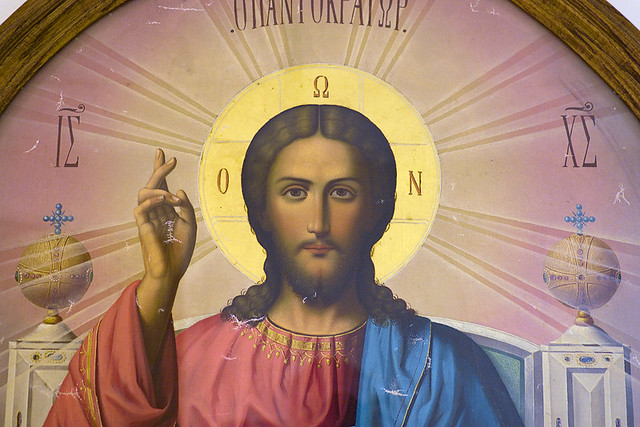
Christ Pantocrator.
The solution is the same as it always has been: penance, include prayer, fasting, and almsgiving; living a moral life (and I am preaching to myself here); loving your enemies even if you don’t like them; being a good example, using common courtesy in all occasions, being a good citizen, preaching the Good News, having faith, hope, and charity; seeking truth, goodness, and beauty; fearing God, not man; protecting the innocent, instructing the doubtful, and living by the Golden Rule. You don’t have to be a Catholic to do these things, but by grace it helps.
GIVEN IN THE Continental Congress on November 1st, 1777, a Thanksgiving Proclamation:
FORASMUCH as it is the indispensable Duty of all Men to adore the superintending Providence of Almighty God; to acknowledge with Gratitude their Obligation to him for Benefits received, and to implore such farther Blessings as they stand in Need of: And it having pleased him in his abundant Mercy, not only to continue to us the innumerable Bounties of his common Providence; but also to smile upon us in the Prosecution of a just and necessary War, for the Defense and Establishment of our unalienable Rights and Liberties; particularly in that he hath been pleased, in so great a Measure, to prosper the Means used for the Support of our Troops, and to crown our Arms with most signal success:
It is therefore recommended to the legislative or executive Powers of these UNITED STATES to set apart THURSDAY, the eighteenth Day of December next, for SOLEMN THANKSGIVING and PRAISE: That at one Time and with one Voice, the good People may express the grateful Feelings of their Hearts, and consecrate themselves to the Service of their Divine Benefactor; and that, together with their sincere Acknowledgments and Offerings, they may join the penitent Confession of their manifold Sins, whereby they had forfeited every Favor; and their humble and earnest Supplication that it may please GOD through the Merits of JESUS CHRIST, mercifully to forgive and blot them out of Remembrance; That it may please him graciously to afford his Blessing on the Governments of these States respectively, and prosper the public Council of the whole: To inspire our Commanders, both by Land and Sea, and all under them, with that Wisdom and Fortitude which may render them fit Instruments, under the Providence of Almighty GOD, to secure for these United States, the greatest of all human Blessings, INDEPENDENCE and PEACE: That it may please him, to prosper the Trade and Manufactures of the People, and the Labor of the Husbandman, that our Land may yield its Increase: To take Schools and Seminaries of Education, so necessary for cultivating the Principles of true Liberty, Virtue and Piety, under his nurturing Hand; and to prosper the Means of Religion, for the promotion and enlargement of that Kingdom, which consisteth "in Righteousness, Peace and Joy in the Holy Ghost."
And it is further recommended, That servile Labor, and such Recreation, as, though at other Times innocent, may be unbecoming the Purpose of this Appointment, be omitted on so solemn an Occasion.
‟MUSIC PLAYED WITHOUT human hands”: this is how the ancients described the sound of the aeolian harp — a musical instrument that sings its unearthly notes when the wind blows over its strings, making sounds that are melancholy, or soothing, or eerie, or distressing.
Here is an unusual aeolian harp from Italy:
Aeolian harps and the Romantics
The Aeolian harp is known for its influence on the Romantic poets. A popular home musical instrument by the turn of the 19th century, small wind harps were made to fit in windows; one such harp or lute is poetically described by Samuel Taylor Coleridge:
And that simplest Lute,
Placed length-ways in the clasping casement, hark!
How by the desultory breeze caressed,
Like some coy maid half yielding to her lover,
It pours such sweet upbraiding, as must needs
Tempt to repeat the wrong! And now, its strings
Boldlier swept, the long sequacious notes
Over delicious surges sink and rise,
Such a soft floating witchery of sound
As twilight Elfins make, when they at eve
Voyage on gentle gales from Fairy-Land,
Where Melodies round honey-dropping flowers,
Footless and wild, like birds of Paradise,
Nor pause, nor perch, hovering on untamed wing!
O! the one Life within us and abroad,
Which meets all motion and becomes its soul,
A light in sound, a sound-like power in light,
Rhythm in all thought, and joyance everywhere—
Methinks, it should have been impossible
Not to love all things in a world so filled;
Where the breeze warbles, and the mute still air
Is Music slumbering on her instrument.
The Romantic poets saw these instruments as playing nature's — or God's — own music, and so they thought that the harps were sources of natural or divine inspiration. These harps were first seen as being passive instruments, but the Romantics later understood that due to their design, they actively shape and transform the wind into music, and so became a symbol of the inspired poets themselves. ‟Make me thy lyre, even as the forest is,” wrote Percy Bysshe Shelley, in his poem Ode to the West Wind, where he is asking to become an instrument of the forces of societal change, as symbolized by a fierce west wind blowing through a forest. Shelley thought that the role of the poet, like a wind harp, is to shape and transform the tempestuous forces of nature, or mysterious spiritual impulses, into something more ordered and harmonious. Shelly explains in this manner:
We live and move and think; but we are not the creators of our own origin and existence. We are not the arbiters of every motion of our own complicated nature; we are not the masters of our own imaginations and moods of mental being. There is a Power by which we are surrounded, like the atmosphere in which some motionless lyre is suspended, which visits with its breath our silent chords at will.
Our most imperial and stupendous qualities — those on which the majesty and the power of humanity is erected — are, relatively to the inferior portion of its mechanism, active and imperial; but they are the passive slaves of some higher and more omnipotent Power. This Power is God; and those who have seen God have, in the period of their purer and more perfect nature, been harmonized by their own will to so exquisite consentaneity of power as to give forth divinest melody, when the breath of universal being sweeps over their frame. That those who are pure in heart shall see God, and that virtue is its own reward, may be considered as equivalent assertions.
Whereas the English saw the aeolian harp as a source of inspiration, the Germans found it a melancholy instrument, giving the listener a longing for heaven and the things beyond this world. Americans instead found themselves attracted for more practical and optimistic reasons. Henry David Thoreau wrote a poem where an aeolian harp itself speaks:
There is a vale which none hath seen,
Where foot of man has never been,
Such as here lives with toil and strife,
An anxious and a sinful life.
There every virtue has its birth,
Ere it descends upon the earth,
And thither every deed returns,
Which in the generous bosom burns.
There love is warm, and youth is young,
And poetry is yet unsung.
For Virtue still adventures there,
And freely breathes her native air.
And ever, if you hearken well,
You still may hear its vesper bell,
And tread of high-souled men go by,
Their thoughts conversing with the sky.
The sound produced by a wind harp is mysterious, ethereal, disembodied, and otherwordly: it almost sounds composed, it almost has order, it almost has harmony, it is almost human music.
The Romantic composer Frédéric François Chopin composed a number of pieces which were partly inspired by the sound of the aeolian harp, including those here and here, as well as his Aeolian Harp Étude. The piano piece Aeolian Harp by Henry Cowell is unique in that the strings of the piano are plucked by hand, rather than sounded by striking the keys. Also of interest is Sergei Lyapunov's Harpes éoliennes (Op. 11 No. 9) which can be heard here.
The aeoline, éolienne, or äoline stop on pipe organs was invented in Germany in the 1820s to imitate the sound of an aeolian harp, and these are usually the softest notes that can be produced by those otherwise magnificent instruments. These are either string stops, sounded with low pressure air, usually at an 8' pitch, or are reed stops which may lack a resonator. A harpe éolienne can be heard in the final chord of the piece here; also listen to this.
Aeolian harps fell out of favor sometime in the early 20th century, as music became less personal and more of an industry, but the 1970s saw a revival of interest in these instruments.
The error of the Romantics
The Romantics wrote during a period before the divorce between art and science (indeed, a virtuous person ought to be equally adept at both, and not simply a narrow specialist), but after the divorce between the passions and the intellect. As Christ tells us, divorce is due to the hardness of our hearts, and the Romantic movement was a heartfelt reaction to cold and heartless Enlightenment rationalism, which gave the world slavery, urban poverty, the absolutist State, and the “dark Satanic Mills” which blighted the formerly beautiful English countryside. The Romantics instead thought that feelings and passion ought to be of primary importance, and they took their main inspiration from nature. The Romantic music of the aeolian harp, discordant, unpredictable, and made by nature, is a fitting symbol of the movement, in contrast to the heavily composed and rational Classical music of the Enlightenment.
But are we to go by our feelings alone, without reason? The Romantic movement led to a mystical nationalism, unrestrained by reason, and which eventually led to the widespread slaughter of the Holocaust. Strains of Romanticism are still found today in horror films and in the irrational, nationalistic — and sometimes violent — reconstructed nature religions which are popular primarily with alienated young women.
A better way is orthodoxy: we let reason judge feelings, while understanding that the heart has its own reasons. Both rationalism and romanticism are half-true, they both have their proper place when joined to a well-formed human will. Likewise, the aeolian harp has its place alongside instruments played by human hands, although it sits not at the center, but at the fringe of art.
Aeolian harps in history
The aeolian harp extends much further back into history than the Romantic period. Aeolus [or in the Greek, Αἴολος, Aiolos] is a character in Greek mythology, whose harp was played by the spirits of the winds, and it is from Aeolus that wind harps are named.
Thomson's Aeolian Harp, 1809, by J.M.W. Turner, Manchester Art Gallery, shows Aeolus with his harp, played by the four winds.
ETHEREAL race, inhabitants of air,
Who hymn your God amid the secret grove ;
Ye unseen beings, to my harp repair,
And raise majestic strains, or melt in love.
Those tender notes, how kindly they upbraid !
With what soft woe they thrill the lover's heart !
Sure, from the hand of some unhappy maid,
Who died of love, these sweet complainings part !
But hark ! that strain was of a graver tone :
On the deep strings his hand some hermit throws ;
Or he, the sacred bard, who sat alone
In the drear waste, and wept his people's woes.
Such was the song which Zion's children sung,
When by Euphrates' stream they made their plaint ;
And to such sadly solemn notes are strung
Angelic harps, to soothe a dying saint.
Methinks I hear the full celestial choir,
Through heaven's high dome their awful anthem raise ;
Now chanting clear, and now they all conspire
To swell the lofty hymn from praise to praise.
Let me, ye wandering spirits of the wind,
Who, as wild Fancy, prompts you touch the string,
Smit with your theme be, in your chorus join'd ;
For, till you cease, my Muse forgets to sing.
One of the Muses in Greek mythology, Terpsichore [Τερψιχόρη], is sometimes portrayed carrying an aeolian harp. Sculpture by John Walsh, 1771, Somerset County Museum in Taunton. [source]
According to the Talmud, the ancient rabbinical commentaries on sacred scripture, King David would hang his lyre in his bedroom window upon retiring for the night. The north wind, blowing across the harp and sounding the aeolian melodies, would wake David around midnight so that he could pray Matins.
The Psalms in the Bible are largely attributed to King David, who sang them while playing on his harp. The aeolian harp thereby can be seen as a symbol of divine inspiration, uniting David's harp with the wind, which is a symbol of the Holy Spirit.
The great English saint, Saint Dunstan, was a harp player, and according to the Golden Legend, his harp once made music played without human hands:
And another time he was in his meditations, he had hanging on the wall in his chamber an harp, on which otherwhile he would harp anthems of our Lady, and of other saints, and holy hymns, and it was so that the harp sounded full melodiously without touching of any hand that he could see, this anthem was, Gaudent in celis animæ sanctorum, wherein this holy saint Dunstan had great joy.
Harps, lyres, zithers, and similar instruments have been found throughout antiquity, and the phenomenon of the wind playing them was well known — and ancient mythologies posit that these musical instruments themselves were inspired by the sounds made when the wind blew through strings found in nature: in one case, a cord attached to a tortoise shell, with the shell acting as resonator. According to Giambattista Della Porta, from his book Magiae Naturalis, 1558, (a book of popular science, household tips, and practical jokes):
Do thus, when the wind is very tempestuous set your instruments just against it as Harps, Flutes, Dulcimers, Pipes. The wind will run violently into them, and play low upon them, and will run into the holes of the Reeds. Whence if you stand near and listen, you will hear most pleasant Music by consent of them all, and will rejoice.
Inspired by Della Porta's book, the first modern aeolian harp was invented by the remarkable Jesuit polymath, Athanasius Kircher, in about 1650. He was famed for his cabinet of curiosities — an early museum — including his collection of the artifacts sent by the Jesuits serving in Asia, as well as for his broad range of interests that is rarely found today. Kircher describes his invention in the book, Musurgia Universalis sive ars magna consoni et dissoni in X. libros digesta [volume 2]:
As the instrument is new, so it is also easy to construct and very pleasant. It is the admiration of every one. It is made exactly to fit a window, in which it is placed ; and the harp, while the window remains shut, is silent : but as soon as it is opened, an harmonious sound, though somewhat melancholy, coming from the passing wind, astonishes the hearers; for they are not able to perceive from whence the sound proceeds, nor yet what kind of instrument it is, for it resembles neither the sound of a stringed nor yet of pneumatic instrument, but partakes of both. The instrument should be made of pine wood, five palms long, two broad, and one deep ; It may contain fifteen or more chords, all equal and composed of the intestines of animals. It should be situated in a close place, yet so that the air may on either side have free access to it, in order which, it may be observed, that the wind may be collected by various methods; first, by canals, that are made the form of cones or shells, or else by valves; these valves should be placed on the out side, and parallel boards in the inside of the room ; its sound very much resembles that of pipes and flutes playing in unison. [source]
Here are illustrations of Kircher's harp from his book [images scanned by Google]:
The strings are attached to a sounding-box, which is placed in a box fitted with vanes to concentrate the wind:
Based on Kircher's invention, the anemocorde was an attempt to create a reliable aeolian harp that was played via a keyboard, with air blowing across the strings powered by bellows. I'm unaware if any such design was successful.
The Romantic interest in the aeolian harp, or even the Romantic movement itself, is said to have been inspired by Thomson's poem The Castle of Indolence of 1748:
...
Each Sound too here to Languishment inclin'd,
Lull'd the weak Bosom, and induced Ease.
Aereal Music in the warbling Wind,
At Distance rising oft, by small Degrees,
Nearer and nearer came, till o'er the Trees
It hung, and breath'd such Soul-dissolving Airs,
As did, alas! with soft Perdition please:
Entangled deep in its enchanting Snares,
The listening Heart forgot all Duties and all Cares.
A certain Music, never known before,
Here lull'd the pensive melancholy Mind;
Full easily obtain'd. Behoves no more,
But sidelong, to the gently-waving Wind,
To lay the well-tun'd Instrument reclin'd;
From which, with airy flying Fingers light,
Beyond each mortal Touch the most refin'd,
The God of Winds drew Sounds of deep Delight:
Whence, with just Cause, The Harp of Aeolus it hight.
Ah me! what Hand can touch the Strings so fine?
Who up the lofty Diapasan roll
Such sweet, such sad, such solemn Airs divine,
Then let them down again into the Soul?
Now rising Love they fan'd; now pleasing Dole
They breath'd, in tender Musings, through the Heart;
And now a graver sacred Strain they stole,
As when Seraphic Hands an Hymn impart:
Wild warbling Nature all, above the Reach of Art!
....
As implied by the poem, the aeolian harp was seen to be a plaything of the idle and indolent wealthy, but soon these instruments became commonplace. In a footnote to a poem, Thompson states that these kinds of harps were manufactured by James Oswald, a Scotsman living in London; Oswald later would achieve great fame, including his appointment as composer for King George III, and his Harp of Aeolus became popular.
This popularity led prominent scientists to investigate how the notes were sounded, since the aeolian harp's tones did not correspond well to human-played music. This research on the fringes of music led to the science of acoustics and well as contributing to fluid mechanics. An unfortunate side-effect of this was the divorce between music and mathematics into unrelated disciplines, which were long joined together in the quadrivium of the classical liberal arts.
Designing an aeolian harp
Constructing an aeolian harp is simple, for all you need is a strong wind and a string. Nylon strings work well, as does steel. However, the sound made will be extremely weak (even more so for steel strings), and for the purpose of amplifying the sound, you need to construct a sound-board for the strings. That is a complicated art: please consider the complexity and effort that goes into constructing and tuning the body of a violin, as well as the great expense that a fine instrument can demand. Modern harp-builders, however, can use magnetic transducers, commonly used in electric guitars, to capture the sound which then can be electronically amplified. Designing a good electrical pickup is an art in itself, and there are many variations and room for improvement.
To design a musical instrument well, you need to have a Pythagorean or Platonic understanding of mathematics, the understanding that was found in the Middle Ages but which fell out of favor in modern times. According to this understanding, mathematics is poetic and harmonious, with its own truth and beauty, and it is at the center of all art. Modernity, however, killed the beauty and the joy of mathematics, and even sometimes its truth, and made it a dreadfully dull subject, perhaps only interesting to specialists. Mathematics has now become the enemy of artists, although it was not yet so in the days of the Romantics. But I ask my dear readers to try to understand the mathematical discourse following, and try to see the beauty in the numbers and their harmonies.
The sound that an aeolian harp makes is caused by a phenomenon called the von Kármán vortex street effect. A fluid flowing over a cylinder (such as a string), under certain conditions, will lead to an alternating series of vortexes that periodically shed from the cylinder, forcing it sideways in one direction and then the other. The equation governing this motion is:
Re = V × d / ν
Where Re is the Reynolds number, V is the velocity of the wind, d is the diameter of the cylinder or string, and ν [Greek letter nu] is the kinematic viscosity of the air. Generally speaking, we can get string vibrations if the Reynolds number is greater than about 90. From the equation we can see that double the diameter of a harp string gives us the same Reynolds number in half the wind speed. The kinematic viscosity of dry air at sea level and 70° F. is about 0.000164 ft2/second, and it gets smaller as the temperature drops, which tells us that these instruments ought to perform better in colder air; also lower altitudes are better.
The Reynolds number is important because it tells us something about the quality of flow:
Less than 5, the flow of air around a string is smooth, and no vibration is possible.
Between 5 and 44, stable vortices form behind the string, but strings do not vibrate.
Between 44 and 49, a transition range, von Kármán vortices may or may not occur.
Between 49 and 90, von Kármán vortices occur, but supposedly, this range does not seem to activate aeolian harps.
At 90, there is a slight change in the quality of the vortices.
Between 90 and 150, aeolian harps start to sing, and the vortices are very regular.
Between 150 and 300, transition range where flow becomes unsteady.
At 300, flow beyond the string is turbulent.
At 400, flow is completely turbulent, higher overtones become much more prominent.
As the Reynolds number increases, the aeolian harp makes sounds that are increasingly screeching and distressful.
Would-be aeolian harp makers are often disappointed that their creations don't work at all except under strong winds. An examination of the Reynolds numbers indicate that thicker strings may be needed.
By the way, von Kármán was inspired to develop his theory upon viewing a Gothic painting of Saint Christopher carrying the Christ child across a river. He was fascinated that the 14th century painting showed alternating swirls of water in the flow behind the Saint's legs, and he wanted to know why.
If the frequency of the vortex shedding is harmonious with the tuning of a string, then resonance develops and the string sings. The vortex shedding frequency has the equation:
f = St × V / d
Where f is the frequency of vortex shedding, V is the velocity of the air, d is the diameter of the string, and St is the Strouhal number, a dimensionless factor which characterizes the air flow. The Strouhal number has a complicated nonlinear relationship with the Reynolds number, as is seen here. But as it so happens, the Strouhal number does not vary much at all in the range of the Reynolds numbers associated with typical aeolian harps — those that use guitar strings in moderate breezes — at say, a range of Reynolds numbers of 400 and higher, and so faster winds will give us proportionally higher notes. At these Reynolds numbers, the Strouhal number is about 0.21.
However, the Strouhal number gets smaller for the Reynolds numbers associated with slow winds and large string diameters, and so we would expect that aeolian harps strings meant to operate under these conditions would require special tuning. It is from a Reynolds number range of between 90 and 400 that we would get the lower, more soothing notes from the instrument, which are often the notes most preferred by listeners. This sound might be compared to the sound of a bagpipe drone.
The fundamental tone or frequency of a string is given by the equation:
f = (1/2L) × √(T/μ)
where f is the frequency of vibration, L is the length of the sting, T is the tension in the string, and μ [Greek letter mu] is the linear density of the string — the mass per unit length of string. The string can also vibrate with frequencies that are integer multiples of the fundamental frequency given by this equation: 2, 3, 4, 5 times and so forth; these frequencies are called overtones or harmonics. If you pluck a stretched string, the tone you get will be the fundamental frequency along with a combination of the various overtones, and similarly, an aeolian harp will intone a rather different combination of these harmonics.
We see how the Strouhal number in the second equation above causes a vibration in the air around a string at a particular frequency: whenever this frequency comes close to one of the harmonic frequencies of an aeolian harp string, the string will resonate strongly at that frequency, giving us an audible tone. Since wind velocities fluctuate, the particular tone voiced on a string will change frequently, gliding from one overtone though silence to another overtone.
All aeolian harps more or less sound the same, although a good amplifier design — either a sounding board or electronic pickup — can increase the quantity of sound, as well as perhaps its quality. For this reason, there is little point in attempting to tune an aeolian harp much beyond tuning the strings to resonate with their sounding board. These harps always sound dissonant, and builders will typically tune all of the strings to the same pitch, although they will typically use various diameters of string within the same instrument to allow it to work under a range of wind speeds.
An important property of aeolian harps is that the fundamental harmonics of the strings is not heard: instead we only hear overtones, with the predominant frequency (according to various authorities) being as high as the fifth, eleventh, or 22nd overtone. Faster winds excite higher overtones, while suppressing the fundamental and lower overtones. Because of this phenomenon, slight mistunings of the fundamental note of a string become highly mistuned at high overtones, contributing to the dissonant sound of the instrument.
To achieve singing, it is noted that laminar winds — such as those found blowing off a large lake or the ocean — are preferred to turbulent ones, as is found in cities. Kircher installed his harp in a box in order to smooth, direct, and amplify the wind. Authorities state that solid strings are preferable to wound ones, as these respond better to the vortex effect.
Conclusion
You can purchase your own monumental aeolian harp here. Although I don't care for the overall design, I do like the concept. Here is an audio recording of this harp:
The creator of this aeolian harp writes that some architecture of the past — on purpose or by happenstance — would create music-like sound in the wind. Would this be a good thing for new architecture, I wonder? Consider the old Catholic tradition of integrating all of the senses into her architecture and liturgy. Would something like this be good for a cloister or church garden? Many people do think that these sounds can be soothing and inspire meditation.
But judging from the reviews of this harp, as well as comments on audio recordings of aeolian harps, I find that many people either ignore or reject the sounds they make, calling the whole endeavor ‘stupid,’ or an intrusion because it doesn't fit their taste in music. Others find them irritating or depressing or a waste of money better spent elsewhere. Considering the types of people who were drawn to aeolian harp in the first place, clearly they would not appeal to those who don't share those traits. On the other hand, other kinds of people may read too much into the sounds that the harps make, turning them into a false mystical experience; clearly there is a New Agey feel to aeolian harps, and this is often due to eccentric design.
I think they could be more successful if their wild and romantic qualities could be rationalized a bit, bringing the emotions and the intellect closer together. Better design of the harps, with significantly better control over the higher harmonics, perhaps through clever damping, could retain the soothing qualities of its sound while eliminating the harsh irritating sounds. A certain classical or medieval influence would help, especially in the designs of the sculptures in which these harps usually reside.