Pages

Showing posts with label architecture. Show all posts

Tuesday, January 07, 2014

Photos from the Snowstorm of January 5th, 2014

EXCEPTIONALLY COLD weather, along with an unusual amount of snowfall this past Sunday, led to widespread difficulties, but also interesting photo opportunities.


The Cathedral Basilica of Saint Louis in the snowstorm. I took this after Mass for the Epiphany, where very few people assisted — understandably. Fortunately, I have a car which is good in the snow, so I drove around town afterwards taking photos.


Lots of snow for this region.


Saint Louis University, with the spire of Saint Francis Xavier Church barely visible.


Most of the streets were empty, even major thoroughfares such as this one, and the blowing snow obscures the skyscrapers of downtown. Many of the traffic lights were malfunctioning.


There were a number of pedestrians, usually carrying grocery bags, and walking in the middle of the street, where the snow was not quite so deep.


Walking the dog is almost a necessity, no matter how cold — unless you are willing to do a cleanup inside. Very many cars were stuck in the snow, fortunately, there were volunteers helping out.


A view from the Eads Bridge.  One of the pleasures of the day was the ability to safely stop my vehicle in the middle of any street or bridge, and take a few moments to take a photo.


The Gateway Arch, also (barely) seen from the bridge.


The Basilica of Saint Louis, King of France, popularly called the Old Cathedral, is shrouded in scaffolding for its first major renovation in over 50 years. This is being done now partially in honor of the 250th anniversary of the founding of the City of Saint Louis by Pierre Laclede and Auguste Chouteau.


Union Station. Nearly every business and office were closed this day — with the notable exception of grocery stores.


The massive railroad yard, which bisects the middle of the city.


Gates to Lafayette Park.


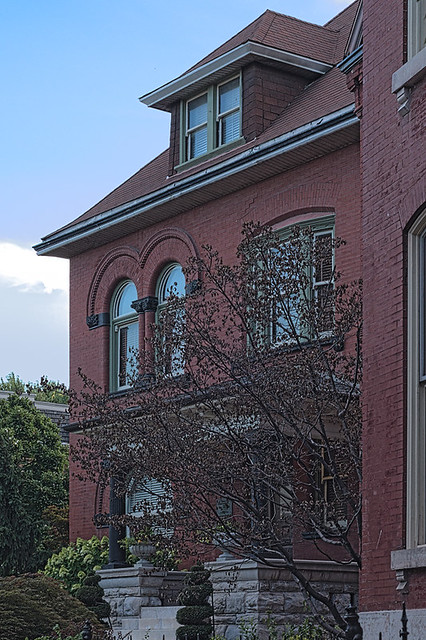
One of the ornate Victorian-era buildings in the Lafayette Square neighborhood, facing the park.


Geese on the wing in Forest Park.


Some of the geese, after they landed on the water of the restored River des Peres.


Winter is usually a good time for hiking in the forest, for you can see farther and aren't bothered by insects. But this afternoon was becoming increasingly cold and windy, and I must admit that I was miserable at this point. But upon getting back to my warm car, after an exhilarating hike, I was glad that I got out of the house instead of staying home.


In warmer weather, this bridge is a good place to see frogs, turtles, and water lilies.


The Victorian footbridge originally led to a railroad station, and for decades this was difficult to find because of overgrown vegetation. This photo might look a bit different from the others, because I took it with my cell phone, so that I could upload it to a friend who asked me to take a picture of it.


It wasn't quite clear where the road was, but that does not deter brave pedestrians.


The World's Fair Pavilion. The same scene, but under quite different circumstances, can be seen on the cover of my photo book, St. Louis Parks.


Art Hill, located between the Saint Louis Art Museum and the Grand Basin, is famous for sledding.


Thursday, October 17, 2013

A Walk Around the Block in Soulard

SOÛLARD, in French, means ‘drunkard’, and this name seems rather appropriate for the Soulard neighborhood of Saint Louis, Missouri, known for its numerous bars, as well as the riotous behavior of visitors during its annual Mardi Gras celebrations. But this near south-side neighborhood — largely delineated by Interstate 55 and South Broadway — has many charms.

This neighborhood gets its name from the colonial figure of Antoine Pierre Soulard (1766-1825). He was a Frenchman, who came to these shores fleeing the Revolution. He eventually became the King of Spain’s Surveyor General of Upper Louisiana — a vast land which included the Saint Louis area. After President Thomas Jefferson purchased the Louisiana territory — an act which doubled the size of the United States — it was Soulard who handed over this part of the territory to the American governor. After his retirement, Soulard tended to his orchard, which was located in this neighborhood which now bears his name.

Here are some photos I took this summer, in the Soulard neighborhood, during a walk around a couple of blocks, at sunset and dusk, near the historic Soulard Farmers Market.

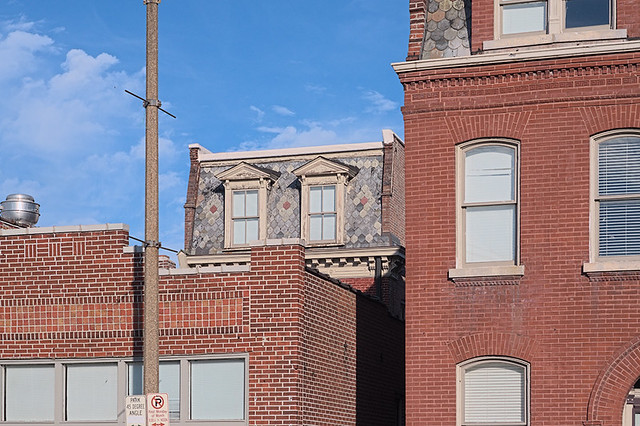
Soulard Neighborhood, in Saint Louis, Missouri, USA - Mansard roofs - 1

Much of the architecture of this area dates from the second half of the 19th century through the first few decades of the 20th. Due to benign neglect, this neighborhood maintained its charm while other areas nearby were destroyed by modernization. The fury of ‘urban renewal’ throughout the nation subsided in the early 1970s — often attributed to the failure of the huge Pruitt-Igoe housing complex in north Saint Louis — and the beauty of the once-hated Victorian-era architecture was rediscovered.

Other neighborhoods in the city — particularly on the north side — are slowly disappearing, due to neglect which cannot be called benign. Recent in-fill housing in these areas tend to be rather disappointing, being largely suburban-style homes with little charm, character, or solidity.

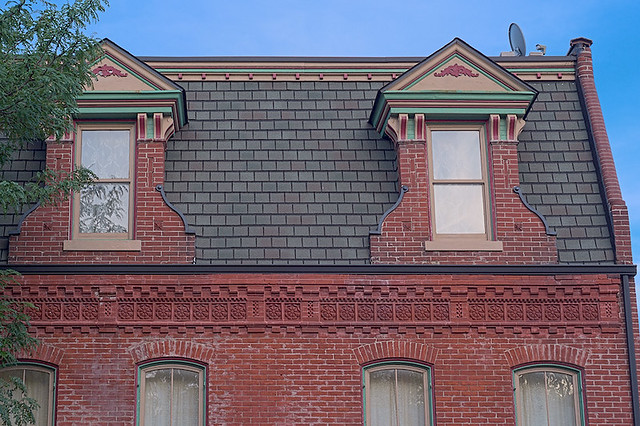
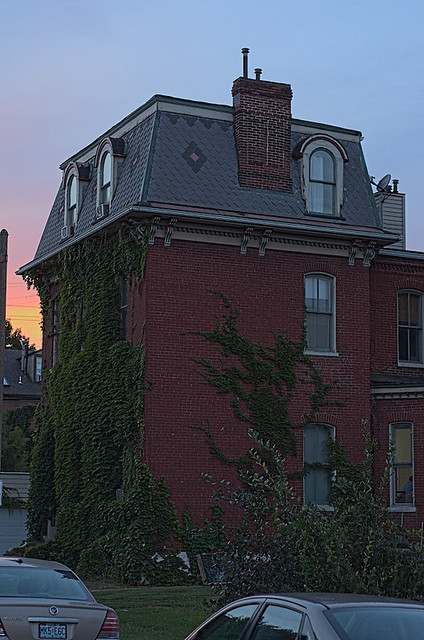
Soulard Neighborhood, in Saint Louis, Missouri, USA - Mansard roof

Notice the ornate detail on this building, exceeding the quality of work that is done today; but this level of artistry is commonplace here.

Many buildings here have Mansard-style roofs. These are named after François Mansart, a royal architect of the Baroque period in France, who popularized this kind of steep roof, which allows for an additional occupiable story on buildings. The style experienced a revival, especially in Paris during the Second French Empire, and was widely copied in the English-speaking world, including here in Soulard. One of the disadvantages of the Mansard roof is that the top story is usually an undesirable place to live: hereabouts, it gets extremely hot under the roof during summer, while in Paris before the invention of elevators, the Mansard was a long climb up from street level, and so the Mansard, often the location of the lowest-rent apartments, became associated with starving artists and bohemians.

The 1960s saw another revival of the Mansard form, but the quality of the work tended to be bad — or cheap and tasteless — and it inspired the local blog Bad Mansard.

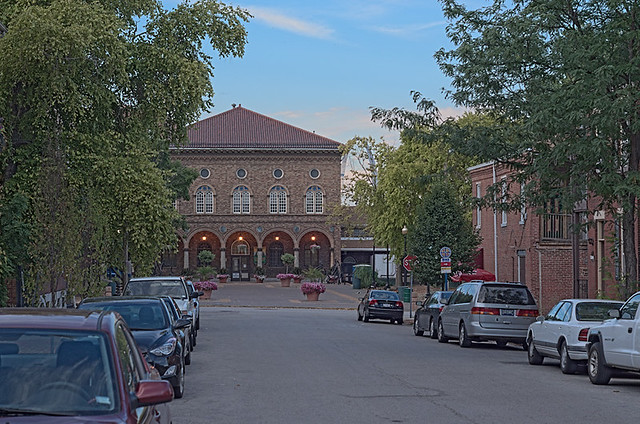
Soulard Neighborhood, in Saint Louis, Missouri, USA - Soulard Market

At the end of the street is the Soulard Farmers Market, which dates back to 1779. You can see the Gateway Arch to the right of the 1929 building, which is modeled after Brunelleschi's Ospedale deli Innocenti or Foundling's Hospital, in Florence.

The amenities of modern supermarkets are lacking here, likewise lacking is the middle-class who patronize those markets; rather, we find here mainly the poor and the wealthy. The form, organization, and economics of this market can be best called premodern, where the City leases out stalls here to farmers and merchants; similar arrangements can be found in the ancient cities in Europe and elsewhere.

Soulard Neighborhood, in Saint Louis, Missouri, USA - townhouses

In Soulard, it is the tops of buildings that tend to have most of the charm. I suspect that architectural details closer to the ground may have been destroyed or otherwise lost in the past century, and you still can see clues of shutters, balconies, and decoration that have been removed. Wood needs to be painted periodically otherwise it will rot, while much ironwork was scrapped during the Second World War to make steel for the war effort. Some buildings here have been fully restored, but most have not.

Home prices can be high here — note the expensive automobiles seen here — and decades ago, many of the old-time residents resented the intrusion of newcomers in the neighborhood who drove up rents and who had odd lifestyles.

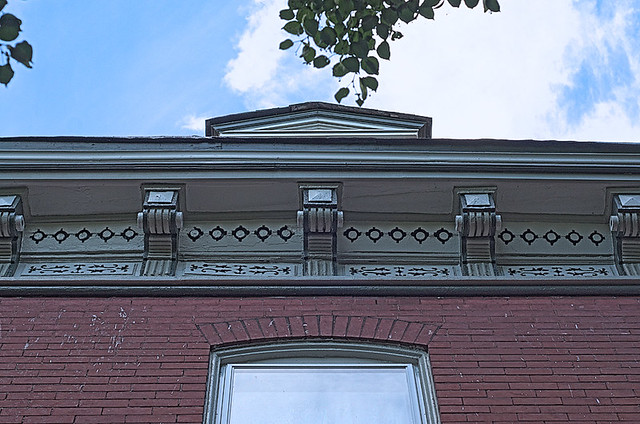
Soulard Neighborhood, in Saint Louis, Missouri, USA - cornice

A major source of Soulard's popularity is undoubtably its beauty, despite its high crime rate, and its many restaurants make it a popular area for weekday lunch.

By means of comparison, the artist David Clayton describes the value of Boston's Beacon Hill neighborhood:
This past weekend I drove down to Boston from southern New Hampshire to meet a friend who was visiting for the weekend. As we walked around town we wandered into the Beacon Hill area. This is the old heart of the town and full of elegant 18th-century terraced homes. They are built in a variation of the style that in England we would call Georgian. I’m not sure what it is called here, perhaps ‘colonial’ style? These are right at the top end of the price range for property in Boston.

Why are they so sought after? Well location will have a lot to do with it certainly. You would probably pay a fortune for the ugliest shoebox here if it could take a bed. But I would say also that their beauty is a big factor too. Beauty adds value because it stimulates greater demand and pushes the price tag up. And why are they beautiuful? Two hundred years of New England weather softening the edges on the red-brick or cobblestone forms probably adds something. But it is more than this. The main reason, I suggest, is their harmonious proportions.
The buildings in Soulard were built over the better part of a century, and yet the structures tend to harmonize with each other, despite being of varying style. Undoubtably part of this is due to the requirement that all buildings were to be built of brick — this law came into force after a steamboat explosion led to the destruction of a sizable part of downtown — but also because the buildings harmonize with each other proportionately. All of this predates Le Corbusier and the Bauhaus, the early champions of Modernism, who discarded centuries of aesthetic wisdom.

Soulard Neighborhood, in Saint Louis, Missouri, USA - Saint Elizabeth Settlement House

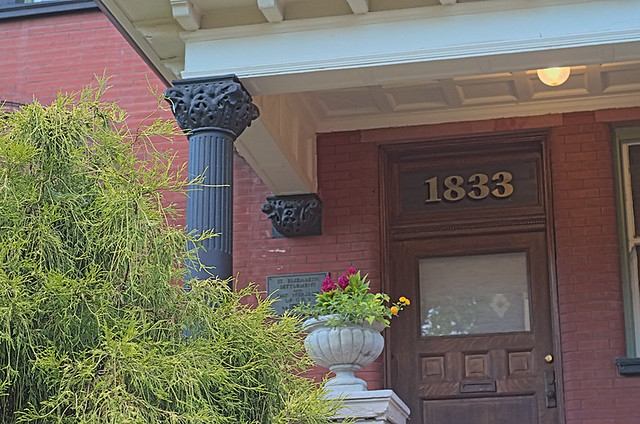
This is the former Saint Elizabeth Settlement House, which was originally a Catholic orphanage.

David Clayton continues:
What struck me about these houses is how simple and reproducible their design is. They have a simple symmetrical arrangement of windows, one above the other, and a pointy roof. There is some decorative work around the doors and the windows, but it could never be called flamboyant. If I knew about building materials then I reckon I could design one myself. Yet despite their simplicity they look good and it is as a result of the traditional proportionality.

Given this simplicity and the value that beauty adds to buildings, I am surprised that it hasn’t occurred to more developers and architects to study traditional proportion and use it, if only for economic reasons.

Look at the photos in this article. Notice how in every case the window size varies, storey to storey, so that the first is to the second as the second is the third and so on. When this rhythmical progression corresponds to the traditional pattern then the result is elegance. Sometimes the order changed around slightly so that it is not always the largest at the bottom. The dimensions of the first and second might be changed so the biggest storey is always the main living area. These architects didn’t play tricks – they put things where you expected them to be, so that the outward signs give an indication of the internal purpose. Similarly, the main door is always more prominent than the servants’ entrance. (You can’t count on this now. I was at an art gallery recently, which was a modern building made completely of reflective glass and the doorway was indistinguishable from any other panel. There was no indication through the external design where the door was. In fact it was placed offset to one side in a counter-intuitive position, presumably deliberately. I had to wait until I saw someone coming out before I knew where I could get in!)

Coming back to Beacon Hill, I am convinced that these houses looked just about as good the day they were built and if anyone chose to conform to these basic patterns today, then it would look good and sell at a high price. This has to be the simplest way for an architect to add greatest value for minimal investment of time and money. There is no need for pastiche – we are not bound slavishly to follow the decorative style of the period in every way, but provided the principles are adhered to, then here is way for modern architect to stand out from the crowd. The mathematics is relatively simple (I have presented it all in an article about proportionality, here).
When Soulard was originally developed, it was a true urban neighborhood in the traditional manner, where the various classes lived side-by-side, with stores and taverns on the corners, and blocks with factories alternated with blocks of housing and blocks with churches and schools. Public parks and amenities were found on the edges of the neighborhood, within easy walking distance.

Some would say that social harmony can be helped by architectural harmony, but the idea of architectural harmony, still seen in Soulard, has been largely lost elsewhere. We nowadays have ugly skyscrapers, products of excessive pride, towering overhead, or huge and featureless warehouses, or we have vast developments of identical, factory-produced homes or apartment complexes, made with inferior materials, little charm, and degraded taste. But harmony means neither discordant notes nor unison, but rather variety within a common key.

Discordant music became popular with the cultural elites, and discordant architecture soon followed, and the great cities of the United States soon fell apart from social disharmony. As good can come out of evil, perhaps this is for the best; industrialization forced the creation of large cities, filled with squalor. Perhaps it is best not to have large numbers of people living on top of each other. But something has been lost: the means of encouraging harmony even in unfortunate circumstances.

Soulard Neighborhood, in Saint Louis, Missouri, USA - Saint Elizabeth Settlement House close-up

A closer view of Saint Elizabeth's.

A traditional neighborhood like this one both promotes democracy as well as private property — or, at least the traditional notions of such concepts, which are both quite specific and on a local scale. Today, both notions are far removed from their source, where decisions are made far away by strangers, and property may be taken arbitrarily by the well-connected.

While the mishmash of land uses found in Soulard would be rejected by most modern zoning laws, please consider that it was in such neighborhoods as this that many of the social problems of their day were solved. The gracious mansions of the business owners were just around the block from the simple but noble row houses of workers. They patronized the same stores and taverns, and would see each other in the same parks. In that day, there were few large housing projects for the poor nor were there significant exurban enclaves for the wealthy.

How much better can decisions be made if ordinary people debate amongst themselves, where opposition is man-to-man? While this system did lead to violence, at least it was between those who had a grudging respect for each other, unlike today. A Puritan-minded employer who felt the need to violently chastise an insolent subordinate was balanced by the fact that his employee lived down the block from him (and had lots of tough friends), and that there were plenty of other employers in the neighborhood to whom the employee could freely go. Likewise, an envious worker who otherwise would seek revenge, could see for himself what goes into making a successful or a failed business, for he would personally know many business owners. In this environment, the common good was more obvious to all.

Nowadays, how many factory owners live within walking distance of the their business and their employees? How many shopkeepers live above their stores? How many owners of businesses that you patronize do you personally know? How many people walk to work or walk to church? How many politicians are actually seen living in their own district? But in Soulard's heyday, these were the norm.

Soulard Neighborhood, in Saint Louis, Missouri, USA - spire of Saints Peter and Paul Church

The tower of Saints Peter and Paul Catholic Church. This is the parish's third church building on this site, dedicated in 1875. The Saint Joseph Croatian church is nearby, as is Saint John Nepomuk, as well as some Protestant churches.

Sts Peter and Paul has a small congregation, but according to its website:
Every day from the 2nd through the 21st of each month, a free meal is served at our Parish Mid-Level Hall. These nutritious, tasty meals are served to the residents of the shelter, as well as to families and individuals in the Soulard area, who may be on limited or fixed incomes. We have between 80 and 200 guests who dine with us each day.

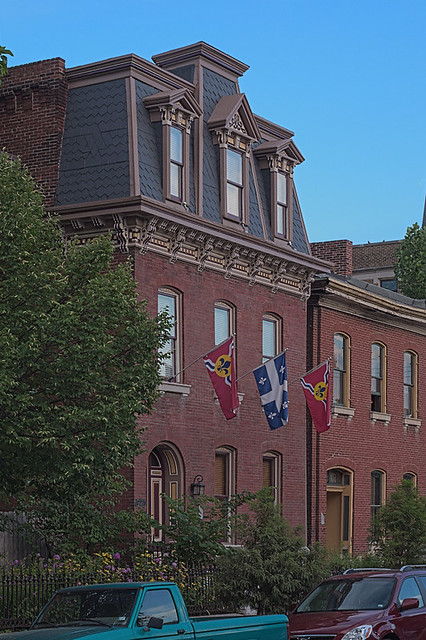
Soulard Neighborhood, in Saint Louis, Missouri, USA - townhouse with Mansard and flags

This house displays the flag of Quebec, flanked on both sides by the flag of the City of Saint Louis. Both flags feature the fleur-de-lys, recognizing that both were once part of the French Empire.

I remember my French grandmother enjoying visits to this neighborhood, for of all places in the City, this most reminded her of her home country.

Soulard Neighborhood, in Saint Louis, Missouri, USA - flowers

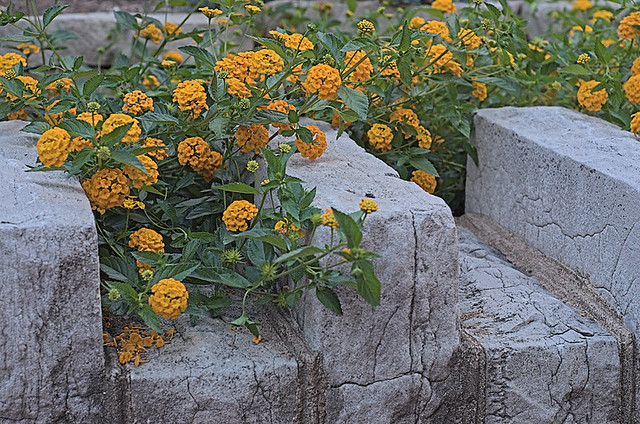
The small yards found here are often nicely ornamented with flowers.

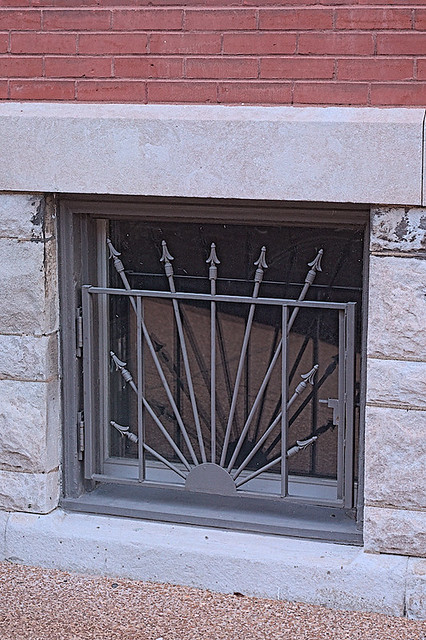
Soulard Neighborhood, in Saint Louis, Missouri, USA - window grille

A decorative grille. Just because an object has a grim utilitarian purpose — in this case, keeping out intruders — that does mean that it has to lack good attractive design. This grille even has symbolic value — arrows are a sign of defense.

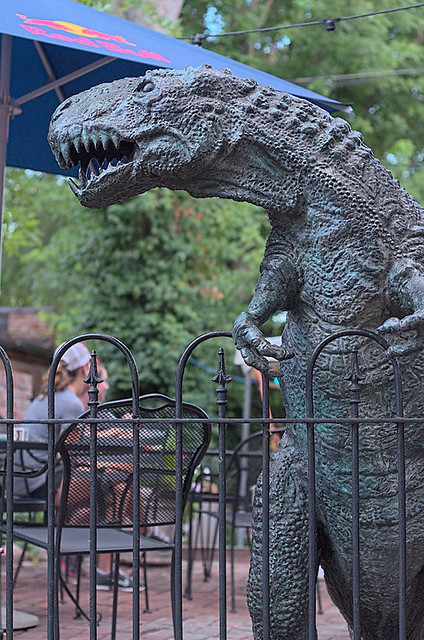
Soulard Neighborhood, in Saint Louis, Missouri, USA - dinosaur sculpture

A dinosaur sculpture? I can’t explain it.

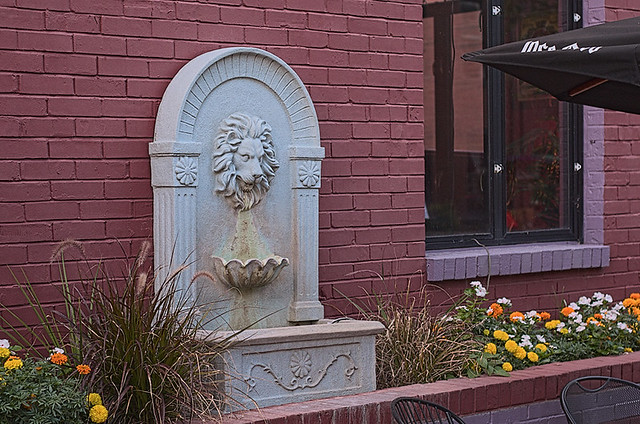
Soulard Neighborhood, in Saint Louis, Missouri, USA - fountain

A decorative fountain with marigolds.

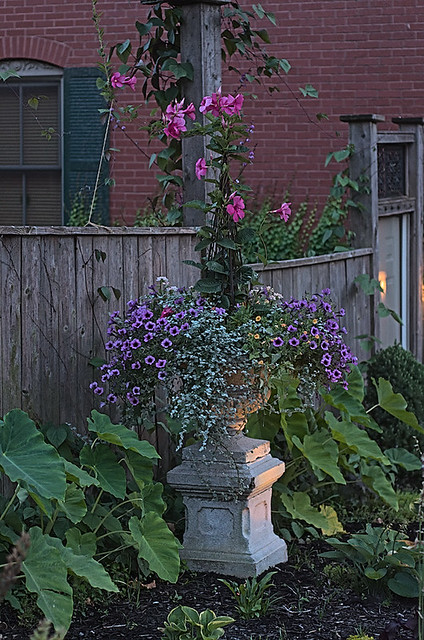
Soulard Neighborhood, in Saint Louis, Missouri, USA - flower pot

More flowers.

Soulard Neighborhood, in Saint Louis, Missouri, USA - Mansard home with ivy

Many artists and members of the avant-garde live in this neighborhood. This is odd, since this traditional neighborhood is the antithesis of modernism, and obviously the architecture here is premodern. However, there is a deeper reason for this apparent disconnect. The philosophy of Existentialism, upon which much of modernity is built, posits and even encourages a definite opposition between the mind and the body, in a Cartesian or even a Gnostic-like manner; this can lead to an existential crisis, where the meaning of life is questioned. One way of coping with this kind of vertiginous crisis is through the search for authenticity. A neighborhood such as this, which is solidly anchored in the past, can help relieve a resident of the restless pursuit of novelty, along with the negative psychological consequences of that pursuit.

Also, it would be hard to point out a contemporary neighborhood which is better designed, but well-designed neighborhoods were once the norm, as any casual inspection of the many neighborhoods in this city will demonstrate.

Soulard Neighborhood, in Saint Louis, Missouri, USA - Mansard home with bus

The apartments and homes found here tend to be quite large by modern standards —  not in land area, but certainly in square footage of livable area.

By the way, these images are made to look best at full resolution on a dark background, which can be found by clicking on each image. Reduced in size as seen here, these images look a bit rough.

Chelsea with dog - 600 px

This young woman asked me to take a picture with her beloved dog.

Soulard Neighborhood, in Saint Louis, Missouri, USA - International Tap House

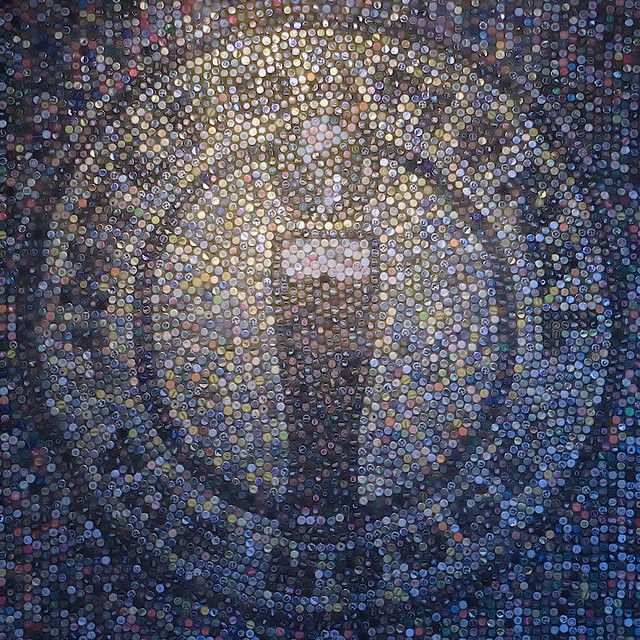
A ‘mosaic’ made of bottle caps at the International Tap House, which is known for its variety of beers on tap. It does not serve light beers, and only sells beers from small brewers, and so it can claim authenticity.

Soulard Neighborhood, in Saint Louis, Missouri, USA - Pere Jacques Ale

As I had just completed my latest book, in celebration I ordered a bottle of Pere Jacques ale, from Chicago's Goose Island brewery. The name comes from Father Jacques Marquette, S.J., who was an early missionary in French north America, who canoed past the future site of Saint Louis in 1673.

Soulard Neighborhood, in Saint Louis, Missouri, USA - diners at outdoor counter

Outdoor dining at the window.

One major difference between Soulard in its prime and Soulard today is children; few are found here. The responsibility of heading a family and raising children — denigrated and unstable vocations in our time — if absent, definitely can change the character of a neighborhood. But this area still has great charms, and lessons to teach us today.

Monday, March 11, 2013

Photos of the Former B’Nai Israel Synagogue, in Cape Girardeau, Missouri

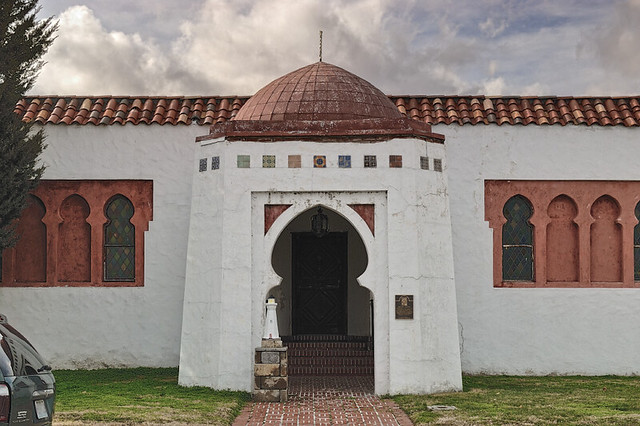
NEXT DOOR TO the old Saint Vincent de Paul Church, in Cape Girardeau, Missouri, is the former B’Nai Israel Orthodox synagogue, constructed in 1937, and made in a Spanish Colonial Revival style with Moorish elements.

B'Nai Israel synagogue, in Cape Girardeau, Missouri, USA

This building was designed by the Saint Louis architect Thomas P. Barnett Jr. who also designed other buildings in Cape Girardeau: he came from a prominent family of architects, his father having designed the Cathedral Basilica of Saint Louis. Reportedly, this synagogue has not been altered since its construction, and the interior remains intact. You can read its nomination for the National Register of Historical Places here.

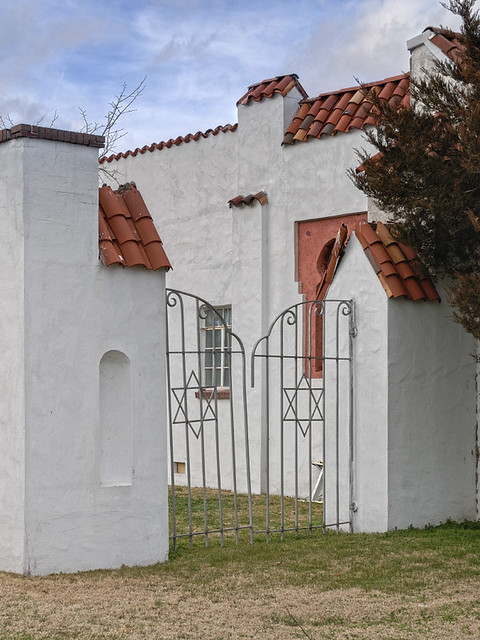
B'Nai Israel synagogue, in Cape Girardeau, Missouri, USA - gate with Stars of David

While we might consider such a style of architecture to be more Islamic than Jewish, understand that the history and art of Spain, which inspired this building, is complex and non-intuitive to those of us more familiar with northern European styles. The New Liturgical Movement tells us of a similarly-decorated ancient Catholic church, in the article Mozarabic Potentialities for Contemporary Church Architecture? This style is largely derived from the arts of the late Roman and Byzantine Empires, and in turn, it inspired the Gothic.

The synagogue closed because the congregation was unable to maintain a quorum for licit liturgies; this in turn was due to the changing economy (most congregants owned their own businesses, but were unable to compete with the suburban malls), and most critically, because of the inability of the youth to find suitable spouses in the region. You can read about its history here.

Thursday, March 07, 2013

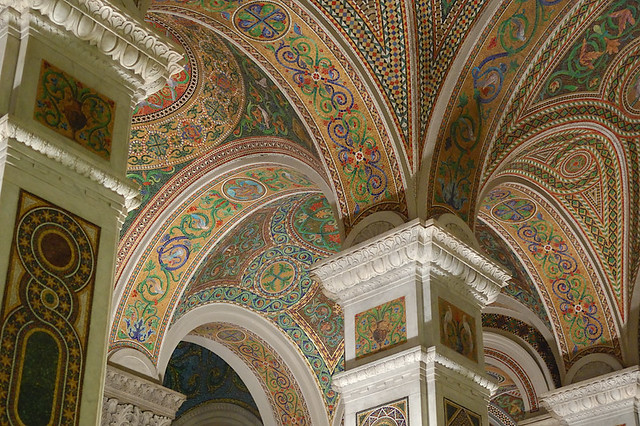
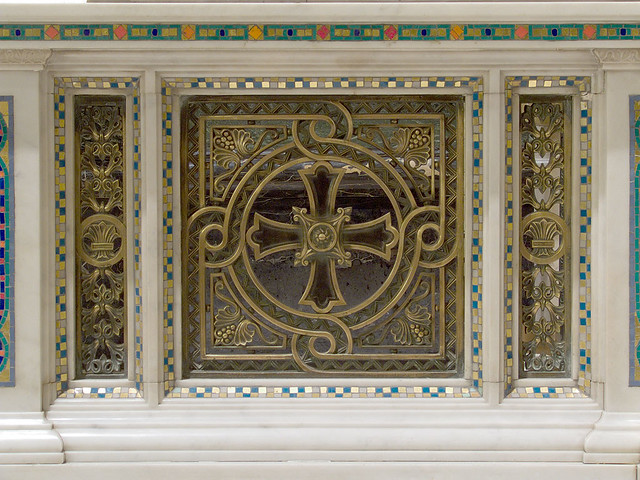
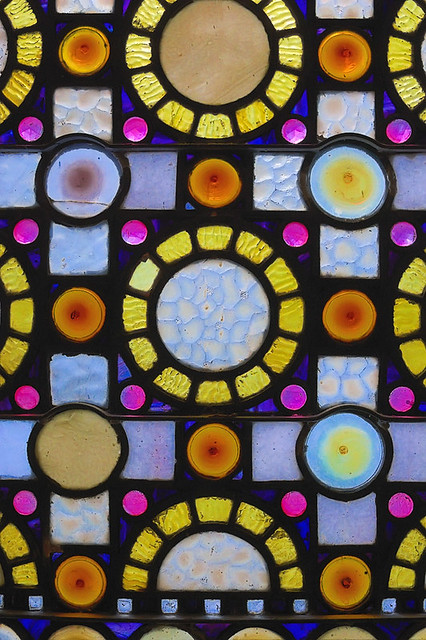
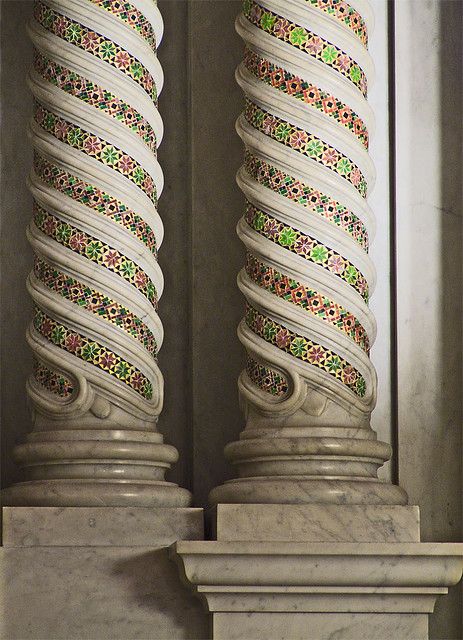
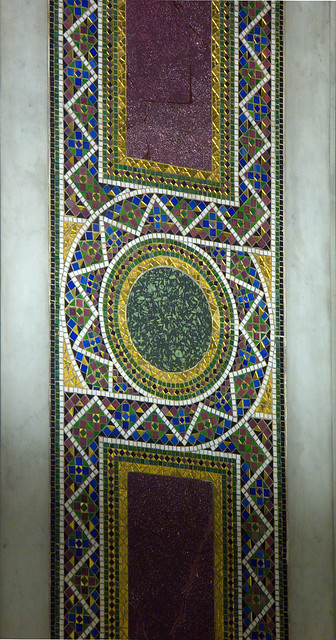
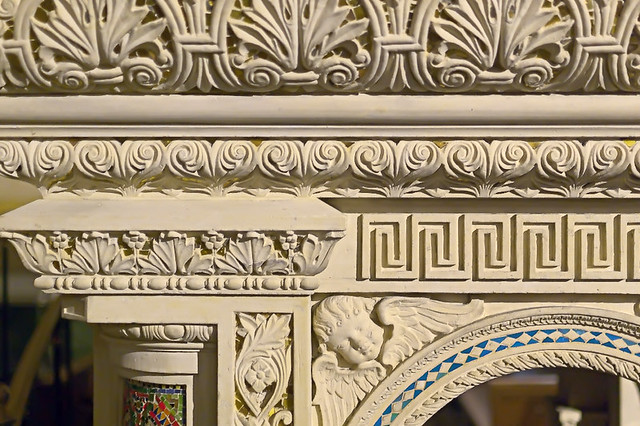
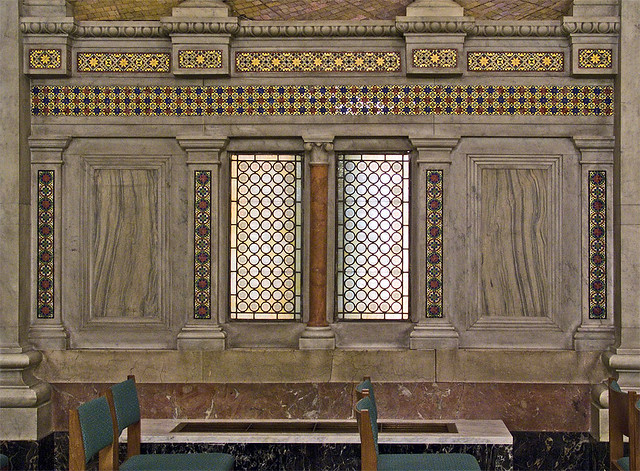
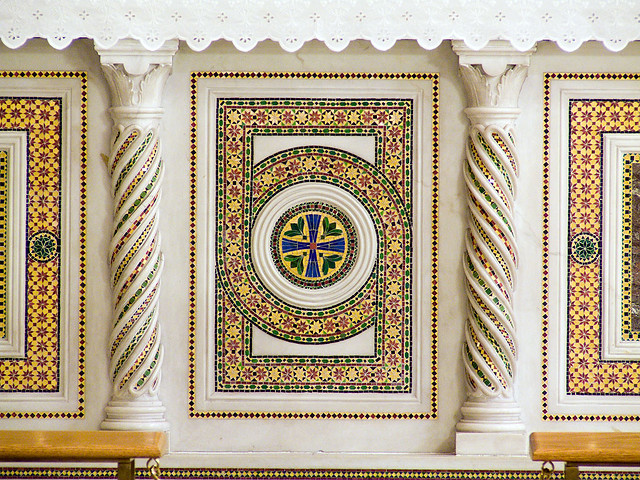
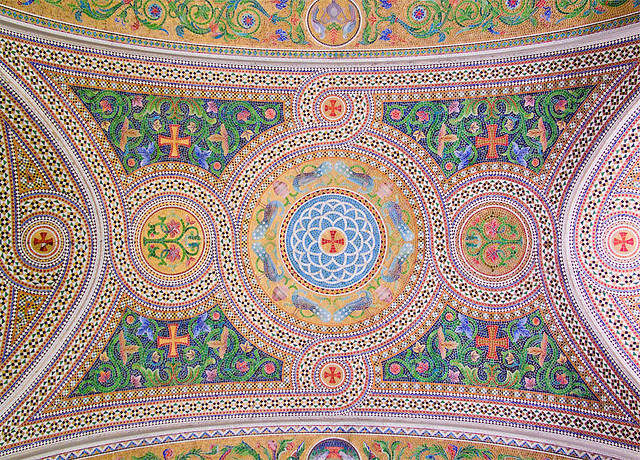
Ornament at the Cathedral Basilica of Saint Louis

, in Saint Louis, Missouri, USA - mosaic details 2

Ornament at the Cathedral Basilica of Saint Louis.

Architectural ornament was for decades a lost art in the West, which is a shame because it is beautiful, giving rest and pleasure to the eye, and it links us to cultures far into the past and across the continents. This loss is also unwarranted, because the principles of making traditional ornament are actually relatively simple — at least compared to figurative art. But perhaps the most important consideration is that the beauty of ornament flows from the underlying truth that it expresses, and so ornament can lift our minds upward towards more spiritual things.

Cathedral Basilica of Saint Louis, in Saint Louis, Missouri - communion rail detail.jpg

I've long wanted to do an in-depth photo essay of the ornament at the Cathedral, largely because it is close to ground level and so easy to photograph. The figurative icons that are located 50 feet or more above are hard to capture because they are usually seen at odd angles from the floor, and so would likely need expensive equipment and intrusive camera work to photograph well. My problem was that the ornament here is found in such a bewildering variety that I had little idea as to how to approach it.

Cathedral Basilica of Saint Louis, in Saint Louis, Missouri, USA - decorative stained glass window detail, in west transept

Fortunately, I found out that there is a mathematical classification of ornament based on its symmetry. These designs can be classified into groups, including symmetries of reflection about a line, rotation around point; frieze groups which exhibit symmetries along a line; wallpaper groups which have symmetries across a surface, helical symmetry on a cylinder, and so forth, in a logical, understandable, and orderly framework.

Cathedral Basilica of Saint Louis, in Saint Louis, Missouri - Our Lady's Chapel - column detail.jpg

Nowadays, mathematics and art are opposed to each other — “drawing on different sides of the brain” according to a popular but discredited theory. But at one time it was not so.

It is surprising, perhaps, to learn that ancient and medieval art has a mathematical foundation, which reflects the mathematical order of the cosmos. Recovering this mathematical understanding is needed before we can recover the good use of ornament in architecture, based on first principles and not mere copying.

Cathedral Basilica of Saint Louis, in Saint Louis, Missouri

Dr. Brian Clair, who teaches mathematics and computer science at Saint Louis University, has web pages at http://euler.slu.edu/~clair/cathedral, which illustrates the various classes of symmetries of ornament found at the Cathedral Basilica. Please note that the classification is quite abstract, and ignores the specific colors and the materials used in the ornament, but instead emphasizes their form. Recall Aristotle's four causes: the most important are the formal cause, or design of an object, and the final cause or purpose for the object; modernity, on the other hand, emphasizes the material and efficient causes, which relate to the composition of an object and how it is made. It is easy to see how the modern emphasis can overlook ornament and its importance.

Cathedral Basilica of Saint Louis, in Saint Louis, Missouri, USA - pulpit detail

I frequently attend Mass and Confession at the Cathedral Basilica, and typically there are numbers of visitors there, for it is a popular tourist attraction. Invariably, these people are awe-struck at the massiveness and beauty of the interior, and we should not be surprised, because Catholic churches  are intended to edify the masses.

These tourists snap innumerable snapshots, but alas, their photos are likely to be disappointing. In my early days of photographing the cathedral, I learned two important lessons in photography: subtracting out the color of the lighting from the image, and harmonizing the position and orientation of the camera with the subject. Some of these photos are old and aren't quite as harmonious as I would like.

Cathedral Basilica of Saint Louis, in Saint Louis, Missouri - Our Lady's Chapel - ambulatory ceiling 1.jpg

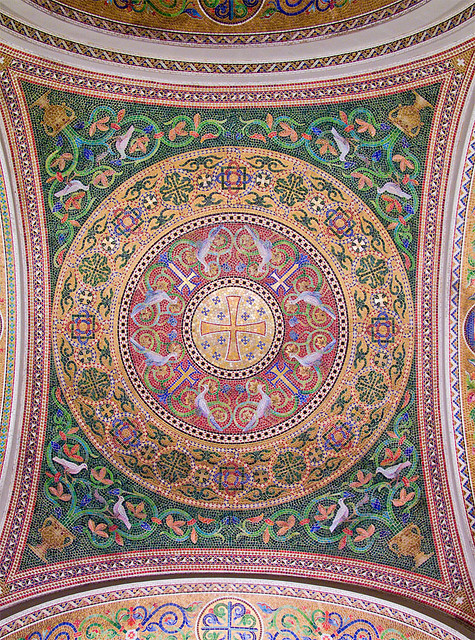
The Jewish Temple in Jerusalem had lush vegetative ornament, being reminiscent of Eden and the promised restoration of the garden of paradise at the world's consummation. Ancient synagogues often followed this pattern, as did the early Christian churches.  Here we see peacocks, symbols of immortality, and two doves at a fountain in each corner, which among other things is a symbol of fidelity and baptism. We also have crosses.

Cathedral Basilica of Saint Louis, in Saint Louis, Missouri - Our Lady's Chapel - windows.jpg

Plainness and lack of ornament is associated with unorthodox sects, from radical denominations to Wahabbism in Islam, which tend to deny the value of the intellect and beauty, or which denigrate the value of the material world. Plain meeting-houses offer nothing for visitors, other than implying “Begone! There is nothing for you here.” Their churches are necessarily uninviting, and they have few willing converts, for they do not “Go into the whole world and proclaim the gospel to every creature.”

But a traditional church is inviting, asking visitors to stay for awhile, perhaps to pray, or even only to contemplate the beauty within, and so such a church ought to be open to visitors at all times.

Cathedral Basilica of Saint Louis, in Saint Louis, Missouri - Our Lady's Chapel - mosaic detail on altar.jpg

Mathematics is traditionally seen as an important step towards enlightenment. Recognizing the underlying unity, order, and causes of things, rather than merely the immediate appearances of things is essential for intellectual — and ultimately spiritual — development. Expressing the mathematical order in works of art inspires not merely the passions, as is found in so much of contemporary art, but also inspires and helps to form the intellect.

Cathedral Basilica of Saint Louis, in Saint Louis, Missouri - Our Lady's Chapel - chapel ceiling 3.jpg

The ornamentation at the Cathedral Basilica has a logical arrangement. The parts of the nave nearest to the main entrance and closest to ground level are more worldly, abstract, and more local, while as we rise upwards, and towards the sanctuary, the ornament is more heavenly, theological, and Christological. Finally the eye is drawn towards the high altar, depicting Christ suffering on the Cross, our salvation. But visitors to the nave are first presented with patterned geometric art, which lifts them above the mundane, ever-changing world, but in a manner that is perhaps gentler than Christ's battered and bloody corpus.

Cathedral Basilica of Saint Louis, in Saint Louis, Missouri, USA

Ornament serves many uses. As the most important church in the archdiocese, it is fitting that it is most richly ornamented, and we would also expect fine ornament in a pilgrimage church, and so the amount and complexity of the ornament tells us of a building's importance. The ornament — including the iconic art — specifically tells us what this building is, that it is a place of Christian worship. The ornament is festive and solemn, reflecting the liturgy offered here.

Cathedral Basilica of Saint Louis, in Saint Louis, Missour

Mosaic work is a popular craft, but it is often done these days in a primitive style, lacking in geometric precision. Adding a basic knowledge of the various orders of symmetry, coupled with good skill in measurement and layout could easily restore this art, at least on a basic level.

More complex figures, such as the vegetative ornament as seen here, require a knowledge of proportion that is hard to find these days, and this may tempt artists to merely copy existing forms for new work. The problem with simple copying is that some designs, especially those that are highly ordered, are largely specific to the surface upon which they ornament. A different proportion of wall, for example, will require a different design pattern to keep a harmonious appearance, even if the basic elements of the design remains the same. The ability to adapt a type of pattern to new circumstances would require greater knowledge than the simple symmetries mentioned here. See the article Abstraction and the “Grammar of Ornament” for some clues on how to do this.

Wednesday, November 28, 2012

A New Line of Sanctuary Appointments for Churches in the United States

SEE THE ARTICLE, Collaboration Leads to New Line of Sanctuary Appointments, at the New liturgical Movement. This links to an interview with the head of Granda Liturgical Arts, which is starting a new line of sanctuary furnishings, in the classical style and designed for the American market, for those who desire “churches that look like churches.” From the interview:
The classicism of the design allows the Rinascimento [Italian, ‘Renaissance’] Series to work with almost any style church in the United States or elsewhere. In contrast, other artistic styles like the Romanesque, Gothic or Baroque demand a more specific architecture. The classic ideals of the Ancient Greek and Roman canons incorporated in the Rinascimento design make the Series universal and timeless.
This makes sense. The strain of Modernism popular in the United States, especially in the vast number of suburban churches built in the 1960s, was based on the idea of stripping ornament from existing designs, while retaining a measure of the original formalism. Therefore restrained ornament can be added and yet the overall design can remain harmonious.

Alas, Europe itself, the birthplace of the great arts, continues its fall from grace:
...there are not many good designers in Europe that are masters of the classic style for liturgical use. You can find plenty that are working in modernist or experimental styles. In many cases, they stir away from traditional works for inspiration and would be embarrassed if someone were to characterize their work as 'classic.’ These designers are indifferent or even inimical towards ideals like proportion, symmetry, timelessness and harmony. They are more focused on the artistically extravagant, intent to elicit strong reactions and working radically independent of the influence of historic architecture...
And so the forefront of ecclesiastical architecture must be found elsewhere:
The United States, on the other hand, is currently the leader in a renewal movement in the area of ecclesiastical architecture, with a different kind of motive. Architects and designers who are the engine of this movement prefer to look towards very specific sources of inspiration: Tradition and Scripture, or the Temple on the Mount and the Heavenly Jerusalem, as models....
For a good overview of the theological and architectural principles expressed by the new American school of Catholic church architecture, I would suggest Catholic Church Architecture and the Spirit of the Liturgy, by Denis R. McNamara.

While good architecture may not save souls, bad architecture may help weaken or kill the Faith, which was one of the specific goals of the Modernist movement. But good architecture may help plant the seeds of Faith by providing inspiration and beauty, as well as providing concrete lessons on the Faith. It is of great importance that new churches, and the restoration of old churches, help provide these things, for they show that we have a living Faith, and not one that is dead or dying.

UPDATE: more information on this can be found here.

Tuesday, November 27, 2012

Modernism, Postmodernism, Remodernism, and the Color of Statues

Saint Louis Art Museum, in Forest Park, Saint Louis, Missouri, USA - view from back with new wing

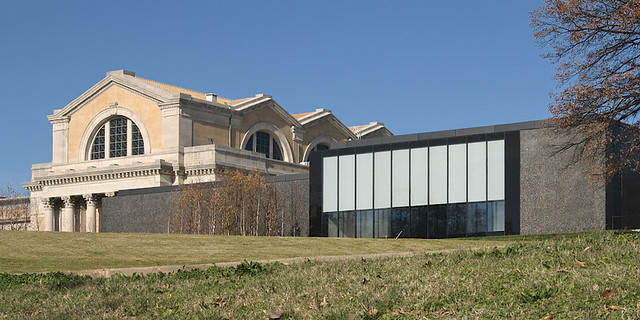
THIS PHOTO SHOWS the back of the Saint Louis Art Museum, in Forest Park, Saint Louis, Missouri. We see on the left the original museum building, designed by Cass Gilbert as the Palace of Fine Arts for the Louisiana Purchase Exposition of 1904, which was modeled after the Baths of Caracalla in Rome.

While we might think that it is odd to model a museum after a public swimming pool, please be aware that the original Baths had two public libraries: one in the Greek language, the other Latin; and that the structure was richly ornamented with top-quality sculpture and mosaics. It was intended to be at the center of the cultural life of Rome.

On the right hand side of the photo above, we see a massive new addition to the museum, designed by Sir David Alan Chipperfield in cooperation with the firm of HOK, which is scheduled to open to the public on June 29th, 2013.

According to the museum website:
“It has been the Museum’s intention to construct a building appropriate for our time and achieve an architectural character that both stands on its own and complements the Cass Gilbert building, while taking advantage of the Museum’s spectacular site in Forest Park.”
“Appropriate for our time”? Superficially, it looks as if it could have been designed in the 1960s, but Chipperfield, the designer, is called “uncompromisingly modernist in outlook,” and modernism in architecture is most associated with that decade; however popular culture is going through a phase of nostalgia for that time, so perhaps this is not surprising. The early 1960s were exceptionally optimistic times, giving us the progressive Kennedy presidency, the struggle against Communism, Vatican II, the civil rights movement, the space race, as well as the domination of modernism in architecture.

However, architectural modernism — in its goals and its aesthetics — fell strongly out of favor after 1972, largely in response to the failure and ultimate destruction of the Pruitt-Igoe project in Saint Louis. This was a massive public works project, which gained international attention, that was designed to provide high-rise housing for workers near downtown. While many architects consider the original design to be good, it was implemented poorly via meddling by the federal government among other factors, most specifically due to a misunderstanding of human nature. This failure led to a reappraisal of modernism itself, and modernism's unrealistically optimistic idea that big problems could be solved with big solutions. This is in contrast to the traditional view that a good society can only be achieved if the individuals in society are good, via the promotion of individual virtue.

But please note that the designer of the museum expansion does not see his design in a prideful modernist manner; rather:
“The project seeks to create an unostentatious new wing of the existing museum which is modest in its architectural language and takes advantage of the museum's extraordinary setting as a ‘pavilion in the park’.”
Although the museum website states the the expansion complements the original building, I rather think that it clashes with it. If I had been asked for my opinion on the museum expansion, I would have suggested a grand and vibrant neo-Baroque structure, designed by one of the many superb architects from the school of architecture at Notre Dame. This complementary style of building would reflect the museum's intrinsic cultural mission of reclaiming ground lost to the barbarous hordes, as the original Baroque of the Counter-Reformation combated the iconoclasm and austerity of the revolutionaries of the 16th century. Much of contemporary architecture today, most especially commercial retail properties and government buildings, are austere and iconoclastic to an extreme extent, and likewise, much of popular culture is tasteless to a degree almost unprecedented, and so the cultural mission is of great urgency.

HOK (formerly Hellmuth, Obata and Kassabaum), the ‘architectural firm of record’ of the museum expansion, was founded in Saint Louis in 1955 by three graduates of the architecture school of Washington University in Saint Louis, and has a long history of promoting modernism in architecture. Not only is HOK the largest architectural firm in the United States, the firm was also largely responsible for making mainstream the revolutionary avant-garde modernist movement, a move that dismayed many progressives, since they considered it ‘selling out’.  But lest we forget, if revolutionaries are successful, then they become the new mainstream.

As earlier noted, the modernist movement fell out of favor, and serious doubts set in amongst intellectuals: was the great optimism of the 1960s misguided? Centralized urban planning led to the destruction of cities, poverty reduction programs increased poverty, efforts to promote racial harmony led to racial hatred, religious reforms led to an abandonment of religion, the promise of happiness via free love and recreational drugs instead led to misery, and the moon proved not to be a realm of wonders, but rather a cold, gray, dead rock. Modernism gave way to postmodernism, which replaced optimism with cynicism, and replaced science with uncertainty. After the economic and political malaise of the 1970s, we find the first major expressions of postmodernism in the architecture of the prosperous, confident 1980s.

Down the hill and across a road from the museum is the postmodernist north entrance to the Saint Louis Zoo, containing the Living World exhibit, designed by HOK. It dates from 1989:
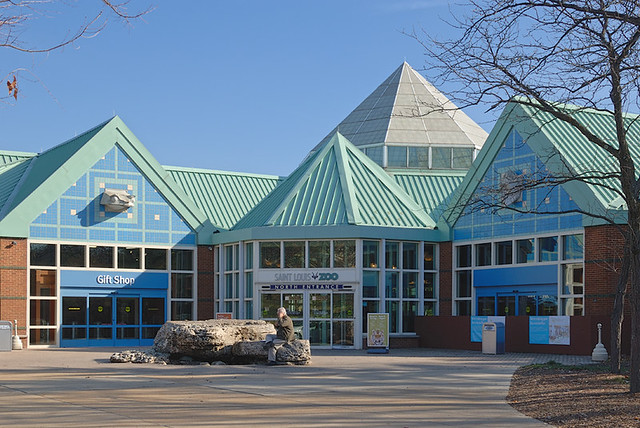
Saint Louis Zoo, in Forest Park, Saint Louis, Missouri, USA - entrance building

Modernism in architecture was eventually considered to be excessively bland and uniform, noted for its monochrome color scheme, its rejection of ornament and its use of only simple geometric forms and, oddly enough, flat roofs, which seems to go against the modernist desire for functionality. And so, modernism got the reputation of being joyless in its Puritanical utopianism, as illustrated here. Contradicting the modernist pioneer Ludwig Mies van der Rohe, who proclaimed that “less is more,” the postmodernist Robert Venturi replied “less is a bore.” This zoo building shows a rejection of modernist principles, with its use of ornament, color, and a gabled roof.

Postmodern architects instead felt that they had the freedom to choose any style, color scheme, and ornament they desired, freeing themselves from the shackles imposed by modernism. Also of great importance was the postmodernists' sense of humor, which was in contrast to the grim seriousness of the modernists. When I first saw this zoo building, it made me smile! Although it is hard to tell from this photo, the building is ornamented with absurd sculpted heads of animals, which along with the bright colors and bold patterns, gives the building a cheerful, comical look.

But if we dig into the theories of postmodern philosophy, we find out that humor of postmodern art is ironic, even cynical, and could plausibly be construed to be a joke at the expense of the client and the general public. As earlier mentioned, the philosophy of postmodernism is based on cynicism and doubt: gone are the ideas of progress and even truth: there is no truth, and if there was truth we wouldn't know it, and if we knew the truth we could not communicate it. If you spend the time digging into the dense, difficult-to-read postmodernist theory, you will ultimately find out that postmodernism is indefinable, for it is nothing at all. That fact about postmodernism ought to give us pause.

Portrait of a Cat I (Shilo) [EV=-4.5]

An ironic, postmodernist photograph of a cat. I actually did point my camera at her, and pressed the shutter, but I knowingly set the exposure too high to actually capture any detail. But this is only a white rectangle; it has lost everything that makes it a photograph.

Postmodernism first found favor with avant-garde leftists, and it was appealing to them because of its marxist flavor, but the philosophy soon became mainstream, being adopted by major institutions, including business. But as postmodernism, at its core, is nothing, some works of postmodernist art attracted much criticism from working artists, who instead thought that the philosophy had gone too far. One example of this kind of art was simply a light bulb turning on and off in a gallery. Coupled with 1960s nostalgia, the pendulum of culture is now swinging back into modernism, a movement called by some ‘remodernism’ or ‘the new sincerity.’ At least modernism stands for something. In the political sphere, we have seen the return of the modernist idea that big problems can be solved by big government programs.

While radicals thought they were doing something new and different with postmodernism, Catholic thinkers understood that postmodernism was really a school of thought that took the assumptions already present in modernism more towards their bitter end. Postmodernism was in reality hypermodernism, and was a continuation of the mode of philosophical thought that gained prominence among heretics in the late middle ages.

In the 1907 encyclical of Pope Pius X, Pascendi dominici gregis (“Feeding the Lord's Flock”), modernism is called “the synthesis of all heresies,” and although we might guess that postmodernism invented a few more heresies, that is probably not correct. The postmodernists themselves have pushed back the roots of postmodernism as far back as the 19th century, even predating modernism itself, which is rather funny. Ultimately, every heresy can be traced back to the very beginning.

Heresies are not simply wrong, for if they did not contain some truth, they would have been quickly rooted out as yet another crank theory worthy of no consideration. Heresies instead embrace some truths and deny others, and so move away from orthodoxy in one direction or the other. We especially find this in politics, where one party will embrace one particular heresy, while the opposing party embraces the opposite error.

Postmodernist architects were correct in seeing that modernism had imposed irrational restrictions on the practice of their art. Monochrome color schemes and iconoclasm were certainly wrong as universal principles of the art, but the postmodernists were themselves wrong when they ignored the theories of proportion, symmetry, and color that held sway for 2,500 years. Too many postmodernist buildings are badly proportioned: they look funny, awkward, and sometimes childish. A good measure of seriousness is not a vice.

The Gothic or Catholic style of architecture was both serious in its icons and altar, but yet was comical in its gargoyles and other ornamentation. It is possible to have both.


By no means can our contemporary architecture be convicted of having too much ornamentation or too much color, for it still errs on the side of nullity. Historically, this modern attitude extends at least as as far as the 15th century. As western Europe started to discard its Catholic faith, at first slowly by the elite in the Renaissance, and then quickly in the Reformation, artists started looking towards ancient history for models of new art. While Protestants chose a literal interpretation of the Bible for inspiration, the more secular-minded selected ancient Greece and Rome.

The religious reformers focused on one of the Ten Commandments, prohibiting “graven images,” as an argument against architectural ornamentation, while the secularists admired the white Carrara marble sculptures that were found among the ancient ruins of antiquity, and used them as an argument against the use of color. These two streams of thought remained entwined ever since. While modernism got its start mainly in Europe, precedents can be found in the United States, particularly amongst radical sects who preferred severe, unornamented, and plain white meeting-houses as their churches.

Perhaps the religious reformers overlooked those passages of the Bible that show that the Jewish temple was richly ornamented, at the command of God. Perhaps they did not realize that the Temple was the prototype for the Church, worthy of emulation in every city in the world. Perhaps they failed to recognize that plain churches do not inspire the imagination, nor do they encourage widespread faith.

If reason, feelings, and the practice of art throughout the world in all ages are not enough to support the generous application of ornament and color to architecture, archeology has lately shown that ornament was used in the early Church, and color was used in the ornament of antiquity.

See the article Bringing the Color Back to Ancient Greece, which shows a reconstruction of a finely painted statue. Please be aware that the modernist architect's desire for a monochrome palette started with the mistaken notion that the fine buildings, monuments, and sculpture of antiquity lacked varying color. It was believed that polychrome statues were a medieval barbarism, and that pure white sculpture was instead the norm and represented a higher aesthetic achievement. Only lately has this been debunked, but our aesthetic life has suffered for centuries. Even the old art museum building, more than a century old, is monochrome in its color scheme: I specially processed a photo of it, and was surprised to find that all of the stonework on it is of the same hue and nearly the same brightness; only the saturation of the coloring varies.

Back in 2003, the art world was shocked at the finding that sculpture of antiquity was actually painted, but for a while it was thought that they were painted garishly in the postmodern fashion.  However, I suspected that this was not true and that these must have been more subtly painted: see the article Common Errors About the Ancient World. Instead, it now seems that the painting were done rather finely, similar to what we find in the Church's polychrome statues.
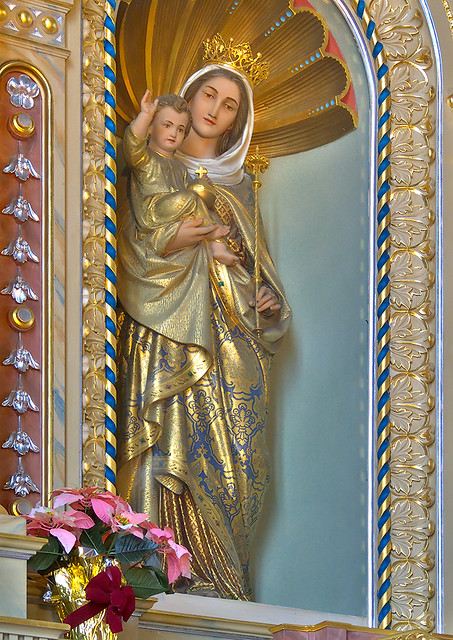
Saint Joseph Shrine, in Saint Louis, Missouri, USA - statue of Mary 2

This richly polychromed statue of the Blessed Virgin and Christ Child was made for the Cathedral of Notre Dame in Paris, but ended up at the Shrine of Saint Joseph in Saint Louis.

As far as I can tell, every traditional culture on the face of the earth decorates its buildings in floral imagery, except for the culture of modernity. Who could possibly dislike flowers and foliage, and not want to see them grown or artistically depicted everywhere? Unfortunately, the products and philosophies of modernism belie a type of gnostic tendency, showing a severe disregard for the material world, which has very unfortunate implications.

Cultural evangelization is difficult these days, largely for the fact that culture has become rather centralized and standardized, like just about everything else in our life, and it is closely linked the powerful in government, big business, media, and education. But our work can be like the mustard seed, which starts small and grows larger later. This kind of evangelization is important even though good architecture will not save the world, for we know that bad architecture will certainly harm it.

Friday, July 06, 2012

“Don’t hate me because I’m beautiful...”

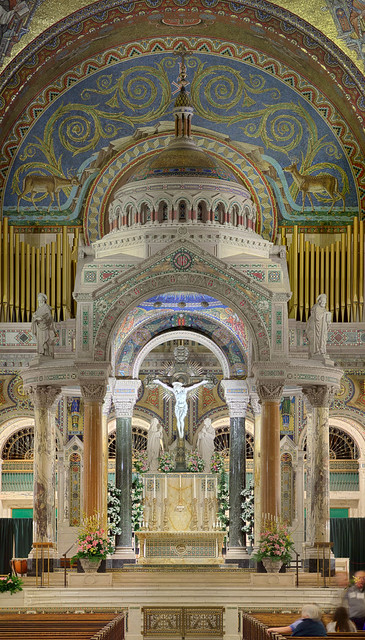
Cathedral Basilica of Saint Louis, in Saint Louis, Missouri, USA - large view of high altar 4

Photo taken at the Cathedral Basilica of Saint Louis.

Click for the article Don’t Hate Me Because I’m Beautiful… over at the Crescat.

Jewish law is well known for having many precise rubrics for the sacramentals of their rites, and Catholicism, which came from this tradition, retains many of these sacramental principles. But simply fulfilling the basic minimum requirements, a utilitarian sense of only observing the bare essentials of these rites, shows a certain meanness of spirit. In Jewish theology, there is the principle of “hiddur mitzvah,” which states that generosity towards the Lord is shown when an extra effort, especially a sense of beauty, is added to the rites. According to one source:
Beauty enhances the mitzvoth [commandments] by appealing to the senses. Beautiful sounds and agreeable fragrances, tastes, textures, colors, and artistry contribute to human enjoyment of religious acts, and beauty itself takes on a religious dimension. The principle of enhancing a mitzvah through aesthetics is called Hiddur Mitzvah.
Historically, this principle, although largely unwritten, was a core part of Catholicism as evidenced by the huge number of elaborate and beautiful churches.  Until our current age, the Church made a great effort in making the liturgy beautiful. The incorporation of Greek philosophy into Catholicism also gives us a solid reason for knowing why beauty has a religious dimension, for the Lord is beauty itself.

Essentialism and utilitarianism has become a part of our culture, and since they say “beauty is in the eye of the beholder” and so subjective, the Beautiful has been excluded from large numbers of our churches, and indeed in life in general.

As the Crescat says, you shouldn’t give a toilet plunger to your beloved on Saint Valentine’s Day, no matter how much it is needed or how useful it is.

Wednesday, June 20, 2012

A New Architecture Blog...

...THE SACRED LANDSCAPE, by Catholic architect Steven Schloeder, PhD, AIA, can be found at http://thesacredlandscape.blogspot.com. He writes:
I soon discovered that while everyone talked about "architecture", no one was really ready to talk about what it really was.  Now if one were to ask a professor of biology what it was that he studied, he might well reply "the study of living organisms", and if asked of an economics professor she might tell you that "economics concerns the production, distribution and consumption of goods and services", or "how people work within markets to get what they want given the problems of scarcity and competition", or even "how money works".  Yet in asking my architecture professors "what is architecture", I would get the most opaque and pretentious answers:

Architecture is the masterly, correct and magnificent play of masses brought together in light. 
 Architecture is frozen music.
The reality of the tea cup is the space within.
Architecture is the art of doing the common uncommonly well.
Architecture is a matter of taste, and our job is to tell you what you should like. 
Architecture is commodity, firmness and delight -- (this last definition seemed more applicable to the young ladies in whom I was interested than to what I was designing).  

In short, none of them could give a reasonable working definition of architecture, and yet were mercilessly dogmatic in our juried crits as to whether the student achieved ARCHITECTURE or not. It was entirely subjective as best as I could make out: Architecture depended on the caprice of the professor. Platitudes were thrown about; definitive judgments made without recourse to any defined standards; the architect was supposed to be some sort of prophet and priest telling others how to live, shaping buildings and whole cities that would shaped peoples' lives for better or for worse, yet with no fixed goals. The study of architectural history concerned what the buildings looked like, what were the defining features of the historical style, but never the 'why were they designed thus and so' question.  There were no objective standards for evaluation (apart from the purely technical and vital aspects of structural stability and how the building responded climatically), no reflection on what it means to be a human being, what it means to live in society, what it means to order raw nature for human habitation, the question of beauty, and how architecture addresses the aspirations of humanity.
 
He just started the blog, but perhaps you can pay it a visit to encourage him?

Tuesday, January 17, 2012

The Hanley House

IN 1876, the City of Saint Louis divested itself of the largely rural and remote Saint Louis County. Seeing the need for a new county seat, two local property owners, Ralph Clayton and Martin Hanley, donated land for the new courthouse.

Hanley's house is still standing and is now a museum. Here are two photos of the interior of the house:

Hanley House 1

Hanley House 2

Much of the furniture in the house is from the Hanley family.

Monday, January 02, 2012

Happy New Year and Most Popular of 2011

MAY EVERYONE HAVE a happy new year, in this the year of Our Lord 2012, and may this year be one of peace, prosperity, and joy.

In remembrance of the year past, here are some of the most popular postings and photographs from this website during 2010:

Billboard for Saint Francis de Sales Oratory

This is billboard, advertising the Latin Mass at Saint Francis de Sales Oratory, showing a monstrance on the left, and the shield of the Institute of Christ the King Sovereign Priest on the right. The Flickr photo-sharing website, which hosts most of my photos, tells me that many people view this image every day. I'm not sure that I'd call this my best photo of the year, since I hurredly took it while driving, but it is certainly the most viewed.  My second-most viewed image is of the monstrance itself:

Monstrance, at Saint Francis de Sales Oratory, in Saint Louis, Missouri, USA

This fine piece of liturgical art was made for the church itself. A crop of this photo is seen on the billboard above.

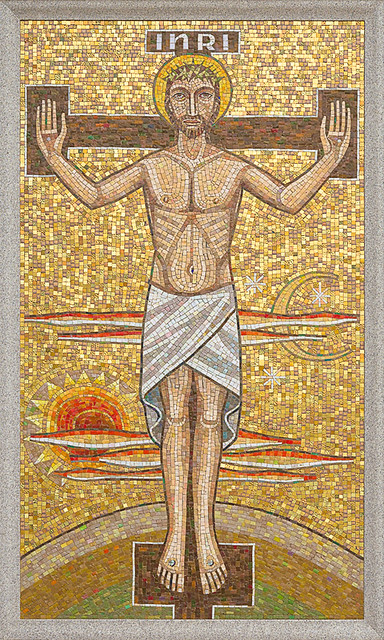
Resurrection Cemetery, in Affton, Missouri, USA - mosaic of the Crucifixion of Our Lord

A mosaic of the Crucifixion of Our Lord, at Resurrection Cemetery, in Shrewsbury, Missouri. The following mosaic of Our Lady is located nearby:

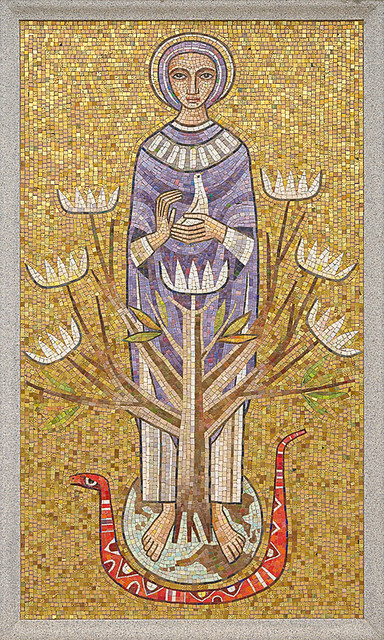
Resurrection Cemetery, in Affton, Missouri, USA - mosaic of the Blessed Virgin Mary

Carondelet Park, in Saint Louis, Missouri, USA - railroad track and bridges, at night, in the snow

A bridge and railroad tracks in the snow, at Carondelet Park, in Saint Louis, Missouri.

A Snowy Night in Saint Louis shows photos that I took on one bright night in the snow. It was so rare and beautiful that I was up until past 4 o'clock in the morning snapping photos. Several of the photos I took that night, as well as more than a hundred others taken at other times and places will be featured — full resolution and optimized for print — in a forthcoming book to be published by Reedy Press.

Clifton Heights Park

Clifton Heights Park, in Saint Louis, at dusk.

Cardinal Burke with seminarians, at Saint Francis de Sales Oratory, in Saint Louis, Missouri, USA

Cardinal Burke, with seminarians, at Saint Francis de Sales Oratory.

Half a Billion is an article which discussed the architecture and philosophy behind the Gateway Arch, the great symbol of the City of Saint Louis, which is one on the most-visited tourist attractions in the world. The title of the article is the estimated cost of renovating and expanding the Arch grounds, which intends to correct some of the flaws of its existing unrelenting Modernist design.


I didn't take this photo of Archbishop Ritter, but it was one of the most popular on this website. Here His Grace leaves for Rome on an aircraft named "Star of Rome of the West"; he came back a Cardinal.

A Warning to Schools that are "Catholic In Name Only" sounds the alarm that the Federal Government now arrogantly decides for itself which schools are Catholic and which are merely Catholic in name only. The secularization of our schools must reverse.

Calvary Cemetery, in Saint Louis, Missouri, USA - statue face detail - monument of Maysie Walker Pittman - right side of face

Detail of a monument, at Calvary Cemetery, in Saint Louis.

Fairgrounds Park, in Saint Louis, Missouri, USA - close-up of frozen berries

Saint Francis de Sales Oratory, in Saint Louis, Missouri, USA - Palm Sunday procession, halted at door of church

Palm Sunday procession at the Oratory.

Saint Elizabeth of Hungary Roman Catholic Church, in Crestwood, Missouri, USA - mosaic

Mosaic at Saint Elizabeth of Hungary Church, in Crestwood, Missouri.

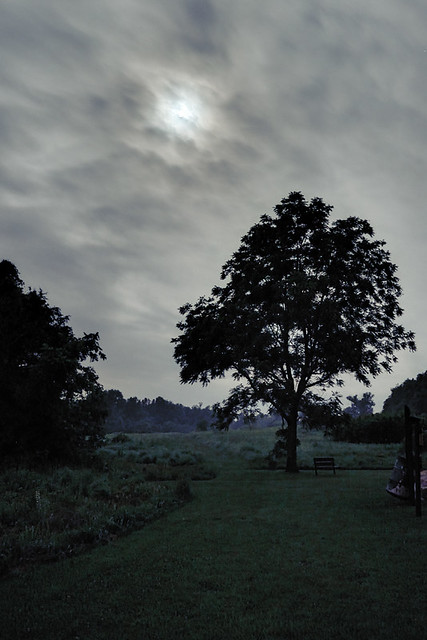
Young Conservation Area, in Jefferson County, Missouri, USA - landscape with moon

Young Conservation Area, in Jefferson County, Missouri. Photo taken by the light of the full moon. I've been inspired to take photographs at night ever since I've seen these photos of Cambridge University.

Forest Park, in Saint Louis, Missouri, USA - suspension bridge at night in fog

Forest Park at night.

Francis Park, in Saint Louis, Missouri, USA - First flowers of spring, in the snow

Flora and fauna are always popular. See the posts Spring Flowers at Shaw's Garden, Spring Wildflowers, Mushrooms and Moss, and Birds, Beasts, and Bugs.

Silver Lake Park, in Highland, Illinois, USA - pink Claytonia virginica (Spring Beauty) wildflower

Silver Lake Park, in Highland, Illinois, USA - white Spring Beauty wildflower

Silver Lake Park, in Highland, Illinois, USA - Erythronium albidum wildflower

Missouri Botanical Garden, in Saint Louis, Missouri, USA - water lily 3

Cuivre River State Park, near Troy, Missouri, USA - small orange mushroom

DSC_6960

Silver Lake Park, in Highland, Illinois, USA - crawfish

Gravois Creek, in Saint Louis County, Missouri, USA - after Spring snowfall

North Riverfront Park, in Saint Louis, Missouri, USA - Mississippi riverbank with two vertical sticks in fog

The articles Photos of Fog and Morning Fog shows pictures taken while enveloped by mist. Fog obscures our sight, and so is a natural symbol of mystery and divinity. Fog is a good photographic subject: by breaking the rules of Photographic Modernism, fog forces the artist to fall back on the older and more delicate principles of Pictorialism.

Cliff Cave County Park, in Mehlville, Missouri, USA - trees along Mississippi River in fog

Cliff Cave County Park, in Mehlville, Missouri, USA - two tugboats on the Mississippi River

Tower Rock in the Mississippi River, in Perry County, Missouri, USA

Tower Rock, located in the Mississippi River.

Sunrise over the Meramec River, at Shaw Nature Reserve, in Gray Summit, Missouri, USA

Dawn over the Meramec River.

Saint Francis de Sales Oratory, in Saint Louis, Missouri, USA - Archbishop Robert Carlson

Archbishop Carlson at the Oratory.

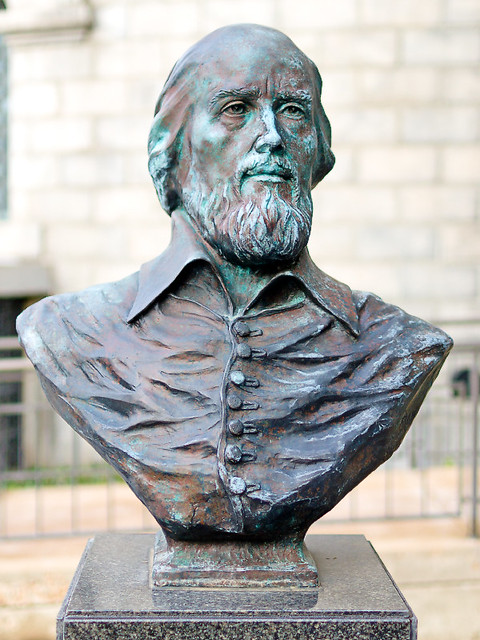
Cathedral Basilica of Saint Louis, in Saint Louis, Missouri, USA - Bust of Saint Francis de Sales

Sculpted bust of Saint Francis de Sales, at the Cathedral Basilica of Saint Louis.

Autochromed altar of Mary, at Saint Peter Church, in Jefferson City, Missouri, USA

Altar at Saint Peter Church, in Jefferson City, Missouri. This photograph has a muted color inspired by the old Autochrome process, the first practical method of color photography. See my posting Autochrome for more attempted examples of recreating the subtle color used by this French process . If you are technically minded and interested in this process, see my article Using ICC Profiles for Creative Color Control, which is located on my photography blog, The Refracted Light.

Calvary Cemetery, in Saint Louis Missouri, USA - ducks

I was trained in the sciences, so I occasionally like to write on the subject. See Unsolved Problems and Higgs Boson Not Found. I got a degree in physics, but a close second interest of mine was theology; as a young man, I also wanted to be an architect and design cathedrals (and secretly I still do)! See my article Build Your Own Gothic Cathedral and New Geometric Patterned Art.

My interest in ecclesiastical architecture led me to dig more deeply into art theory. The subject of Catholic Art Theory is problematical, because not too much magisterial guidance is available, that is, we don't have too many authoritative sources; however, the great Catholic arts tradition speaks for itself, and as these churches and works of art were commissioned by our bishops, this tradition is authoritatively magisterial. There are a number of ancient and more modern philosophical works that proved to be greatly influential on this tradition. Also see the article Catholic Art, which goes into some detail about the great Tradition. Also see the article On the Sublime, which describes a very important idea in the arts, which tends to be sadly neglected or confused these days.


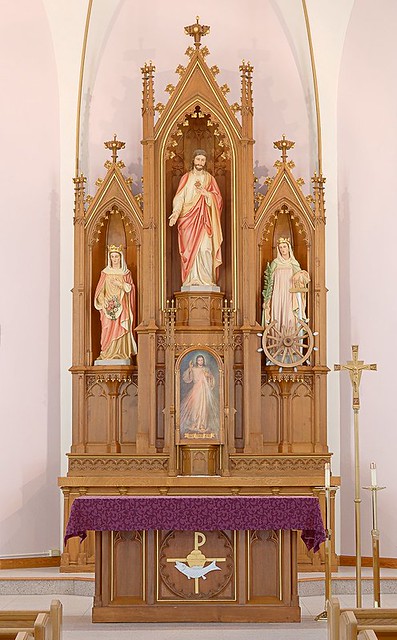
Saint Elizabeth Roman Catholic Church, in Marine, Illinois, USA - altar

Altar at Saint Elizabeth Church, in Marine, Illinois.

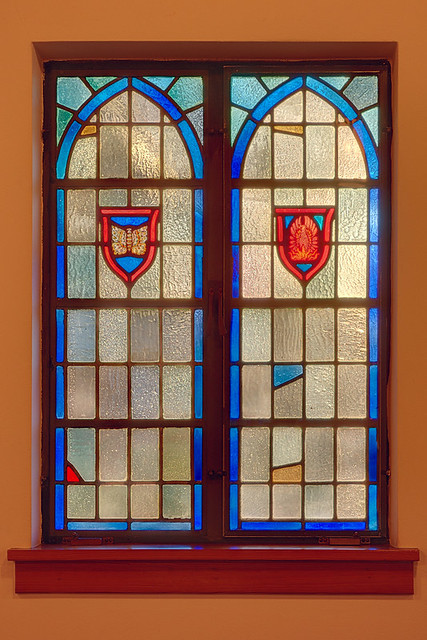
Saint Nicholas Roman Catholic Church, in Pocahontas, Illinois, USA - stained glass window with butterfly and phoenix

Stained glass window at Saint Nicholas Roman Church, in Pocahontas, Illinois.

Saint Paul Roman Catholic Church, in Highland, Illinois, USA - nave

Saint Paul Church, in Highland, Illinois.

Cathedral Basilica of Saint Louis, in Saint Louis, Missouri, USA - sign "silentium" at the Blessed Sacrament Chapel

Silence! At the Cathedral Basilica of Saint Louis.

Immaculate Conception Roman Catholic Church, in Augusta, Missouri, USA - exterior at sunset with rectory

Immaculate Conception, in Augusta, Missouri.

Saint Joseph Roman Catholic Church, in Apple Creek, Missouri, USA - outdoor statute of Saint Francis of Assis

Statue of Saint Francis of Assisi, at Saint Joseph Church, in Apple Creek, Missouri.

Holy Cross Roman Catholic Church, in Cuba, Missouri, USA - exterior 1

Holy Cross, in Cuba, Missouri.

Many of my readers come to this website come for the church photos. These posts proved popular this past year:

Photos of Saint Maurus Church, in Biehle, Missouri
Photos of Saint Joseph Church, in Highland, Missouri
Some Photos of Saint Mary's Church, in Alton, Illinois
Photos of Saint Elizabeth Church, in Marine, Illinois
Photos of Saint Joseph Church, in Louisiana, Missouri

And sadly, this posting, from a few days ago:

Saint Mary's Church, in Brussels, Illinois, Destroyed by Fire

Now as it so happens I've taken photos of many more churches this past year but have been too busy/lazy to post them. Perhaps during these upcoming cold days of winter I'll work on them.