“I implore each of you: Choose peace!” said Archbishop Carlson, who prayed at the memorial site for Brown in the days after the shooting and led a Rosary on Nov. 5 in January-Wabash Park. “Reject any false and empty hope that violence will solve problems. Violence only creates more violence. Let’s work for a better, stronger, more holy community— one founded upon respect for each other, respect for life, and our shared responsibility for the common good.”
Showing posts with label people. Show all posts
Showing posts with label people. Show all posts
Tuesday, November 25, 2014
Archbishop Carlson on the Current Situation
FROM THE ARTICLE Archbishop Carlson calls for peace as grand jury says no indictment for Ferguson police officer:


Sunday, June 15, 2014
HAPPY FATHERS DAY

My father building a snow arch in front of our house in 1966, a miniature Gateway Arch. My dad is always working on interesting projects.
Tuesday, January 07, 2014
Photos from the Snowstorm of January 5th, 2014
EXCEPTIONALLY COLD weather, along with an unusual amount of snowfall this past Sunday, led to widespread difficulties, but also interesting photo opportunities.
The Cathedral Basilica of Saint Louis in the snowstorm. I took this after Mass for the Epiphany, where very few people assisted — understandably. Fortunately, I have a car which is good in the snow, so I drove around town afterwards taking photos.
Lots of snow for this region.
Saint Louis University, with the spire of Saint Francis Xavier Church barely visible.
Most of the streets were empty, even major thoroughfares such as this one, and the blowing snow obscures the skyscrapers of downtown. Many of the traffic lights were malfunctioning.
There were a number of pedestrians, usually carrying grocery bags, and walking in the middle of the street, where the snow was not quite so deep.
Walking the dog is almost a necessity, no matter how cold — unless you are willing to do a cleanup inside. Very many cars were stuck in the snow, fortunately, there were volunteers helping out.
A view from the Eads Bridge. One of the pleasures of the day was the ability to safely stop my vehicle in the middle of any street or bridge, and take a few moments to take a photo.
The Gateway Arch, also (barely) seen from the bridge.
The Basilica of Saint Louis, King of France, popularly called the Old Cathedral, is shrouded in scaffolding for its first major renovation in over 50 years. This is being done now partially in honor of the 250th anniversary of the founding of the City of Saint Louis by Pierre Laclede and Auguste Chouteau.
Union Station. Nearly every business and office were closed this day — with the notable exception of grocery stores.
The massive railroad yard, which bisects the middle of the city.
Gates to Lafayette Park.
One of the ornate Victorian-era buildings in the Lafayette Square neighborhood, facing the park.
Geese on the wing in Forest Park.
Some of the geese, after they landed on the water of the restored River des Peres.
Winter is usually a good time for hiking in the forest, for you can see farther and aren't bothered by insects. But this afternoon was becoming increasingly cold and windy, and I must admit that I was miserable at this point. But upon getting back to my warm car, after an exhilarating hike, I was glad that I got out of the house instead of staying home.
In warmer weather, this bridge is a good place to see frogs, turtles, and water lilies.
The Victorian footbridge originally led to a railroad station, and for decades this was difficult to find because of overgrown vegetation. This photo might look a bit different from the others, because I took it with my cell phone, so that I could upload it to a friend who asked me to take a picture of it.
It wasn't quite clear where the road was, but that does not deter brave pedestrians.
The World's Fair Pavilion. The same scene, but under quite different circumstances, can be seen on the cover of my photo book, St. Louis Parks.
Art Hill, located between the Saint Louis Art Museum and the Grand Basin, is famous for sledding.
Friday, November 22, 2013
The Allegory of Love
FIFTY YEARS AGO TODAY, there passed one of the greats of the 20th century. But Clive Staples Lewis’ death went largely unnoticed, lost in the traumatic events of the day. Lewis was an apologist, novelist, popular writer, and essayist, beloved of Christians of all churches, denominations, and sects; but he was also an accomplished scholar.
Love and marriage are horribly confused, conflated, and misunderstood in our current age, which does not understand the forms and purposes of these things — or rather, our age doesn’t seem to understand the form and purpose of anything. It was on the topics of love and marriage that C.S. Lewis gained his academic fame, in his book The Allegory of Love: A Study in Medieval Tradition, dating from 1936. It was this book that showed that the Medieval literature on love was worthy of serious academic study: and it remains the starting point of much of contemporary scholarship.
Marriage is a human institution, closely tied to the law and specific human circumstances — but it is rooted in human nature — while love is universal. How these two things interrelate is explored in great and even shocking depth in the Medieval literature. It is said that one flaw in Lewis’ book is that he treats love as a literary phenomenon, and not as something real, which he later corrected in his more popular book The Four Loves. Another flaw in his book is his incorporation of modern literary theories, whose frameworks don’t quite fit the data, and today we likewise have ideological — Marxist, Darwinist, Postmodernist, or Calvinist — readings of the literature which might explain one or another narrow aspect of love fairly well, while failing to consider the entire whole in a satisfactory manner.
Studying Medieval love literature can be hazardous: its allegorical method can be overlooked, its explicit depictions may be shocking, its unromantic portrayals of romantic love can be disturbing, and its essential Catholicity is rejected by contemporary conservatives and liberals alike. But Lewis was onto something: understanding love in all of its aspects is of great value to us today, and in every age.
Friday, November 08, 2013
Dawn Eden to Speak at SLU High
DAWN EDEN, known for her books The Thrill of the Chaste and My Peace I Give You: Healing Sexual Wounds with the Help of the Saints, will be speaking at the St. Louis University High School, on Sunday, November 10th, 2013 at 1:30 p.m.
Her talk will be followed by Holy Mass offered by Fr. Augustine Wetta, O.S.B.

This talk is intended for parents.
A recent talk by Miss Eden, “What the Saints Can Teach Us About Purification of Memory”, can be found here.
Address:
4970 Oakland Avenue
Saint Louis, Missouri 63110
Friday, July 12, 2013
Acknowledgments
FIRST, I would like to offer again my congratulations and my love to my parents on the occasion of their 60th anniversary of marriage, which occurred on July 10th. We had a fine celebration this week.
I would also like to recall my entrance into the Church, on Trinity Sunday, ten years ago. This has been a blessing to me, although I admit to my shame that I hardly ever acknowledge those blessings. I have new crosses to bear, but also the grace to carry them. Perhaps like what was said of the ancient Irish, my songs are now sad but my battles are happy.
I spent the months of May and June working on processing photos for a new book, which should be out this autumn, and so I haven’t blogged much here lately. Like my other Reedy Press books, this will be a full-color coffee-table photo book featuring scenes from around Saint Louis, and will be available at local bookstores as well as online booksellers. I would also like to acknowledge my long-suffering friend Tina, who drove me thousands of miles for this book, in brutal winter weather, often in the dead of night, in the cold and snow, and who constantly cajoled me to complete my task even though I was ill at the time and could hardly walk.
While I do have other urgent tasks that I ought to take care of in the near future, I am also looking for future topics for photo books and am open to suggestions. I have two titles currently under development, but would like to fill up the pipeline, so to speak, with more works. I would like to find writers who are open to doing collaborations: if you are a good writer, diligent, able to meet deadlines, good at public speaking, and are willing to work on speculation — please understand that the first royalty check might appear a year after completing the work — please contact me. My major limitation in doing photography is travel expenses, and would be delighted to find donors or organizations who would be willing to underwrite my travel costs, in exchange for sharing in the income of the resulting books.
I would also like to acknowledge my father, and my patroness Laura Rogers, who recently gave me a camera for my birthday. It has a quiet shutter and can take excellent pictures even in dimly lit churches.
If you are on Facebook, you might want to ‘like’ two pages that I manage there:
- St. Louis Parks features my photography and supports the book of the same name by Reedy Press; you can purchase a copy of the book by clicking the button on the sidebar.
- Catholic Art Theory features quotes on the arts from artists, philosophers, theologians, and magisterial documents, which help explain the meaning, theory, and importance of the arts in the Church and in general.
Friday, April 12, 2013
Medal of Honor Posthumously Awarded to Capt. Emil J. Kapaun, Servant of God
FROM THE UNITED STATES ARMY:
Kapaun graduated from the college seminary of Conception Abbey, located north of Kansas City, and also attended Kenrick Seminary in Saint Louis, Missouri. He was ordained a priest in the Diocese of Wichita.
Fr. Kapaun exhibited spiritual and corporal works of mercy in great abundance, and the number of miracles attributed to his intercession are remarkable. Because of his heroic virtue, Fr, Kapaun was recognized as a Servant of God by Pope John Paul II in 1993. Fr. Kapaun’s Cause for Sainthood can be found at the Diocese of Wichita’s website here.
From a homily of Fr. Kapaun for Palm Sunday:
Chaplain Emil J. Kapaun, while assigned to Headquarters Company, 8th Cavalry Regiment, 1st Cavalry Division, distinguished himself by extraordinary heroism, patriotism, and selfless service between Nov. 1-2, 1950. During the Battle of Unsan [North Korea], Kapaun was serving with the 3rd Battalion of the 8th Cavalry Regiment. As Chinese Communist forces encircled the battalion, Kapaun moved fearlessly from foxhole to foxhole under direct enemy fire in order to provide comfort and reassurance to the outnumbered Soldiers. He repeatedly exposed himself to enemy fire to recover wounded men, dragging them to safety. When he couldn't drag them, he dug shallow trenches to shield them from enemy fire. As Chinese forces closed in, Kapaun rejected several chances to escape, instead volunteering to stay behind and care for the wounded. He was taken as a prisoner of war by Chinese forces on Nov. 2, 1950.During yesterday’s award ceremony, President Obama called Capt. Kapaun “An American soldier who didn’t fire a gun, but who wielded the mightiest weapon of all, a love for his brothers so pure that he was willing to die so that they might live.”
After he was captured, Kapaun and other prisoners were marched for several days northward toward prisoner-of-war camps. During the march Kapaun led by example in caring for injured Soldiers, refusing to take a break from carrying the stretchers of the wounded while encouraging others to do their part.
Once inside the dismal prison camps, Kapaun risked his life by sneaking around the camp after dark, foraging for food, caring for the sick, and encouraging his fellow Soldiers to sustain their faith and their humanity. On at least one occasion, he was brutally punished for his disobedience, being forced to sit outside in subzero weather without any garments. When the Chinese instituted a mandatory re-education program, Kapaun patiently and politely rejected every theory put forth by the instructors. Later, Kapaun openly flouted his captors by conducting a sunrise service on Easter morning, 1951.
When Kapaun began to suffer from the physical toll of his captivity, the Chinese transferred him to a filthy, unheated hospital where he died alone. As he was being carried to the hospital, he asked God's forgiveness for his captors, and made his fellow prisoners promise to keep their faith. Chaplain Kapaun died in captivity on May 23, 1951.
Chaplain Emil J. Kapaun repeatedly risked his own life to save the lives of hundreds of fellow Americans. His extraordinary courage, faith and leadership inspired thousands of prisoners to survive hellish conditions, resist enemy indoctrination, and retain their faith in God and country. His actions reflect the utmost credit upon him, the 1st Cavalry Division, and the United States Army.
[source]
Kapaun graduated from the college seminary of Conception Abbey, located north of Kansas City, and also attended Kenrick Seminary in Saint Louis, Missouri. He was ordained a priest in the Diocese of Wichita.
Fr. Kapaun exhibited spiritual and corporal works of mercy in great abundance, and the number of miracles attributed to his intercession are remarkable. Because of his heroic virtue, Fr, Kapaun was recognized as a Servant of God by Pope John Paul II in 1993. Fr. Kapaun’s Cause for Sainthood can be found at the Diocese of Wichita’s website here.
From a homily of Fr. Kapaun for Palm Sunday:
A great leader exerts a most powerful influence over the hearts and minds of his followers. Though the task of following such a leader is most arduous in itself, yet it becomes sweet and honorable, and comparatively easy in practice when the followers consider the dignity of the leader, the relation of the leader to his followers, the motives which prompt the leader, and the rewards which he offers.More information can be found at the Father Kapaun Guild: http://www.frkapaun.org
Greater dignity than the dignity of Christ we cannot imagine. Christ is God the Son, equal to the Father and the Holy Ghost in all things. He is our King, for God the Father sent Him to redeem us and teach us the way of salvation. His position and honor among God’s people in this world is the highest. No other leader can compare in dignity with Him.
[source]
Monday, March 25, 2013
A Question for my readers…
MARSHALL McLUHAN, the famed media theorist of the 20th century, who coined the phrases "the medium is the message" and "global village," studied and taught at Saint Louis University.
Does anyone have any information regarding McLuhan's time at Saint Louis University?
What is not generally known is that McLuhan was a faithful Catholic, a convert and daily communicant, whose ideas regarding the media were informed by the Catholic sacramental and iconographic systems, where signs and symbols represent greater realities.
His work is still widely regarded today, especially in the fields of cinema and television, although no doubt his ideas are poorly understood.
If anyone has information regarding his stay at SLU, I would appreciate it. I think this would make a good article here.
Wednesday, March 13, 2013
Habemus Papam!
POPE FRANCIS, Jorge Mario Bergoglio of the Society of Jesus, age 76, Archbishop of Buenos Aires, Argentina.
O God, who in your providential design willed that your Church be built upon blessed Peter, whom you set over the other apostles, look with favor, we pray, on Francis, our Pope, and grant that he, whom you have made Peter’s successor, may be for your people a visible source and foundation of unity in faith and of communion.
Through our Lord Jesus Christ, your Son,
who lives and reigns with you in the unity of the Holy Spirit,
one God, forever and ever.
Friday, March 01, 2013
ON THE WEBSITE of the Holy See is a little 'photo book' of the pontificate of Benedict XVI, which includes numerous photos as well as his significant speeches:
http://www.vatican.va/bxvi/omaggio/index_en.html
Wednesday, February 27, 2013
...The decision I have made, after much prayer, is the fruit of a serene trust in God’s will and a deep love of Christ’s Church. I will continue to accompany the Church with my prayers, and I ask each of you to pray for me and for the new Pope. In union with Mary and all the saints, let us entrust ourselves in faith and hope to God, who continues to watch over our lives and to guide the journey of the Church and our world along the paths of history...— Pope Benedict XVI, excerpt from his last General Audience, Saint Peter's Square, Wednesday, 27 February 2013
Saturday, January 26, 2013
Wednesday, January 16, 2013
On Analogy
THERE ARE SEVERAL common modes of human reason, which includes the familiar processes of inductive and deductive reasoning, as well as abductive reasoning, hypothetical reasoning, and others.
But one of the most powerful modes of reasoning — if not the most precise — is analogical reasoning, where you compare and contrast one sort of thing to another. Inductive and deductive methods are rather precise, but can be slow, plodding, expensive, or difficult, and we can often end up with trivial results such as “Oceans are determined to be very large and full of water.” However, analogical reasoning takes the full capacity of the human imagination to quickly jump from one thing to another, which may lead to unexpected and novel results. For example, Niels Bohr developed a model of the atom, analogizing it with the solar system, which led to a new understanding of nature. Some think that analogical reasoning is the base or primary mode of reasoning of the human intellect, since it contains within it aspects of all the other modes of reason. Analogical reasoning is very fruitful: it proposes, and the other more precise modes of reasoning fills in the details; perhaps deduction and induction are not possible without first making the analogy.
Examples, parts, or close relations of analogy include:
...exemplification, comparisons, metaphors, similes, allegories, and parables, ... association, ... correspondence, mathematical and morphological homology, homomorphism, iconicity, isomorphism, ... resemblance, and similarity....In the field of artificial intelligence, it was originally thought that computer systems based on pure deductive reasoning would lead to a human level of intelligence, but this did not work out in practice, and it seems that research on this has been moribund since the 1980s. However, a newer computer algorithm, the Vector Space Model, uses analogical reasoning and has nearly achieved the average human level of performance on the College Board's SAT multiple-choice analogy test. Analogical reasoning is used effectively in Google Search, which often produces surprising yet reasonable Internet search results.
Some of the powerful analogies include arguments from symmetry and proportion. Indeed, the English word “analogy” derives from the ancient Greek ἀναλογία, analogia, meaning “proportion”. We say that the proportions 3:2 and 6:4 are analogous since they have the same ratio of 1.5, and likewise we can analogize by saying that fingers are to the hand as toes are to the foot. The Greek philosopher Plato used his allegories as analogical arguments, as did Our Lord in His parables. Analogy is particularly important in the figurative arts, where we associate daubs of paint on a canvas with say, a human face. Biologists use analogy extensively when comparing the anatomy of various species, and have thereby discovered the principle of convergence.
Good analogical reasoning not only compares similarities between two things, but also contrasts their differences. When Bohr developed his atomic model, he reasoned that the tiny electrons orbit around a large nucleus, as the planets orbit around the sun. But on the atomic scale, quantum effects predominate, and so the analogy breaks down a bit, since it is hard to claim that the electrons are actually orbiting, and so this needed a better mathematical model. But one of the great benefits of analogical reasoning is that the things that we learn about a new unfamiliar system (such as the atom) can shed light back upon the old familiar system (such as the solar system): some of the newer mathematics that explained the atom, in turn, can be analogously used to more fully explain the solar system.
Some claim that analogies are methods used by those in power to impose meaning, and this could happen, and so analogies have to be made intelligently to be truthful and fruitful. An old model of the atom, called the ‘plum pudding model,’ did not bear (or even contain) fruit, although it does sound tasty: but it is an absurd analogy. A good analogy must highlight any differences that exist, as well as similarities, otherwise it indeed is an imposition of meaning. It seems that a good analogy must start with something baser, and then go by analogy to something higher. Modern political discourse will often attempt to analogize a current political issue with something Biblical, such as the Jews' exodus from Egypt. Since this is an inversion of the hierarchy of importance, this trivializes scripture and tells us nothing new, and so we aren't learning anything: where, according to the politicians, are the Commandments of God? Lest we forget, new knowledge is the goal of reasoning. Our Lord's parable of the Prodigal Son indeed starts with something common — a father's forgiveness towards his wayward son — but instead points to the greater meaning of God's forgiveness for our sins; while this analogy tells us something about the relationship between human fathers and sons, that is not the main point of the parable, which mainly reveals to us knowledge of God.
Analogy is of great importance in Catholic and Orthodox Biblical exegesis — the interpretation of scripture — and this forms the basis of what is called Biblical typology. A ‘type’ in ancient Greek is a small model which is made by an artist in preparation for his larger final work of art (we still use this sense in the English word prototype), and so what God made in the Old Testament can seen as types, figures, or models for what we find fulfilled in the New Testament. We find many striking similarities in events and persons between the Old and New Testaments, and by using analogical reasoning, we can compare and contrast these, seeing the Old Testament types as models or foreshadowings of what is to come. We often find that something in the Old Testament reveals something in the New, and that what is found in the New Testament more fully explains the Old. We are told, explicitly, that the lamb slaughtered on Passover is a type of Christ, and in turn, Christ reveals more clearly the meaning of the Passover. The lovers in the Song of Songs analogously show the relationship between God and the human soul, which is something that was long recognized by the ancient rabbis, but can also be seen as a type of the relationship between Christ and the Church, and the Holy Spirit with the Virgin Mary. Through analogy, we see that Eve is a type of Mary, and so the Virgin is called the New Eve, and the main contrast illuminated by the analogy is that Mary succeeded where Eve failed.
Analogical reasoning applied to sacred scripture is also used in moral theology as well as in eschatology. We also find much analogy in the liturgy: the Old Testament reading at the Mass often prefigures the Gospel reading, and the Roman Canon explicitly mentions various Old Testament figures:
Be pleased to look upon these offerings with a serene and kindly countenance, and to accept them, as once you were pleased to accept the gifts of your servant Abel the just, the sacrifice of our Abraham, our father in faith, and the offering of your high priest Melchizedek, a holy sacrifice, a spotless victim.
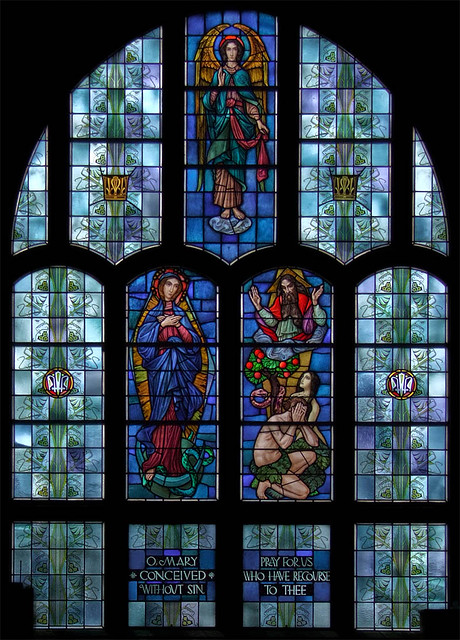
A stained glass window depicting Mary and Eve, at Immaculate Conception Church in Union, Missouri, illustrates the typology of Mary being the New Eve.
These analogies are of great importance to understanding Catholicism in general, and even when understanding Catholic art, where we might see the sacrifice of Abraham juxtaposed with the Crucifixion, or Melchizedek juxtaposed with the Last Supper. A flat, exclusively literal reading of sacred scripture — while not being denied by the Church, which is very important — tends to be dull, plodding, and disconnected. Reading the analogies in scripture brings it to life. Also, analogous reasoning can also be applied to nature, where natural objects such as water and light (which can be used to wash us or to light our way) give us spiritual insights, and in turn, we find that natural things such as water can have a sacramental role as in baptism.
We also find that analogical-typological reasoning can be useful for analyzing secular works. In the novel The Lord of the Rings, the characters of Gandalf, Frodo, and Aragorn, are each seen to be Christ types, being analogous to Christ's threefold office of prophet, victim-priest, and king respectively, and the plot of the novel can be better understood in this light. Analogies between secular Roman works on love and sacred scripture have also proved to be fruitful: the Romans discovered that jealousy is necessarily found in a lover, otherwise he does not love, and this shows to us the Biblical claim that God is jealous is likewise necessary, otherwise He does not love us; the Faith then more fully illuminates the classical notion that love has a Divine source.
In general, failure to observe analogous situations tends to set up an intellectual opposition between things, leading to ideologies. Scientism, for example, is an ideology that claims that the inductive method is the only valid form of reasoning, and this in turn ends up denying cause and effect. In religion, some see the Old and New Testaments as being in opposition to each other, which is core idea behind Gnosticism and ideological anti-Semitism; but this makes analogy impossible and so destroys the full Christian understanding and has unfortunate implications. Without good analogizing, things are seen in conflict which ends in destruction, and indeed we find a great distrust of analogy in Marxism, which is the ideology responsible for the greatest shedding of blood in human history. Analogy, on the other hand, tends to unify knowledge, and so in turn may help unify and harmonize society.
Starting on Wednesday, January 23rd, 2013, Dr. Lawrence Feingold will deliver a series of lectures at the Cathedral Basilica of Saint Louis, “Typology: How the Old Testament Prefigures the New,” where he will demonstrate the fruits of the Church's typological understanding of sacred scripture. More information can be found here, and the outline (and eventually, God willing, audio recordings) of the lectures can be found here. Some of Dr. Feingold's previous lectures on typology can be found here and here.
Also, you might want to visit the exhibit Federico Barocci: Renaissance Master at the Saint Louis Art Museum, which runs through January 20th, 2013. The exhibit is free on Friday. In addition to devotion-inspiring large religious paintings by a little-known but excellent artist, the exhibit includes many fine drawings that are models or types that Barocci used before making his finished work.
Monday, January 07, 2013
George Will and the Problem of History
RECENTLY, I attended a lecture given by political journalist George Will, in Graham Chapel at Washington University in Saint Louis, where he argued favorably about the importance of religion in civic life. Following a glowing introduction from former United States Senator John Danforth, Mr. Will, despite being a prominent conservative, received a warm reception from the crowd in this university known for its liberalism. Will's style is professorial and not argumentative, and he presented his case using factual evidence, not lowering himself to using ad hominem attacks; in his genteel manner, he seems much like his mentor, the late William F. Buckley, Jr., and rather unlike the conservative — but quite confrontational — talk show host Rush Limbaugh.
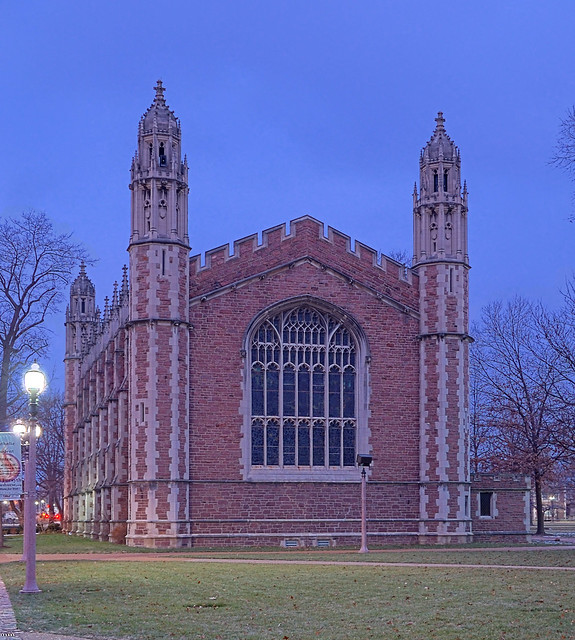
Graham Chapel, the venue for the lecture. Although called a chapel, this building is not set apart for sacred worship, but is used mainly for concerts and lectures. The university was founded by liberal Protestant clergy and wealthy businessmen. More of my photos of architecture on the campus can be seen here.
Will talked about how progressivism differs from conservatism. Initially he focused on the person of Woodrow Wilson, president of the United States (1913-1921), and leading Progressive, who radically expanded the role of government in the republic. According to Will, the Founding Fathers of the country feared the tyranny of majorities in a democratic state, and so placed in the Constitution a system of checks and balances to protect the rights of minorities. According to Will, thanks to the writings of Niccolò Machiavelli, Martin Luther, and Thomas Hobbes, the author of the book Leviathan, the Founders knew how to put together a good government (despite all three being highly problematic authors, especially for Catholics). It seems that history, to George Will, started in the Renaissance, and nothing from the age of Christendom seems to be of value to him. The progressives however, ignore history as irrelevant, and thought that the process of evolution, shaped by democracy in the U.S., had bred-out the bad tendencies of human nature, and that there should no longer be a fear of the majority or of strong leaders.
Mr. Will repeated the belief of the Founders that a good republic rests on civic morality, which is promoted by religion, and therefore we ought not fear the influence of the religious on political culture. England, he noted, was ravaged cheap gin, but it was not politics but rather John Wesley and Methodism that saved her. Will — when responding to a comment about the possibility of the religious Right turning the U.S. into a theocracy like Iran — stated that religious conservatives in the U.S. traditionally are ‘quietist’ regarding politics, until they are forced to become politically active to protect their rights. Indeed, religion once had an influential role in the political life of the U.S., but led by liberal Christians such as Wilson and Martin Luther King.
But to Will, an agnostic, it seems that any religion will do, and he backed up his belief in indifferentism by a number of quotes from the Founders. [However, a friend of mine who also attended the lecture knew of contradictory quotes from the same men, who rather seemed to think that any Christian religion would do.] Recall that the Founders feared the tyranny of the majority: they particularly feared a majority of any particular religion; so while they promoted religion in general, they wanted a radical Protestant kind of religion, one that was unorganized and chaotic, and therefore, not a threat to the State.
Religious liberty is often promoted as a core belief of the American republic, but precisely what this liberty means to the political elites of the country is questionable. The Left typically defines this as ‘freedom from’ religion, similar to the French policy of laïcité, which seeks to free the people from the burdens of morality and “superstition,” which we see here. To the Left, it is the duty of religion, if it is allowed to exist at all, to conform to the desires of the State, and the State is more than willing to regulate or exterminate religions to reach these goals.
But the attitude of the elites of the political Right, if we consider Mr. Will's opinions to be common, is more benign but also harmful. To them, the role of religion is limited to building up the civic virtue of the citizenry, and so therefore is a means to an end instead of something valuable in itself, and as we have seen, no one religion is allowed to become an majority. It appears that a divide-and-conquer strategy is used often, typically by splitting religions along political lines, as has occurred often in U.S. history. Christ, who is the same yesterday, today, and forever (Heb. 13:8), is instead seen as a changeable political hack.
Both the Left and Right encourages infiltration of religions: nonbelievers are strongly encouraged to be members of a church, and to take an active part in governing them, despite their lack of faith. This is seen as being respectable, traditional, or even conservative or progressive according to various viewpoints. In my youth, I even recall government-sponsored public service announcements that encouraged people to “attend the church or synagogue of your choice.” Historically, the non-believer Presidents George Washington and Thomas Jefferson were regular church attendees, as is our current president, who according to his autobiography is also a non-believer. Former presidents Bill Clinton and Jimmy Carter actually started their own religion, the New Baptist Covenant, although I know nothing of these men's religiosity. However, the most conservative president in recent memory, Ronald Reagan, did not attend church at all. Coldness is perhaps better than being lukewarm (Rev. 3:16)?
The U.S. is a good place to be a member of a small or fringe religion, for the kind of freedom of religion found here allows small groups to flourish with little explicit pressure either from government or from the culture in general. Orthodox Christians, Jews, small Protestant sects, and even New Age religionists find themselves here a pleasant land where they can do as they will. Unlike other countries, they do not have to register with a department of government (although they might have to submit paperwork to be recognized as a 501(c)(3) non-profit organization), nor do they normally have to deal with hostile, violent crowds.
But what is good for a small religion does not work for Catholicism, which claims universality. Offering services once a week is a simple thing that is barely regulated (unlike what is found in Canada or China). Doing other things, things which we are compelled to do out of love of neighbor, such as education and health care, are not so simple, and the State has been grasping for these, first with the public schools and now with the health care mandate. In this, conservatives and progressives agree: the Church must be restricted. Be aware that the state cared little about these until the Church brought them to these shores, and the public school system was created specifically to counter the Catholic schools. But as Catholic schools declined, the state-owned schools also declined with them, and if Catholic hospitals are allowed to fall, then health care in general will also fall. Few of those who rule the State know why these things are good and what they are for. Reproductive ‘health’ (meaning abortion on demand) and the economics of chronic health care are not valid or moral reasons for state control of hospitals.
Many traditional Catholics long for the days when powerful monarchs, such as the Kings of France and Spain actively promoted the Faith, especially since atheistic regimes now rule much of the world. But realize that these monarchs often tightly controlled the Church, by appointing her bishops and regulating her religious orders, and the situation was even worse in Russia, where the Tsars took over the role of the local Patriarch of the faith. When atheists took control of those states, they continued the policies of state control over religion. Even to this day, the secularistic government of France has a role in the selection of Catholic bishops.
In history, the ultramontanes strongly supported the role of the Papacy over local sovereigns. But some asked, why should Catholics support a weak Pope when they had a king who was powerful enough to get things done? We find this attitude even among the faithful today, putting too much trust in the princes and powers of the world. But the ultramontanists were right, as was affirmed by the First Vatican Council. An unrooted Christianity will soon find itself subverted to one political ideology or another, even in the United States, but an ultramontane attitude, leading to an integral and activist Catholicism, is the best remedy.
Wednesday, December 19, 2012

Yours truly, on the Missouri River at Saint Charles. Thanks to low water, I was able to walk out to the end of one of the wing dams on the river, which are used to narrow and deepen the channel for barge traffic. Photo taken by Tina aka Snup.
I managed to injure my knee only slightly while scrambling down the steep riverbank to pose for this photo. You can encourage me to suffer more dangers, thereby cultivating the cardinal virtue of courage, by purchasing prints at http://msabeln.zenfolio.com!
Tuesday, December 11, 2012
Joseph Pearce at the Priory

Joseph Pearce, writer-in-residence at Thomas More College of Liberal Arts, speaking at the Priory in Creve Coeur, Missouri. He spoke about the life of the Modernist novelist Evelyn Waugh, his conversion to Catholicism, and Waugh’s arguments for the retention of the old Latin liturgy in the church. Pearce has written numerous literary biographies of writers, including Shakespeare, J.R.R. Tolkien, and G.K. Chesterton.
The Saint Louis Priory School is a college-prep school run by the Benedictines of the Abbey of Saint Mary and Saint Louis.
Wednesday, October 03, 2012

Peter Elliott, auxiliary Bishop of Melbourne, last Sunday, during his homily at Saint Mary of Victories Church, in Saint Louis, Missouri.
UPDATE: audio recordings from Bishop Elliott's visit to Saint Louis can be found at the link here.
Sunday, September 30, 2012
A Visit to the Maronite Cathedral with the Melkite Clergy of the United States
LAST WEEK, the clergy of the Melkite Greek Catholic Church in the United States conferred in Saint Louis, Missouri. On Wednesday, they celebrated the Divine Liturgy at Saint Raymond's Maronite Cathedral.

The Melkites descend from the church founded by Saint Peter in Antioch, and they use the Byzantine Rite with Arabic being their official language. The Church calls itself الروم الكاثوليك or ar-Rūm al-Kathūlīk, literally ‘Roman Catholic.’ The Melkites are the oldest continuously existing Christian community.
Several of the clergy saw my camera and asked that I take photos:

Here the clergy receive Holy Communion. The liturgy was primarily in English with Byzantine chant tones.

After the Divine Liturgy.
The clergy afterwards retired to the Cathedral's banquet center, where they partook of the traditional Lebanese food served there every Wednesday:

Wednesday, September 05, 2012
The Abolition of Woman
THE BOOK, “The Abolition of Man,” by C.S. Lewis, starts with his criticism of the fashionable intellectual view that values are purely subjective. This debunking of values — which were largely shared by most great civilizations and religions — leads, almost inevitably, to a dystopian future: a political and economic system with the aim of universal genocide. That book comes originally from scholarly lectures, and so may not be easily readable; Lewis also fictionalized his observations in his novel, That Hideous Strength.
Some may consider this to be an antiquated opinion, surely contemporary thinkers want nothing more than a better life for us all? But perhaps a hundred million people were killed in the 20th century by revolutionary regimes who also claimed to want build a better future. But consider the aims of “deep” environmentalists: they believe that the world’s population must be quickly eliminated, with needed deaths in the billions. A bad intellectual fashion can have a huge body count: ideas matter.
I am not being alarmist, for the same intellectual trends continue today, and politicians have eagerly taken up the cause.
Recently, the influential feminist Shulamith Firestone was found dead at age 67. She was famed for her 1970 book The Dialectic of Sex: The Case for Feminist Revolution. Quoting from the book:
So that just as to assure elimination of economic classes requires the revolt of the underclass (the proletariat) and, in a temporary dictatorship, their seizure of the means of production, so to assure the elimination of sexual classes requires the revolt of the underclass (women) and the seizure of control of reproduction: not only the full restoration to women of ownership of their own bodies, but also their (temporary) seizure of control of human fertility - the new population biology as well as all the social institutions of child-bearing and child-rearing. And just as the end goal of socialist revolution was not only the elimination of the economic class privilege but of the economic class distinction itself, so the end goal of feminist revolution must be, unlike that of the first feminist movement, not just the elimination of male privilege but of the sex distinction itself: genital differences between human beings would no longer matter culturally. (A reversion to an unobstructed pansexuality Freud's 'polymorphous perversity' - would probably supersede hetero/homo/bi-sexuality.) The reproduction of the species by one sex for the benefit of both would be replaced by (at least the option of) artificial reproduction: children would born to both sexes equally, or independently of. either, however one chooses to look at it; the dependence of the child on the mother (and vice versa) would give way to a greatly shortened dependence on a small group of others in general, and any remaining inferiority to adults in physical strength would be compensated for culturally. The division of labour would be ended by the elimination of labour altogether (through cybernetics). The tyranny of the biological family would be broken.Although it was written decades after Lewis’ books, The Dialectic of Sex continues the same themes in surprisingly close detail: the need for a revolution via force or the threat of force, the institution of a totalitarian government, the aggressive use of new technology, the promise of utopia, all leading to universal genocide, or in her words, “the elimination of labour altogether.” Under Firestone’s system, women would not be free to be women, and eventually they may not be allowed to exist at all. Man, and Woman, would be abolished.
Underlying this is a hatred of biology: the revolution would be complete when “The tyranny of the biological family would be broken.” Likewise, Lewis’ antagonists in That Hideous Strength have an extreme hatred of biology. Should we decry the tyranny of the ant colony, or two birds in a nest with their eggs? Why then the hatred of the natural human family, imperfect as it is?
Underlying much of the contemporary agenda is a Gnostic-like hatred of the material world, which has bad consequences. See the article, Rapture and the Gnostic Tendency: this kind of thinking ultimately leads to the desire for genocide. How many millions of unborn children have been abolished because of Firestone’s influence?
But slippery slope arguments are logical fallacies. Arguing thusly with someone can get them to actually want genocide. Be aware that very many people support the basic aims of Firestone’s program, but few know the radical goals of those who actually are implementing it. What alternative can we offer? According to Blessed Teresa of Calcutta, “The child is God’s gift to the family. Each child is created in the special image and likeness of God for greater things - to love and to be loved.” Clearly there is a difficult road ahead of us.
Monday, June 25, 2012
Dominicans Make Vows at Old Cathedral
EARLIER THIS MONTH, three men made solemn vows to the Order of Friar Preachers (the Dominicans), at the Basilica of Saint Louis, King of France.
This happened at the “Old Cathedral,” once the cathedral church for half of the United States, an edifice which once was one of the most highly indulgenced churches in the world, located near the base of the Gateway Arch, in downtown Saint Louis, Missouri.
For photos, see the article Three Brothers Take Solemn Vows, from the website of the Dominican Brothers of the Province of St. Albert the Great.
Founded by Saint Dominic, the Order of Preachers is an active order devoted to preaching, being of one heart and mind in the Lord, and the salvation of souls. The modern university system developed from the work of the Dominicans in the Middle Ages, who according to their constitutions, were to devote much time in study. The Dominican Order was one of the earliest groups to have formed a constitutional form of democratic or parliamentary government; because of their broad knowledge and liberality, friars often served in the Inquisition — and so Modernity unfairly castigates them, even though their intent was to moderate the severity of the secular rulers.
Subscribe to:
Posts (Atom)
