Pages

Showing posts with label philosophy. Show all posts

Wednesday, April 24, 2013

Terror and the Romantic Movement

THE ROMANTIC MOVEMENT was an artistic, literary, and intellectual movement, centering on human emotions, which formed in response to the cold-hearted rationalism of the Enlightenment. As I wrote earlier, “Disgust with the poisonous fruits of rationalism — war, absolutism, poverty, industrial ugliness, and slavery — led to the Romantic movement, which emphasized feelings and emotion at the expense of the intellect.”

We usually remember the Romantic Movement for the exquisite art it produced, which was often full of deep emotion and great beauty. It is from the Romantic Movement that we got the great Gothic Revival, which brought church architecture towards a more Catholic feeling.


The Lady of Shalott, by John William Waterhouse, is one of my favorite Romantic paintings.

But the emotions expressed in Romantic art ranged further than love and the attraction towards beauty. The Romantics also used the emotion of fear, which we find in Gothic romance. The Romantic novelists understood horror, which is the emotional shock and revulsion impressed upon us by suffering and carnage. But more effective in literature, they discovered, is the emotion of foreboding or dread, of being tortured by one’s own imagination over possible future horrors: this emotion they called terror.

The Romantic movement was more than just an artistic movement, it also was political. Likewise, the Enlightenment was also political, and it lead to the absolutist state. Constitutional republicanism, in the forms cemented in the American and French Revolutions, got its start on the cusp between Enlightenment and Romanticism, a time period when older ideas had been largely digested and others were being rediscovered. The American revolution definitely was influenced by Enlightenment ideas, while the French revolution also incorporated Romantic notions.

Terrorism, in its modern political sense, got its name from the French Revolution, during the “Reign of Terror” or la Terreur, when the Revolution turned inward, killing the revolutionaries themselves in great numbers. Thousands of government terroristes roamed the country, often seeking those who weren’t revolutionary enough, leading people to live in constant terror of being suspected. This forced the more moderate revolutionaries to support the violent regime at the threat of being convicted themselves. This only ended when the leader of the group, Maximilien de Robespierre, was himself guillotined.


The execution of Robespierre and his followers. Note the people dancing for joy. [source]

Heterodox ideas lead to heterodox means to heterodox ends. As the world fell away from orthodoxy in philosophy and religion, it fell away from orthodox morality, including in politics and war. Modern terrorism, like we recently suffered in Boston, is a result of this heterodoxy. Bad ideas can have very bad consequences.

War in Christendom

Chronicles of medieval warfare are fascinating because the Christian character often shines through. While brutality has always occurred, with the Crusades being held up as an example, we find many instances where great courtesy is extended to opponents, where fighting is limited, and where the sides put forth great effort to avoid bloodshed. We even find this in the Crusades, and on both sides. If you believe that your opponent is made in the Image and Likeness of God, that killing is a mortal sin only justifiable in self-defense and in defending the weak in times of immediate danger, that innocents have a right to life, and that no one should be dealt an unprovided death, then certainly warfare and bloodshed is minimized, despite our fallen nature due to Original Sin.

Consider the famed sword fight scene from the 1987 comedy film, The Princess Bride:


This film clip would make no sense whatsoever if we did not have a remembrance of the nobility of Christendom.

While this is an exaggerated piece of fiction for comic effect, it does show a Catholic understanding of courtesy and honor between the fighters. The Spaniard, as a bodyguard, has a duty to protect his employer, while the Englishman is attempting to rescue an innocent, and so they fight. They are not enemies and they have no personal reason to have a dispute, although fight they must. There is no hint of animosity between the two because of religion, nationality, social class, privilege, or ethnic origin — things which are so much a part of disputes today, and which get dissected in great detail by our contemporary media.

At one time, a Christian king would have a dispute with a monarch of another land, and would take up arms in the name of justice; his followers would support him due to loyalty, but the dispute was the king’s and the king’s alone. Certainly it had little or nothing to do with the vast bulk of the king’s subjects, the peasantry, who generally had very low levels of taxation, and did not have to suffer from national conscription. Warriors of that period were sometimes greedy for the spoils of war, but often would agree not to pillage. Although they loved to fight, they were usually fighting for personal honor and loyalty and not riches: after all, honor gives greater happiness than wealth. They certainly did not fight for their country or other modern abstract concepts which arose largely during the Romantic period.

Modern War

The last major war which had a significant Christian moral component to it was World War I; while that war was brutal due to modern weaponry, very often the opposing sides in the trenches would refuse to fight each other. Why would they? They had no personal animosity against the other side, considering them fairly decent chaps. After all, lobbing chemical weapons over to the other side with artillery is hardly an honorable way to fight.

Also, consider that civilian casualties in WWI were historically low for warfare in the 20th century. Innocents, particularly children, are not morally valid targets for warfare, and civilians, who typically provide at most remote material cooperation in their nation’s affairs, are also not valid targets. This moral principle was widely accepted by the combatants in that war.

As the century progressed, the number of civilian casualties as a percentage of the total has tended to increase greatly. Were it not for the Spanish Influenza epidemic, the civilian percentage for WW I would have actually been much smaller: these statistics do take into account indirect casualties due to the hardships of wartime, such as greater incidence of disease and famine. The percentage of total war deaths suffered by civilians has gotten somewhat smaller at the end of the last century and in the 21st century, believed to be due to more precise weapons and tactics.

One of the side-effects of the devastation of the First World War was a loss of faith; and this loss of faith ironically led to even greater devastation during the Second World War, when civilians were directly targeted or disregarded. Moral opinions changed, repudiating the orthodox regard that is to be held towards innocents.


Terrorism attempts bring the percentage to 100%, where all casualties are civilian. We saw this disregard for civilians in the Boston bombings. But why were civilians even considered a target? If the surviving, nominally Islamic and Chechen-descent suspect of the bombings had a military target in mind, would it not have been in Russia? Chechens have been in conflict with Russia since the 19th century, with several major wars being fought on that territory in recent years. Why were civilians targeted? They had nothing to do with what happened in Russia, and the typical American civilian certainly is doing nothing against Islam. They bombers didn’t even take credit for what they did.

Romanticism and Terrorism

As earlier mentioned, Romanticism developed in opposition to the Enlightenment and the poisonous fruits of that ideology, focusing on feelings at the expense of impersonal rationality. Certainly the Enlightenment never completely went away, and it was revived after World War II — because it does tell some truth  — and the same can be said for Romanticism, which saw a revival in the 1960s counterculture. These neo-Romantics eventually gained power and have subsequently reshaped society into our current form.

Terrorism as a means of warfare developed after the French Revolution, particularly with many anarchist groups adopting the tactic. There were earlier groups who used terror tactics, such as the first-century Sicarii (literally, ‘dagger-men’) in Palestine and the twelfth-century Assassins (Ḥashshāshīn, literally, ‘marijuana smokers’) in the Middle East. They would use daylight public killings of political opponents as a psychologically effective means of instilling terror in enemies, as well as eliminating them. But modern terrorism, as developed in the nineteenth century, does not target specific powerful individuals, but rather, the general public. There are a number of reasons why this might be true.

Romanticism is based on feelings, and these days we often hear someone saying “I feel that…” rather than “I think that…”  What is problematic is not that feelings are considered to be a valid — feelings do have some moral validity, when judged by the intellect, but rather that feelings are promoted as being the primary means of determining moral action. Consider that the early psychiatrist, Sigmund Freud, called the intellect the ’superego’ and made it primarily an unconscious product of parents, teachers, and the culture, rather than being a consciously active part of a person. If two people feel love for each other, as goes modern thinking, then sexual activity between them is moral, no matter how unreasonable the act may be. You may not like some other people or groups: you might find their hair styles ridiculous, their food unpalatable, or whatever. Or, you might feel that your own family and neighbors are unlovable. And so, your feelings of dislike are a valid reason for attacking these others. But since we all have our own personal feelings, how can we judge someone else’s actions?

From the German Romantic idea of Weltanschauung, we get the English phrase ‘world view,’ where all of reality is determined by subjective perceptions. Today, we hear people say, “Well, that is true for you, but not for me,” and so truth is considered to be relative to someone’s world view. This is contrasted with orthodox belief that there is a single objective reality for all of us, although admittedly, the truth can be difficult to find.

Nationalism and moral relativism were invented by the Romantics. It was felt that the worldview of the ‘genius of a nation’ permeated its people, and so history became closely linked to distinct places and peoples, and specific ‘great men’ who shaped and dominated these. These Romantic views made history relative to specifics with no overarching themes transcending time, place and persons, and so has much in common with postmodernism. The Romantics saw themselves as being inspired by the ‘spirit of the times’ (or Zeitgeist, in the original German), which blows one direction at one time, and in another direction in another, and so they tend to reject the universal objective morality which is promoted by the Church and some other religions and philosophical systems. However, who determines which way the spirit of the age is blowing? As it turns out, young radicals will often harshly criticize the radicals of the previous generation.


Calvin and Hobbes by Bill Watterson; April 9, 1989

From the Romantics we get the notion that “the ends justify the means” — despite the fact that means are ends unto themselves — and so they ultimately repudiate morality while trying to lay claim to an objective morality. This inverts the traditional Church teaching that a good society can only be good if the people who make it up are good. Goodness permeates culture via many small, good acts, and it is absurd to imagine that many great bad acts can lead to goodness. Even the Enlightenment understood the value of the Golden Rule, but this was rejected by the Romantics.

Romantic nationalism was a key idea in both racism and Fascism that became quite prominent later on. But a parallel worldview, regarding social classes instead of nations or races, led to Marxism. Instead of a genius permeating a nation, the same kind of genius instead permeates the proletariat or the avant-garde. Under these ideologies, violent conflict became easily justifiable, and they both repudiated the fact that some people are innocent. Simply belonging to the wrong group makes you a target for attack.

Modern terrorism, therefore, is descended from the ideas of the Romantic movement, which can be summarized:
  • Terror is an effective device for overcoming a person, even more so than horror.
  • Moral obligations flow from feelings.
  • Personal identity is found in race, nation, or class, and
  • Bad feelings naturally occur between these groups, but,
  • We shouldn’t judge someone else’s feelings, and so,
  • Conflict between these groups is inevitable or even desirable.
  • The ends justify the means, and so,
  • Terrorism against members of other groups is an effective or even desirable means of conflict.
  • Terrorism works better if the perpetrator is unknown, because that will cause the enemy to tear itself apart with the fear and uncertainty of terror.
Following the lead of the French Revolution, other Romantically-inspired regimes have used terror practices against their own citizens, particularly in the Soviet Union and Nazi Germany. Arrests and beatings were often done in a seemingly capricious manner, instilling fear in the populace that they may be next, while keeping them uncertain as to the cause of the arrests, leading to extreme caution. This is in contrast to operating under the rule of law, where there is a clear line of demarcation between lawful and criminal behavior, and where arrests are made according to due process. One romantic revolutionary strategy was to overburden the due process system so much that the population clamored for relaxation of the rules.

A ‘strategy of tension’ was used in Greece, Turkey, and Italy in the 1960s and 70s, consisting of terror attacks orchestrated by the governments but falsely attributed to other groups, in order to make the population agree to greater government control. Due to psychological effects and the essential uncertainly of terror, it doesn’t matter who perpetrates the attacks, and since the state and its enemies all perversely stand to gain from these acts, this gives incentive to more of such attacks in the future.

In the United States, there have been numerous innovations in the law since the 1960s which inject a measure of uncertainty and even fear in the population — including extraordinary damages awarded in lawsuits, relaxation of the rules of evidence, the creation of crimes based on hate, and the Patriot Act, CISPA, and related legislation — leading us to act more cautiously, misplace blame, and to support the government reflexively out of fear.

Romanticism and Religion

During the Reformation, the doctrine of sola scriptura was developed, the idea that the faith is entirely contained within sacred scripture. This was extended to the idea that every individual reading sacred scripture would be guided by the Holy Spirit to understand the meaning of scripture. But people understand scripture differently! This destroys the unity of Christianity and the unity of creation, but it was embraced by the Romantics who interpreted the spirit as being capricious and always-changing, and has led to the conflicts that have plagued us since.

The Church, and culture as a whole, does not exist here on earth in a vacuum, and intellectual trends have a great effect on religion, whether we want them to or not. We find Romantic notions of nationality and class in the church in the history of the past century or so. Antisemitism became quite prominent in church thinking during the first part of the twentieth century, and Liberation Theology became likewise fashionable in the second half of the same century — although both trends were censured by the magisterium.

Pope John the XXIII said that it was time to open the windows of the Church to let in some fresh air, and through these open windows blew Enlightenment and Romantic notions found in the Zeitgeist of the 1960s, which we call Modernism. Perhaps it was through one of these fissures that “the smoke of Satan has entered the temple of God,” as observed by Pope Paul VI. When people refer to the “spirit of Vatican 2,” they are not referring to the actual texts of the Council, nor to the Holy Spirit, but rather the zeitgeist, or the spirit of the age, whose winds have shifted directions on many occasions since, and clearly many of the reforms of that era had a Romantic flavor to them. For example, Liberation Theology supported the use of terrorism in the struggle against social injustice, and some of the new ecclesial movements used highly suspect methods of manipulating the feelings of their adherents.

Many of the facts of nature and of the human person discovered by the heretical movements of the past several centuries are true even if the ideologies behind them are not, and for this reason we cannot reject everything that comes from outside of Holy Mother Church: to do so would be acting against the virtues of science and wisdom. But they also must not be accepted uncritically, but be judged accordingly, and so this is why the hermeneutic of continuity is important. Discernment is also important: is the Barque of Peter being sped on its journey by the gentle breeze of the Holy Spirit, or by the changing tempests of the zeitgeist? (Let’s not forget that in ancient symbolism, the Ship of the Church was rowed by the laity, with the Bishops and clergy acting as the ship’s officers. In case of stormy zeitgeists, Christ is symbolized as the ship’s anchor, protecting the Church from smashing on the rocks.) Clearly, the Church must understand the zeitgeist in order to defend against it, but not to be swayed by it.

We often think that Islam is a primal religion, born in the sands of Arabia, and to this day keeping true to its roots. But like Catholicism, Islam is also tossed about by the winds of change, and has also been greatly influenced by modern ideas. The fastest-growing offshoot of that religion has been greatly overwhelmed by modern ideas, and is quite unlike the richly ornamented and historically-rooted Islam found before modernity. It is from this offshoot that we find much of the terrorism of our current age. But even domestic terrorists of recent decades often have come from similar unorthodox nominally Christian sects. While these groups are often derided as being ‘fundamentalist’ we ought to consider that ideologically they have much in common with liberal religion: both kinds of sects are not historically rooted, but rather emphasize current events; they both tend to be iconoclastic, with plain white meeting-rooms, where their liturgies — if we can call them that — do not engage all of the senses. These groups encourage action which goes far beyond the boundaries of the universal moral law, including the Just War doctrine.

Solution to Terrorism

No law enforcement or military action can stop terrorism without becoming the source of terror itself, for as we see, terrorism is a problem of bad philosophy, misguided morals, and the splintering of humanity into us versus them, and it can appear wherever anyone disregards the moral law. This is also a problem of bad leadership: as long as the ideology of modernism is accepted and promoted by the government and the culture, the problem will not go away. Sadly, terrorism might even be desired.
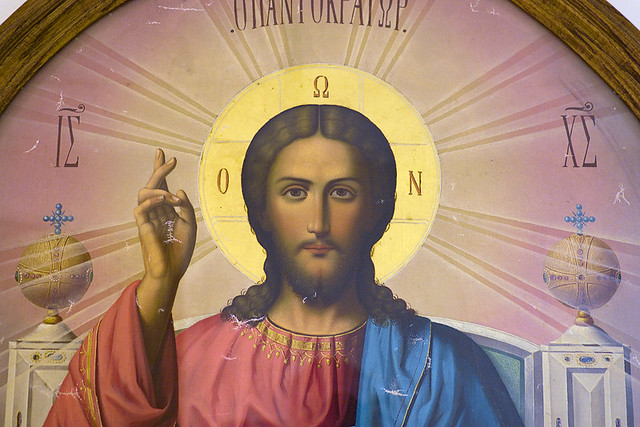
Christ Pantocrator detail, at Assumption Greek Orthodox Church, in Town and Country, Missouri, USA

Christ Pantocrator.

The solution is the same as it always has been: penance, include prayer, fasting, and almsgiving; living a moral life (and I am preaching to myself here); loving your enemies even if you don’t like them; being a good example, using common courtesy in all occasions, being a good citizen, preaching the Good News, having faith, hope, and charity; seeking truth, goodness, and beauty; fearing God, not man; protecting the innocent, instructing the doubtful, and living by the Golden Rule. You don’t have to be a Catholic to do these things, but by grace it helps.

Thursday, January 03, 2013

Christmas and Cartesian Dualism

ONE OF THE CORE principles of modernism is ‘Cartesian dualism,’ the philosophical theory that the spiritual mind of man is divorced from the material human body. We see the practical results of the belief in this divorce in political practice, where material concerns are tightly and comprehensively regulated by the state, while the soul is seen as being completely free from all considerations, even regarding morality, which we find in political rhetoric considering freedoms and rights. According to the notorious ‘mystery passage’ of the Casey decision, the Supreme Court of the United States stated: “At the heart of liberty is the right to define one's own concept of existence, of meaning, of the universe, and of the mystery of human life”; Besides being metaphysically absurd, this passage has been subsequently used to devise novel rights.

The fact that people do make up various theories of the meaning of life should not mean that all these theories are right: we are all free to make up our own theories of gravitation, but we know that there are very few theories of gravity that are even close to be plausibly correct. The orthodox view instead sees the material body and spiritual soul integrated into the human person; in the order of creation, we sit midway between the purely material animals and the purely spiritual angels.

It is quite odd, but it is quite common for men of science — pure materialists, one would think — to be attached to strange, occult and unorthodox spiritualism. Perhaps this is a consequence of the modern divorce between the soul and body.

Modern Cartesian man often has a feeling of unreality; he feels that he is a ghost wandering in a material cosmos, for that is a consequences of the theory that we are ghosts in a machine. But we know that we are one person, and not two. It has been noticed that there are some circumstances when modern men snap back into reality, when they realize who they are. The late southern Catholic writer, Walker Percy, noted that both sex and violence pull us back into the real; the normal Cartesian disembodied state snaps back into reality when something really important happens, especially if that something is violent, cataclysmic, or involves the basest of animal passions.

Everyone who remembers the attack on Pearl Harbor, or the assassination of President Kennedy, or the destruction of the World Trade towers, or times of more personal tragedy, can likely recall in vivid detail what they were doing at that time when they first heard of the news. They, suddenly, were pulled back into what is real. In the aftermath of such disasters, all that is truly good in human nature suddenly flourishes: people show love and concern for each other, people appreciate what they have, they see the world about themselves with a new clarity; drug addicts no longer feel the need to get a fix, and abortionists have no clients.

Sadly, this clarity of life and the new appreciation of reality does not last, and modern men go back into their disembodied, ghostly Cartesian state. But perversely, this means that people look forward to the next disaster because it makes them feel real. Percy argues that this is the reason why people are fascinated by news reports on tragedies, and I suspect this may be a reason why people find end-of-the-world predictions so compelling or even desirable. This can lead to gnostic-like thinking, where people are so alienated from the material world that they seek to chastise or even destroy it.

The Church has always been inflexible in holding to the doctrine of the Trinity, because it is the center of our Faith. But it is also psychologically necessary: the season of Christmas reminds us in a vivid, concrete way that Christ is God Who took on human flesh to save us. The material world is not a mistake, but was made very good; its is not a prison house for the soul but is an essential part of what we are; although fallen it has been sanctified.

One of the delights of the Catholic faith is its liturgical year, and its cycle of festivals, where one mystery of the faith is celebrated on one day, and other mysteries are celebrated on other days or during other seasons. But some modernist theologians insist that all of the mysteries ought to be celebrated simultaneously, all of the time, as if a Christian would forget about Good Friday on Christmas Eve. But does this not seem excessively spiritualistic, denying the right ordering of things in time? Is this a sign of the modern Cartesian mentality?

The public festivity of religious holidays therefore signals an orthodox understanding of the importance of the material world.

Tuesday, November 27, 2012

Modernism, Postmodernism, Remodernism, and the Color of Statues

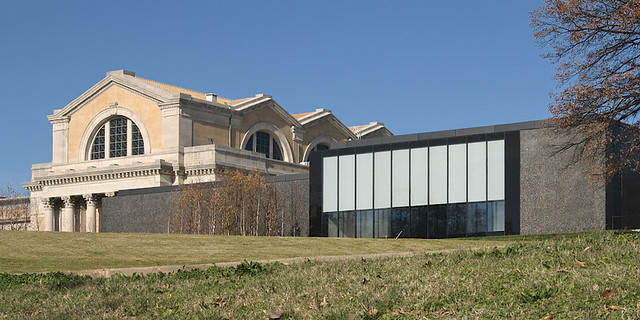
Saint Louis Art Museum, in Forest Park, Saint Louis, Missouri, USA - view from back with new wing

THIS PHOTO SHOWS the back of the Saint Louis Art Museum, in Forest Park, Saint Louis, Missouri. We see on the left the original museum building, designed by Cass Gilbert as the Palace of Fine Arts for the Louisiana Purchase Exposition of 1904, which was modeled after the Baths of Caracalla in Rome.

While we might think that it is odd to model a museum after a public swimming pool, please be aware that the original Baths had two public libraries: one in the Greek language, the other Latin; and that the structure was richly ornamented with top-quality sculpture and mosaics. It was intended to be at the center of the cultural life of Rome.

On the right hand side of the photo above, we see a massive new addition to the museum, designed by Sir David Alan Chipperfield in cooperation with the firm of HOK, which is scheduled to open to the public on June 29th, 2013.

According to the museum website:
“It has been the Museum’s intention to construct a building appropriate for our time and achieve an architectural character that both stands on its own and complements the Cass Gilbert building, while taking advantage of the Museum’s spectacular site in Forest Park.”
“Appropriate for our time”? Superficially, it looks as if it could have been designed in the 1960s, but Chipperfield, the designer, is called “uncompromisingly modernist in outlook,” and modernism in architecture is most associated with that decade; however popular culture is going through a phase of nostalgia for that time, so perhaps this is not surprising. The early 1960s were exceptionally optimistic times, giving us the progressive Kennedy presidency, the struggle against Communism, Vatican II, the civil rights movement, the space race, as well as the domination of modernism in architecture.

However, architectural modernism — in its goals and its aesthetics — fell strongly out of favor after 1972, largely in response to the failure and ultimate destruction of the Pruitt-Igoe project in Saint Louis. This was a massive public works project, which gained international attention, that was designed to provide high-rise housing for workers near downtown. While many architects consider the original design to be good, it was implemented poorly via meddling by the federal government among other factors, most specifically due to a misunderstanding of human nature. This failure led to a reappraisal of modernism itself, and modernism's unrealistically optimistic idea that big problems could be solved with big solutions. This is in contrast to the traditional view that a good society can only be achieved if the individuals in society are good, via the promotion of individual virtue.

But please note that the designer of the museum expansion does not see his design in a prideful modernist manner; rather:
“The project seeks to create an unostentatious new wing of the existing museum which is modest in its architectural language and takes advantage of the museum's extraordinary setting as a ‘pavilion in the park’.”
Although the museum website states the the expansion complements the original building, I rather think that it clashes with it. If I had been asked for my opinion on the museum expansion, I would have suggested a grand and vibrant neo-Baroque structure, designed by one of the many superb architects from the school of architecture at Notre Dame. This complementary style of building would reflect the museum's intrinsic cultural mission of reclaiming ground lost to the barbarous hordes, as the original Baroque of the Counter-Reformation combated the iconoclasm and austerity of the revolutionaries of the 16th century. Much of contemporary architecture today, most especially commercial retail properties and government buildings, are austere and iconoclastic to an extreme extent, and likewise, much of popular culture is tasteless to a degree almost unprecedented, and so the cultural mission is of great urgency.

HOK (formerly Hellmuth, Obata and Kassabaum), the ‘architectural firm of record’ of the museum expansion, was founded in Saint Louis in 1955 by three graduates of the architecture school of Washington University in Saint Louis, and has a long history of promoting modernism in architecture. Not only is HOK the largest architectural firm in the United States, the firm was also largely responsible for making mainstream the revolutionary avant-garde modernist movement, a move that dismayed many progressives, since they considered it ‘selling out’.  But lest we forget, if revolutionaries are successful, then they become the new mainstream.

As earlier noted, the modernist movement fell out of favor, and serious doubts set in amongst intellectuals: was the great optimism of the 1960s misguided? Centralized urban planning led to the destruction of cities, poverty reduction programs increased poverty, efforts to promote racial harmony led to racial hatred, religious reforms led to an abandonment of religion, the promise of happiness via free love and recreational drugs instead led to misery, and the moon proved not to be a realm of wonders, but rather a cold, gray, dead rock. Modernism gave way to postmodernism, which replaced optimism with cynicism, and replaced science with uncertainty. After the economic and political malaise of the 1970s, we find the first major expressions of postmodernism in the architecture of the prosperous, confident 1980s.

Down the hill and across a road from the museum is the postmodernist north entrance to the Saint Louis Zoo, containing the Living World exhibit, designed by HOK. It dates from 1989:

Saint Louis Zoo, in Forest Park, Saint Louis, Missouri, USA - entrance building

Modernism in architecture was eventually considered to be excessively bland and uniform, noted for its monochrome color scheme, its rejection of ornament and its use of only simple geometric forms and, oddly enough, flat roofs, which seems to go against the modernist desire for functionality. And so, modernism got the reputation of being joyless in its Puritanical utopianism, as illustrated here. Contradicting the modernist pioneer Ludwig Mies van der Rohe, who proclaimed that “less is more,” the postmodernist Robert Venturi replied “less is a bore.” This zoo building shows a rejection of modernist principles, with its use of ornament, color, and a gabled roof.

Postmodern architects instead felt that they had the freedom to choose any style, color scheme, and ornament they desired, freeing themselves from the shackles imposed by modernism. Also of great importance was the postmodernists' sense of humor, which was in contrast to the grim seriousness of the modernists. When I first saw this zoo building, it made me smile! Although it is hard to tell from this photo, the building is ornamented with absurd sculpted heads of animals, which along with the bright colors and bold patterns, gives the building a cheerful, comical look.

But if we dig into the theories of postmodern philosophy, we find out that humor of postmodern art is ironic, even cynical, and could plausibly be construed to be a joke at the expense of the client and the general public. As earlier mentioned, the philosophy of postmodernism is based on cynicism and doubt: gone are the ideas of progress and even truth: there is no truth, and if there was truth we wouldn't know it, and if we knew the truth we could not communicate it. If you spend the time digging into the dense, difficult-to-read postmodernist theory, you will ultimately find out that postmodernism is indefinable, for it is nothing at all. That fact about postmodernism ought to give us pause.

Portrait of a Cat I (Shilo) [EV=-4.5]

An ironic, postmodernist photograph of a cat. I actually did point my camera at her, and pressed the shutter, but I knowingly set the exposure too high to actually capture any detail. But this is only a white rectangle; it has lost everything that makes it a photograph.

Postmodernism first found favor with avant-garde leftists, and it was appealing to them because of its marxist flavor, but the philosophy soon became mainstream, being adopted by major institutions, including business. But as postmodernism, at its core, is nothing, some works of postmodernist art attracted much criticism from working artists, who instead thought that the philosophy had gone too far. One example of this kind of art was simply a light bulb turning on and off in a gallery. Coupled with 1960s nostalgia, the pendulum of culture is now swinging back into modernism, a movement called by some ‘remodernism’ or ‘the new sincerity.’ At least modernism stands for something. In the political sphere, we have seen the return of the modernist idea that big problems can be solved by big government programs.

While radicals thought they were doing something new and different with postmodernism, Catholic thinkers understood that postmodernism was really a school of thought that took the assumptions already present in modernism more towards their bitter end. Postmodernism was in reality hypermodernism, and was a continuation of the mode of philosophical thought that gained prominence among heretics in the late middle ages.

In the 1907 encyclical of Pope Pius X, Pascendi dominici gregis (“Feeding the Lord's Flock”), modernism is called “the synthesis of all heresies,” and although we might guess that postmodernism invented a few more heresies, that is probably not correct. The postmodernists themselves have pushed back the roots of postmodernism as far back as the 19th century, even predating modernism itself, which is rather funny. Ultimately, every heresy can be traced back to the very beginning.

Heresies are not simply wrong, for if they did not contain some truth, they would have been quickly rooted out as yet another crank theory worthy of no consideration. Heresies instead embrace some truths and deny others, and so move away from orthodoxy in one direction or the other. We especially find this in politics, where one party will embrace one particular heresy, while the opposing party embraces the opposite error.

Postmodernist architects were correct in seeing that modernism had imposed irrational restrictions on the practice of their art. Monochrome color schemes and iconoclasm were certainly wrong as universal principles of the art, but the postmodernists were themselves wrong when they ignored the theories of proportion, symmetry, and color that held sway for 2,500 years. Too many postmodernist buildings are badly proportioned: they look funny, awkward, and sometimes childish. A good measure of seriousness is not a vice.

The Gothic or Catholic style of architecture was both serious in its icons and altar, but yet was comical in its gargoyles and other ornamentation. It is possible to have both.


By no means can our contemporary architecture be convicted of having too much ornamentation or too much color, for it still errs on the side of nullity. Historically, this modern attitude extends at least as as far as the 15th century. As western Europe started to discard its Catholic faith, at first slowly by the elite in the Renaissance, and then quickly in the Reformation, artists started looking towards ancient history for models of new art. While Protestants chose a literal interpretation of the Bible for inspiration, the more secular-minded selected ancient Greece and Rome.

The religious reformers focused on one of the Ten Commandments, prohibiting “graven images,” as an argument against architectural ornamentation, while the secularists admired the white Carrara marble sculptures that were found among the ancient ruins of antiquity, and used them as an argument against the use of color. These two streams of thought remained entwined ever since. While modernism got its start mainly in Europe, precedents can be found in the United States, particularly amongst radical sects who preferred severe, unornamented, and plain white meeting-houses as their churches.

Perhaps the religious reformers overlooked those passages of the Bible that show that the Jewish temple was richly ornamented, at the command of God. Perhaps they did not realize that the Temple was the prototype for the Church, worthy of emulation in every city in the world. Perhaps they failed to recognize that plain churches do not inspire the imagination, nor do they encourage widespread faith.

If reason, feelings, and the practice of art throughout the world in all ages are not enough to support the generous application of ornament and color to architecture, archeology has lately shown that ornament was used in the early Church, and color was used in the ornament of antiquity.

See the article Bringing the Color Back to Ancient Greece, which shows a reconstruction of a finely painted statue. Please be aware that the modernist architect's desire for a monochrome palette started with the mistaken notion that the fine buildings, monuments, and sculpture of antiquity lacked varying color. It was believed that polychrome statues were a medieval barbarism, and that pure white sculpture was instead the norm and represented a higher aesthetic achievement. Only lately has this been debunked, but our aesthetic life has suffered for centuries. Even the old art museum building, more than a century old, is monochrome in its color scheme: I specially processed a photo of it, and was surprised to find that all of the stonework on it is of the same hue and nearly the same brightness; only the saturation of the coloring varies.

Back in 2003, the art world was shocked at the finding that sculpture of antiquity was actually painted, but for a while it was thought that they were painted garishly in the postmodern fashion.  However, I suspected that this was not true and that these must have been more subtly painted: see the article Common Errors About the Ancient World. Instead, it now seems that the painting were done rather finely, similar to what we find in the Church's polychrome statues.

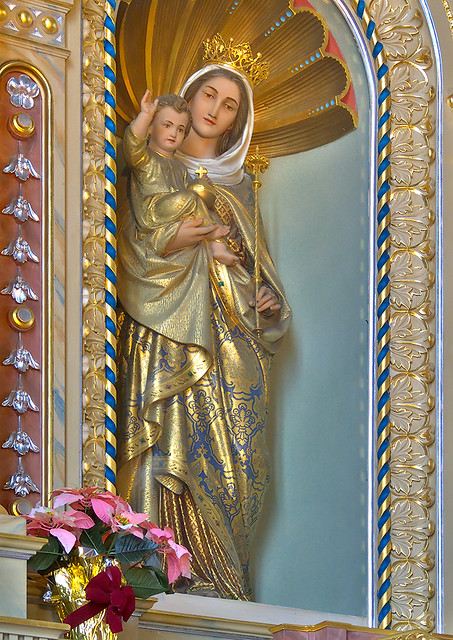
Saint Joseph Shrine, in Saint Louis, Missouri, USA - statue of Mary 2

This richly polychromed statue of the Blessed Virgin and Christ Child was made for the Cathedral of Notre Dame in Paris, but ended up at the Shrine of Saint Joseph in Saint Louis.

As far as I can tell, every traditional culture on the face of the earth decorates its buildings in floral imagery, except for the culture of modernity. Who could possibly dislike flowers and foliage, and not want to see them grown or artistically depicted everywhere? Unfortunately, the products and philosophies of modernism belie a type of gnostic tendency, showing a severe disregard for the material world, which has very unfortunate implications.

Cultural evangelization is difficult these days, largely for the fact that culture has become rather centralized and standardized, like just about everything else in our life, and it is closely linked the powerful in government, big business, media, and education. But our work can be like the mustard seed, which starts small and grows larger later. This kind of evangelization is important even though good architecture will not save the world, for we know that bad architecture will certainly harm it.

Tuesday, November 06, 2012

Boethius on Politics

Saint George Catholic Church, in Affton, Missouri, USA - parish center during elections

Taken at Saint George Church, in Affton, Missouri, showing election signs. The church offered hourly Masses for the election today.

Saint Anicius Manlius Severinus Boëthius (ca. 480 — 524/525 AD), wrote a moving philosophical and spiritual work on the meaning of political power, happiness, and fortune. Of a noble Roman family, Boethius held high office, working for a heretical barbarian King, but he eventually fell from the king's favor. He wrote the book, The Consolation of Philosophy, while imprisoned and awaiting execution.

Why is it, he asked, that good men suffer under the wicked? How can a man be happy if he doesn't have the good things in life? In politics we see undeserving men being given great power, and these men lord over others to either help or harm their fellow men. Fortunes are made and they are lost; men hold high office one day and are disgraced the next.

In the book, Boethius meets Lady Philosophy, who reminds him that the favors of Fortune, such as wealth, fame, honor, and power, are fleeting. It is the nature of Fortune to be fickle, and a man cannot lay permanent claim on these things. They are freely given, and just as quickly taken away. A common illustration during the Middle Ages shows Fortune's wheel; some people go up, gaining prestige, and then they are flung off of the wheel when their time has come.


The Wheel of Fortune, from Vol. 1 of Boccaccio’s De Casibus Virorum Illustrium (On the Fates of Famous Men), 1467. [Source and attribution.]

Lady Philosophy explains that man's happiness cannot come from the gifts of Fortune, because they do not properly belong to persons but rather are external. Anyone who places their trust in money, power, or fame may very quickly realize how empty those gifts are, and if they do not have a strong interior life of virtue, they could lose everything in a moment, and their happiness proves to be illusory.

It is important to know that virtue, with a will conformed to God, is the true source of happiness, for these are internal to a person and properly belong to him.

Evil, we learn, is not a thing unto itself, but instead is only the absence of good. No man, not even a politician, is evil in himself, but only his will can be evil insofar as it does not conform to virtue and to God. Evil, being merely the absence of good, has no being in itself; consider a disease: it may harm a body, but if the disease kills the body, the disease itself loses existence.

No politician, if he is successful, can be said to be completely evil, for goodness is required for any kind of success, and even wicked tyrants can be converted with grace. Power, being external, can only be wielded well insofar as a man has some goodness left in him.

Boethius teaches that a man in whom evil grows, or rather in whom goodness decreases, becomes insatiable, and turns against nature. No amount of wealth, power, or fame becomes enough. Wealth is spent protecting wealth; power is expended in protecting power; fame is increased by the support of the wicked and not the virtuous. The evil man turns to destruction and killing. He eventually loses those good things, the higher things, that are properly a part of a human person, and he increasingly resembles an animal, giving in to lusts and other base instincts. Eventually he becomes impotent, his wealth and power becomes ineffectual. If he does not turn back, he will lose himself altogether.

Under the modern political process, the attempt is made to defeat evil men in elections, but this rarely seems to work for obvious reasons. The older method of Christendom, conversion of the wicked, is sadly left untried.

Friday, October 19, 2012

“The Lost Tools of Learning”

“HAVE YOU EVER, in listening to a debate among adult and presumably responsible people, been fretted by the extraordinary inability of the average debater to speak to the question, or to meet and refute the arguments of speakers on the other side?.”

— Dorothy L. Sayers, The Lost Tools of Learning
So we read in the late Miss Sayers' essay on classical education, first given in 1947, a passage that seems to be rather relevant during this political season.

I found the link to this essay on the website of Our Lady of Lourdes School, in Denver, Colorado, which lately has found much success in its adoption of classical methods of education, namely, the trivium, which emphasizes the foundation of all learning. From the school's website:
One of the most important goals of education is to teach students how to learn. This goal can become lost in a mirage of textbooks that oversimplify and remove the traditional classical method of mental discipline to students. The classical method of education not only provides academic rigor, it also instructs and prepares the students to become independent thinkers based on their knowledge of grammar, logic and rhetoric. In short, classical education prepares and equips students to be leaders in the community with their ability to communicate logically with their peers and colleagues.
The roots of the classical tradition of learning are lost to history, but they crystallized in ancient Athens, in the mystical yet mathematical school of Pythagoras, and in the philosophical schools of Plato and Aristotle, following the master Socrates. While we don't know how much of this knowledge was perceived by these Greeks alone, we do know that they also passed down wisdom from Egypt and the East. These methods became the standard of good education in the Roman Empire, as we find in the books of the architect Vitruvius, and were retained through the middle ages and beyond, rendering it the ultimate “multicultural” curriculum, finding favor with Christians, Jews, Muslims, and pagans over thousands of years.

While modern pedagogy has emphasized the learning of useful facts or political propaganda (or nowadays, passing standardized tests), the classical model instead narrowly encourages a high level of language skills, logical thinking, and the ability to communicate persuasively. This is the foundation for a liberal education, that is, an education proper to a person who is free and not a slave. It is assumed that children who have these educational tools will freely learn throughout their lifetimes, and will have little need to be specifically taught various subjects, for they will eagerly learn these things on their own.

This is a two-edged sword: for the Catholic schools, a classically educated child can either end up to be an ardent defender of the Faith or a formidable arch-heretic, for it produces children who are either hot or cold, but not lukewarm. I think for this reason, our public schools (which by the way, have compulsory attendance) tend to produce children who are lukewarm, while remaining curiously inarticulate about the malaise of their lives, leading to either self-destructive pleasure-seeking or to violence. Therefore it is not surprising that the education which is forced upon children is not a liberal education, but rather is the education of a slave.

Thursday, October 04, 2012

On an Art Curriculum

FROM THE ARTICLE An Art Curriculum for Catholic Children, over at New Liturgical Movement:
...The approach is anchored highly on the human person as an image of God and how the invisible and visible meet in Man. This means that we take image making from two poles, one which is based on proportion, rule and ideal, and one which is based on observation, detail and particularity. Drawing exercises move along those poles as we work towards finding balance between the two. All students begin by learning to draw a face through discovery of proportion, balance and symmetry found therein. This approach is extended to the human body. Then as the children perfect their knowledge of the ideal form, they will also be brought to draw strictly from observation, a hand, a drapery or another child’s face. As the student’s knowledge grows, we integrate basic Christian iconology, and so for example the children will learn the elements of a crucifixion and will be asked to produce one based on what they have learned, copying as well from traditional images.

I have found this approach to give amazing results as even the children that seemed to have the least “talent” have advanced their drawing skills by leaps and bounds and have learned to enjoy something they had once found daunting....
The Catholic Church was the greatest patron of the arts in history, and the Body of Christ has in its possession some of the most magnificent works of art ever made. The theory of art that she preserved, elaborated, and upholds therefore ought to be of great importance.

Art, according to the traditional definition, is recta ratio factibilium, that is, “right reason applied to things made,” and so all parts of life include an aspect of art, not simply those artifacts that happen to be exhibited in a museum. Instead, we ought to desire that all things be made artfully. Also, art is not simply an expression of an artist's feelings (although these are not unimportant), but are the products of rational consideration, where the intellect judges feelings and the external senses.

Note that according to the traditional theory, aesthetics is not directly mentioned, but rather it flows out from considerations of first principles. In the quote above, both direct observation as well as theories of proportion, balance, and symmetry are considered important. Good art requires consideration of things from above and from below in the order of Creation. Beauty, the main and most perfect component of aesthetics, comes from above and is expressed by the proportions and symmetries mentioned. When we observe the natural world, this beauty is best expressed in light and in the multitude of colors.

As art is an application of human reason, we can expect that humans with a minimal capacity for reason, such as children, should be able to make good art with enough knowledge and practice. It doesn't take innate genius, as even those who seem to be particularly predisposed to making art still need to learn theory and to develop by practice.

Wednesday, September 19, 2012

Aeolian Harps

‟MUSIC PLAYED WITHOUT human hands”: this is how the ancients described the sound of the aeolian harp — a musical instrument that sings its unearthly notes when the wind blows over its strings, making sounds that are melancholy, or soothing, or eerie, or distressing.


Here is an unusual aeolian harp from Italy:


Aeolian harps and the Romantics

The Aeolian harp is known for its influence on the Romantic poets. A popular home musical instrument by the turn of the 19th century, small wind harps were made to fit in windows; one such harp or lute is poetically described by Samuel Taylor Coleridge:
And that simplest Lute,
Placed length-ways in the clasping casement, hark!
How by the desultory breeze caressed,
Like some coy maid half yielding to her lover,
It pours such sweet upbraiding, as must needs
Tempt to repeat the wrong! And now, its strings
Boldlier swept, the long sequacious notes
Over delicious surges sink and rise,
Such a soft floating witchery of sound
As twilight Elfins make, when they at eve
Voyage on gentle gales from Fairy-Land,
Where Melodies round honey-dropping flowers,
Footless and wild, like birds of Paradise,
Nor pause, nor perch, hovering on untamed wing!
O! the one Life within us and abroad,
Which meets all motion and becomes its soul,
A light in sound, a sound-like power in light,
Rhythm in all thought, and joyance everywhere—
Methinks, it should have been impossible
Not to love all things in a world so filled;
Where the breeze warbles, and the mute still air
Is Music slumbering on her instrument.

— from The Eolian Harp, 1795.
The Romantic poets saw these instruments as playing nature's — or God's — own music, and so they thought that the harps were sources of natural or divine inspiration. These harps were first seen as being passive instruments, but the Romantics later understood that due to their design, they actively shape and transform the wind into music, and so became a symbol of the inspired poets themselves. ‟Make me thy lyre, even as the forest is,” wrote Percy Bysshe Shelley, in his poem Ode to the West Wind, where he is asking to become an instrument of the forces of societal change, as symbolized by a fierce west wind blowing through a forest. Shelley thought that the role of the poet, like a wind harp, is to shape and transform the tempestuous forces of nature, or mysterious spiritual impulses, into something more ordered and harmonious. Shelly explains in this manner:
We live and move and think; but we are not the creators of our own origin and existence. We are not the arbiters of every motion of our own complicated nature; we are not the masters of our own imaginations and moods of mental being. There is a Power by which we are surrounded, like the atmosphere in which some motionless lyre is suspended, which visits with its breath our silent chords at will.

Our most imperial and stupendous qualities — those on which the majesty and the power of humanity is erected — are, relatively to the inferior portion of its mechanism, active and imperial; but they are the passive slaves of some higher and more omnipotent Power. This Power is God; and those who have seen God have, in the period of their purer and more perfect nature, been harmonized by their own will to so exquisite consentaneity of power as to give forth divinest melody, when the breath of universal being sweeps over their frame. That those who are pure in heart shall see God, and that virtue is its own reward, may be considered as equivalent assertions.
Whereas the English saw the aeolian harp as a source of inspiration, the Germans found it a melancholy instrument, giving the listener a longing for heaven and the things beyond this world. Americans instead found themselves attracted for more practical and optimistic reasons. Henry David Thoreau wrote a poem where an aeolian harp itself speaks:
There is a vale which none hath seen,
Where foot of man has never been,
Such as here lives with toil and strife,
An anxious and a sinful life.

There every virtue has its birth,
Ere it descends upon the earth,
And thither every deed returns,
Which in the generous bosom burns.

There love is warm, and youth is young,
And poetry is yet unsung.
For Virtue still adventures there,
And freely breathes her native air.

And ever, if you hearken well,
You still may hear its vesper bell,
And tread of high-souled men go by,
Their thoughts conversing with the sky.
 The sound produced by a wind harp is mysterious, ethereal, disembodied, and otherwordly: it almost sounds composed, it almost has order, it almost has harmony, it is almost human music.

The Romantic composer Frédéric François Chopin composed a number of pieces which were partly inspired by the sound of the aeolian harp, including those here and here, as well as his Aeolian Harp Étude. The piano piece Aeolian Harp by Henry Cowell is unique in that the strings of the piano are plucked by hand, rather than sounded by striking the keys. Also of interest is Sergei Lyapunov's Harpes éoliennes (Op. 11 No. 9) which can be heard here.

The aeoline, éolienne, or äoline stop on pipe organs was invented in Germany in the 1820s to imitate the sound of an aeolian harp, and these are usually the softest notes that can be produced by those otherwise magnificent instruments. These are either string stops, sounded with low pressure air, usually at an 8' pitch, or are reed stops which may lack a resonator. A harpe éolienne can be heard in the final chord of the piece here; also listen to this.

Aeolian harps fell out of favor sometime in the early 20th century, as music became less personal and more of an industry, but the 1970s saw a revival of interest in these instruments.

The error of the Romantics

The Romantics wrote during a period before the divorce between art and science (indeed, a virtuous person ought to be equally adept at both, and not simply a narrow specialist), but after the divorce between the passions and the intellect. As Christ tells us, divorce is due to the hardness of our hearts, and the Romantic movement was a heartfelt reaction to cold and heartless Enlightenment rationalism, which gave the world slavery, urban poverty, the absolutist State, and the “dark Satanic Mills” which blighted the formerly beautiful English countryside. The Romantics instead thought that feelings and passion ought to be of primary importance, and they took their main inspiration from nature. The Romantic music of the aeolian harp, discordant, unpredictable, and made by nature, is a fitting symbol of the movement, in contrast to the heavily composed and rational Classical music of the Enlightenment.

But are we to go by our feelings alone, without reason? The Romantic movement led to a mystical nationalism, unrestrained by reason, and which eventually led to the widespread slaughter of the Holocaust. Strains of Romanticism are still found today in horror films and in the irrational, nationalistic — and sometimes violent — reconstructed nature religions which are popular primarily with alienated young women.

A better way is orthodoxy: we let reason judge feelings, while understanding that the heart has its own reasons. Both rationalism and romanticism are half-true, they both have their proper place when joined to a well-formed human will. Likewise, the aeolian harp has its place alongside instruments played by human hands, although it sits not at the center, but at the fringe of art.

Aeolian harps in history

The aeolian harp extends much further back into history than the Romantic period. Aeolus [or in the Greek, Αἴολος, Aiolos] is a character in Greek mythology, whose harp was played by the spirits of the winds, and it is from Aeolus that wind harps are named.


Thomson's Aeolian Harp, 1809, by J.M.W. Turner, Manchester Art Gallery, shows Aeolus with his harp, played by the four winds.

This painting was inspired by James Thomson's poem, Ode on Æolus's Harp:
ETHEREAL race, inhabitants of air,
  Who hymn your God amid the secret grove ;
Ye unseen beings, to my harp repair,
  And raise majestic strains, or melt in love.

Those tender notes, how kindly they upbraid !
  With what soft woe they thrill the lover's heart !
Sure, from the hand of some unhappy maid,
  Who died of love, these sweet complainings part !

But hark ! that strain was of a graver tone :
  On the deep strings his hand some hermit throws ;
Or he, the sacred bard, who sat alone
  In the drear waste, and wept his people's woes.

Such was the song which Zion's children sung,
  When by Euphrates' stream they made their plaint ;
And to such sadly solemn notes are strung
  Angelic harps, to soothe a dying saint.

Methinks I hear the full celestial choir,
  Through heaven's high dome their awful anthem raise ;
Now chanting clear, and now they all conspire
  To swell the lofty hymn from praise to praise.

Let me, ye wandering spirits of the wind,
  Who, as wild Fancy, prompts you touch the string,
Smit with your theme be, in your chorus join'd ;
  For, till you cease, my Muse forgets to sing.


One of the Muses in Greek mythology, Terpsichore [Τερψιχόρη], is sometimes portrayed carrying an aeolian harp. Sculpture by John Walsh, 1771, Somerset County Museum in Taunton. [source]

According to the Talmud, the ancient rabbinical commentaries on sacred scripture, King David would hang his lyre in his bedroom window upon retiring for the night. The north wind, blowing across the harp and sounding the aeolian melodies, would wake David around midnight so that he could pray Matins.

The Psalms in the Bible are largely attributed to King David, who sang them while playing on his harp. The aeolian harp thereby can be seen as a symbol of divine inspiration, uniting David's harp with the wind, which is a symbol of the Holy Spirit.

The great English saint, Saint Dunstan, was a harp player, and according to the Golden Legend, his harp once made music played without human hands:
And another time he was in his meditations, he had hanging on the wall in his chamber an harp, on which otherwhile he would harp anthems of our Lady, and of other saints, and holy hymns, and it was so that the harp sounded full melodiously without touching of any hand that he could see, this anthem was, Gaudent in celis animæ sanctorum, wherein this holy saint Dunstan had great joy.
Harps, lyres, zithers, and similar instruments have been found throughout antiquity, and the phenomenon of the wind playing them was well known — and ancient mythologies posit that these musical instruments themselves were inspired by the sounds made when the wind blew through strings found in nature: in one case, a cord attached to a tortoise shell, with the shell acting as resonator.  According to Giambattista Della Porta, from his book Magiae Naturalis, 1558, (a book of popular science, household tips, and practical jokes):
Do thus, when the wind is very tempestuous set your instruments just against it as Harps, Flutes, Dulcimers, Pipes. The wind will run violently into them, and play low upon them, and will run into the holes of the Reeds. Whence if you stand near and listen, you will hear most pleasant Music by consent of them all, and will rejoice.
Inspired by Della Porta's book, the first modern aeolian harp was invented by the remarkable Jesuit polymath, Athanasius Kircher, in about 1650. He was famed for his cabinet of curiosities — an early museum — including his collection of the artifacts sent by the Jesuits serving in Asia, as well as for his broad range of interests that is rarely found today. Kircher describes his invention in the book, Musurgia Universalis sive ars magna consoni et dissoni in X. libros digesta [volume 2]:
As the instrument is new, so it is also easy to construct and very pleasant. It is the admiration of every one. It is made exactly to fit a window, in which it is placed ; and the harp, while the window remains shut, is silent : but as soon as it is opened, an harmonious sound, though somewhat melancholy, coming from the passing wind, astonishes the hearers; for they are not able to perceive from whence the sound proceeds, nor yet what kind of instrument it is, for it resembles neither the sound of a stringed nor yet of pneumatic instrument, but partakes of both. The instrument should be made of pine wood, five palms long, two broad, and one deep ; It may contain fifteen or more chords, all equal and composed of the intestines of animals. It should be situated in a close place, yet so that the air may on either side have free access to it, in order which, it may be observed, that the wind may be collected by various methods; first, by canals, that are made the form of cones or shells, or else by valves; these valves should be placed on the out side, and parallel boards in the inside of the room ; its sound very much resembles that of pipes and flutes playing in unison. [source]
Here are illustrations of Kircher's harp from his book [images scanned by Google]:


The strings are attached to a sounding-box, which is placed in a box fitted with vanes to concentrate the wind:


Based on Kircher's invention, the anemocorde was an attempt to create a reliable aeolian harp that was played via a keyboard, with air blowing across the strings powered by bellows. I'm unaware if any such design was successful.

The Romantic interest in the aeolian harp, or even the Romantic movement itself, is said to have been inspired by Thomson's poem The Castle of Indolence of 1748:
...

Each Sound too here to Languishment inclin'd,
Lull'd the weak Bosom, and induced Ease.
Aereal Music in the warbling Wind,
At Distance rising oft, by small Degrees,
Nearer and nearer came, till o'er the Trees
It hung, and breath'd such Soul-dissolving Airs,
As did, alas! with soft Perdition please:
Entangled deep in its enchanting Snares,
The listening Heart forgot all Duties and all Cares.

A certain Music, never known before,
Here lull'd the pensive melancholy Mind;
Full easily obtain'd. Behoves no more,
But sidelong, to the gently-waving Wind,
To lay the well-tun'd Instrument reclin'd;
From which, with airy flying Fingers light,
Beyond each mortal Touch the most refin'd,
The God of Winds drew Sounds of deep Delight:
Whence, with just Cause, The Harp of Aeolus it hight.

Ah me! what Hand can touch the Strings so fine?
Who up the lofty Diapasan roll
Such sweet, such sad, such solemn Airs divine,
Then let them down again into the Soul?
Now rising Love they fan'd; now pleasing Dole
They breath'd, in tender Musings, through the Heart;
And now a graver sacred Strain they stole,
As when Seraphic Hands an Hymn impart:
Wild warbling Nature all, above the Reach of Art!
....
As implied by the poem, the aeolian harp was seen to be a plaything of the idle and indolent wealthy, but soon these instruments became commonplace. In a footnote to a poem, Thompson states that these kinds of harps were manufactured by James Oswald, a Scotsman living in London; Oswald later would achieve great fame, including his appointment as composer for King George III, and his Harp of Aeolus became popular.

This popularity led prominent scientists to investigate how the notes were sounded, since the aeolian harp's tones did not correspond well to human-played music. This research on the fringes of music led to the science of acoustics and well as contributing to fluid mechanics. An unfortunate side-effect of this was the divorce between music and mathematics into unrelated disciplines, which were long joined together in the quadrivium of the classical liberal arts.

Designing an aeolian harp

Constructing an aeolian harp is simple, for all you need is a strong wind and a string. Nylon strings work well, as does steel. However, the sound made will be extremely weak (even more so for steel strings), and for the purpose of amplifying the sound, you need to construct a sound-board for the strings. That is a complicated art: please consider the complexity and effort that goes into constructing and tuning the body of a violin, as well as the great expense that a fine instrument can demand. Modern harp-builders, however, can use magnetic transducers, commonly used in electric guitars, to capture the sound which then can be electronically amplified. Designing a good electrical pickup is an art in itself, and there are many variations and room for improvement.

To design a musical instrument well, you need to have a Pythagorean or Platonic understanding of mathematics, the understanding that was found in the Middle Ages but which fell out of favor in modern times. According to this understanding, mathematics is poetic and harmonious, with its own truth and beauty, and it is at the center of all art. Modernity, however, killed the beauty and the joy of mathematics, and even sometimes its truth, and made it a dreadfully dull subject, perhaps only interesting to specialists. Mathematics has now become the enemy of artists, although it was not yet so in the days of the Romantics. But I ask my dear readers to try to understand the mathematical discourse following, and try to see the beauty in the numbers and their harmonies.

The sound that an aeolian harp makes is caused by a phenomenon called the von Kármán vortex street effect. A fluid flowing over a cylinder (such as a string), under certain conditions, will lead to an alternating series of vortexes that periodically shed from the cylinder, forcing it sideways in one direction and then the other. The equation governing this motion is:
Re = V × d / ν
Where Re is the Reynolds number, V is the velocity of the wind, d is the diameter of the cylinder or string, and ν [Greek letter nu] is the kinematic viscosity of the air. Generally speaking, we can get string vibrations if the Reynolds number is greater than about 90. From the equation we can see that double the diameter of a harp string gives us the same Reynolds number in half the wind speed. The kinematic viscosity of dry air at sea level and 70° F. is about 0.000164 ft2/second, and it gets smaller as the temperature drops, which tells us that these instruments ought to perform better in colder air; also lower altitudes are better.

The Reynolds number is important because it tells us something about the quality of flow:
  • Less than 5, the flow of air around a string is smooth, and no vibration is possible.
  • Between 5 and 44, stable vortices form behind the string, but strings do not vibrate.
  • Between 44 and 49, a transition range, von Kármán vortices may or may not occur.
  • Between 49 and 90, von Kármán vortices occur, but supposedly, this range does not seem to activate aeolian harps.
  • At 90, there is a slight change in the quality of the vortices.
  • Between 90 and 150, aeolian harps start to sing, and the vortices are very regular.
  • Between 150 and 300, transition range where flow becomes unsteady.
  • At 300, flow beyond the string is turbulent. 
  • At 400, flow is completely turbulent, higher overtones become much more prominent.
  • As the Reynolds number increases, the aeolian harp makes sounds that are increasingly screeching and distressful.
Would-be aeolian harp makers are often disappointed that their creations don't work at all except under strong winds. An examination of the Reynolds numbers indicate that thicker strings may be needed.

By the way, von Kármán was inspired to develop his theory upon viewing a Gothic painting of Saint Christopher carrying the Christ child across a river. He was fascinated that the 14th century painting showed alternating swirls of water in the flow behind the Saint's legs, and he wanted to know why.

If the frequency of the vortex shedding is harmonious with the tuning of a string, then resonance develops and the string sings. The vortex shedding frequency has the equation:
f = St × V / d
Where f is the frequency of vortex shedding, V is the velocity of the air, d is the diameter of the string, and St is the Strouhal number, a dimensionless factor which characterizes the air flow. The Strouhal number has a complicated nonlinear relationship with the Reynolds number, as is seen here. But as it so happens, the Strouhal number does not vary much at all in the range of the Reynolds numbers associated with typical aeolian harps — those that use guitar strings in moderate breezes — at say, a range of Reynolds numbers of 400 and higher, and so faster winds will give us proportionally higher notes. At these Reynolds numbers, the Strouhal number is about 0.21.

However, the Strouhal number gets smaller for the Reynolds numbers associated with slow winds and large string diameters, and so we would expect that aeolian harps strings meant to operate under these conditions would require special tuning. It is from a Reynolds number range of between 90 and 400 that we would get the lower, more soothing notes from the instrument, which are often the notes most preferred by listeners. This sound might be compared to the sound of a bagpipe drone.

The fundamental tone or frequency of a string is given by the equation:
f = (1/2L) × √(T/μ)
where f is the frequency of vibration, L is the length of the sting, T is the tension in the string, and μ [Greek letter mu] is the linear density of the string — the mass per unit length of string. The string can also vibrate with frequencies that are integer multiples of the fundamental frequency given by this equation: 2, 3, 4, 5 times and so forth; these frequencies are called overtones or harmonics. If you pluck a stretched string, the tone you get will be the fundamental frequency along with a combination of the various overtones, and similarly, an aeolian harp will intone a rather different combination of these harmonics.

We see how the Strouhal number in the second equation above causes a vibration in the air around a string at a particular frequency: whenever this frequency comes close to one of the harmonic frequencies of an aeolian harp string, the string will resonate strongly at that frequency, giving us an audible tone. Since wind velocities fluctuate, the particular tone voiced on a string will change frequently, gliding from one overtone though silence to another overtone.

All aeolian harps more or less sound the same, although a good amplifier design — either a sounding board or electronic pickup — can increase the quantity of sound, as well as perhaps its quality. For this reason, there is little point in attempting to tune an aeolian harp much beyond tuning the strings to resonate with their sounding board. These harps always sound dissonant, and builders will typically tune all of the strings to the same pitch, although they will typically use various diameters of string within the same instrument to allow it to work under a range of wind speeds.

An important property of aeolian harps is that the fundamental harmonics of the strings is not heard: instead we only hear overtones, with the predominant frequency (according to various authorities) being as high as the fifth, eleventh, or 22nd overtone. Faster winds excite higher overtones, while suppressing the fundamental and lower overtones. Because of this phenomenon, slight mistunings of the fundamental note of a string become highly mistuned at high overtones, contributing to the dissonant sound of the instrument.

To achieve singing, it is noted that laminar winds — such as those found blowing off a large lake or the ocean — are preferred to turbulent ones, as is found in cities. Kircher installed his harp in a  box in order to smooth, direct, and amplify the wind. Authorities state that solid strings are preferable to wound ones, as these respond better to the vortex effect.

Conclusion

You can purchase your own monumental aeolian harp here. Although I don't care for the overall design, I do like the concept. Here is an audio recording of this harp:


The creator of this aeolian harp writes that some architecture of the past — on purpose or by happenstance — would create music-like sound in the wind. Would this be a good thing for new architecture, I wonder? Consider the old Catholic tradition of integrating all of the senses into her architecture and liturgy. Would something like this be good for a cloister or church garden? Many people do think that these sounds can be soothing and inspire meditation.

But judging from the reviews of this harp, as well as comments on audio recordings of aeolian harps, I find that many people either ignore or reject the sounds they make, calling the whole endeavor ‘stupid,’ or an intrusion because it doesn't fit their taste in music. Others find them irritating or depressing or a waste of money better spent elsewhere. Considering the types of people who were drawn to aeolian harp in the first place, clearly they would not appeal to those who don't share those traits. On the other hand, other kinds of people may read too much into the sounds that the harps make, turning them into a false mystical experience; clearly there is a New Agey feel to aeolian harps, and this is often due to eccentric design.

I think they could be more successful if their wild and romantic qualities could be rationalized a bit, bringing the emotions and the intellect closer together. Better design of the harps, with significantly better control over the higher harmonics, perhaps through clever damping, could retain the soothing qualities of its sound while eliminating the harsh irritating sounds. A certain classical or medieval influence would help, especially in the designs of the sculptures in which these harps usually reside.

Wednesday, September 05, 2012

The Abolition of Woman

THE BOOK, “The Abolition of Man,” by C.S. Lewis, starts with his criticism of the  fashionable intellectual view that values are purely subjective. This debunking of values — which were largely shared by most great civilizations and religions — leads, almost inevitably, to a dystopian future: a political and economic system with the aim of universal genocide. That book comes originally from scholarly lectures, and so may not be easily readable; Lewis also fictionalized his observations in his novel, That Hideous Strength.

Some may consider this to be an antiquated opinion, surely contemporary thinkers want nothing more than a better life for us all? But perhaps a hundred million people were killed in the 20th century by revolutionary regimes who also claimed to want build a better future. But consider the aims of “deep” environmentalists: they believe that the world’s population must be quickly eliminated, with needed deaths in the billions. A bad intellectual fashion can have a huge body count: ideas matter.

I am not being alarmist, for the same intellectual trends continue today, and politicians have eagerly taken up the cause.

Recently, the influential feminist Shulamith Firestone was found dead at age 67. She was famed for her 1970 book The Dialectic of Sex: The Case for Feminist Revolution. Quoting from the book:
So that just as to assure elimination of economic classes requires the revolt of the underclass (the proletariat) and, in a temporary dictatorship, their seizure of the means of production, so to assure the elimination of sexual classes requires the revolt of the underclass (women) and the seizure of control of reproduction: not only the full restoration to women of ownership of their own bodies, but also their (temporary) seizure of control of human fertility - the new population biology as well as all the social institutions of child-bearing and child-rearing. And just as the end goal of socialist revolution was not only the elimination of the economic class privilege but of the economic class distinction itself, so the end goal of feminist revolution must be, unlike that of the first feminist movement, not just the elimination of male privilege but of the sex distinction itself: genital differences between human beings would no longer matter culturally. (A reversion to an unobstructed pansexuality Freud's 'polymorphous perversity' - would probably supersede hetero/homo/bi-sexuality.) The reproduction of the species by one sex for the benefit of both would be replaced by (at least the option of) artificial reproduction: children would born to both sexes equally, or independently of. either, however one chooses to look at it; the dependence of the child on the mother (and vice versa) would give way to a greatly shortened dependence on a small group of others in general, and any remaining inferiority to adults in physical strength would be compensated for culturally. The division of labour would be ended by the elimination of labour altogether (through cybernetics). The tyranny of the biological family would be broken.
Although it was written decades after Lewis’ books, The Dialectic of Sex continues the same themes in surprisingly close detail: the need for a revolution via force or the threat of force, the institution of a totalitarian government, the aggressive use of new technology, the promise of utopia, all leading to universal genocide, or in her words, “the elimination of labour altogether.” Under Firestone’s system, women would not be free to be women, and eventually they may not be allowed to exist at all. Man, and Woman, would be abolished.

Underlying this is a hatred of biology: the revolution would be complete when “The tyranny of the biological family would be broken.” Likewise, Lewis’ antagonists in That Hideous Strength have an extreme hatred of biology. Should we decry the tyranny of the ant colony, or two birds in a nest with their eggs?  Why then the hatred of the natural human family, imperfect as it is?

Underlying much of the contemporary agenda is a Gnostic-like hatred of the material world, which has bad consequences. See the article, Rapture and the Gnostic Tendency: this kind of thinking ultimately leads to the desire for genocide. How many millions of unborn children have been abolished because of Firestone’s influence?

But slippery slope arguments are logical fallacies. Arguing thusly with someone can get them to actually want genocide. Be aware that very many people support the basic aims of Firestone’s program, but few know the radical goals of those who actually are implementing it. What alternative can we offer? According to Blessed Teresa of Calcutta, “The child is God’s gift to the family. Each child is created in the special image and likeness of God for greater things - to love and to be loved.” Clearly there is a difficult road ahead of us.

Tuesday, August 14, 2012

The Two Million Dollar Book

WHEN I HEAR that a particular book project has a budget of $30,000, I think “that’s expensive,” but this is simply because I don’t have the means to come up with that amount myself. However, the most expensive book project ever undertaken was A Syntopicon: An Index to The Great Ideas, published as volumes two and three of the series Great Books of the Western World, which had cost over $2,000,000 to compile by the time it was published by Britannica in 1952. According to Wikipedia:
Compiled by Mortimer Adler, an American philosopher, under the guidance of Robert Hutchins, president of the University of Chicago, the volumes were billed as a collection of the 102 great ideas of the western canon. The term “syntopicon” was coined specifically for this undertaking, meaning “a collection of topics.” The volumes catalogued what Adler and his team deemed to be the fundamental ideas contained in the works of the Great Books of the Western World, which stretched chronologically from Homer to Freud. The Syntopicon lists, under each idea, where every occurrence of the concept can be located in the collection’s famous works…

…Adler undertook a project that would consume over a decade of his life: identifying and indexing the western world’s Great Ideas. In the end, the Syntopicon would require over 400,000 man-hours of reading and cost over two million dollars. Britannica publisher Senator William Benton joked at the Great Books presentation dinner that “the Syntopicon is said to be the most expensive two volumes editorially in all publishing history. How Hutchins and Adler achieved that unique distinction, the publisher is still trying to figure out…”
The first volumes were given to U.S. President Harry S. Truman and Queen Elizabeth II.  It did not sell well.

Adler himself was famed as being one of the leading Catholic apologists of his age, having honed his skills by his study of the philosophy of Saint Thomas Aquinas. This is remarkable because he was a non-observant Jew, calling himself a modern pagan, and only was brought into the Church at the age of 97. The reason for his reticence, he claimed, was due to moral and not theological problems, possibly due to his favoring of the philosophers of classical liberalism.