Pages

Wednesday, September 28, 2005

The Pastoral Plan of Saint John Vianney

See the article, St. John Vianney's Pastoral Plan, by Reverend John Cihak, from homiletic & pastoral review.

France, after the Revolution, was exhausted, secular, suspicious, and lukewarm in faith. John Vianney (1786 1859), came to Ars, a town where faith was weak and where people "worked hard and played hard" in a fashion similar to our own day. They were too busy to pray regularly or come to Mass on Sunday, but they had plenty of time to get drunk and revel all night.

St. John Vianney, the Curé of Ars, created this pastoral plan to recover his flock.

  • He set out to save his own soul first. His "spirituality" was simply that of being a priest. He took his vows seriously. He didn't start his career by being a saint, but he started it with the intention of sanctity.

  • He tried to be approachable and available. He walked around his parish, often in prayer, and would approach everyone, discussing everyday matters of interest to the people. He found out about the lack of faith of the children, the causes for the social ills of town, and everyday worries of the people. He didn't have an abstract idea of his parish, nor did he set out to change the world: he was only concerned about individuals.

  • He lived ascetically with a deep prayer life. His inspiration was the Desert Fathers: he lived simply, wore a coarse cassock and plain shoes, had bare furnishings, and ate simple food. He knew that he was powerless, and that only God would work through him. He was committed to regular prayer life and penitential practices. His goal was to do the Father's Will and he prayed for the conversion of his flock.

  • He put most of his energy into the already faithful families; they would then help spread the fire of faith.

  • He beautified his church, even spending his own money to have an exquisite altar and vestments of the finest materials. He wanted his church to be attractive as possible. The liitle expense of having a beautiful church led to a great increase of alms-giving to the poor. He had a great love of the Mass and showed it. He was precise and reverent. He strove to put the same love of the liturgy in his parishioners. His spent many hours a week working on his homily; his preaching was on the basics of the Faith, and he used everyday descriptions of life and colloquialisms that would be familiar to his flock. He personally taught Catechesis; he didn't consider it just a formality.

  • He addressed the root problems, not the symptoms. People considered Sunday to be a day of work, and he would refuse to accept absence for Mass due to work, he did this also for Holy Days of Obligation. Too many people spent most of their free time in taverns, and he worked hard to close them down, even to the point of paying tavern owners to close them. As a result, poverty and dissolute life decreased

  • He developed in his parishioners a strong prayer life and works of mercy. He founded women's groups dedicated to regular prayer in homes and promoting charity. He depended on the women to convert the men and boys. He had evening prayer meetings for those too busy in the morning. He organized parish missions and it was here that he discovered his gift of being a Confessor. At his own expense, he sent girls to school to become teachers. He built a home for orphans and street children.

  • He had a strong priestly identity. He spent himself in the service of others, without counting the cost. He was not a social worker, manager, psychologist, or center of a cult of personality, but a Priest in the service of God.

Monday, September 26, 2005

A New Jail, A New Kind of Prisoner

Last night I met a woman who works for an Evangelical Protestant Bible ministry to women in jail. She holds a weekly Bible study group for women in the Saint Louis County Justice Center, in Clayton, Missouri.


This is the huge 1,232-bed Saint Louis County Justice Center, completed in 1998. It is far larger than the older jail it replaced, and dominates this part of downtown Clayton.

The woman who teaches Bible study says that most of the women she meets in jail are there for mainly minor charges: unpaid traffic tickets, passing bad checks, petty theft, and selling illegal drugs. Nearly all of these crimes are financially motivated, since these women have recently become poor. I was shocked when she said that the most common reason for this poverty was legal gambling. These women had gambled their paychecks away, had lost their jobs due to excessive times spent in casinos, and had resorted to debt, illegal drug sales, sale of their assets, and stealing to get money to continue gambling. According to a friend who works with homeless women in this jail, there is a strange demographic split of the imprisoned: the men here are primarily minority, the women are primarily white. Men tend to be violent and underprivileged men tend become even more violent, and nearly all of the jail population used to be male. But now we have a perverse new equality: more women are going to jail. A great Feminist victory, no doubt.

Our American system of government gives great freedom to its citizens, but imposes harsh penalties on those who trespass on the law. In particular, the two types of freedom granted are freedom of doing business and freedom of personal behavior. Legal gambling is the flourishing of both kinds of freedom: casinos can operate openly, while gamblers can legally spend their money as they see fit. Our system of government, however, is merciless to those who break the law; our laws are enforced by a huge police force and court system. Our system which has both great freedom and harsh control leads to the strange situation -- people are encouraged to live life on the edge, yet are punished harshly when they almost inevitably step over the edge. This is hardly an ideal system of government: shouldn't people be taught and encouraged to do what is right in the first place? And shouldn't the State do what is right also?

But is gambling a sin? From the Catechism of the Catholic Church, paragraph 2413: "Games of chance (card games, etc.) or wagers are not in themselves contrary to justice. They become morally unacceptable when they deprive someone of what is necessary to provide for his needs and those of others. The passion for gambling risks becoming an enslavement. Unfair wagers and cheating at games constitute grave matter, unless the damage inflicted is so slight that the one who suffers it cannot reasonably consider it significant." Many Protestant denominations, however, consider the addictive quality of gambling, like alcohol, sufficiently dangerous to prohibit their members for partaking in it. Our jail example does shows the great increase in sinful gambling behavior: the inability to meet needs. I've met a number of people who've lost all of their assets in gambling.

A basic Catholic principle for living a just life is to avoid the occasions of sin. It's far easier to do what is right if you avoid the people, places, or things that lead to sin. Most people, even if attracted to excessive gambling, wouldn't go into the bad part of town to enter a gambling establishment of questionable legality. When Las Vegas had just about the only legal gambling in the United States, there were many people who would go there on vacation; but it wasn't a weekly or daily habit for them. Numerous legal casinos increase the occasion and attractiveness of gambling: they are conveniently located, have many amenities, and have safe and well-lit parking lots. Therefore, we should expect a large increase in the number of gamblers and money spent on gambling. Likewise, the easy accessibility of pornography over the Internet and pay-television has led to a huge increase in pornography addiction.

Back when gambling houses were rare and illegal, there were a few corrupt politicians who received favors from gaming operators and looked the other way. This is inevitable, and tolerance of a small amount of illegal gambling is preferable to a harsh totalitarian state. But in these more democratic days, the whole voting population is now bribed. Gaming was reintroduced top-down, with huge tax revenues promised to "help our children". It is typically local governments who propose new casinos, and who dream of huge tax increases.

In 1986 Missouri started a state lottery, promising that its revenues would go to schools. In 1994, so-called "riverboat gambling" started in the state, limited to only games of skill; loss of gambling revenue to Illinois led to a great deregulation of gambling in Missouri. In 1998, the new, larger jail was opened, to house women who committed crimes because of gambling losses.

Gambling was legal twice before in American history. In both cases, the major factor was the state lotteries. The first wave of gambling were lotteries used to support the colonial governments and to pay for the new Puritan universities: Harvard and Yale amongst the other Ivy League schools. This led to widespread professional gambling; the result was great impoverishment and declining economies. This was halted by a Great Awakening of Protestants in the 1830s, a movement that also opposed slavery. The state lotteries reappeared after the Civil War to help pay for Reconstruction, this period also led to organized betting on horse races. Both the lottery and the ponies were eventually proved to be corrupt; moralists realized that poverty was crushing, and that the economy was stagnant due to the productivity losses of gambling. It was outlawed nearly everywhere by 1910. Our current legal gambling era was started once again by the state lotteries, followed by Las Vegas, and then the entire country.

This is what we have: far more people are addicted to gambling. They spend their days and evenings being unproductive. Their wealth is transferred to others, with no net additional goods or services being produced. People are losing their homes, declaring bankruptcy, divorcing, becoming impoverished, and going to jail. This is what we could have: the economy will collapse, and we will become a nation of papers. We will become a nation crushed under by sin and immorality.

Plato's Republic argues that morality is just as important to the State as it is to each individual. But we live in an era where morality is not taught in schools, and morality is declared irrelevant to the Law; this is about the greatest stupidity that I can imagine. Wake up, folks.

Thursday, September 22, 2005

What is your Philosophical Anthropology? - A quiz.

You scored as Classical Humanist. You are traditional and orthodoxy is very important to you. You are most likely Catholic, or else your religion is ancient, with a long continuous tradition. You have a good sense of humor and like to take things easy. You aren't a very exciting person, but are dependable. You think that people need to cultivate the virtues of prudence, temperance, fortitude, and justice. You think that the study of science is good, but don't often keep up with the products of technological progress. You believe that the study of history has great application to understanding current events. You think that people can govern themselves most of the time, and that government needs to be mainly small; however, you do not expect too much of government. Your favorite philosophers are Plato, Aristotle, Confucius, Marcus Aurelius, Augustine of Hippo, and Thomas Aquinas.

Classical Humanist

100%

Enlightenment Optimist

13%

Existentialist

0%

Pessimist

0%

What's your Philosophical Anthropology?
created with QuizFarm.com

Tuesday, September 20, 2005

Photos of Old Saint Stanislaus Seminary

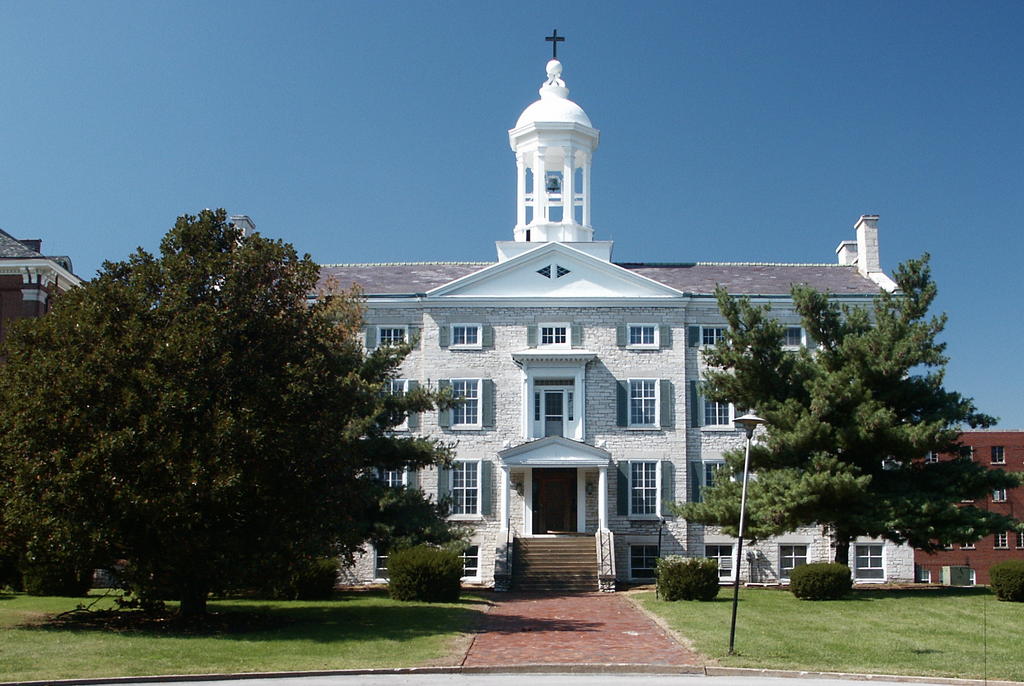
The missions to half of the United States started HERE, at the Saint Stanislaus Seminary, of the Society of Jesus, in Florissant, Missouri, about 20 highway miles northwest of downtown Saint Louis. The Jesuits left in 1971, and this is now the Pentecostal Gateway College of Evangelism.


This is the Old Rock Building, built by hand by the Jesuits seminarians and brothers out of rock they cut themselves from the bluffs overlooking the nearby Missouri River. It replaced an earlier log structure. In its earlier days, this seminary of 999 acres was self-supporting, like the monasteries of old. This was one of the first seminaries west of the Mississippi River.

The school that was to become the seminary was founded in 1823 by eight Belgian Jesuits, at the encouragement of Bishop Louis DuBourg of the Diocese of Louisiana and the Two Floridas, and U.S. President James Monroe. The missionaries built a log school for Indian children, and 17 years later opened the seminary.

This was the home base of Father Pierre De Smet, who traveled 200,000 miles on foot, mule, and boat, and made 19 ocean crossings in his missionary journeys.


Thousands of Jesuits lived and studied in these buildings.


This covered walkway is an example of the excellent detail found in classic Catholic buildings.


The imposing chapel.


Detail of the pediment of the chapel, showing the popular motto of the Society of Jesus " AD MAJOREM DEI GLORIAM" ("for the greater glory of God").


This little hill, the Memorial Mound, is an Indian burial mound and was also the Jesuit cemetery for the entire Missouri Province. Some remains and the tombstones were removed in 2002, the remains going to Calvary Cemetery in Saint Louis. Father Pierre De Smet was buried here; but only a few fragments of his skeleton were recovered. Most of the Jesuits were reinterred in a mass grave. The mound has not been fully excavated.


An old mausoleum on the grounds. Above the doorway is the Angelic Salutation.

The chaos in the culture following the Second Vatican Council led to the quick demise of the seminary. The combination of sexual libertinism, changing catechesis and liturgy, psychological experimentation, and great wealth, killed vocations.

The Collection of the Western Jesuit Missions, at Saint Louis University, opened in 2003: http://www.sjweb.info/world/museum_west_missions/index.cfm

An archive web site describing the Museum of the Western Jesuit Missions, that used to be housed in the Old Rock Building: http://www.usgennet.org/usa/mo/county/stlouis/jesuit/mwjm.htm

More photos of the Collection: http://www.geocities.com/davidjsuwalsky/

[UPDATE: see the newer article on the Collection of the Western Jesuit Missions.]

Map of location

Wednesday, September 14, 2005

It's the Other Mary

In Dan Brown's novel, The Da Vinci Code,Jesus is said to have been secretly married to Mary Magdalene, and their descendants live to this day, protected by a secret society, and attacked by the Catholic Church and Opus Dei monks.

Amy Welborn has a commentary on writings by Stephen J. Shoemaker, an author who has studied the Gnostic texts that spawned Mr. Brown's novel. Shoemaker has authored the recent book The Ancient Traditions of the Virgin Mary's Dormition and Assumption,

Apparently, in the Gnostic texts, Jesus is very close to, even intimate with, a woman named Mary. He holds her in higher esteem than even His own Apostles. He wants her to hold a central place in His religion. Modern commentary on the Gnostic texts was done by Protestant theologians, starting in the 19th century, and they just assumed that this Mary was the Magdalene, although this Saint isn't explicitly mentioned as such. The texts, however, don't mention that Jesus married this Mary or had children with her; that is just recent Masonic speculation. This speculation led to further recent Feminist speculation that the Apostles were jealous of this Mary, that they usurped her power, persecuted her, and hid the truth about her, which leads to Dan's bestselling story.

But better evidence is that this Mary, "most blessed among women", is none other than the Blessed Virgin Mary; an idea that any good Protestant theologian worth his salt wouldn't even think of. This is a Mary who is blessed among women, intimate with Jesus, greater than the Apostles, and holds a central part in the Religion, exactly what Catholics and Orthodox say regarding the Blessed Virgin Mary.

Someone ought to write a bestselling novel about this.