I just discovered Google's Related Sites feature. It finds web sites similar to any given one.
I tried it with mine: http://www.google.com/search?q=related:saint-louis.blogspot.com
I only got two pages of results, but they are quite interesting, including Father John Corapi, Priests for Life, and Opus Dei, as well as some well-known Catholic blogs. I've never linked to Fr. Corapi's site, but I like his preaching.
The one big surprise was the link to "Orthodoxy Today", but then again I always mention little-o "orthodoxy". I also got a link to Spirit Daily, which I don't think is similar at all.
You want to know about Catholicism? http://www.google.com/search?q=related:www.vatican.va/ takes you right to the USCCB, New Advent, EWTN, the Catechism, and Zenit. Do the same with a corporation, and you get a list of its major competitors, really quickly.
I don't know what algorithm Google uses to determine what is "related", but it seems to do a fairly good job. Try it on your own.
Monday, March 13, 2006


Saturday, March 11, 2006
Spanish Colonial Fort Discovered in Saint Charles County, Missouri - Intact!
What was thought to be a barn was discovered to have a stone fort inside of it:
See the article, Fort built in 1793 will now guard area's past.
See the article, Fort built in 1793 will now guard area's past.
"In 2004, as developers cleared farmland on the site, they discovered that the barn had a unique interior. The barn was wood on the outside, but on the inside, four thick stone walls held up its second floor. The stone walls formed a room on the barn's first floor, which was probably once used as a livestock crib."The fort is being rebuilt nearby at Daniel Boone's home.
Friday, March 10, 2006
Quotes from The Symbolism of Churches
THE SYMBOLISM OF Churches and Church Ornaments was a commentary on the book Rationale Divinorum Officiorum by Durandus, the first book of an uninspired writer ever printed. THE SYMBOLISM was published in 1843, and was part of an effective reform of the Church of England, moving it towards Catholicity.
Following are some quotes from that book.
On architecture and architects:
But there is still room for greater architectural perfection in the future:
On the fittingness of symbolism:
Symbolism in worship:
Symbolism in church design:
The spiritual meaning of symbolism:
The Sacramental nature of symbolism:
Symbols used in church design:
The limitations of symbolism:
Prudential use of some symbols:
These arguments are valid today. They can be one basis for a new restoration of the Church.
Following are some quotes from that book.
On architecture and architects:
- ...the two great rules of design:--"1. That there should be no features about a building which are not necessary for convenience, construction, or propriety: 2. That all ornament should consist of enrichment of the essential construction of a building." [Pugin's True Principles, p. 1.] And we may add, as a corollary, still quoting the same writer: "The smallest detail should HAVE A MEANING or serve a purpose: the construction itself should vary with the material employed: and the designs should be adapted to the material in which they are to be executed." Still, most true and most important as are these remarks, we must insist on one more axiom, otherwise Christian art will but mock us, and not shew us wherein its great strength lieth...
- ...A Catholick architect must be a Catholick in heart. Simple knowledge will no more enable a man to build up GOD'S material, than His spiritual, temples. In ancient times, the finest buildings were designed by the holiest Bishops.
- Holy Scripture, in mentioning the selection of Bezaleel and Aholiab, as architects of the Tabernacle, expressly asserts them to have been filled "with the SPIRIT OF GOD in wisdom, and in understanding, and in knowledge, and in all manner of workmanship, to devise cunning works, to work in gold and in silver and in brass, and in cutting of stones to set them, and in carving of timber, to work in all manner of workmanship." And this indeed is only a part of the blessing of the pure in heart: they see GOD, the Fountain of Beauty, even in this life; as they shall see Him, the Fountain of Holiness, in the next. From Catholick consent we may learn the same truth. Why else was Ecclesiastical Architecture made a part of the profession of Clerks, than because it was considered that the purity and holiness of that profession fitted them best for so great a work?
- We surely ought to look at least for Church-membership from one who ventures to design a church.
- We wish to vindicate the dignity of this noble science against the treason of its own professors. If architecture is anything more than a mere trade; if it is indeed a liberal, intellectual art, a true branch of poesy; let us prize its reality and meaning and truthfulness, and at least not expose ourselves by giving to two contraries one and the same material expression.
- It is objected that architects have a right to the same professional conscience that is claimed, for instance, by a barrister. To which we can only reply, that it must be a strange morality which will justify a pleader in violating truth; and how much worse for an architect to violate truth in things immediately connected with the House and worship of GOD!
- The Church architect must, we are persuaded, make very great sacrifices: he must forego all lucrative undertakings, if they may not be carried through upon those principles which he believes necessary for every good building; and particularly if the end to be answered, or the wants to be provided for, are in themselves unjustifiable or mischievous.
- An architect ought indeed to be acquainted, and the more the better, with all styles of building: but if architecture, as we said before, is a branch of poesy, if the poet's mind is to have any individuality, he must design in one style, and one style only.
- We fear however that very few, as yet, take that religious view of their profession, which we have shewn to be seemly, even if not essential. If, however, we succeed in proving that religion enters very largely into the principles of Church architecture, a religious ethos, we repeat, is essential to a Church architect. At all events, in an investigation into the differences between ancient and modern Church architecture, the contrast between the ancient and modern builders could not be overlooked: and it is not too much to hope that some, at least, may be struck by the fact, that the deeply religious habits of the builders of old, the Hours, the cloister, the discipline, the obedience, resulted in their matchless works; while the worldliness, vanity, dissipation, and patronage of our own architects issue in unvarying and hopeless failure.
But there is still room for greater architectural perfection in the future:
- Secondly, the Decorated [Gothic] style may be indeed the finest developement of Christian architecture which the world has yet seen; but it does not follow that it is the greatest perfection which shall ever be arrived at. No: we too look forward, if it may be, to the time when even a new style of Church architecture shall be given us, so glorious and beautiful and true, that Cologne will sink into a fine example of a Transitional period, when the zeal and faith and love of the reunited Church shall find their just expression in the sacramental forms of Catholick art.
On the fittingness of symbolism:
- And if in the Old Testament we find authority for the principle of symbolism, much more do we in the New.
- With symbolical writings, enactments, events, personages, observances, buildings, vestments, for Her guides and models, how could the Church Catholick fail of following symbolism, as a principle and a passion?
- Now Catholicity, which teaches men constantly to live above their senses, to mortify their passions, and to deny themselves;--nay even Hindooism, which, so far as it approximates to the truth, preaches the same doctrine, must constantly lead men by the seen to look on to the unseen.
- But now, the Church, not content with warning us that we are in an enemy's country, boldly seizes on the enemy's goods, converting them to Her own use.
- But we must constantly bear in mind that Nature and the Church answer to each other as implicit and explicit revelations of GOD.
- Now, that the teaching of Nature is symbolical, none, we think, can deny. Shall we then wonder that the Catholick Church is in all Her art and splendour sacramental of the Blessed TRINITY, when Nature herself is so?
- Shall there be a trinity of effect in every picture, a trinity of tone in every note, a trinity of power in every mind, a trinity of essence in every substance,--and shall not there be a trinity in the arrangements and details of Church art?
- Furthermore, whatever was the character of our LORD'S teaching,--such is likely to be that of His Church. If the former were plain, unadorned, setting forth naked truths in the fewest and simplest words; then we allow that there is a primâ facie argument against the system which we are endeavouring to support. But if it were parabolick, figurative, descriptive, allegorical,--why should not the Church imitate Her Master? His parables are at once the surest defence, and the most probable originators, of Her symbolism.
Symbolism in worship:
- Hence every effort of devotion is attended by some bodily act. Whether we lift our eyes or hands to heaven, or kneel in prayer, we shew forth this necessity of our being: our body has sinned, has been redeemed, will be punished or glorified, no less than the soul: it must therefore worship with the soul.
- ...all religious actions are from their nature symbolical and figurative.
- The Catholick ritual is indeed symbolical from first to last. Without the clue to its figurative meaning, we should never have understood its pregnant truthfulness and force.
Symbolism in church design:
- So true it is that those who would most object to symbolism, as a rule of design, are themselves (did they but know it) symbolizing, in every church they build, their own arbitrary and presumptuous ideas on the subject.
- [But, according to the Apostolic Constitutions,] 'The church,' they say, 'must be oblong in form, and pointing to the East.' [Apost. Const. 2, 57, (61.)] The oblong form was meant to symbolize a ship, the ark which was to save us from the stormy world.
- ...it will be sufficient to refer once more to the remarkable parallel between a Christian church and the Jewish Temple. There can be little doubt that Mede proved his point of the propriety of genuflexion towards the Altar. We are contending for a much simpler thing: for no more indeed than the concession of a probability that in the earliest Christian churches there was at least this resemblance to the Temple; that there should be in both a Holy of Holies and an outer-court.
- The praying towards the East was the almost invariable custom in the Early Churches, and as symbolical as their standing in prayer upon the Festivals of the Resurrection.
- The circular form given to the church of the Holy Sepulchre was of course appropriate enough in that particular case, where the Sepulchre would naturally become the centre. The circular churches of Europe were again imitated from this.
- The Cross form would appear to have made its first appearance in Constantinople: that is, in the city which was the first to take a completely Christian character.
- It was not a mere ejection of idols that was required to make a temple into a church: but some change of form and arrangement.
The spiritual meaning of symbolism:
- In the comparison between the material temple and the 'living temple' the Spiritual Church, there are several points worthy of observation. The symbolical explanation of the corner stone as our LORD, of the foundation as the Apostles and Prophets, of the stones as the Members of the Church, are of course taken directly from Holy Scripture. It is scarcely necessary to remark the great authority for considering the fabrick of the Church as symbolical which these passages convey.
- Again he proceeds to compare the Bishop Paulinus with the "great High Priest," not only in being permitted to enter the holy of holies, but in doing what CHRIST has done, just as the SON did what He saw the FATHER do. "Thus he, looking with the pure eyes of his mind unto the Great Teacher, whatsoever he seeth Him doing, as if making use of archetypal patterns, has, by building (demiourgwn) as much like them as possible, wrought out images of them as closely as can be; having in no respect fallen short of Bezaleel, whom GOD Himself, having filled him with the Spirit of wisdom and knowledge and other skilful and scientifick lore, called to be the builder of the material expression of the heavenly types in the symbols of the temple. In this way then Paulinus also, carrying wholly like a graven image in his soul CHRIST Himself, the Word, the Wisdom, the Light ...... has constructed this magnifical temple of the Most High GOD, resembling in its nature the pattern of the better (temple) as a visible (emblem) of that which is invisible." [Euseb. X. iv. 24, 25.] This remarkable passage appears to assert (i) the inspiration of the architect, (ii) the fact of this heavenly type, which (iii) material churches ought to follow; and (iv) the general symbolism of the Spiritual Church by the visible fabrick.
- And again, "More wonderful than wonders are the archetypes, and the intelligent and godlike prototypes and patterns (of earthly church building); namely, I say, the renewing of the divine and reasonable building in the soul"; [Ibid 54] assuming that material churches are but copies from some heavenly type.
The Sacramental nature of symbolism:
- Seeing then that there are strong reasons a priori for believing that the ritual and architecture of the Church would partake of a decidedly symbolical character: that by the analogy of the practice amongst all religionists, of the operations of GOD in nature, of the conditions of Art, and especially of the whole sacramental system of the Church, it is likely that Church architecture itself would be sacramental: that from the nature of things every thing material is in some sort sacramental, and a material fabric essentially figurative of the purpose for which it was designed: that an actual Christian church, (taken as we find it,) has such accidents as can be explained on no other than a symbolical supposition, and might be analyzed into just those elements from which, by induction we first constructed an hypothetical Christian church: and lastly, that from express and continuous historical testimony without any actual acquaintance with existing fabrics we might have deduced that the material church would be itself, to some extent, a figurative expression of the religion for the celebration of which it was constructed: it does not seem too much to assert that Christian architecture owes its distinctive peculiarities to its sacramental character, and that consequently we can neither appreciate ancient examples nor hope to rival them, at least in their perfection, without taking into account this principle of their design. In other words, the cause of that indefinable difference between an ancient and modern church which we were led to discover at the beginning of this treatise, is neither association of ideas, nor correctness of detail, nor picturesqueness, nor of a mechanical nature, but, (in the most general point of view) is the sacramentality, the religious symbolism, which distinguished and sanctified this as every other branch of mediaeval art.
Symbols used in church design:
- The Doctrine of the HOLY TRINITY has left, as might be expected, deeper traces in the structure of our churches than any other principle of our Faith. We have already noticed that possibly the Basilican arrangement might be providentially adduced with reference to this. In Saxon times we find the idea carried out, not only by the Nave and two Aisles, but also by the triple division in length, into Nave, Chancel, and Sanctum Sanctorum.
- In the early ages of Christianity, it was a matter requiring no small courage to make an open profession of Christianity, to join one's self to the Church Militant:--and this fact has left its impress in the various representations, of Martyrdom surrounding the Nave-doors of Norman and the first stage of Early English churches: as well as in the frightful forms which seem to deter those who would enter. But in process of time, as the world became evangelized, to be a member of the visible Church was an easy matter: the difficulty was transferred from an entrance into that, to the so living, as to have part in the Communion of Saints:--in other words, to an entrance into the Church Triumphant.
The limitations of symbolism:
- It is a condition of emblems that the points of similitude must not be pressed too far. The material Sun indeed typifies the Sun of Righteousness: but in what particulars? in its being created, in its rising on the dark world every day, in its being matter? Surely not: but in this one point, that it brings light and heat to the earth. I AM THE DOOR, said our LORD. In what particulars, we may again ask? It would be profane to show by examples that it is only in this point; that a door is for entrance into a material house just as we enter into the Church through CHRIST. The ark, our Church teaches us, was an emblem of the Church: not in its human building, nor in its final perishing.; but in that it saved souls by water. Did the Paschal Lamb typify the Immaculate Victim in any thing more than its comparative purity and its bloody death? We need not multiply such examples.
- But there is another consideration to be adduced. Our LORD'S own parables must not be pressed too far. The history of the five wise and five foolish virgins, must not be adduced to prove that the number of the lost will equal that of the saved. This may be dangerous ground, but the assertion is true. Every parable is figurative to a certain point, and no further.
- ...the resemblance, for the most part, is derived from grouping independent things together and viewing them in a particular light. We do not deny the real essential symbolism of a material result: but this its particular significancy need not obtrude itself at all times: the thing itself in other combinations, and viewed under other aspects, may acquire an additional and occasional meaning.
- We have the highest authority for believing that one type can symbolize two things quite independent of each other, in that the Jewish Sabbath, commanded from Sinai to be observed in commemoration of the Rest after the Creation, is enforced in Deuteronomy as the representation of the rest of the children of Israel from Egyptian bondage.
- Now we never asserted that it was necessary that all, or indeed any, given things should be intentionally symbolized. We have pointed out that some things are essentially symbolical; others accidentally and occasionally. We might attempt to classify what must be symbolized in church building, and what may be. But we decline to do so because we do not think that the principles of symbolism are yet sufficiently investigated or apprehended. However in a general way, every building must, from the nature of things, have some accidents, as of material, of parts, of plan; every particular building must have particular accidents, as of use and purpose. These accidents must be symbolical, from their nature, in a general way: they may derive, from purpose added to their nature, a further or modified symbolism in a particular way.
- So we do not mean to insist that certain things shall be symbolized; we say they may be symbolized.
Prudential use of some symbols:
- It has never been asserted that every church shall have Nave and Aisles: but if a church has Nave and Aisles it will be symbolical of a great doctrine; and for this reason it is better for a church to have Nave and Aisles.
- Yet it is undeniable that the cross form was chosen for its symbolical meaning: and this in spite of mechanical disadvantages. A mechanical reason fails here, as in the former case, in accounting for the fact. How will they account for the cross form? Their own argument tells against them. We may still further remark that in modern times we have had some curious practical lessons upon this cross form. Messrs. Britton and Hosking, in their atrocious plan for rearranging S. Mary Redcliffe church, unwittingly testified to the inconvenience, and want of any utilitarian end, of this plan by placing the pulpit under the lantern, and ranging the congregation in the four arms so as to face it. On the other hand, some modern architects confessedly employ the cross form because it allows of people arranged as in the last case, all seeing the preacher. But why do they not look deeper into things? Why have the Cross at all? Why not have an amphitheatre, an octagon, an acoustically designed Mechanicks' Institute Lecture Room? Then all could hear, all could see much better, and the building would not cost half so much. They may think that they are designing on utilitarian principles. In truth they are unknowingly, unwillingly, symbolizing the Cross.
These arguments are valid today. They can be one basis for a new restoration of the Church.
The Symbolism of Churches
In the 1839, the Ecclesiological Society started a successful reform of the Church of England, moving it back to its Catholic roots. From one of its publications, THE SYMBOLISM OF Churches and Church Ornaments, comes this description of the degraded form of their contemporary churches:
The authors continue with a description of ideal Catholic churches:
It is choked up and concealed by surrounding shops and houses, for religion, now-a-days, must give way to business and pleasure: it stands North and South, for all idea of fellow-feeling with the Church Catholick is looked on as mere trifling, or worse: the front which faces the High Street is of stone, because the uniformity of the street so required it: or, (which is more likely) of stucco, which answers as well, and is cheaper: the sides, however, are of brick, because no one can see them: there is at the entrance a large vestibule, to allow people to stand while their carriages are being called up, and to enter into conversation on the news of the day, or the merits of the preacher: it also serves the purpose of making the church warmer, and contains the doors and staircases to the galleries. On entering, the, pulpit occupies the central position, and towards it every seat is directed: for preaching is the great object of the Christian ministry: galleries run all round the building, because hearing is the great object of a Christian congregation: the Altar stands under the organ gallery, as being of no use, except once a month: there are a few free seats in out-of-the-way places, where no one could hear, and no pues would be hired, and therefore no money is lost by making the places free: and whether the few poor people who occupy them can hear or not, what matters it? The Font, a cast-iron vase on a marble pillar, stands within the Altar rails; because it there takes up no room: the reading pue is under the pulpit, and faces the congregation; because the prayers are to be read to them and not addressed to GOD. Look at this place on Sunday, or Thursday Evening. Carriages crash up through the cast-iron gates, and, amidst the wrangling and oaths of rival coachmen, deposit their loads at the portico: people come, dressed out in the full fashion of the day, to occupy their luxurious pue, to lay their smelling-bottles and prayer books on its desk, and reclining on its soft cushions, to confess themselves-if they are in time-miserable sinners: to see the poor and infirm standing in the narrow passages, and close their pue doors against them, lest themselves should be contaminated, or their cushions spoilt, at the same time beseeching GOD to give their fellow-creatures the comfort which they refuse to bestow: the Royal Arms occupy a conspicuous position; for it is a chapel of the ESTABLISHMENT: there are neat cast-iron pillars to hold up the galleries, and still neater pillars in the galleries to hold up the roof; thereby typifying that the whole existence of the building depends on the good-will of the congregation: the roof is flat, with an elegant cornice, and serves principally to support a gas-lighted chandelier: and the administration of this chapel is carried on by clerk, organist, beadle, and certain bonnetless pue-openers.Too many of the features described here could be said of modern Catholic churches!
The authors continue with a description of ideal Catholic churches:
Far away, and long ere we catch our first view of the city itself, the three spires of its Cathedral, rising high above its din and turmoil, preach to us of the Most Holy and Undivided Trinity. As we approach, the Transepts, striking out cross-wise, tell of the Atonement: the Communion of Saints is set forth by the chapels clustering round Choir and Nave: the mystical weathercock bids us to watch and pray and endure hardness: the hideous forms that seem hurrying from the eaves speak the misery of those who are cast out of the church: spire, pinnacle, and finial, the upward curl of the sculptured foliage, the upward spring of the flying buttress, the sharp rise of the window arch, the high-thrown pitch of the roof, all these, overpowering the horizontal tendency of string course and parapet, teach us, that vanquishing earthly desires, we also should ascend in heart and mind. Lessons of holy wisdom are written in the delicate tracery of the windows: the unity of many members is shadowed forth by the multiplex arcade: the duty of letting our light shine before men, by the pierced and flowered parapet that crowns the whole.This comparison, written in 1843, has a strong parallel with the comparason between our contemporary vs. traditional Catholic churches described in Michael Rose's book Ugly as Sin, published 163 years later.
We enter. The triple breadth of Nave and Aisles, the triple height of Pier arch, Triforium, and Clerestory, the triple length of Choir, Transepts, and Nave, again set forth the Holy TRINITY. And what besides is there that does not tell of our Blessed SAVIOUR? that does not point out "HIM First," in the two-fold Western door: "HIM Last," in the distant Altar: "HIM Midst," in the great Rood: "HIM Without End," in the monogram carved on boss and corbel, in the Holy Lamb, in the Lion of the Tribe of Judah, in the Mystick Fish? Close by us is the Font; for by Regeneration we enter the Church: it is deep and capacious; for we are buried in Baptism with CHRIST: it is of stone; for HE is the Rock: and its spiry cover teaches us, if we be indeed risen from its waters with HIM, to seek those things that are above. Before us, in long drawn vista are the massy Piers, which are the Apostles and Prophets: they are each of many members, for many are the graces in every Saint: there is delicate foliage round the head of all; for all were plentiful in good works. Beneath our feet are the badges of worldly pomp and glory, the charges of Kings and Nobles and Knights: all in the Presence of GOD as dross and worthlessness. Over us swells the vast 'valley' of the high pitched roof: from the crossing and interlacing of its curious rafters hang fadeless flowers and fruits which are not of earth: from its hammer-beams project wreaths and stars, such as adorn heavenly beings: in its centre stands the LAMB as It had been slain: from around HIM the celestial Host, Cherubim and Seraphim, Thrones, Principalities, and Powers, look down peacefully on the worshippers below. Harpers there are among them harping with their harps: for one is the song of the Church in earth and in Heaven. Through the walls wind the narrow cloister galleries: emblems of the path by which holy hermits and anchorets, whose conflicts were known only to their GOD, have reached their Home. And we are compassed about with a mighty cloud of witnesses: the rich deep glass of the windows teems with saintly forms, each in its own fair niche, all invested with the same holy repose: there is the glorious company of the Apostles: the goodly fellowship of the Prophets: the noble army of Martyrs: the shining band of the Confessors: the jubilant chorus of the Virgins: there are Kings, who have long since changed an earthly for an heavenly crown: and Bishops, who have given in a glad account to the Shepherd and Bishop of souls. But on none of these things do we rest; piers, arch behind arch, windows, light behind light, arcades, shaft behind shaft, the roof, bay behind bay, the Saints around us, the Heavenly Hierarchy above with dignity of pre-eminence still increasing Eastward, each and all, lead on eye and soul and thought to the Image of the Crucified Saviour as displayed in the great East window. Gazing steadfastly on that, we pass up the Nave, that is through the Church Militant, till we reach the Rood Screen, the barrier between it and the Church Triumphant, and therein shadowing forth the death of the Faithful. High above it hangs, on His Triumphal Cross, the image of HIM Who by His Death hath overcome death; on it are pourtrayed Saints and Martyrs, His warriors, who fighting under their LORD have entered into rest and inherit a tearless eternity. They are to be our examples, and the seven lamps above them typify those graces of the SPIRIT, by Whom alone we can tread in their steps. The screen itself glows with gold and crimson: with gold, for they have on their heads golden crowns; with crimson, for they passed the Red Sea of Martyrdom to obtain them. And through the delicate net work, and the unfolding Holy Doors, we catch faint glimpses of the Chancel beyond. There are the massy stalls; for in Heaven is everlasting rest: there are the sedilia, emblems of the seats of the Elders round the Throne: there is the Piscina; for they have washed their robes and made them white: and there, heart and soul and life of all, the Altar with its unquenched lights, and golden carvings, and mystick steps, and sparkling jewels: even CHRIST Himself, by Whose only Merits we find admission to our Heavenly Inheritance. Verily, as we think on the oneness of its design, we may say: Jerusalem edificatur ut civitas cujus participatio ejus in idipsum.
Thursday, March 09, 2006
Photos of Saint Peter's Church and Saint Charles Borromeo Church, Saint Charles, Missouri
Saint Charles, Missouri, a city with French and Spanish colonial roots and a great Catholic history, is located on the banks of the Missouri River about 22 highway miles northwest of downtown Saint Louis, Missouri. It has historic Catholic churches, as well as a shrine containing the tomb of Saint Rose Philippine Duchesne, pioneer educator to the Indians. Saint Charles County is booming with real estate and commercial development, and is quickly becoming largely suburban. Old Town Saint Charles is a gem on the riverbanks, with historical buildings dating from the late 18th and early 19th centuries.

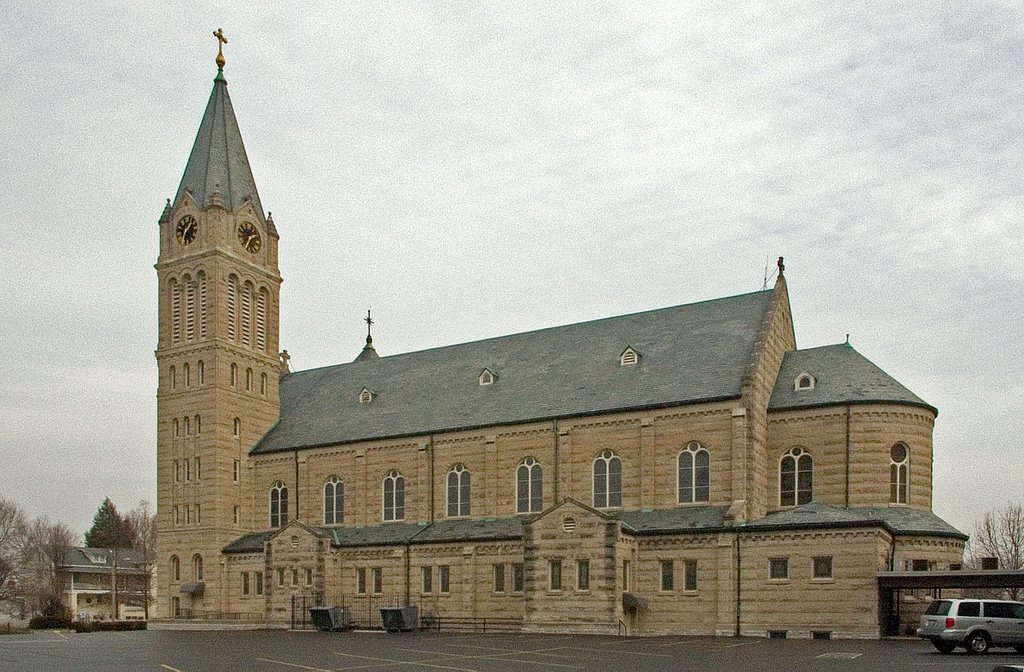
Saint Peter's is the oldest existing Catholic church in Saint Charles. It is one block up from the historical and touristic Main Street, featuring craft shops and numerous restaurants. The church is on First Capital Drive; located on the corner of those streets is the first capitol building of the State of Missouri.
Archdiocesan web site.
Click for map.

The exterior of the church. Directly across the street is a hospital of the Sisters of Saint Mary, and its modern chapel is seen just beyond the church. Vastly more money and resources go into the charitable and educational works of the Church compared to its pastoral works in the churches. A Catholic church—even if it is gold-plated and diamond-encrusted—is far cheaper than a hospital or university, yet the latter would not exist if it weren't for the former. Beauty is the bait: it leads us to goodness and truth, which are greater than beauty, but naturally are not the first things that our intellect perceives.

A spire.

The nave. Because Eucharistic Adoration was going on at the time, I did not take many photos of the interior.
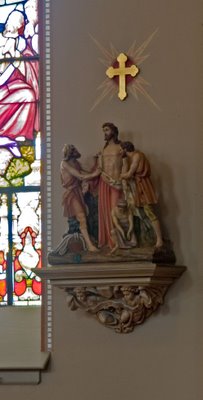
Station of the Cross. Jesus is stripped of his garments.

Attached to the main nave of the church is a new addition which includes a second chapel (also used as a cry room) and large narthex; this addition is of post-modern design. This is one of its stained glass windows, commemorating Saints Frances Xavier Cabrini and Vincent de Paul, both of whom have extensive local veneration.

Saint Charles Borromeo Church is about seven blocks north of Saint Peter's; Borromeo is the namesake and patron of Saint Charles City and County. The church was closed at the time, so I don't have any photos. The interior has been modified with the high altar removed and the Presider's chair placed in the center of the nave. The tabernacle of the Blessed Sacrament is on one of the side-altars. One of the Archdiocese's Hispanic ministries is at this church.
Archdiocesan web site.
Parish web site.
Click for map.
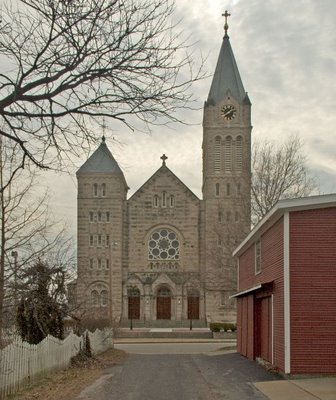
The facade.

The main door.

Detail next to the door.

Window.

The cornerstone:
+
D.O.M.
IN HONOREM SANCTI
CAROLI BORROMÆI
A.D. 1916
+
BUILT 1869-72
DESTROYED 1915
REBUILT 1915-16

Saint Charles owes its founding and existence to the Missouri River, being orginally the home of French furtrappers and traders with the Indians. These voyageurs started here and explored the continent before their friends Lewis and Clark went on their expedition; rivers that are tributary to the Missouri have French names because of these Saint Charles explorers. Here we are about 27 miles upstream from the Missouri's confluence with the Mississippi; due to various factors, it was easier to unload goods at Saint Louis and cart them overland to the river at Saint Charles. At the time of the photo, the river was close to the near-record low level: Click here for more information. A local man told me that near here is a steamboat wreck, accessible during low water on the opposite side of the river. The photo was taken from Frontier Park, which often floods during high water. The park is the site of the annual Frontier Days festival, which features re-enacters in colonial and indian attire; replicas of Lewis and Clark's boats are stored here in a small museum. Main Street is on the first terrace above the river, less exposed to flooding, while the two churches are safely sited away from floodwaters on higher terraces.
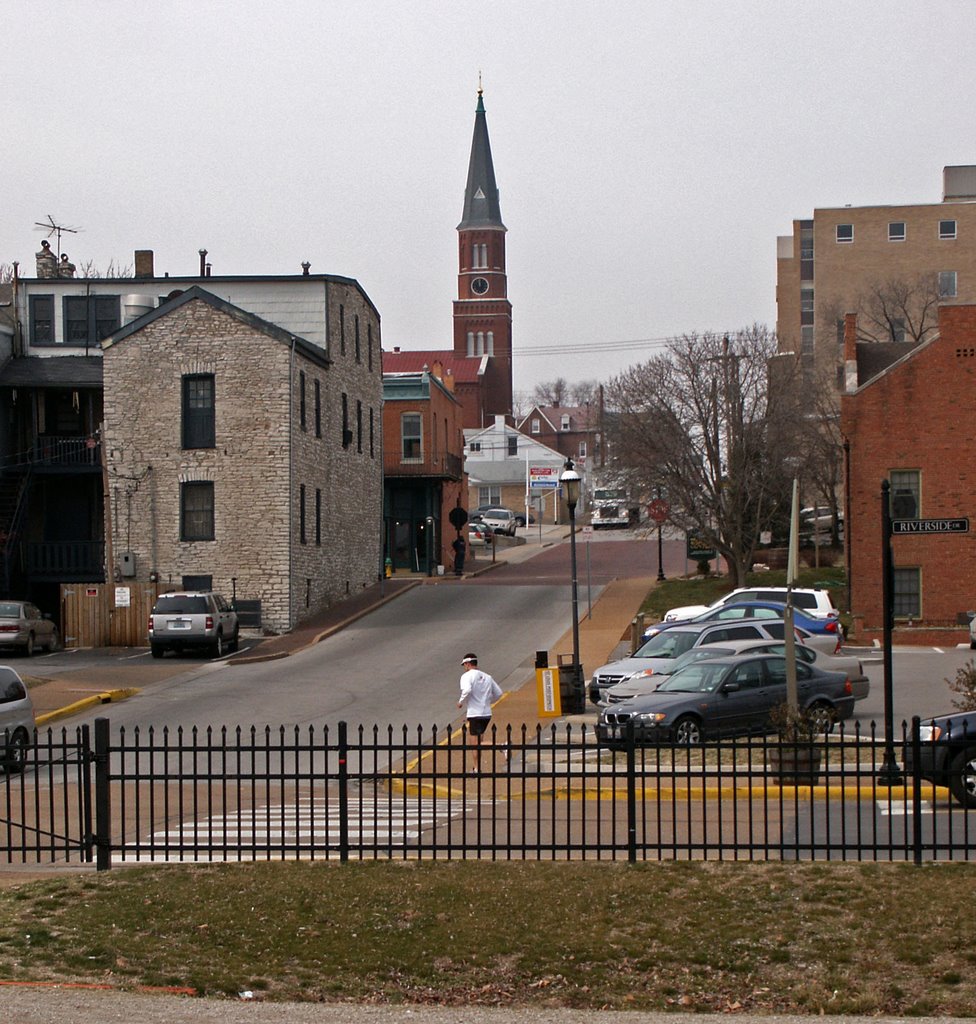
Saint Peter's is the oldest existing Catholic church in Saint Charles. It is one block up from the historical and touristic Main Street, featuring craft shops and numerous restaurants. The church is on First Capital Drive; located on the corner of those streets is the first capitol building of the State of Missouri.
Archdiocesan web site.
Click for map.

The exterior of the church. Directly across the street is a hospital of the Sisters of Saint Mary, and its modern chapel is seen just beyond the church. Vastly more money and resources go into the charitable and educational works of the Church compared to its pastoral works in the churches. A Catholic church—even if it is gold-plated and diamond-encrusted—is far cheaper than a hospital or university, yet the latter would not exist if it weren't for the former. Beauty is the bait: it leads us to goodness and truth, which are greater than beauty, but naturally are not the first things that our intellect perceives.

A spire.
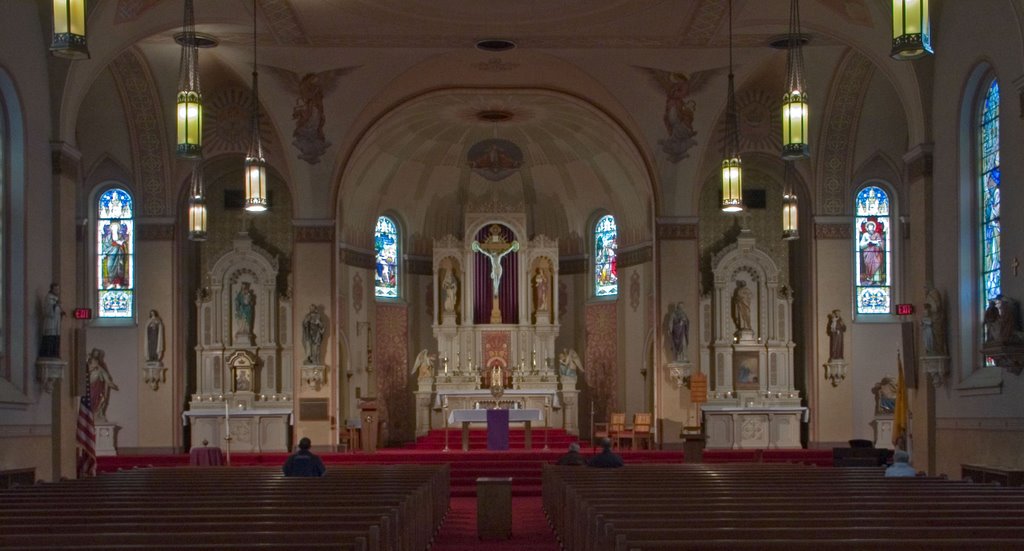
The nave. Because Eucharistic Adoration was going on at the time, I did not take many photos of the interior.
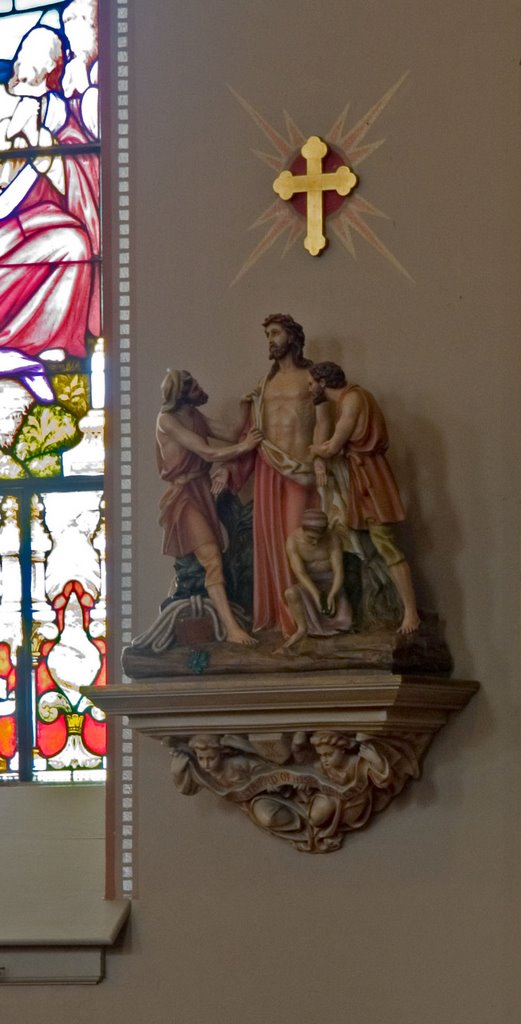
Station of the Cross. Jesus is stripped of his garments.
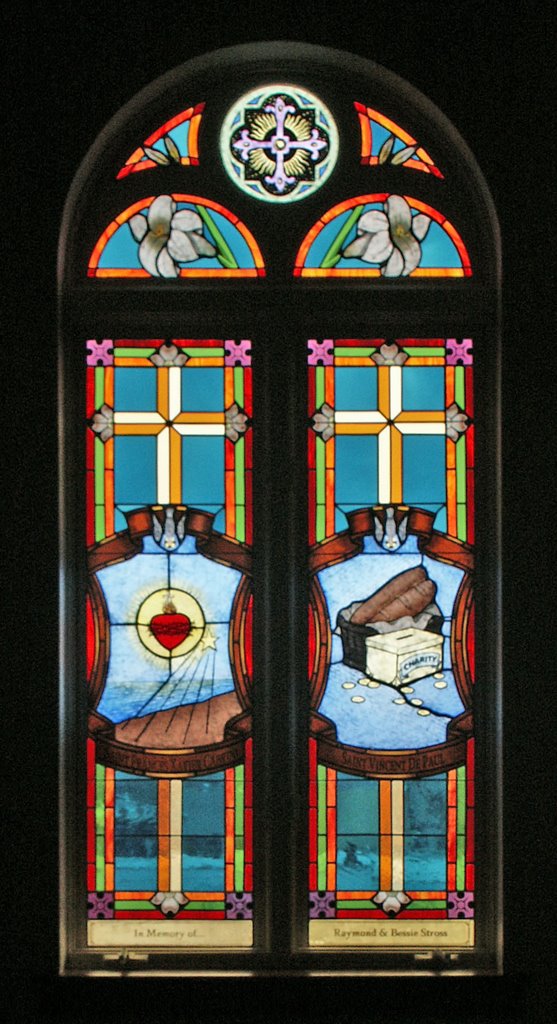
Attached to the main nave of the church is a new addition which includes a second chapel (also used as a cry room) and large narthex; this addition is of post-modern design. This is one of its stained glass windows, commemorating Saints Frances Xavier Cabrini and Vincent de Paul, both of whom have extensive local veneration.
Saint Charles Borromeo Church is about seven blocks north of Saint Peter's; Borromeo is the namesake and patron of Saint Charles City and County. The church was closed at the time, so I don't have any photos. The interior has been modified with the high altar removed and the Presider's chair placed in the center of the nave. The tabernacle of the Blessed Sacrament is on one of the side-altars. One of the Archdiocese's Hispanic ministries is at this church.
Archdiocesan web site.
Parish web site.
Click for map.
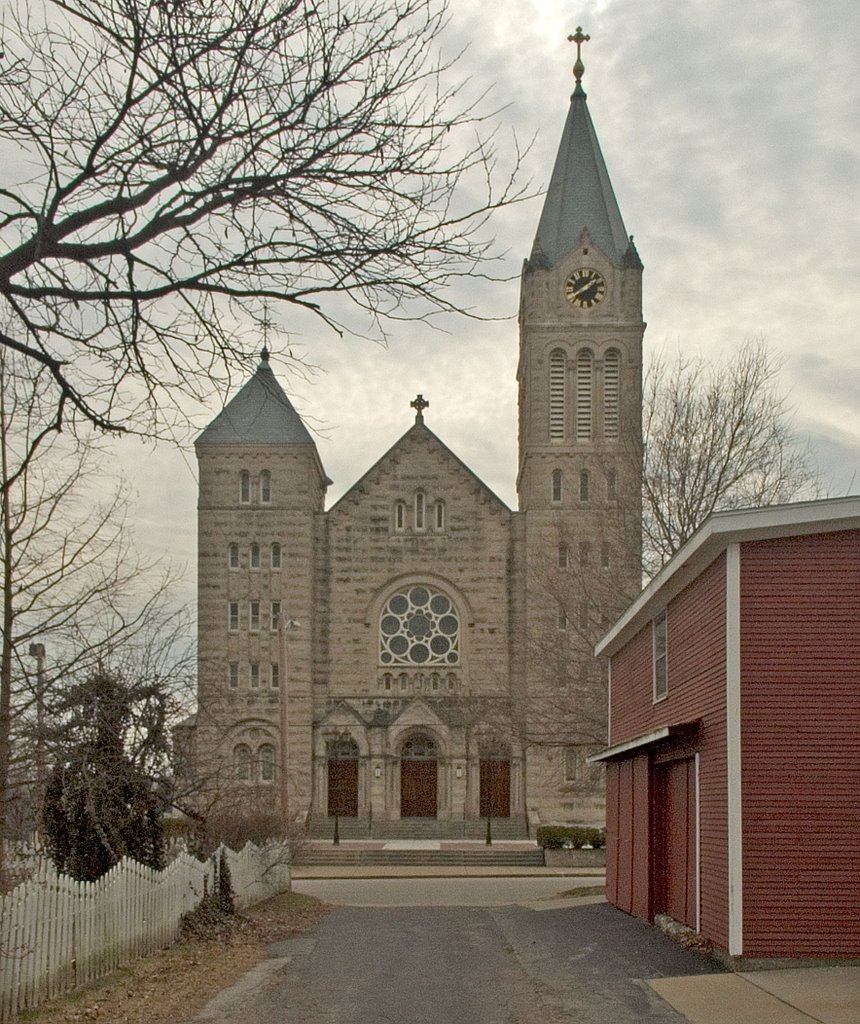
The facade.

The main door.
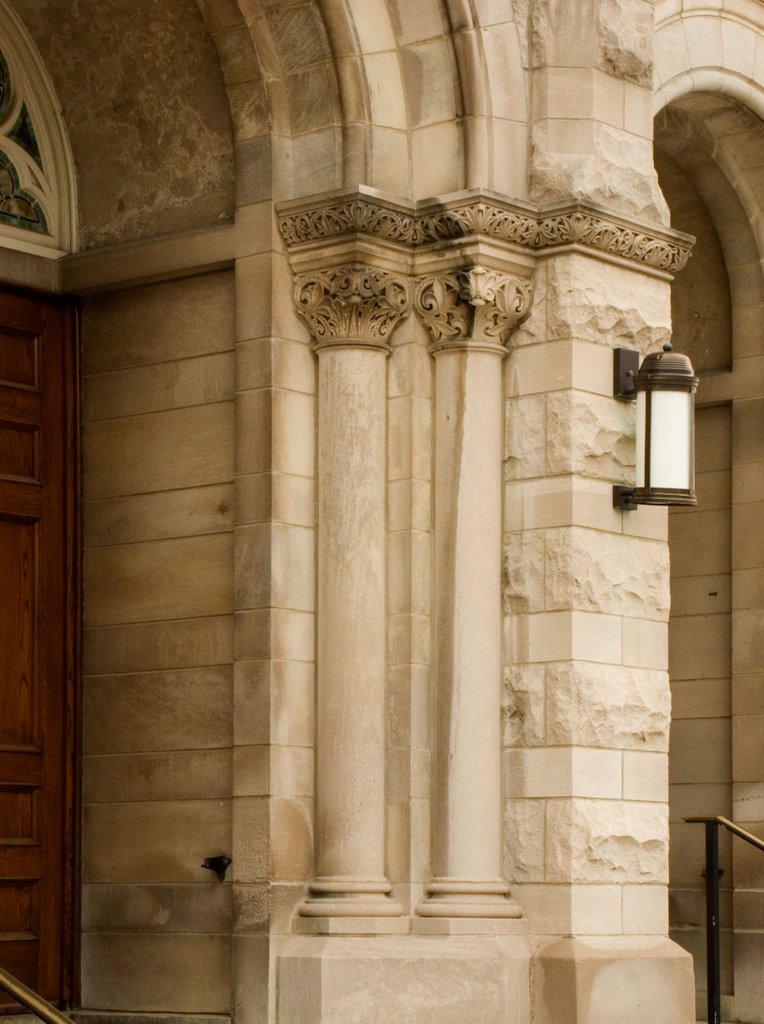
Detail next to the door.

Window.
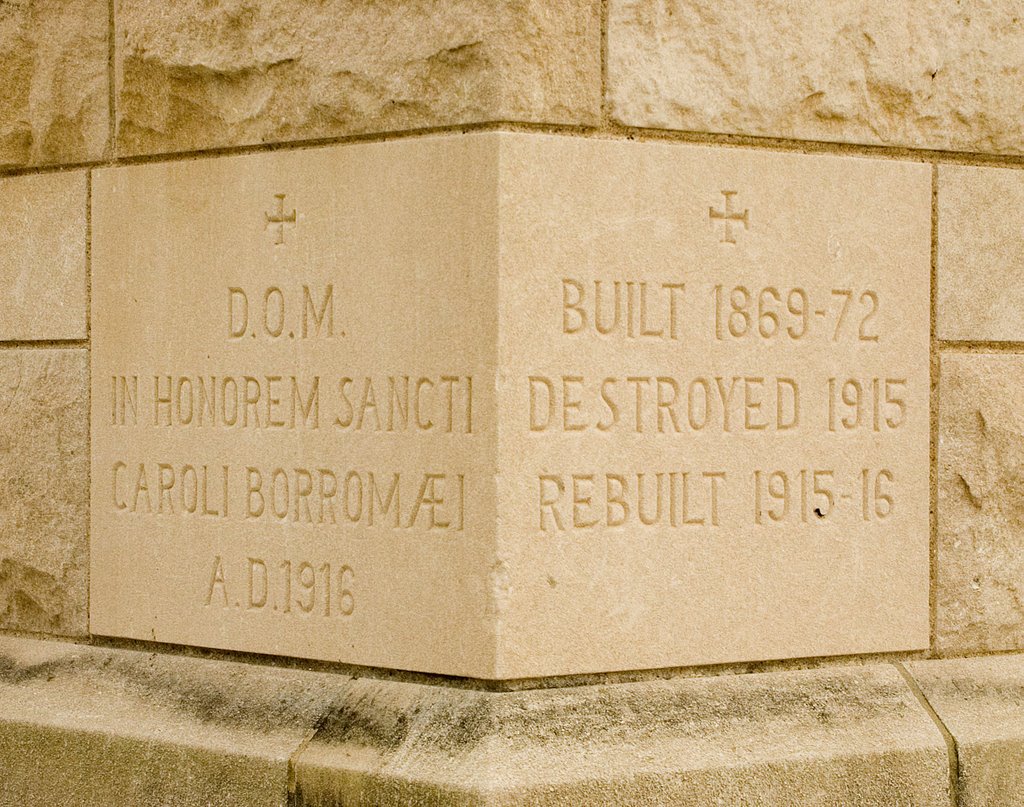
The cornerstone:
D.O.M.
IN HONOREM SANCTI
CAROLI BORROMÆI
A.D. 1916
+
BUILT 1869-72
DESTROYED 1915
REBUILT 1915-16

Saint Charles owes its founding and existence to the Missouri River, being orginally the home of French furtrappers and traders with the Indians. These voyageurs started here and explored the continent before their friends Lewis and Clark went on their expedition; rivers that are tributary to the Missouri have French names because of these Saint Charles explorers. Here we are about 27 miles upstream from the Missouri's confluence with the Mississippi; due to various factors, it was easier to unload goods at Saint Louis and cart them overland to the river at Saint Charles. At the time of the photo, the river was close to the near-record low level: Click here for more information. A local man told me that near here is a steamboat wreck, accessible during low water on the opposite side of the river. The photo was taken from Frontier Park, which often floods during high water. The park is the site of the annual Frontier Days festival, which features re-enacters in colonial and indian attire; replicas of Lewis and Clark's boats are stored here in a small museum. Main Street is on the first terrace above the river, less exposed to flooding, while the two churches are safely sited away from floodwaters on higher terraces.
Subscribe to:
Posts (Atom)
