Pages

Saturday, May 31, 2008

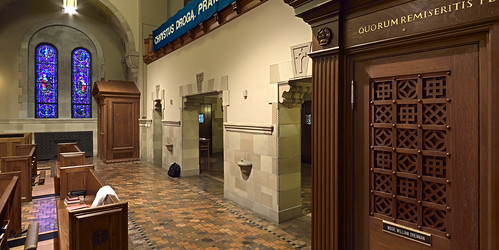
Photo of New Confessionals

Confessionals at Kenrick-Glennon Seminary

Confessionals at the chapel of Kenrick-Glennon Seminary, in Shrewsbury, Missouri. Designed by Duncan G. Stroik, of South Bend, Indiana.

Click image for larger versions.

Friday, May 30, 2008

"In the Eye of the Beholder"

BEAUTY, so says contemporary art theory, "is in the eye of the beholder".

The word "is" indicates a state of being, and the word "in" implies that beauty exists completely in each individual's subjective perception. So according to contemporary theory, there is no beauty "out there", but it all exists completely in our eye, or mind.

We could assume that perception is fairly constant among most people (at least under controlled conditions), but modern theory goes one step further, saying that these perceptions cannot be compared with each other. This is due to the denial of the existence of an objective human nature.

So the contemporary theory completely discounts the concept of beauty. Just because you think something is ugly, doesn't mean that someone else may think it is beautiful.  In other words, if you think something is ugly, shut up.  They don't want to hear your opinion. Or if you insist on stating your opinion, you are obviously a philistine who doesn't understand the contemporary art scene, and are therefore to be excluded.

Now we could have recourse to sociology, and its favorite tool, the public opinion poll, and we could have voluminous data on the perceived beauty of large numbers of artworks.  Imagine an art museum allowing viewers to rate each individual work of art, and eliminating those works that are rated poorly, and putting up works similar to those that are highly rated.  That probably is not going to happen anytime soon, nor should it:  polls are interesting and often worthy, but too many bad policy decisions are made in response to them.

What we get instead is some work of art that everyone hates (experts and public included), yet is still proudly displayed as an exemplar, because individual opinion is suppressed.  Debates on certain topics, especially beauty, are prohibited.

I am reminded of a certain atonal symphonic work, which in my opinion, was unlistenable, and I could tell from the reactions of other listeners that they thought that it was unlistenable, too. But someone told me that he did not want to hear my negative opinion, and wore a forced smile (more of a grimace with teeth gritted), as if he was pretending to be enjoying it.  Or maybe he did not like being in the company of "philistines".

Instead, let's go back to Thomas Aquinas' simple definition of beauty:  "pulchra enim dicuntur quae visa placent" (Summa, I q. 5 a. 4 ad 1) or "for beautiful things are those which please when seen" (New Advent translation).  Note that beauty is a property of things, and hence is a Formal Cause, but it also includes the process of seeing, which is indeed influenced by subjective and relative circumstances.  We ought to note that modern art theory developed in reaction to 19th century art theories that were absolutistic and which denied those personal factors.  The truth, we believe, includes all three factors.

And just because something is subjective does not mean that it does not follow certain laws, which modern theory often denies.  For example, the influence of the color blue has a certain predictable effect on perceived tone value even in colorblind persons.  And when persons, blind from birth, are asked to draw pictures of objects, they will naturally use common artistic conventions, although they never seen them.  And in polls on beauty, taken throughout the world in diverse cultures, have seen strong similarities on what is perceived as beautiful, strongly indicating an objective component to beauty, even if it is only an objective component of human nature and not of the object itself.

We live in a fallen world, and so our perception and judgment of beauty is flawed, but with grace and right reason we ought to be able to improve our understanding and appreciation of it.

Another Cat Photo

Twinkly

My sincere apologies to my readers who don't like cats!

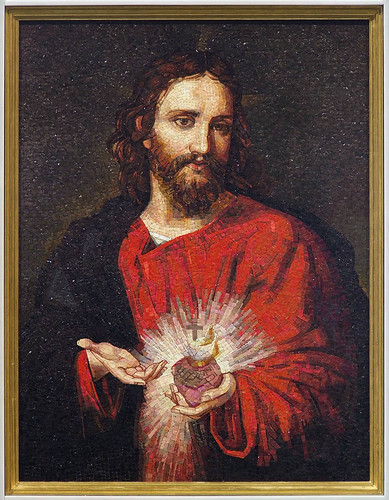
Solemnity of the Sacred Heart of Jesus

Shrine of the Sacred Heart at the Cathedral Basilica of Saint Louis, in Saint Louis, Missouri, USA - mosaic of Christ 2.jpg

Image at the Cathedral Basilica of Saint Louis.

Thursday, May 29, 2008

The Existential Crisis

EXISTENTIALISM WAS the fashionable philosophy of the intelligentsia until the 1960s, and still remains a key source of ideas to the present day.  This philosophy centers on the self, coping in an absurd, ugly world, and is a reaction to Enlightenment Rationalism and Scientific Empiricism.

You know the type.   The Existentialist protagonist is a bored, angry, alienated, cynical, profane, violent, and angst-filled teenager, who sees through other people's phoniness with absolute clarity, who often experiments with drugs and sex, and who basically is experiencing an extreme crisis of self-identity.  His future is uncertain.  While this was scandalous in the 1950s, especially when depicted in the 1951 novel The Catcher in the Rye, what was once a rare example of problematic psychology in the Enlightenment Age is now unfortunately the norm.

A discussion forum on Walker Percy's book Lost in the Cosmos, was quite illuminating.  This book identifies the core problem of today's society as an existential one, where people lose sense of self and especially their relationship with others and with God, leading to our culture's embrace of violence and disordered sexuality.  One commenter stated that reading the old books on Existentialism, like Percy's, is like reading a radical book which denounces geocentrism: so what?  The fact of 'existential angst' is now well-recognized.  Nearly everyone under a certain age, he claims, is in an existential crisis and knows it, and credits the mass media and education system for this.

Existentialism in film is well established, with well-known titles including:  High Noon, The Graduate, One Flew Over the Cuckoo's Nest, Taxi Driver, The Matrix, Fight Club, Garden State, A Clockwork Orange, Donnie Darko, Cool Hand Luke, American Beauty, Apocalypse Now, Blade Runner, and the films of Woody Allen, François Truffaut, and Jean-Luc Godard. And many others.  Life, as we have seen, does imitate art, for the crisis of identity for most was preceded by the popular culture.

The key attribute of someone in an existential crisis is overwhelming anxiety, and an existentialist seeks to embrace this anxiety or angst by a free search for 'meaning' or 'authenticity'. But we ought to recall the words from the Mass of Paul VI:  Deliver us, Lord, from every evil, and grant us peace in our day. In your mercy keep us free from sin and protect us from all anxiety as we wait in joyful hope for the coming of our Savior, Jesus Christ.  Or in other words, anxiety is due to our fallen nature and is not to be embraced.

Modern Existentialism was founded by the Protestant philosopher Søren Kierkegaard, and this philosophical movement has since split into numerous denominations, with various thinkers — atheist or Christian — jettisoning one particular aspect of the theory or another to suit their taste.  Like the huge Enlightenment armies doing battle against each other, the modern philosophies also conflict with each other, with supremacy being gained through brute force, and not because they are shown to be true.

Existentialism was rejected by Pope Pius XII in his encyclical Humani Generis, dating from 1950.  He instead called for a return to the far richer and more universal philosophy of Saint Thomas Aquinas.  As it turns out, Aquinas also has quite a bit to say about existence and the self, but no one makes films about it.