Pages

Tuesday, February 03, 2009

Monday, February 02, 2009

Pictures of People

IF I WERE to photograph people, I'd do classical portraiture.

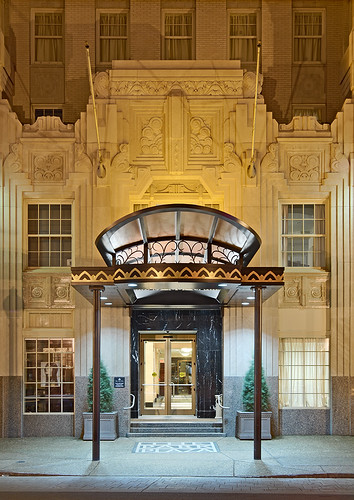
As it so happens, my photos of people are terrible. Just horrible. So I don't show them here. There are several reasons for this, and I often resort to the absolute worst excuse of blaming my equipment, although good lighting equipment is very important, as is a fast-focusing, large-aperture lens, all of which I lack. Also consider that people, unlike buildings, have egos, and so I worry about how subjects would respond to their photos. Also, buildings normally stand completely still for as many hours as I need to take a photo, unlike people who may be impatient or in a hurry. I'm not much of a people person either, which makes things more difficult. Finally, I just don't know how to photograph people well.

Up until a number of years ago, I thought that the electronics in a digital camera ought to make good quality photos appear magically, even though my long experience with film cameras and wet chemical darkrooms should have told me otherwise. Photoshop is the digital tool of choice which replaces the darkroom, but it was a useless expensive purchase for me until I learned some basic theory of human vision and color representation. Likewise, photographing people is an art form in itself: mere experience and experimentation is largely fruitless unless you know some theory behind it.

Contemporary portrait photography seems to be excessively ego-driven, with the main players all attempting to create their own distinctive 'look'. Worse, the subjects of these styles of photography often look rather odd, lacking in dignity. Now this may be a good marketing strategy — consider clothing retailers who change styles frequently in the attempt to drive sales, or youth-oriented religious programs that strive to always be relevant — but the results quickly look dated and eventually comical. This does not serve the common good in the long run.

Contemporary portraiture emphasizes the body, clothing, gestures, and environment: mainly transient things, which may not have much to say about the interior life of the person portrayed. Or worse, a contemporary portrait can portray what the photographer wants us to believe about the subject. Glamour photography is this style taken to an extreme, which creates a fantasy which never existed, for the end result is often as strongly conditioned by creations in Photoshop as by the subject originally photographed.

Classical portraiture instead attempts to portray the person as he is, and at its best, portrays a person's innate and ontological dignity. A classical portrait emphasizes a person's face and especially the eyes: this makes sense, especially if you consider that a significant percentage of our mental capacity is used to recognize and analyze faces. By showing a face clearly, we are able to use these innate abilities. Does the person have subtle laugh lines, or frown lines? Have they suffered from years of worry, or joy? Showing the eyes clearly is of great importance: Our Lord implies this on the Sermon on the Mount (see Matthew 6:22-23). The eyes are the window to the soul. This emphasis on the face and eyes is made stronger by photographing the subject in a studio with a muted backdrop, which provides little distraction from what is important.

Worthy of study is this tutorial: The Zeltsman Approach to Traditional Classic Portraiture, by master portrait photographer Joseph Zeltsman, who passed to his reward on December 15th, 2008, at the age of 100 years. This study is dated, with scans of photographs dating from the 1970s, but these portraits have a timeless quality once we get past the fashions of hair and clothing of that era. His advice is quite timeless.

According to Zeltsman:
The remaining category, the pure traditional classic approach to portraiture, is indeed, aimed specifically toward a portrayal showing the subject’s face from an attractive angle, supported by an effectively arranged body pose. The total effect, as the viewer sees it, should appear natural, comfortable looking, and unaffected. Regardless of how much of the subject’s body is showing, the clothing, props, background, or any other item included in the picture, must remain subdued. Only the face and expression should stand out as the dominant point of interest to a beholder.
I already mentioned the importance of emphasizing the face, but notice how Zeltsman says that the pose must appear “natural, comfortable looking, and unaffected” — this is critical, and strongly distinguishes the tradition from much contemporary practice, which can often be unnatural and quite affected.

The elites of the Victorian Era can be rightly criticized for reducing both morality and art to sets of rules, while forgetting the underlying theories of moral theology and the virtue of art. The avant-garde reacted by rejecting all rules, and we suffer from this chaos to our present day. Zeltsman reminds us of what is important, and any rules he gives merely facilitate this higher goal.

Upcoming Events at the Oratory

At Saint Francis de Sales Oratory in Saint Louis, Missouri:

Candlemas: Solemn High Mass, February 2nd, 6:30 pm
Feast of Saint Blaise and the blessing of the throats: February 3rd, Low Mass 8:00 am, Low Mass with organ: 6:30 pm
First Friday: Solemn High Mass, February 6th, 6:30 pm
Quinquagesima Sunday Brunch: February 22nd
Lenten retreat: Saturday, February 28th - March 1st

Candlemas

TODAY IS the Feast of The Purification of Mary and the Presentation of Jesus in the Temple, also known as Candlemas. From the Catholic Encyclopedia:
According to the Mosaic law a mother who had given birth to a man-child was considered unclean for seven days; moreover she was to remain three and thirty days "in the blood of her purification"; for a maid-child the time which excluded the mother from sanctuary was even doubled. When the time (forty or eighty days) was over the mother was to "bring to the temple a lamb for a holocaust and a young pigeon or turtle dove for sin"; if she was not able to offer a lamb, she was to take two turtle doves or two pigeons; the priest prayed for her and so she was cleansed. (Leviticus 12:2-8)
This feast is celebrated on February 2nd in the Latin Church. In Jerusalem in ancient times this feast was celebrated 40 days after Epiphany, which then as now is a feast which includes as an aspect the birth of Christ.

On this day, beeswax candles are blessed for liturgical use, whence we get the name 'Candlemas'. According to the Baronius Press version (2004) of the Roman Missal:
The procession on this day is one of the most picturesque features of the Western Liturgy. The blessing and distribution of candles, to be carried lighted in procession, precedes the Mass today—a symbolic presentation of the truth proclaimed in the Canticle of Simeon: Our Lord is the “Light for the revelation of the Gentiles.” The anthems sung during this procession, eastern in origin, will express the joy and gladness of this happy festival, and the honour and praise we give to our blessed Lady and her Divine Son by its devout observance.
The English word ‘candle’ is very ancient and comes from the Latin candela ‘candle’, which derives from the Latin verb candere, meaning ‘to be white or glisten’. The liturgical use of candles and oil lamps has roots going back to the Jewish Temple, and the Church preserves a number of uses. Certainly candles have the utilitarian use of providing illumination, but there are a number of symbolical and mystical reasons for using these even in daytime.