Pages

Thursday, December 17, 2009

“Catholic Church Architecture and the Spirit of the Liturgy”


Today I received my copy of the newly-published book, Catholic Church Architecture and the Spirit of the Liturgy by Denis R. McNamara, M.Arch.H., Ph.D., Assistant Director of The Liturgical Institute, University of St. Mary of the Lake (Mundelein Seminary), in Mundelein, Illinois.

I can't wait to read it. It is an attractive, and theologically and historically rich evaluation of church architecture, simultaneously pious and scholarly.

McNamara is the author of the book Heavenly City: The Architectural Tradition of Catholic Chicago a picture book of the churches of Chicago, and writes at the Society of St. Barbara.


I will provide a full review after I read it.  The restoration continues.

O Sapientia

O Sapientia, quæ ex ore Altissimi prodiisti, attingens a fine usque ad finem, fortiter suaviterque disponens omnia : veni ad docendum nos viam prudéntiæ.
O Wisdom, which camest out of the mouth of the Most High, and reachest from one end to another, mightily and sweetly ordering all things: Come and teach us the way of prudence.
— Great “O” Antiphon for Vespers, on December 17th.

The liturgy for Advent starts with an expectation of the end of the world and Second Coming of Our Lord; then it considers the preaching of Saint John the Baptist, forerunner of the Messiah; now it shifts to ancient prophesy of the coming of Our Savior, which culminates in Christmas.

Each O Antiphon is a title of the Messiah: click here for more information.


Contemporary society has a schizophrenic personality: we have a view of the cosmos made of impersonal elementary particles and forces, with scientific knowledge building up from there — and we have a view of the person as a radically free individual, who infallibly creates his own meaning and morality. These are incompatible views of the human person and of knowledge, and so we often choose one and then another — or more often — chose the radical view for ourselves, and the materialistic view for everyone else.

But the older view recognizes the existence of wisdom — knowledge that comes from above, from the general to the particular, drawing conclusions from the highest causes. Wisdom is problematic for contemporary man, for it contradicts the atheism and moral relativism of the world. But even the scientific method implies wisdom, for modern science is not possible without a Platonic view of mathematics, and radical individualism assumes that individuals actually have being, which implies the existence of a supreme being. New systems of thought are quickly proposed, accepted, and then rejected when the inevitable conclusion of wisdom becomes clear.

Contemporary man flees wisdom, due to pride and the desire for sin, but wisdom still pursues him; there is only one place where man can stop this pursuit and completely rid himself of wisdom, and that is in Hell.

Wisdom saves, and Wisdom is a person. May we pray that Wisdom comes to us, and quickly!

Wednesday, December 16, 2009

Advent Wreath

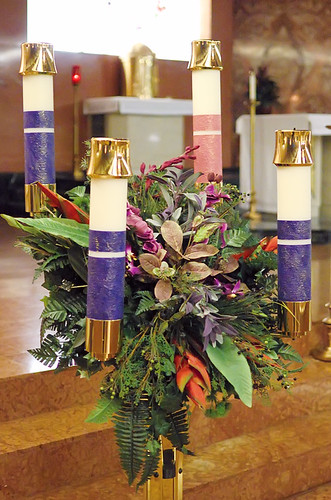
Saint Gabriel the Archangel Roman Catholic Church, in Saint Louis, Missouri, USA - Advent wreath

Advent wreath at Saint Gabriel the Archangel Church, in Saint Louis.

Tuesday, December 15, 2009

Photos of Saint Dominic Church, in Breese, Illinois

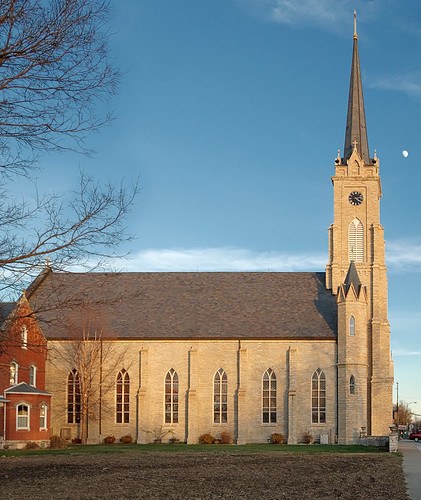
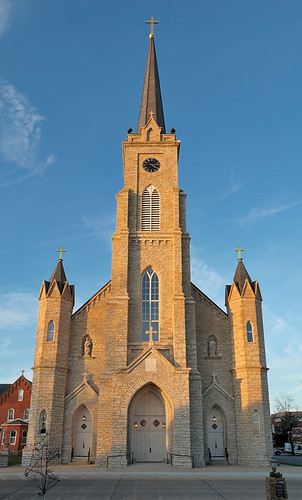
HERE ARE PHOTOS of Saint Dominic Church, in Breese, Illinois.  It is located approximately 40 road miles east of downtown Saint Louis, in Clinton County, on the grand Illinois prairie.  The church is a part of the Diocese of Belleville.
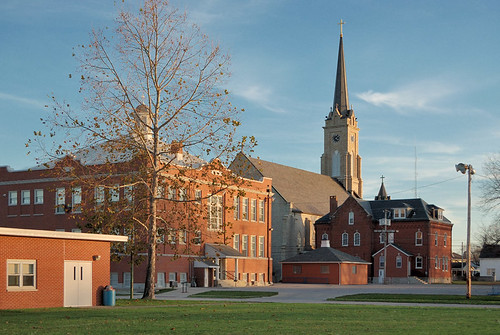
Saint Dominic Roman Catholic Church, in Breese, Illinois, USA - exterior back with school

Last year this parish celebrated its 150th anniversary.

Saint Dominic Roman Catholic Church, in Breese, Illinois, USA - exterior side

The moon appears on the right of this limestone church.  Stone for this church was quarried from nearby Shoal Creek.  These photos were taken on the eve of the first Sunday in Advent, November 28th, 2009.

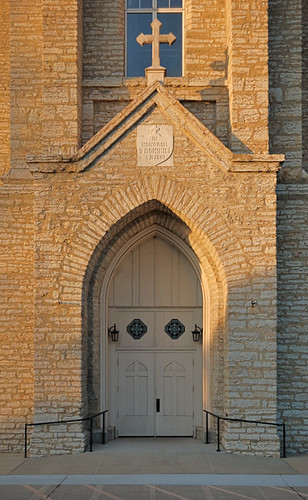
Saint Dominic Roman Catholic Church, in Breese, Illinois, USA - front door

IN HONOREM ST DOMINICI A. D. 1867

The church was completed in December of 1869, and was designed by Otto Koenig, whose firm Koenig and Brothers also designed the first synagogue west of the Mississippi (now destroyed), in downtown Saint Louis for the B'Nai El congregation.
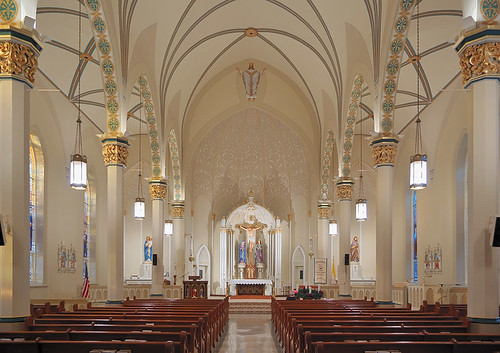
Saint Dominic Roman Catholic Church, in Breese, Illinois, USA - nave

As Mass was scheduled soon after I arrived, I was unable to take many photos here, which is a pity, for it is such a beautiful church.

According to a history of Breese:
Surrounded by high prairie grass and wild animals, the first settlers of Breese arrived by way of the Goshen Road, which passes through the north part of the township. The first two land entries were those of George Green and Joseph Johnson during the year 1816 . Other settlers soon arrived and developed toll bridges across the Shoal Creek waterway. A store and post office was developed at the Toll Bridge on Old State Road in the year 1822.
German farmers began to settle in the area around 1835. The prairie land settlers battled malarial diseases which thrived in the poorly drained flatlands. The worried farmers built crosses on their properties in the hopes of protecting their families from disease. Some of these crosses still stand today.
Growth was slow for Breese until the completion of the Mississippi and Ohio Railroad in 1855. The railroad brought new settlers and business for the area now that travelers no longer had to battle the enormous prairie land grasses which slowed travel. The town was laid out into twenty four blocks in February of 1855. The Shoal Creek Post Office was moved into the Robert Donne home, which was the first house built in the township.
Click here for a history of the church.
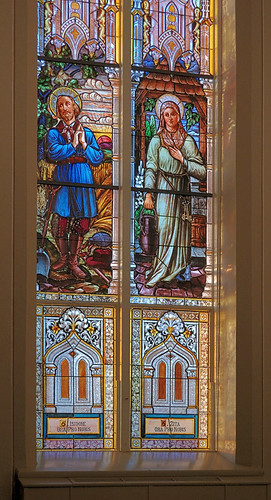
Saint Dominic Roman Catholic Church, in Breese, Illinois, USA - stained glass window

S. Isidore Ora pro nobis
S. Zita Ora pro nobis
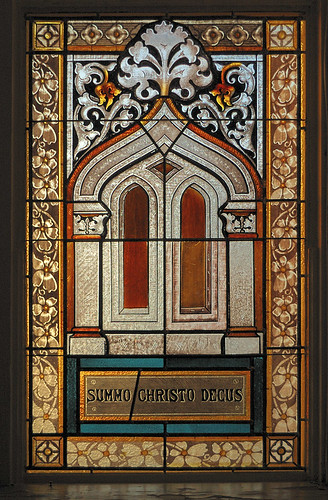
Saint Dominic Roman Catholic Church, in Breese, Illinois, USA - stained glass window detail

SUMMO CHRISTO DECUS

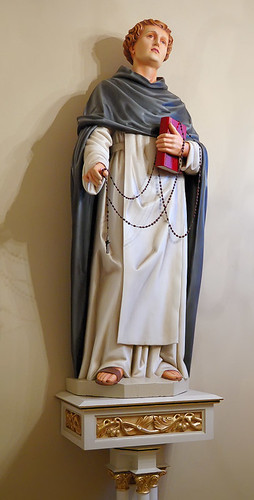
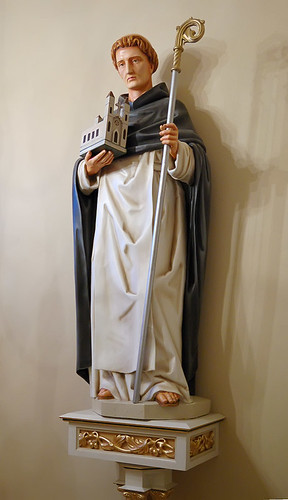
Saint Dominic Roman Catholic Church, in Breese, Illinois, USA - statue 1

The church's patron is Saint Dominic, Santo Domingo de Guzmán Garcés (1170-1221), founder of the Order of Preachers, also known as the Dominicans.

Dominic was accompanying a diplomatic delegation from the King of Castile, who were traveling to Denmark to secure a bride for the Crown Prince.  Along the way, they found Cathar heretics; as these were cultured, educated men, Dominic realized that combating this heresy would require an equally high-calibre of preachers.  He later lived among the heretics, winning souls with austerity, holiness of life, and intellectual rigor.

From Saint Dominic and his order of friars we get the devotion of the Rosary of the Blessed Virgin Mary.
Saint Dominic Roman Catholic Church, in Breese, Illinois, USA - statue 2

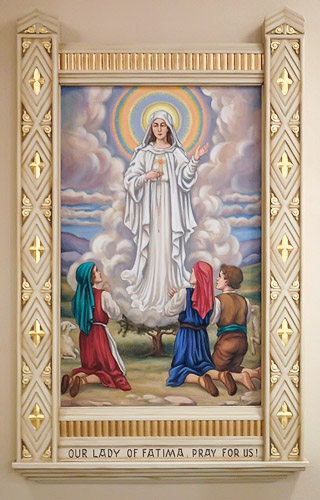
Saint Dominic Roman Catholic Church, in Breese, Illinois, USA - Our Lady of Fatima

Our Lady of Fatima.

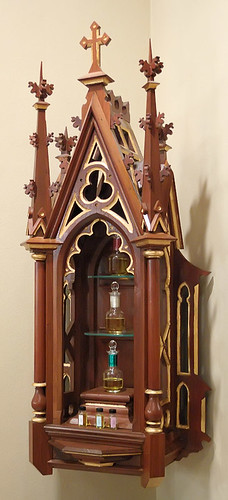
Saint Dominic Roman Catholic Church, in Breese, Illinois, USA - Holy oils ambry

Olea Sancta.

Saint Dominic Roman Catholic Church, in Breese, Illinois, USA - exterior front

Looking up to the church's impressive towers
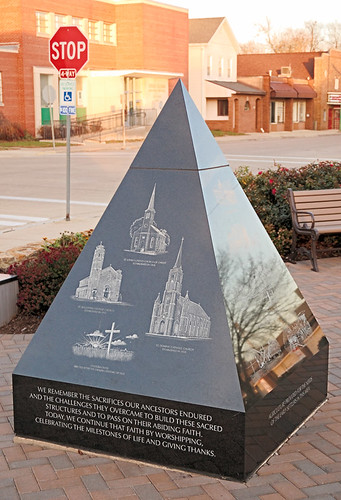
Pyramidal historical monument, in Breese, Illinois, USA

Across from the front door of the church is a small park maintained by the Breese Historical Society. This side of the pyramidal monument depicts three churches in Breese; other sides depict the history, industry, and coal mining in this town.

Click here for photos of other churches in Clinton County.

Address:
493 North 2nd Street
Breese, Illinois 62230
Monday, December 14, 2009

Rose Vestments at the Oratory

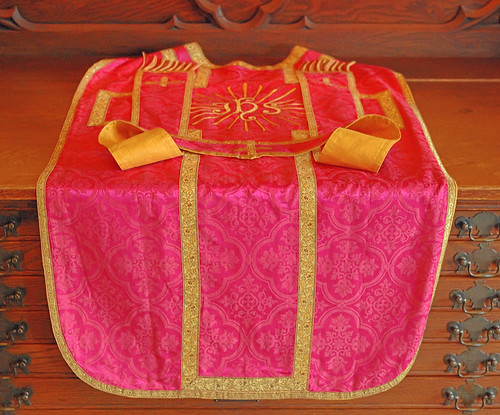
Rose vestments at Saint Francis de Sales Oratory, in Saint Louis, Missouri, USA

Rose vestments, worn yesterday at Saint Francis de Sales Oratory.

I took this photo under mixed lighting: daylight illumines the front, while incandescent light shines on the top. The front color looks, to my eye, to be closest to the actual shade. As digital cameras are not generally calibrated for colors, this is only an approximate rendering.

The Oratory is raising funds for the repair of this magnificent church: Tradition For Tomorrow.