 SAINT FRANCIS DE SALES ORATORY EMAIL NEWSLETTER 2653 Ohio Avenue Saint Louis, Missouri 63118 www.institute-christ-king.org www.TraditionForTomorrow.com 314-771-3100 | ||
|

Friday, February 25, 2011
News From the Oratory



Controversy Over Consequences
UNDOUBTABLY MOST of my readers are familiar with the current controversy raging in Catholic circles in the United States:
Did Live Action lie?
Is Deception Always Wrong? I'm Not Convinced
Building a Culture of Lie
Why Live Action did right and why we all should know that
Faustian Bargains
Augustine vs. the Priscillianists
In Defense of Live Action
Live Action president responds to controversy over group's tactics
Moral Theology? Bah! Humbug!
Justified Deception or Lying? The Case of Live Action v. Planned Parenthood
Is Lying Ever Right?
Catechism of the Catholic Church ¶2464
The controversy is so bad that old friends have become enemies and people are losing their faith over this. Satan laughs.
The argument is revolving around two basic thoughts:
Many are arguing purely from the objective moral law. Lying is a sin, and the Saints, the Magisterium, moral theologians, sacred Tradition, and sacred Scripture all strongly agree. But neglecting the subjective and relative circumstances is legalism and is unjust. Jesus criticized the Pharisees for legalism. But Martin Luther coined the term ‘antinomian’ to describe those Protestant sects whom he accused of rejecting legalism to the point of recognizing no law at all. True virtue is found between legalism and antinomianism.
Others may only consider subjective factors, which is pure hedonism — if it feels good, do it. This can hardly be the foundation for a good society, for only the strong will thrive. More nuanced views will claim that someone ought to put off easy pleasures to gain greater pleasures, but then this brings up the problem of distinguishing greater and lesser desires: could this hierarchy of desire be somehow rooted in human nature, or something higher?
Relativism only takes circumstances into account. This is very fashionable because it appears to be tolerant, but again it isn't a basis for a good society because it fails to answer why some actions are better than another. Why not choose any action? If relativism is the only means of judging moral culpability, then why should society judge any action wrong? Were you there? How can you judge? But we know from history that moral relativists judge others extremely harshly, more than those who have the orthodox view of moral culpability.
Modern thinking rejects the objective component of moral culpability (usually for reasons of sexuality or greed), and tries to devise ethical systems based solely on subjective and relative factors. Situational Ethics, devised in the 1960s by the Episcopalian priest Joseph Fletcher (R.I.P.), ignored all moral law except supposedly agape love. Fletcher's system justified abortion, euthanasia, sterilization, eugenics, genetic engineering, and infanticide. Fletcher later became an atheist.
Proponents of these antinomian moral systems like to construct difficult moral dilemmas, where you have to decide on a course of action. Here is one of Fletcher's examples:
Another problem with antinomians is that they apply this morality only to themselves; everyone else will be forced to follow their laws without choice or conscientious objection — which is pure legalism. Please remember that evils are found in opposite pairs.
Here is another moral dilemma:
The intention of situational ethics is to make you to chose evil.
Likewise in the Live Action controversy (seen in the links above) people have constructed moral dilemmas regarding lying, and why it might be justified in some situations. For example:
But it isn't World War II. There is no Gestapo. Although the Jews will remain a target of destruction by Satan and his minions until the end of the age, this scenario will never happen in precisely this way. We can discuss moral culpability from the comfort of our homes or offices, but can we predict with certainty what we would do under extreme circumstances? Who has the right to determine morality from an artificial situation like this? If you believe that the ends justify the means, why is it that some ends are preferable over some means? Doesn't this require an objective factor in moral culpability? Aren't the means ends in themselves?
The answer to this controversy is to understand what the objective moral law is about. Lying is a sin, one of many sins. It is a person's responsibility to avoid sin every day, even in ordinary situations. Do you habitually lie to your family, friends, superiors, subordinates, or to the strangers you meet every day? Or do you make truthfulness a part of yourself? Do you lie when you can get away with it, and are truthful if you will be found out? Do you lie in trivial situations, while you pretend that you will be truthful in important situations? Are you plainspoken, or are you always trying to find nuanced ways to tell untruth so that you don't feel guilt about it? Or do you hold to a philosophy that there is no truth so that you can lie with impunity?
Constant daily practice of upholding the truth makes you a more truthful person. Daily practice of the virtues will make you a more virtuous person. Forget about hypothetical situations. Be truthful and moral NOW (yes, I am preaching to myself here). If a modern-day Gestapo comes knocking on your door, then, and only then will you know what to do, with God's grace.
Did Live Action lie?
Is Deception Always Wrong? I'm Not Convinced
Building a Culture of Lie
Why Live Action did right and why we all should know that
Faustian Bargains
Augustine vs. the Priscillianists
In Defense of Live Action
Live Action president responds to controversy over group's tactics
Moral Theology? Bah! Humbug!
Justified Deception or Lying? The Case of Live Action v. Planned Parenthood
Is Lying Ever Right?
Catechism of the Catholic Church ¶2464
The controversy is so bad that old friends have become enemies and people are losing their faith over this. Satan laughs.
The argument is revolving around two basic thoughts:
- Lying is sinful.
- We have to do something about abortion. What Live Action did worked.
- Objective moral law.
- Subjective mental state.
- Relative circumstance.
Many are arguing purely from the objective moral law. Lying is a sin, and the Saints, the Magisterium, moral theologians, sacred Tradition, and sacred Scripture all strongly agree. But neglecting the subjective and relative circumstances is legalism and is unjust. Jesus criticized the Pharisees for legalism. But Martin Luther coined the term ‘antinomian’ to describe those Protestant sects whom he accused of rejecting legalism to the point of recognizing no law at all. True virtue is found between legalism and antinomianism.
Others may only consider subjective factors, which is pure hedonism — if it feels good, do it. This can hardly be the foundation for a good society, for only the strong will thrive. More nuanced views will claim that someone ought to put off easy pleasures to gain greater pleasures, but then this brings up the problem of distinguishing greater and lesser desires: could this hierarchy of desire be somehow rooted in human nature, or something higher?
Relativism only takes circumstances into account. This is very fashionable because it appears to be tolerant, but again it isn't a basis for a good society because it fails to answer why some actions are better than another. Why not choose any action? If relativism is the only means of judging moral culpability, then why should society judge any action wrong? Were you there? How can you judge? But we know from history that moral relativists judge others extremely harshly, more than those who have the orthodox view of moral culpability.
Modern thinking rejects the objective component of moral culpability (usually for reasons of sexuality or greed), and tries to devise ethical systems based solely on subjective and relative factors. Situational Ethics, devised in the 1960s by the Episcopalian priest Joseph Fletcher (R.I.P.), ignored all moral law except supposedly agape love. Fletcher's system justified abortion, euthanasia, sterilization, eugenics, genetic engineering, and infanticide. Fletcher later became an atheist.
Proponents of these antinomian moral systems like to construct difficult moral dilemmas, where you have to decide on a course of action. Here is one of Fletcher's examples:
I dropped in on a patient at the hospital who explained that he only had a set time to live. The doctors could give him some pills (that would cost $40 every three days) that would keep him alive for the next three years, but if he didn't take the pills, he’d be dead within six months. Now he was insured for $100,000, double indemnity and that was all the insurance he had. But if he took the pills and lived past next October when the insurance was up for renewal, they were bound to refuse the renewal, and his insurance would be canceled. So he told me that he was thinking that if he didn't take the pills, then his family would get left with some security, and asked my advice on the situation.We ought to be aware that the situation proposed is designed to force you to chose euthanasia. It is a simple extension from this conclusion to euthanasia as public policy. In fact, our options are not limited, nor can we predict the future with great accuracy, and situationism ignores or trivializes grace.
Another problem with antinomians is that they apply this morality only to themselves; everyone else will be forced to follow their laws without choice or conscientious objection — which is pure legalism. Please remember that evils are found in opposite pairs.
Here is another moral dilemma:
Former President George W. Bush and President Barack Obama have been kidnapped and are tied to the tracks in a railroad switching yard. A train is heading towards them. You can throw a switch one of two ways, so that only one of either President Bush or President Obama is run over, while saving the other; if you do nothing, both of them will be run over by the train. What do you do?Undoubtably many people would love to throw the switch one way or the other — or chose to do nothing. But my advice is to not play the game at all — for this game is designed purely to reveal your partisan bias. If you do reveal a choice, please be very aware of what you are publicly advocating.
The intention of situational ethics is to make you to chose evil.
Likewise in the Live Action controversy (seen in the links above) people have constructed moral dilemmas regarding lying, and why it might be justified in some situations. For example:
It is World War II and you are hiding Jews in your attic. The Gestapo knocks on your door and asks you if any Jews are in your home. If the Gestapo finds them, they will be certainly murdered. But lying is a sin, so you cannot lie to the Gestapo; moral theology says you cannot sin to prevent sin. So in defense of the truth, do you honestly reply to the Gestapo, even though your Jews will be murdered?This is a classic situational ethics dilemma, and from this dilemma come charges of Pharisaism, legalism, and even disbelief — some refuse to believe in a God that would prefer a person not to lie than to save innocent lives. Controversialists are jumping through hoops attempting to nuance what is a lie and what is not, while others are saying that it doesn't matter at all — the ends justify the means.
But it isn't World War II. There is no Gestapo. Although the Jews will remain a target of destruction by Satan and his minions until the end of the age, this scenario will never happen in precisely this way. We can discuss moral culpability from the comfort of our homes or offices, but can we predict with certainty what we would do under extreme circumstances? Who has the right to determine morality from an artificial situation like this? If you believe that the ends justify the means, why is it that some ends are preferable over some means? Doesn't this require an objective factor in moral culpability? Aren't the means ends in themselves?
The answer to this controversy is to understand what the objective moral law is about. Lying is a sin, one of many sins. It is a person's responsibility to avoid sin every day, even in ordinary situations. Do you habitually lie to your family, friends, superiors, subordinates, or to the strangers you meet every day? Or do you make truthfulness a part of yourself? Do you lie when you can get away with it, and are truthful if you will be found out? Do you lie in trivial situations, while you pretend that you will be truthful in important situations? Are you plainspoken, or are you always trying to find nuanced ways to tell untruth so that you don't feel guilt about it? Or do you hold to a philosophy that there is no truth so that you can lie with impunity?
Constant daily practice of upholding the truth makes you a more truthful person. Daily practice of the virtues will make you a more virtuous person. Forget about hypothetical situations. Be truthful and moral NOW (yes, I am preaching to myself here). If a modern-day Gestapo comes knocking on your door, then, and only then will you know what to do, with God's grace.
Wednesday, February 23, 2011
"Where Have All the Good (Wo)Men Gone?"
SEE THE ARTICLE Where Have All the Good (Wo)Men Gone? by Jennifer Fulwiler, which quotes the article Where Have The Good Men Gone? by Kay S. Hymowitz.
Social Justice is not just a catchphrase for those who want to pursue liberal issues. It in fact derives from Catholic teaching greatly developed in the 19th and is de fide. The situation described in the articles above is very much a social justice issue. Unfortunately, the division between the sexes is presented as class conflict of the marxist kind: instead of partners, men and women are seen as competitors.
Social Justice is not just a catchphrase for those who want to pursue liberal issues. It in fact derives from Catholic teaching greatly developed in the 19th and is de fide. The situation described in the articles above is very much a social justice issue. Unfortunately, the division between the sexes is presented as class conflict of the marxist kind: instead of partners, men and women are seen as competitors.
Tuesday, February 22, 2011
Upon This Rock I Will Build My Church
ACCORDING TO ancient tradition, on February 22nd Our Lord granted Saint Peter leadership of His Church on earth, symbolically represented with keys in this stained glass window:
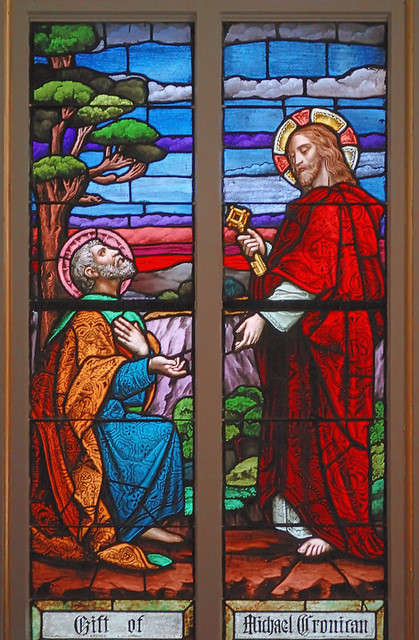
At Saint Joseph Church, in Louisiana, Missouri.
At Saint Joseph Church, in Louisiana, Missouri.
Subscribe to:
Posts (Atom)
