

Wednesday, April 13, 2011


Tuesday, April 12, 2011
Unsolved Problems
AN INTELLECTUAL HISTORY of the world, according to contemporary scholars:
- Evolving from bonobo-like apes, early hominids slowly developed language skills, starting with basic grunts and gestures, to pidgin-like vocalizations, and finally to languages with full grammar and syntax.
- Increased travel and leisure led to an intellectual interest in the natural world. The Greek philosopher Democritus (ca. 460 - ca. 370 B.C.) posited the existence of atoms, indivisible primary constituents of matter.
- ...nothing interesting happens for 2000 years...
- Galileo (1564-1642) confronts the backwards Catholic Church by declaring that the sun — and not the earth — is at the center of the cosmos, and also that the moon has no influence on the ocean tides. Because he is a scientist, Galileo is harshly persecuted, worse than any other man in history. Scientists subsequently return the favor many times over.
- Progress in the sciences is made through the work of Descartes, Pascal, Newton, Leibniz, Linnaeus, Lavoisier, Gauss, Faraday, Darwin, Kelvin, Maxwell, Mendeleev, Lorenz, Freud, Planck, Curie, Jung, Einstein, Bohr, Heisenberg, von Neumann, Skinner, Levi-Strauss, Turing, Feynman, Hawking, and many others. Each generation of scientists, building on the work of those before, increases and perfects Man's knowledge of the world. Progress is inevitable.
- The accelerating increase in the rate of change of scientific progress means that soon we will pass through a technological singularity, after which there will be no more want, war, or suffering (most likely because everyone will be dead). Until that time, more money is needed for research.
Paradox of the plankton
Evolution seems to demand that when multiple species compete against each other for limited resources, one species will become dominant, wiping out other species, until evolutionary progress creates a new, more fit species, which in turn will wipe out its former rival. We can extend this evolutionary analogy to other cases, such as men versus women, capitalists versus proletariats, Walmart versus main street, and so forth, all of which will struggle for supremacy. But wide varieties of plankton species coexist, and we do not see a struggle for mastery.
I don't see this as a paradox. Rather, I see winner-take-all competition as the exception and not the rule: certainly among humans, competition is something that is very often imposed, and is not the normal state of affairs. In nature, a fairly harmonious balance is what we almost always see, and that is as it must be.
Why are there two sexes?
Undoubtably, there are some people who would prefer to reproduce themselves asexually via cloning, and I claim that these people are likely the worst candidates for reproduction. From an evolutionary standpoint, sexual reproduction is seemingly poor because only half the individuals in a population bear offspring, and each individual can only pass on half of its genes at one time. And so, a supremely fit individual cannot fully reproduce itself and must deign to mix its genes with a genetic inferior (which is why some misguided people want cloning). However, sexual reproduction is quite robust in providing healthy genetic material to individuals, because the process of genetic recombination usually eliminates damaged genes.
Usually it is asserted that sexual reproduction increases variation in the population, but this may not be true when you consider whole populations. Although controversial, some think that sexual reproduction instead acts as a brake on evolution, since mutations tend to be largely eliminated. Forced breeding, as we see with domestic animals, does generate a great variety of individuals, but only at the risk of very poor fitness. Tabbies and mutts are usually healthier than purebreds. My thoughts on forced breeding can be found here.
Evolution is often seen by theorists as ‘whatever’; but rather all organisms by necessity follow the laws of chemistry, physics, and mathematics. Some people go into biology because they like science but aren't good at math. Scaling, for example, is often considered to be a problem in biology: small organisms simply don't operate like larger ones. But this is a problem only when you ignore the math. Problems in biology become certainties in mathematics. Scale is also a major problem with fiction writers.
Why we have sexual reproduction is considered by biologists to be an unsolved problem, although there are some odd and largely unsupported theories to its origin. But let us consider the possibility that sexuality is somehow inherent in the cosmos or is a basic reality. A bird cannot fly unless its wings correspond to the laws of aerodynamics; might it also be possible that sexuality is somehow a law of nature? Chinese philosophy certainly thinks so — consider the concept of yin and yang. We find similar ideas in traditional Western philosophy also, although they aren't popular these days. Alas, many people go into science because they like the truth, but aren't good at philosophy: this in my opinion is a huge problem.
The problem of consciousness
Why is there a subjective component to experience? Although this is a core fact of theology, scientists have made no progress on this problem. For various reasons, scientists self-limit themselves in this inquiry, and usually seek purely materialistic solutions, but this doesn't work. Some hold to a theory of panpsychism or hylopathism (such as Phillip Pullman's series of anti-Christian novels) where consciousness is somehow inherent in matter or in some particles. This seems rather arbitrary and reductionistic, and its First Cause is a lesser god indeed. Quantum-mechanical solutions to the problem are problematical since we don't know the meaning of quantum mechanics.
Others hold that consciousness is an illusion, but to whom is this illusion presented? Undoubtably there may be people who believe that they are the only ones who are conscious, with the rest of us being unthinking sheep. Certainly you can see the side-effect of this kind of solipsism when it comes to public policy: if our laws tell us what to do in minute detail, then undoubtably our leaders must think that we are in fact unthinking machines. This attitude likely is derived from the Puritan theory of double-predestination, where some people can know for a fact they are saved, while others are certainly damned. I've written more about this problem here.
Although the mind-body dualism of Descartes seems to be a popular opinion, scientists are sharply divided on philosophy of the mind. Catholic anthropology posits the existence of a world of matter and a world of spirit, with the human person straddling the two worlds; the human brain acts as the sense organ for the spiritual human intellect, and this distinguishes us from pure matter which has no intellect, and from the spiritual angels who are pure intellect. This anthropology has a bit in common with Cartesian dualism, but it avoids certain existential problems inherent in dualism, since it does not set up a divorce between the body and the spirit.
The Problem of Free Will
This is closely related to the problem of consciousness. Scientists are mixed in their opinion of free will, and adherents to one side or the other will often embrace the extreme political philosophies of libertarianism or totalitarianism. Some Protestants deny free will, whereas free will is a core doctrine in Catholicism, Orthodoxy, and Judaism. The determinism inherent in reform theologies led to determinism in the sciences and politics: the discovery of the apparently non-deterministic quantum mechanics did much to change opinions among scientists. This apparent non-determinism awoken a new interest in spirituality among scientists, but they notably reject Catholic spirituality in favor of philosophies of the far east or the New Age. Ultimately we can hope that scientists will recognize the Catholic roots of the scientific method, as well as the reason why science is even important.
Many think that free will and determinism are contradictory. Catholic theology instead posits the greatness, infinitude, and transcendence of God as the solution to the paradox. A lesser god cannot both allow freedom while knowing the future, while the God who transcends space and time can. Unlike the libertarians, Catholics believe that free will in humans is limited by the damage caused by Original Sin.
Why do we dream?
It was horrible. I was flat on my back for hours, unable to move and unconscious of everything going on around me. During this time I suffered extreme hallucinations that I thought were real. It is hard to believe, but people call this sleeping ‘normal’.
Why do we dream? Nobody knows. We don't even know why we sleep. Maybe the brain is always active, so we interpret this activity as dreams. Perhaps dreams have something to do with sorting out our thoughts and experiences of the day, saving some as memories, and discarding others as junk; this seems quite plausible. Maybe dreams can include the intersection of our mind with the spiritual world: most scientists, but not all, would discard this hypothesis. I wrote about dreaming here.
Nature versus Nurture
What is the relative importance of our genetics compared to our environment? Even relatively lately, your worth as an individual was seen as being largely dependent on one or the other: Nazis judged genetics, while Communists discriminated on environment.
Obviously genetics plays an important role. Take a human baby and a rock, raise them in the same environment, and the rock will show hardly any personality development at all. But environment also plays a role: raise a baby in Alaska, and raise its identical twin in Kenya, and they will likely be quite different in adulthood. This relationship is now seen to be particularly complex, with great interdependence of factors. Quality schooling is more predominant among certain genetic groups, but do certain genes cause a predilection for good education? Or if you send children from various groups to the same school, can we expect a similar outcome? But unlike the 20th century, scientists now mainly agree that this is not an either/or issue of nature versus nurture, but rather is nature and nurture. This does not mean that we understand how the factors interrelate, and so studies on personality development still have difficulty.
This is still considered a major unsolved problem, and is mirrored by the controversies on grace versus nature in theology. In fundamentalism grace predominates, in liberalism nature is dominant, while Catholicism marries grace and nature together.
We ought not think that a reasonable understanding of nature and nurture will be found in the political sphere. Some groups organize themselves, or are distinguished, by what is claimed to be purely genetic factors — such as ethnicity and sex — while others groups emphasize nurture, such as religion and ideology. The modern trend is to invert nature and nurture: sex, for example, is claimed by some to be a purely cultural phenomenon, while some have proposed that religious belief is caused by a 'god gene'; however I see this as being more of a political strategy rather than a careful investigation of the truth.
Catholic anthropology emphasizes the sameness of human beings, while modernity emphasizes, and strongly acts on even minor differences among humans. This variation in belief has extreme consequences, including the rise of slavery, oppression, and genocide in the post-Reformation world.
“Nurture” was once assumed to be mainly family life, and was particularly focused on the mother. Nowadays, environmental factors such as peers, schooling, and the media are seen to have a greater effect on personality than family life, which is a strong argument for homeschooling.
But notice that this debate is based purely on determinism. We must also take free will into account, but most contemporary scientists are uncomfortable with this.
Does extraterrestrial life exist?
The idea of life in outer space was rare until the modern age, particularly after it was discovered that Earth does not physically occupy the center of the cosmos. The common scenario presented by fiction writers is that extraterrestrial life is quite common, and that sometime in the near future we will be able to travel to these exotic locales and interact with these lifeforms, if they haven't visited us already. But we ought to contrast this fictional view with the apparent fact that space, as far as we can tell, is lifeless, and there is no practical way we can travel much beyond earth (of course, this reality doesn't have much dramatic potential). I wrote more about space travel here.
What is the structure of water?
The composition of water, we are told, is H2O, but that isn't quite right, for water molecules connect to their neighbors in complicated and unknown ways. Water just isn't like other chemicals.
Do one-way functions exist?
In computer science, a function is a process that takes an input, transforms it in some way, producing an output. For example, take a function that simply multiplies the input number by two. Given an output, you can easily determine the input by dividing by two. But some functions appear to be vastly more complex; given an output, you can't quickly determine the input with a simple formula, even if you know precisely how the function works. These are called one-way functions.
Here is another simple function: input two prime numbers and multiply them together, producing an output. Given an output, is there any quick way to determine the two numbers? (A prime number is indivisible by any positive whole number other than 1 and itself: 2, 3, 5, 7, and 11 are examples of small prime numbers.) OK, if the function returns 6, you know that the input numbers must be 2 and 3. But what if the number is really, really big? At present time, the only method of solving this problem involves trial-and-error: is the number evenly divisible by 2? No, well how about 3? What about 5 then? 7? And so on. A 232 digit number was successfully broken in the year 2009 using hundreds of computers that worked over the course of two years. Just adding a few digits makes the problem vastly harder to solve; no matter how fast computers get, you can easily overwhelm them with little effort on your part.
One way functions are used in cryptography, which is not only important to spy agencies, but also to ordinary folks who use wireless technology. The common WiFi networking standard, found in innumerable Internet cafes, uses one-way functions to ensure privacy of data transmitted over the air.
But do one-way functions actually exist? Is there some simple formula, currently unknown, which will quickly solve them? This is closely related to NP-complete problems, for which no fast solution is known.
Valuation problems in economics.
Investors are more likely to highly value companies that pay dividends, contrary to utilitarian models. This dividend puzzle ought to be easily explainable. Economists tend to define all money as being equal, but a bird in hand — a dividend — is worth two in the bush — that is, owning a stock. Cash in hand is yours, while cash tied up in companies is not quite so easy to extract, and getting that cash is contingent on constantly fluctuating stock prices.
Options allow an investor to manage risk, but economists are puzzled since they appear to be overpriced. There are formulas which calculate the expected price of options, but some of these severely underestimate risk, and so give a wrong value for options. These formulae also incorporate something called a “risk free interest rate” — typically defined as the U.S. Treasury bond rate — but that concept is unreasonable; I can come up with all sorts of plausible and likely scenarios which will drive any investment to zero, including treasury bonds. Are theorists really that optimistic? Should we be listening to them? Reality is riskier than theory, and so it is plausible that options ought to cost more.
Is there an objective measure for the quality of translation?
This is highly debated with the new translation of the Roman Missal into English, due to come into use at Advent this year.
In theory, the dynamic equivalence translation found in the current missal is valid, since it theoretically converted idiomatic Latin into good idiomatic American English. However, the translators sometimes seemed to go out of their way to change the meaning of the texts, which is something else altogether. The translation is also rather flat and unpoetical, unlike the original Latin.
A literal translation, which translates a text word-for-word, will usually produce a stilted text. The presence of idioms and unusual word orders will make texts hard to understand. Changing word order and substituting some idioms in the translation can make texts more readable while still being largely literal. But perhaps we should keep a certain amount of Latinity in our translations in the Latin Church; Catholics ought not be ignorant about their liturgy and Rite.
A literary translation will attempt to preserve the meaning and style of a text. This is the most difficult to do well, and requires great expertise. How do you translate puns, rhyming, and alliteration? The old Anglican Book of Common Prayer is well-regarded as a largely elegant translation of Latin texts into English.
The most extreme philosophies will state that even primary texts themselves have no meaning, and so there is no objective component to translation, and so translation is arbitrary. But this is nonsense; language is more than just random utterances. We can't live if language is meaningless, or if it means only what we want it to mean. Words are not mere vocal utterances, they instead ought to correspond to real things, and we must attempt to keep these real-world references intact. Never, ever allow a postmodernist near your texts.
The Yang–Mills Existence and Mass Gap.
“Prove that for any compact simple gauge group G, a non-trivial quantum Yang–Mills theory exists on R4 and has a mass gap Δ > 0. Existence includes establishing axiomatic properties at least as strong as those cited in [45, 35].”Um. I don't think I have anything to offer here. Math is hard.
What is randomness?
That there are several schools of thought in probability theory — utterly unlike most other branches of mathematics — leads me to believe that the theory of randomness is a great unsolved problem. Can we state with certainty that something is utterly, irreducibly random, or is there order behind the chaos?
Probability and statistics is the bane of most university students, largely because much of it is counter-intuitive, and (I think) that some of it may be — well, not strictly wrong, but problematic. Mathematics can be seen as logic taken to an extreme degree, but there seems to be an attitude that it is all a complex word game, not relating to anything real. But if one of your axioms is false, has no being, has no reality, then your theorems based on that axiom will fall apart, and that is precisely what we see in probability theory: people can come to differing conclusions based on the same axiom of randomness. We see this when dealing with imaginary numbers — they are useful, but need to be handled according to convention, and so we can conclude that imaginary numbers are not real, but are truly fabricated. (There are better mathematical entities than imaginary numbers, which have the same usefulness without the need to handle them according to arbitrary convention.)
Is a random variable something that exists ontologically? Or is it just a useful convention based on our ignorance? I tend to think that you can't be both Catholic and think that random variables have ultimate existence, since you'd be denying God's omniscience, and you would be positing randomness as a First Cause. One of the best purely secular explanations of this is found in Volume 1 of the book The Art of Computer Programming, by Donald Knuth, a book which also helped me think of art as being something more than just what is found in museums. Here Knuth, who is a practicing Lutheran, states that we ought to consider randomness to be merely a measure of naive unpredictability, even if the process used to generate these random numbers is completely deterministic (see the section above on one-way functions). The problem of randomness figures into debates on the interpretation of quantum mechanics and free will.
Some of my thoughts on randomness and the scientific method are found in the article How Random?
What is Art?
This is an easy one, but too often we are given narrow explanations by specialists, which isn't helpful and leads to controversy. According to Saint Thomas Aquinas, art is “right reason with regard to external productions” (recta ratio factibilium). It isn't just something that hangs in museums, or something purely aesthetic. Everything habitually made by humans according to right reason is art. I wrote more about it here.
Monday, April 11, 2011
Photos of Saint Elizabeth Church, in Marine, Illinois
HERE ARE PHOTOS of Saint Elizabeth Church, in the village of Marine, Illinois. Located about 30 highway miles northeast of downtown Saint Louis, the church is in Madison County and is a part of the Diocese of Springfield in Illinois.
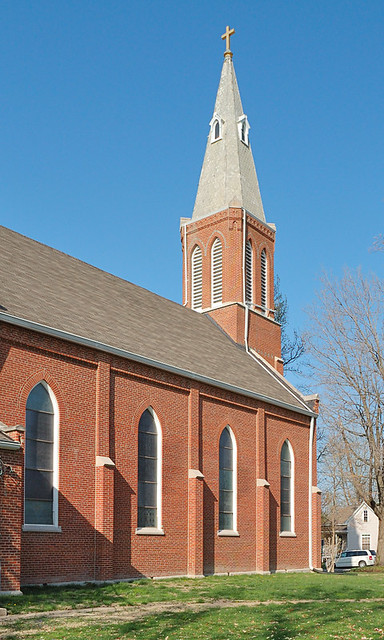
Fifteen Catholic families organized in 1856 to start a new parish; with $1500 they started building a church, and the first Mass was held on Easter Monday, 1859, by Fr. Paul Limacher, Rector of Saint Paul Church in nearby Highland, Illinois.
The original church was small and quickly became dilapidated. The present church is 80 feet long, 38 feet wide, with walls 25 feet high. The tower is 110 feet high with three bells; it was completed at a cost of $10,000, and dedicated on Saint Elizabeth of Hungary's feast day in 1883. The first Mass was celebrated by Pastor Henry Eggenstein, who served the parish from 1877-1914.
The stained glass windows were installed by the next pastor, the Rev. Antoine Wieneke. In the 1990s, a catechetical center was constructed adjacent to the church.

There are approximately 350 registered Catholics in the parish.

The Sacred Heart and Divine Mercy are shown here on the altar, flanked by Saint Elizabeth of Hungary and Saint Catherine of Alexandria.
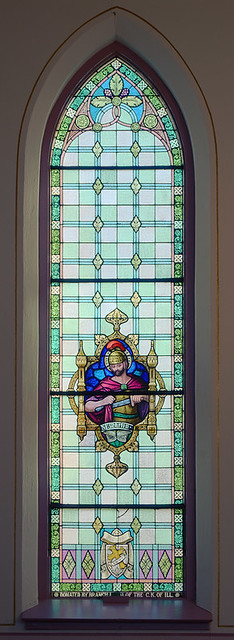
Stained glass window, showing Saint Martin of Tours. A Roman soldier, Martin is shown here cutting his cape to give to a beggar.
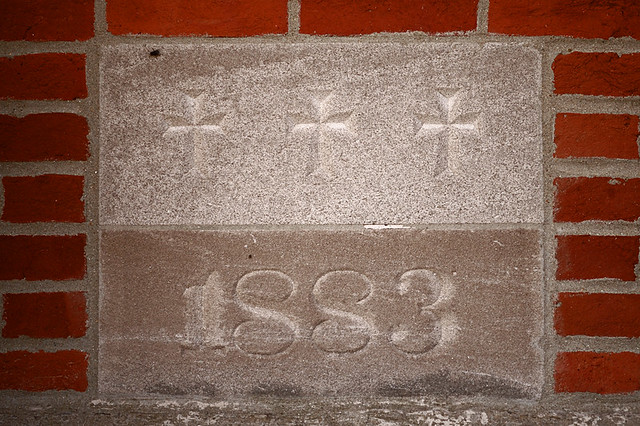
The cornerstone. 1883.
Address:
120 North Windmill Street
Marine, Illinois 62061
Fifteen Catholic families organized in 1856 to start a new parish; with $1500 they started building a church, and the first Mass was held on Easter Monday, 1859, by Fr. Paul Limacher, Rector of Saint Paul Church in nearby Highland, Illinois.
The original church was small and quickly became dilapidated. The present church is 80 feet long, 38 feet wide, with walls 25 feet high. The tower is 110 feet high with three bells; it was completed at a cost of $10,000, and dedicated on Saint Elizabeth of Hungary's feast day in 1883. The first Mass was celebrated by Pastor Henry Eggenstein, who served the parish from 1877-1914.
The stained glass windows were installed by the next pastor, the Rev. Antoine Wieneke. In the 1990s, a catechetical center was constructed adjacent to the church.
Many thanks to Fr. who showed me a history of this parish.
There are approximately 350 registered Catholics in the parish.
The Sacred Heart and Divine Mercy are shown here on the altar, flanked by Saint Elizabeth of Hungary and Saint Catherine of Alexandria.
Stained glass window, showing Saint Martin of Tours. A Roman soldier, Martin is shown here cutting his cape to give to a beggar.
The cornerstone. 1883.
Address:
120 North Windmill Street
Marine, Illinois 62061
Saturday, April 09, 2011
Suffering and Lent
CATHOLICISM IS NOT nice or pleasant, for it is a religion of warfare. If a religion is nice, if everything is OK, if things are getting better and better, then why bother? But in spiritual warfare there will be loss and sorrow — even if final victory is guaranteed.
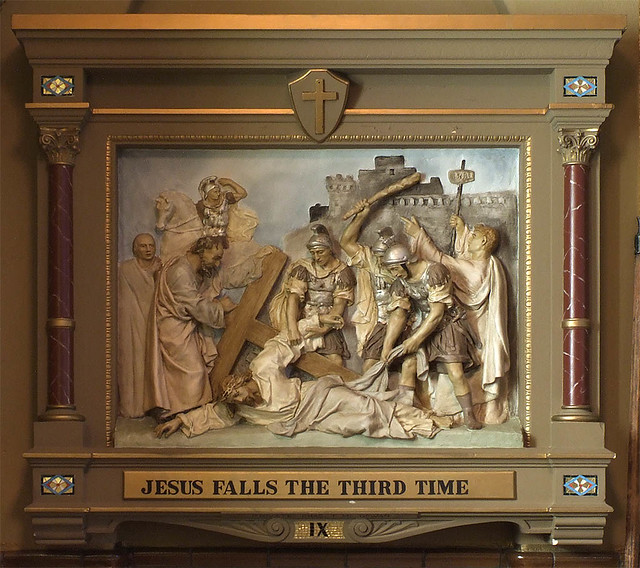
Station of the Cross at Saint Charles Borromeo Church, in Saint Charles, Missouri. Photo taken in 2007.
I think it is often a mistake for new Christians, or the merely curious, to attempt to read sacred scripture unaided starting from Genesis. Rather, I would instead recommend starting with the Old Testament wisdom books and the Gospels. Wisdom is not nice and pleasant, although it can give faith and hope. The wisdom literature is an arrow that pierces the heart, avoiding the worldly barricades that attempt to prevent the Gospel from reaching our intellect.
The liturgical texts are often full of suffering and lament, and in Lent, we recall the passion of Christ. The English word ‘passion’ derives from the post-classical Latin word passio, meaning ‘a suffering’ or ‘enduring’, while the Latin word compassio means to ‘suffer with’. And so we are to have compassion, to suffer with Christ: “O God my God, why have you forsaken me?”
And let us consider Mary, the woman of sorrows, as our model for this suffering.
From Ruth:
From Lamentations:
Job disagrees, and laments:
Viktor Frankl, psychiatrist and Holocaust survivor, rediscovered the principles of redemptive suffering and compassion while in the concentration camps; the world listened for a while, but has now forgotten those lessons. The world does not want to suffer, which is natural but unrealistic, but I think that it is worse in that it lacks compassion. Most people, of more-or-less good will, may be willing to do a little to relieve the suffering of others, but are they willing to have compassion, to suffer with the suffering, to share the burden of the suffering of others? Are we willing to help bear the cross of others?
The critics don't realize that you can both suffer and be happy at the same time. There can even be beauty in sorrow, although it might take some time to see it.
Bearing suffering gracefully is an art, which, we may pray, can be lifted by grace and with patience. Compassion is a virtue which Lent helps strengthen, and when we have true compassion, we then may more fully experience the joy of Easter.
Station of the Cross at Saint Charles Borromeo Church, in Saint Charles, Missouri. Photo taken in 2007.
I think it is often a mistake for new Christians, or the merely curious, to attempt to read sacred scripture unaided starting from Genesis. Rather, I would instead recommend starting with the Old Testament wisdom books and the Gospels. Wisdom is not nice and pleasant, although it can give faith and hope. The wisdom literature is an arrow that pierces the heart, avoiding the worldly barricades that attempt to prevent the Gospel from reaching our intellect.
The liturgical texts are often full of suffering and lament, and in Lent, we recall the passion of Christ. The English word ‘passion’ derives from the post-classical Latin word passio, meaning ‘a suffering’ or ‘enduring’, while the Latin word compassio means to ‘suffer with’. And so we are to have compassion, to suffer with Christ: “O God my God, why have you forsaken me?”
And let us consider Mary, the woman of sorrows, as our model for this suffering.
From Ruth:
Call me not Noemi (that is, beautiful), but call me Mara (that is, bitter), for the Almighty has quite filled me with bitterness. I went out full and the Lord has brought me back empty. Why then do you call me Noemi, whom the Lord has humbled, and the Almighty has afflicted?Modern people dislike traditional, weepy Catholicism; they ask why don't they do something about it? But life is difficult. We live in a vale of tears, exiles from our native land. We have the right to weep. Traditional Catholics take pity on those modern people who are always doing something and saying they are happy yet attempt to solve their problems via drugs and suicide.
From Lamentations:
א. I am the man that see my poverty by the rod of his indignation.Contemporary religion often promises prosperity to those who have faith; God, they say, gives riches to those who are prudent and trust in themselves. Or, religion is seen as a merely social institution, a component of a just society; it is promised that suffering will be eliminated via political initiatives such as universal health care.
א. He has led me, and brought me into darkness, and not into light.
א. Only against me he has turned, and turned again his hand all the day.
ב. My skin and my flesh he has made old, he has broken my bones.
ב. He has built round about me, and he has compassed me with gall, and labour.
ב. He has set me in dark places as those that are dead for ever.
ג. He has built against me round about, that I may not get out: he has made my fetters heavy.
ג. Yea, and when I cry, and entreat, he has shut out my prayer.
ג. He has shut up my ways with square stones, he has turned my paths upside down.
ד. He has become to me as a bear lying in wait: as a lion in secret places.
ד. He has turned aside my paths, and has broken me in pieces, he has made me desolate.
ד. He has bent his bow, and set me as a mark for his arrows.
ה. He has shot into my reins the daughters of his quiver.
ה. I am made a derision to all my people, their song all the day long.
ה. He has filled me with bitterness, he has inebriated me with wormwood.
Job disagrees, and laments:
1 The life of man upon earth is a warfare, and his days are like the days of a hireling.Along with Job, we lament, and we wonder why we are stricken. But the answer is a mystical one. After hearing God's defense, Job replies “With the hearing of the ear, I have heard you, but now my eye sees you. Therefore I reprehend myself, and do penance in dust and ashes.” In some respects, the discipline of Lent trains us to handle suffering well. It is easy to demonstrate that the psychological suffering in the contemporary, irreligious West is greater than the suffering found in Catholic culture.
2 As a servant longs for the shade, as the hireling looks for the end of his work;
3 so I also have had empty months, and have numbered to myself wearisome nights.
4 If I lie down to sleep, I shall say: When shall I rise? And again, I shall look for the evening, and shall be filled with sorrows even till darkness.
5 My flesh is clothed with rottenness and the filth of dust; my skin is withered and drawn together.
6 My days have passed more swiftly than the web is cut by the weaver, and are consumed without any hope.
7 Remember that my life is but wind, and my eye shall not return to see good things.
8 Nor shall the sight of man behold me: your eyes are upon me, and I shall be no more.
9 As a cloud is consumed, and passes away: so he that shall go down to hell shall not come up.
10 Nor shall he return any more into his house, neither shall his place know him any more.
11 Wherefore, I will not spare my month, I will speak in the affliction of my spirit: I will talk with the bitterness of my soul.
12 Am I a sea, or a whale, that you have inclosed me in a prison?
13 If I say: My bed shall comfort me, and I shall be relieved, speaking with myself on my couch:
14 You will frighten me with dreams, and terrify me with visions.
15 So that my soul rather chooses hanging, and my bones death.
16 I have done with hope, I shall now live no longer: spare me, for my days are nothing.
17 What is a man, that you should magnify him or why do you set your heart upon him?
18 You visit him early in the morning, and you prove him suddenly.
19 How long will you not spare me, nor suffer me to swallow down my spittle?
20 I have sinned: what shall I do to you, O keeper of men? Why have you set me opposite to you and am I become burdensome to myself?
21 Why do you not remove my sin, and why do you not take away my iniquity? Behold now I shall sleep in the dust: and if you seek me in the morning, I shall not be.
Viktor Frankl, psychiatrist and Holocaust survivor, rediscovered the principles of redemptive suffering and compassion while in the concentration camps; the world listened for a while, but has now forgotten those lessons. The world does not want to suffer, which is natural but unrealistic, but I think that it is worse in that it lacks compassion. Most people, of more-or-less good will, may be willing to do a little to relieve the suffering of others, but are they willing to have compassion, to suffer with the suffering, to share the burden of the suffering of others? Are we willing to help bear the cross of others?
The critics don't realize that you can both suffer and be happy at the same time. There can even be beauty in sorrow, although it might take some time to see it.
Bearing suffering gracefully is an art, which, we may pray, can be lifted by grace and with patience. Compassion is a virtue which Lent helps strengthen, and when we have true compassion, we then may more fully experience the joy of Easter.
Friday, April 08, 2011
New String Orchestra at the Oratory
NEW STRING ORCHESTRA at Saint Francis de Sales Oratory in Saint Louis:
A string orchestra has formed at St. Francis de Sales Oratory. Rehearsals are Wednesdays at 2:00PM. The first rehearsals have been a great success. Anyone who is interested in joining can contact Mr. Nick Botkins (314-771-3100).
Subscribe to:
Posts (Atom)
