THE EARLY 20
th Century saw the recovery of canonical iconography in the Christian East, and we now are seeing a revival of the Baroque. But as far as I know, there is nowhere an artist can go to learn Gothic art and architecture: it is not a living tradition. But if we understand the original principles used, we can reconstruct a tradition and make it our own. David Clayton writes about his work to recreate Gothic painting from scratch
here. And it so happens that we know many of the original design principles of Gothic architecture.
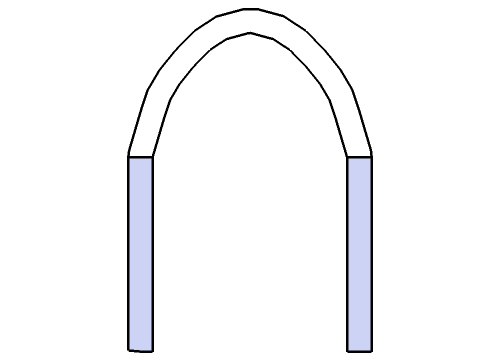
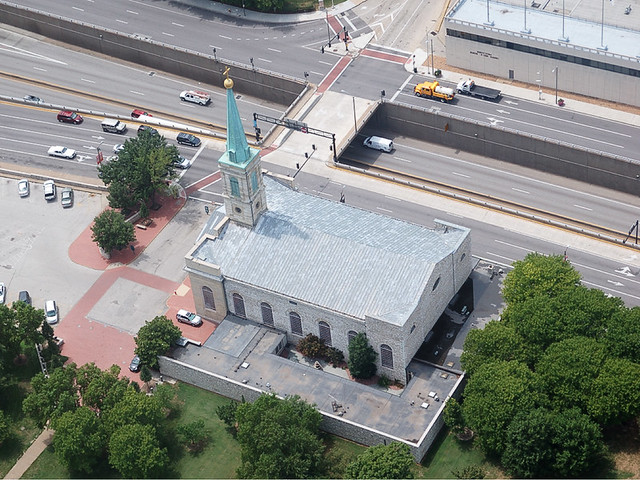
In my travels I've seen lots of attempts at putting a Gothic ‘look’ on churches of various denominations. Decorative elements, such as pointed arches and rose windows, are supposed to make a building look ‘churchy’, but these designs often fall flat and can even look comical (let's hope not on purpose, for the sake of the souls of the designers). The problem is that these design elements simply don't look right. Their proportions are wrong, sometimes severely wrong, and are far from the originals they purport to resemble. In the case of Gothic pointed arches, often the geometry isn't even close, and they may end up looking something like the Gateway Arch (which itself is often poorly duplicated hereabouts). You cannot have just any kind of curve to reproduce a Gothic arch. Because I do not want to embarrass any property owners, I didn't take any pictures.
This is not a Gothic arch.
I'm willing to understand poor work for C-grade buildings that are inexpensively made and quickly constructed out of cheap materials: perhaps the builder simply didn't know how such design elements are made, and wasn't paid to find out, and so the client is more at fault. I am far less willing to accept the same from high end architecture. But I seriously doubt that most contemporary architecture schools — of the revolutionary kind that came out of the 1960s — would even allow the teaching of antique design methods. There is a school of thought that thinks that the study of history is dangerous because people will be tempted to reproduce the errors of the past; rather, I say the study of history allows someone the ability to recognize mistakes and not repeat them, as well as help you see more recent mistakes that ought to be corrected. (An old joke says that conservatives never allow mistakes to be corrected, while progressives keep making the same mistakes over and over again.)
The Gothic style was not a mistake: it is the crowning glory of architecture.
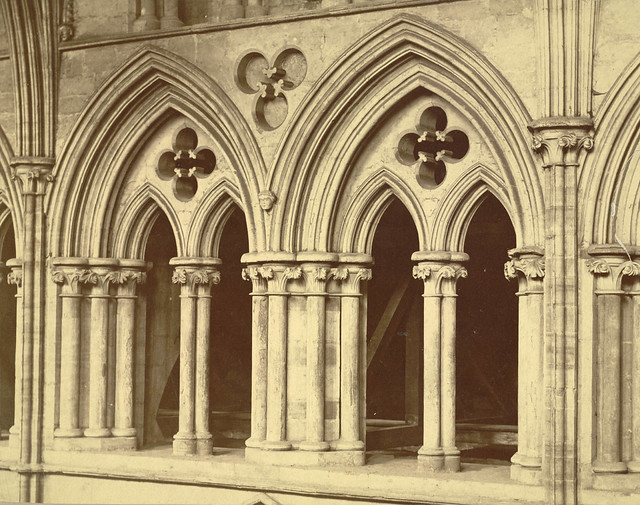
Authentic Gothic arches at Lincoln Cathedral. Source: A. D. White Architectural Photographs, Cornell University Library.
We are told that the Middle Ages were barbarous and ignorant, the worst of times, and have nothing to offer contemporary Man. But still they made the Gothic cathedrals, and contemporary Man is held in awe, knowing that he is incapable of building such things today. Nowadays, we assume that knowledge equals understanding, and that technology is a substitute for theory, but the artifacts of our culture merely show that we have more money than we do a sense of beauty. And a little bit of faith is worth more than a lot of knowledge.