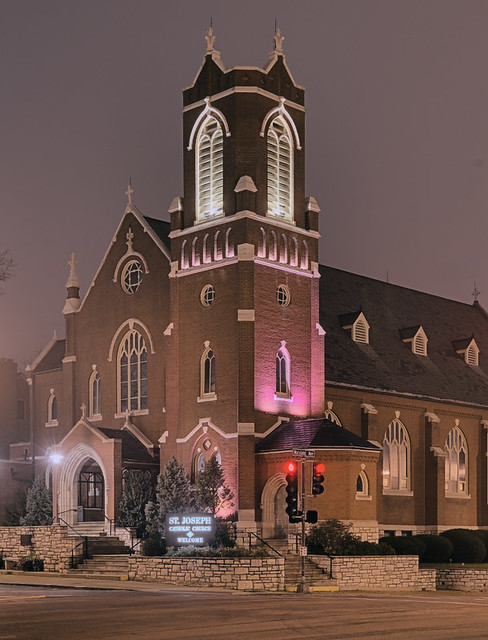
Located on the highest hill of Clayton, Missouri, this church offers a daily confession and a noontime Mass. Photo taken yesterday evening.

Whosoever thou art who longest to enter upon this happy state or seekest to direct thither thy steps, thus it behoveth thee to act.Scientific knowledge is not the same thing as wisdom. Scientific endeavors, for which Saint Albert is justly famous, have no value if they aren’t based ultimately in charity: the love for God and the love for our fellow men. This lack of true charity is common in our skeptical, egotistical age, which so often uses the fruits of the scientific method with evil intent.
First, close, as it were, thine eyes, and bar the doors of thy senses. Suffer not anything to entangle thy soul, nor permit any care or trouble to penetrate within it.
Shake off all earthly things, counting them useless, noxious, and hurtful to thee.
When thou hast done this, enter wholly within thyself, and fix thy gaze upon thy wounded Jesus, and upon Him alone. Strive with all thy powers, unwearyingly, to reach God through Himself, that is, through God made Man, that thou mayest attain to the knowledge of His Divinity through the wounds of His Sacred Humanity.
In all simplicity and confidence abandon thyself and whatever concerns thee without reserve to God's unfailing Providence, according to the teaching of St. Peter: “Casting all your care upon Him,” Who can do all things. And again it is written: “Be nothing solicitous”; “Cast thy care upon the Lord and He shall sustain thee”; “It is good for me to adhere to my God”; “I set the Lord always in my sight”; “I found Him Whom my soul loveth”; and “Now all good things came to me” together with Him. This is the hidden and heavenly treasure, the precious pearl, which is to be preferred before all. This it is that we must seek with humble confidence and untiring effort, yet in silence and peace.
It must be sought with a brave heart, even though its price be the loss of bodily comfort, of esteem, and of honour.
Lacking this, what doth it profit a religious if he “gain the whole world, and suffer the loss of his own soul?” Of what value are the religious state, the holiness of our profession, the shaven head, the outward signs of a life of abnegation, if we lack the spirit of humility and truth, in which Christ dwells by faith and love? St. Luke says: “The kingdom of God,” that is, Christ, “is within you,”
In proportion as the mind is absorbed in the thought and care of the things of this world do we lose the fervour of our devotion, and drift away from the things of Heaven.
The greater, on the other hand, our diligence in withdrawing our powers from the memory, love and thought of that which is inferior in order to fix them upon that which is above, the more perfect will be our prayer, the purer our contemplation. The soul cannot give itself perfectly at the same time to two objects as contrary one to another as light to darkness; for he who lives united to God dwells in the light, he who clings to this world lives in darkness.
The highest perfection, therefore, of man in this life lies in this: that he is so united to God that his soul with all its powers and faculties becomes recollected in Him and is one spirit with Him. Then it remembers naught save God, nor does it relish or understand anything but Him. Then all its affections, united in the delights of love, repose sweetly in the enjoyment of their Creator.
The image of God which is imprinted upon the soul is found in the three powers of the reason, memory, and will. But since these do not perfectly bear the Divine likeness, they have not the same resemblance to God as in the first days of man's creation.
God is the “form” of the soul upon which He must impress His own image, as the seal on the wax or the stamp on the object it marks.
This can only be fully accomplished when the reason is wholly illuminated according to its capacity, by the knowledge of God, the Sovereign Truth; the will entirely devoted to the love of the Supreme Good; the memory absorbed in the contemplation and enjoyment of eternal felicity, and in the sweet repose of so great a happiness.
As the perfect possession of this state constitutes the glory of the Blessed in Heaven, it is clear that in its commencement consists the perfection of this life.
I HAVEN’T POSTED here much lately, because I’ve been working on some new picture books for Reedy Press.



“But I know not whither he has gone,” say you. Wherefore do you not know, tell me? For according as he lived well or otherwise, it is evident whither he will go. “Nay, on this very account I lament,” say you, “because he departed being a sinner.” This is a mere pretext and excuse. For if this were the reason of your mourning for the departed, you ought to have formed and corrected him, when he was alive. The fact is thou dost every where look to what concerns yourself, not him.— Homily 41 on 1 Corinthians
But grant that he departed with sin upon him, even on this account one ought to rejoice, that he was stopped short in his sins and added not to his iniquity; and help him as far as possible, not by tears, but by prayers and supplications and alms and offerings. For not unmeaningly have these things been devised, nor do we in vain make mention of the departed in the course of the divine mysteries, and approach God in their behalf, beseeching the Lamb Who is before us, Who takes away the sin of the world—not in vain, but that some refreshment may thereby ensue to them. Not in vain does he that stands by the altar cry out when the tremendous mysteries are celebrated, “For all that have fallen asleep in Christ, and for those who perform commemorations in their behalf.” For if there were no commemorations for them, these things would not have been spoken: since our service is not a mere stage show, God forbid! Yea, it is by the ordinance of the Spirit that these things are done.
Let us then give them aid and perform commemoration for them. For if the children of Job were purged by the sacrifice of their father, why do you doubt that when we too offer for the departed, some consolation arises to them? Since God is wont to grant the petitions of those who ask for others.
 SAINT FRANCIS DE SALES ORATORY EMAIL NEWSLETTER 2653 Ohio Avenue Saint Louis, Missouri 63118 www.institute-christ-king.org www.TraditionForTomorrow.com 314-771-3100 | ||
|


