Pages

Tuesday, July 31, 2012

Feast of Saint Ignatius of Loyola

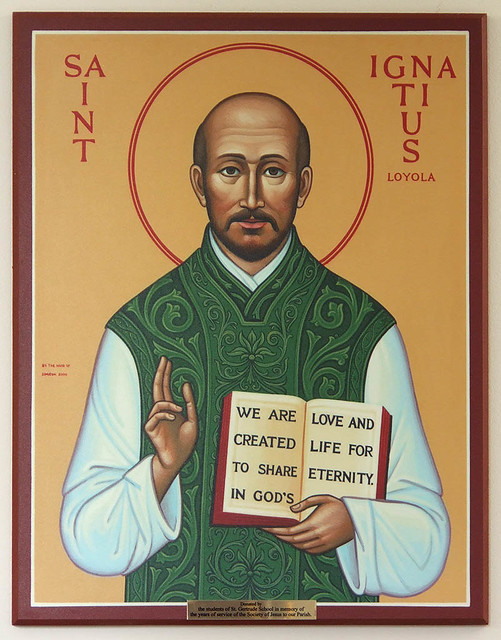
Saint Gertrude Roman Catholic Church, in Krakow, Missouri, USA - icon of Saint Ignatius Loyola.jpg

Icon at Saint Gertrude Church, in Krakow, Missouri. Photo taken in May, 2007.

“Up to his twenty-sixth year the heart of Ignatius was enthralled by the vanities of the world. His special delight was in the military life, and he seemed led by a strong and empty desire of gaining for himself a great name. The citadel of Pampeluna was held in siege by the French. All the other soldiers were unanimous in wishing to surrender on condition of freedom to leave, since it was impossible to hold out any longer; but Ignatius so persuaded the commander, that, against the views of all the other nobles, he decided to hold the citadel against the enemy…”
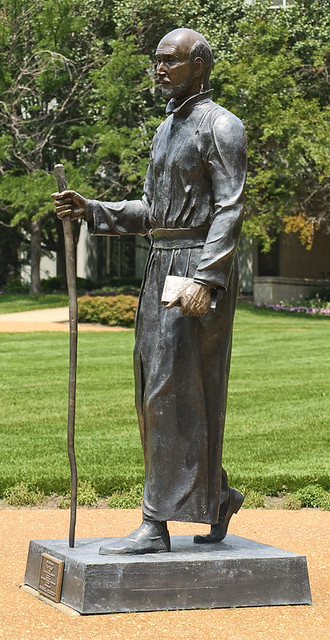
Statue of Saint Ignatius Loyola ("The Pilgrim" by Vicki Reid), at Saint Louis University, in Saint Louis, Missouri, USA

Statue of Saint Ignatius of Loyola (“The Pilgrim” by Vicki Reid), at Saint Louis University, in Saint Louis, Missouri. Photo taken in June, 2009.
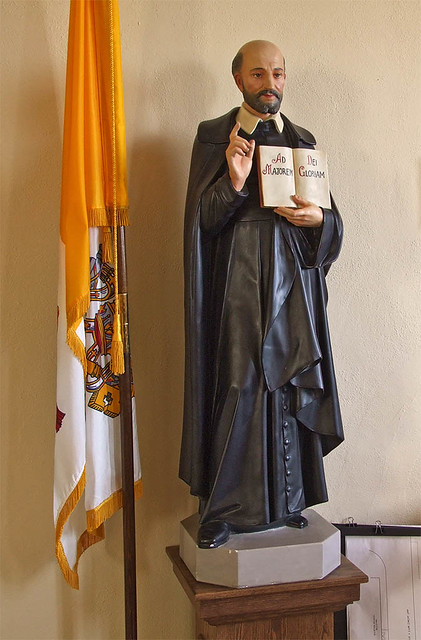
Saint Ignatius Loyola Roman Catholic Church, in Concord Hill, Missouri, USA - statue of Saint Ignaius.jpg

At Saint Ignatius Loyola Church, in Concord Hill, Missouri. Photo taken in July, 2007.

Ignatius was severely wounded in battle, and was captured by the French. However, his captors admired Ignatius for his great courage.  He then had to spend much time in recovery:

“As Ignatius had a love for fiction, when he found himself out of danger he asked for some [chivalric] romances to pass away the time. In that house there was no book of the kind. They gave him, instead, “The Life of Christ” by Ludolph, the Carthusian, and another book called the “Flowers of the Saints,” both in Spanish. By frequent reading of these books he began to get some love for spiritual things. This reading led his mind to meditate on holy things, yet sometimes it wandered to thoughts which he had been accustomed to dwell upon before.

“Among these there was one thought which, above the others, so filled his heart that he became, as it were, immersed and absorbed in it. Unconsciously, it engaged his attention for three and four hours at a time. He pictured to himself what he should do in honor of an illustrious lady, how he should journey to the city where she was, in what words he would address her, and what bright and pleasant sayings he would make use of, what manner of warlike exploits he should perform to please her. He was so carried away by this thought that he did not even perceive how far beyond his power it was to do what he proposed, for she was a lady exceedingly illustrious and of the highest nobility.

“In the meantime the divine mercy was at work substituting for these thoughts others suggested by his recent readings. While perusing the life of Our Lord and the saints, he began to reflect, saying to himself: "What if I should do what St. Francis did?" "What if I should act like St. Dominic?" He pondered over these things in his mind, and kept continually proposing to himself serious and difficult things. He seemed to feel a certain readiness for doing them, with no other reason except this thought: "St. Dominic did this; I, too, will do it." "St. Francis did this; therefore I will do it." These heroic resolutions remained for a time, and then other vain and worldly thoughts followed. This succession of thoughts occupied him for a long while, those about God alternating with those about the world. But in these thoughts there was this difference. When he thought of worldly things it gave him great pleasure, but afterward he found himself dry and sad. But when he thought of journeying to Jerusalem, and of living only on herbs, and practicing austerities, he found pleasure not only while thinking of them, but also when he had ceased.

“This difference he did not notice or value, until one day the eyes of his soul were opened and he began to inquire the reason of the difference. He learned by experience that one train of thought left him sad, the other joyful. This was his first reasoning on spiritual matters. Afterward, when he began the Spiritual Exercises, he was enlightened, and understood what he afterward taught his children about the discernment of spirits. When gradually he recognized the different spirits by which he was moved, one, the spirit of God, the other, the devil, and when he had gained no little spiritual light from the reading of pious books, he began to think more seriously of his past life, and how much penance he should do to expiate his past sins.”
— From The Autobiography of St. Ignatius: The Account of his Life dictated to Father Gonzalez by St. Ignatius

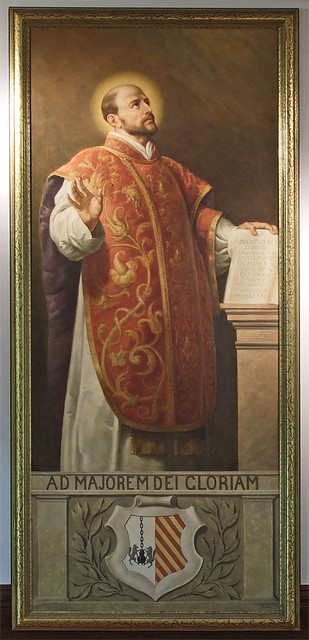
Saint Louis University Art Museum, in Saint Louis, Missouri - Collection of the Western Jesuit Missions - painting of Saint Ignatius Loyola.jpg

At the Collection of the Western Jesuit Missions, Saint Louis University Museum of Art. Photo taken in December, 2006.
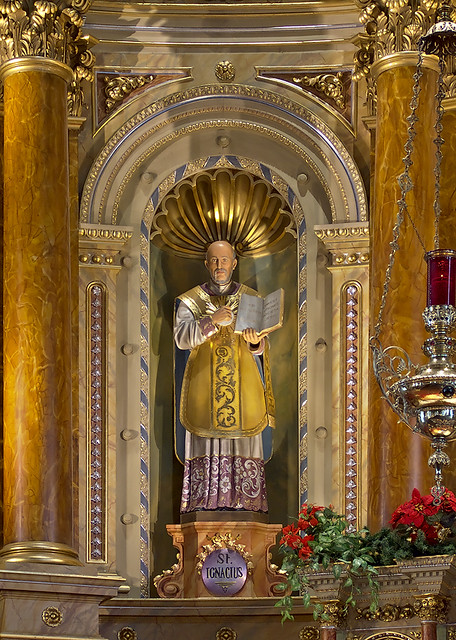
Saint Joseph Shrine, in Saint Louis, Missouri, USA - statue of Saint Ignatius Loyola

At the Shrine of Saint Joseph, in Saint Louis. Photo taken January, 2008.

Monday, July 30, 2012

Aunt Blanche, R.I.P.

Please pray for the repose of the soul of Blanche Peterson.


Officium defunctorum by Tomás Luis de Victoria (1605), including one of the readings from the Office of the Dead at Matins, followed by the Missa Defunctorum.

The reading here is from the sorrowful Book of Job (10:1-7):
1 Tædet animam meam vitæ meæ; dimittam adversum me eloquium meum : loquar in amaritudine animæ meæ.
2 Dicam Deo : Noli me condemnare; indica mihi cur me ita judices.
3 Numquid bonum tibi videtur, si calumnieris me, et opprimas me opus manuum tuarum, et consilium impiorum adjuves?
4 Numquid oculi carnei tibi sunt? aut sicut videt homo, et tu videbis?
5 Numquid sicut dies hominis dies tui, et anni tui sicut humana sunt tempora,
6 ut quæras iniquitatem meam, et peccatum meum scruteris,
7 et scias quia nihil impium fecerim, cum sit nemo qui de manu tua possit eruere?

1 I will give myself up to complaint; I will speak from the bitterness of my soul.
2 I will say to God: Do not put me in the wrong! Let me know why you oppose me.
3 Is it a pleasure for you to oppress, to spurn the work of your hands, and shine on the plan of the wicked?
4 Have you eyes of flesh? Do you see as mortals see?
5 Are your days like the days of a mortal, and are your years like a human lifetime,
6 That you seek for guilt in me and search after my sins,
7 Even though you know that I am not wicked, and that none can deliver me out of your hand?
From the Missa Defunctorum, (John 6:51-54):
51 Ego sum panis vivus, qui de caelo descendi. Si quis manducaverit ex hoc pane, vivet in aeternum: et panis, quem ego dabo, caro mea est pro mundi vita.
52 Litigabant ergo Judaei ad invicem, dicentes: Quomodo potest hic nobis carnem suam dare ad manducandum?
53 Dixit ergo eis Jesus: Amen, amen dico vobis: nisi manducaveritis carnem Filii hominis, et biberitis ejus sanguinem, non habebitis vitam in vobis.
54 Qui manducat meam carnem, et bibit meum sanguinem, habet vitam aeternam: et ego resuscitabo eum in novissimo die.
51 “I am the living bread that came down from heaven; whoever eats this bread will live forever; and the bread that I will give is my flesh for the life of the world.”
52 The Jews quarreled among themselves, saying, “How can this man give us [his] flesh to eat?”
53 Jesus said to them, “Amen, amen, I say to you, unless you eat the flesh of the Son of Man and drink his blood, you do not have life within you.
54 Whoever eats my flesh and drinks my blood has eternal life, and I will raise him on the last day.”

Thursday, July 26, 2012

Julian the Apostate

ON THIS DAY, in the year of Our Lord 363, the Roman Emperor Flavius Claudius Julianus Augustus, called ‘the Apostate,’ gained his eternal reward.

Julian the Apostate is known for having repudiated Christianity in favor of an eccentric version of a philosophized Roman paganism. But like many Christians today, raised under a heretical interpretation of the religion, his attachment to the Holy Catholic Faith was weak and he ended up rejecting it.  How many today claim to be delighted by the eccentric reforms which were supposed to have been required by the Council, yet never themselves darken the door of a Church, ending up completely outside of the Church? How many people today, especially powerful people, are repulsed by the yoke of Christ, and instead piece together their own religion, one completely pleasing to them?

Among his policies included the Imperial support of schools, hospitals, and charities; not out of a love for learning, the sick, and the poor, but rather to break the back of the Catholic Church, who provided most of those services in the Empire. This is a kind of robbery, because the sick and the poor are the treasure of the Church. He sought to eliminate all Christian influence on political life, and worked hard to provoke schism and heresy within the Church, using the effective policy of ‘divide and conquer.’

The direct persecution of Christians, he knew, would not work, for the blood of the martyrs is the seed of the Church; rather, he attacked Christ indirectly, by harassing and marginalizing Him. For this reason, Julian the Apostate is admired and imitated today by those who hate Christ. This kind of persecution, a new one in its day, ended with Julian, but it appears to have been revived once again in our own day.

Wednesday, July 25, 2012

Cinema and Censorship

SOME THINK THAT film is an inferior medium — compared to say, written novels — mainly because 90 or so minutes is hardly enough time to cover the material in even a short novella. But no one denies that film is a powerful medium: its immersive quality means that impressions flow directly into our minds, bypassing our critical faculties. The little gatekeeper to our soul, who actively scrutinizes ideas as we read them on a page, is seemingly asleep when we are in a darkened theater watching a film. So cinema can be a two-edged sword — potentially a great good or a great evil.

But in a civil society, should not power come with greater responsibility? Those who have great means have a far greater moral culpability than the rest of us. Cinema is very powerful, but who has the right or the responsibility to regulate this power?

Early commercial cinema tended to be sensational, and it seemed that films with racy or violent content sold well, and this led to an industry-wide trend to embrace this lowest-common-denominator content, as studio executives were not willing to lose business to their competitors. But children and youth were observed to directly imitate the evil things they saw at the movies, and this led Progressive Era reformers to demand government censorship of the media. Eventually, government censorship boards were set up in many states and municipalities in the United States. The censors had the power to cut out scenes or even to deny licenses to films, preventing them from being shown in their jurisdiction. Ironically, this censorship had an effect that was not intended — Hollywood made films that were even more sensational, salacious, and violent, hoping that some would make it past the censors, and many did.

But this is hardly a good way to do business and it compromises the artistic integrity of a film. Besides, is government the best institution to ensure the morals of youth? A better solution would be for the industry to regulate itself in cooperation with associations of cinema-goers, avoiding the heavy-hand of government.

Dawn Eden discusses this self-regulation of cinema in her article "Dark Knight" and the soul: The Catholic Church's prophetic warnings about the toxic effects of cinematic violence. She discusses the role of Fr. Daniel A. Lord S.J., who wrote the self-regulating code used by Hollywood cinema from the 1930s through the 1960s.  Lord reportedly wrote one of Pope Pius XI's encyclicals on the subject of film. (Lord's relics can be found in Calvary Cemetery in Saint Louis.)

Now, many decried this kind of self-censorship — even though it is far better than government censorship — as limiting artistic freedom.  But what was the result of such self-regulation? It is now called the “Golden Age of Hollywood,” an era of filmmaking that embraced humanism and the high ideals of our civilization, an era where films were more literate, psychologically nuanced, and with a very high quality of art. This was also an unexpectedly profitable time for filmmakers, and many films of that era transcend their time and remain popular today.

Pope Pius stated that films must be morally good — they must encourage the good and discourage evil — but they must also be artistically good.  Good intentions must be coupled with good art. Too many Christian groups, naive or dismissive about the medium and business of film, put out nice but terribly inartistic films that have minimal influence on our culture. Good art, on the other hand, cannot be ignored.

Monday, July 23, 2012

Photos of Saint Joseph Church, in Prairie du Rocher, Illinois

HERE ARE PHOTOS of Saint Joseph Church, located in the village of Prairie du Rocher, Illinois, which is a parish of the Diocese of Belleville. One of the oldest parishes in the region, dating back to 1721, in the oldest surviving settlement in Illinois, this church is located on the flood plain of the Mississippi River in Randolph County, about 47 road miles south of downtown Saint Louis.

Saint Joseph Church, in Prairie du Rocher, Illinois, USA - exterior

Saint Joseph church has its roots in the royal church of Saint Anne, founded in 1721, at the French colonial Fort de Chartres, located about 3-½ miles to the west of here. At the time, this was the territory of the Diocese of Santiago de Cuba, and the parish was staffed by Fr. Joseph Ignatius le Boullenger (a polyglot missionary who wrote a catechism in the Illinois language) and Fr. Joseph François de Kereben (later Superior of the Louisiana missions) of the Society of Jesus. A list of parish pastors can be found here. Originally a chapel of ease of Saint Anne’s, a log chapel was built at what is now the church’s cemetery, less than a half mile to the south of the present church, and was replaced at least once by a larger log church. A new stone church was begun there in 1851, but work was abandoned due to flooding. The cornerstone of the current church was laid in 1858, on higher ground, and the church was expanded in 1925, and its interior was renovated later.

Another chapel of ease of Saint Anne’s parish was built at Saint Phillipe, and was called Our Lady of the Visitation, which was destroyed by flooding in 1765. This also severely damaged Saint Anne’s church. Saint Joseph became the parish church sometime about 1767, when this region was under British rule.

A history of Prairie du Rocher, and Saint Joseph’s, dating from 1942, can be found here. A history from 1972 is here, from which was adapted the history on the parish’s website here.

Saint Joseph Church, in Prairie du Rocher, Illinois, USA - nave

The church is named after the foster-father of Our Lord, patron of the Universal Church, of fathers, of carpenters, of social justice, of a happy death, and of New France. The town was originally called “La Belle Prairie du Rocher” which is French for “The Beautiful Meadow of the Rock” and is named after the tall limestone bluffs above it, and for the vast grassy lowlands upon which it sits. This region remains a beautiful and interesting place to visit.

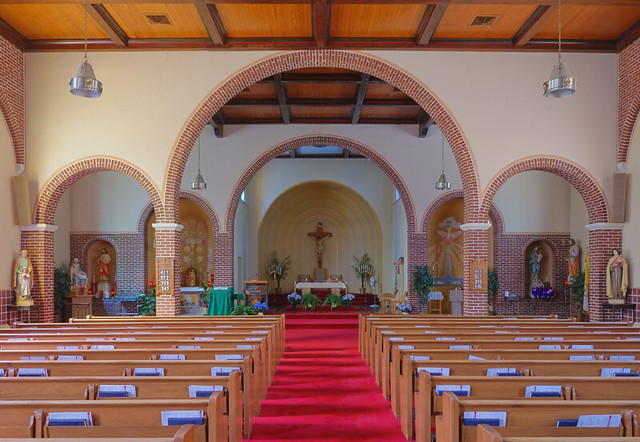
The interior is rather curious, particularly with the arch located in front of the pews but at a considerable distance from the sanctuary.  I’ve never seen anything like it before. The tabernacle is located to the left in a niche, and the baptismal font is located in a symmetrical position on the right, with devotional statues placed at the far opposite sides.

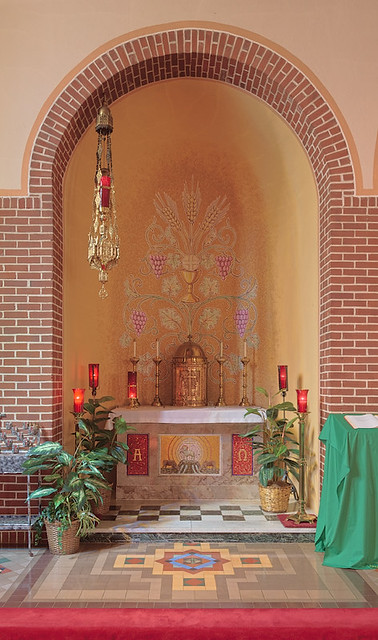
Saint Joseph Church, in Prairie du Rocher, Illinois, USA - tabernacle

The tabernacle is nicely decorated with a worthy setting, with various Christological and Eucharistic symbols.

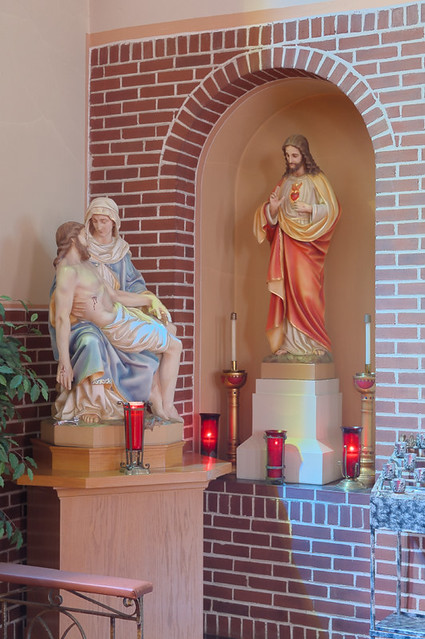
Saint Joseph Church, in Prairie du Rocher, Illinois, USA - statues of the Pieta and Sacred Heart of Jesus

The Pièta and Sacred Heart of Jesus.

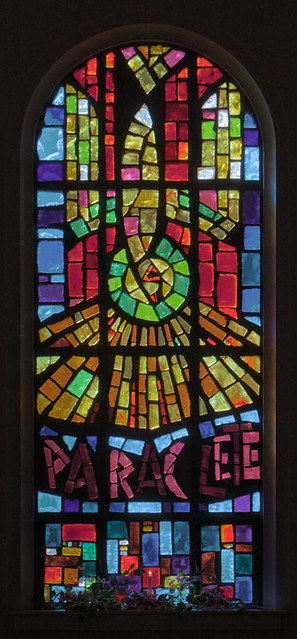
Saint Joseph Church, in Prairie du Rocher, Illinois, USA - stained glass window of Paraclete

Paraclete — from the Greek word for the Holy Spirt.

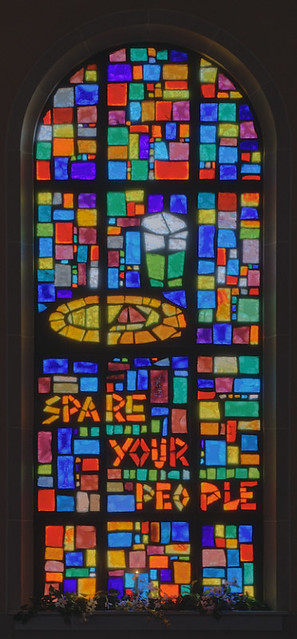
This style of faceted stained glass, which uses large, thick chunks of broken glass, dates from the early 1950s and was used extensively until about the mid-1960s. These kinds of windows are exceptionally difficult to photograph well. The colors you see here are not particularly accurate — they are more saturated in color than can be shown on a computer monitor.

Saint Joseph Church, in Prairie du Rocher, Illinois, USA - stained glass window "spare your people"

Spare Your People.

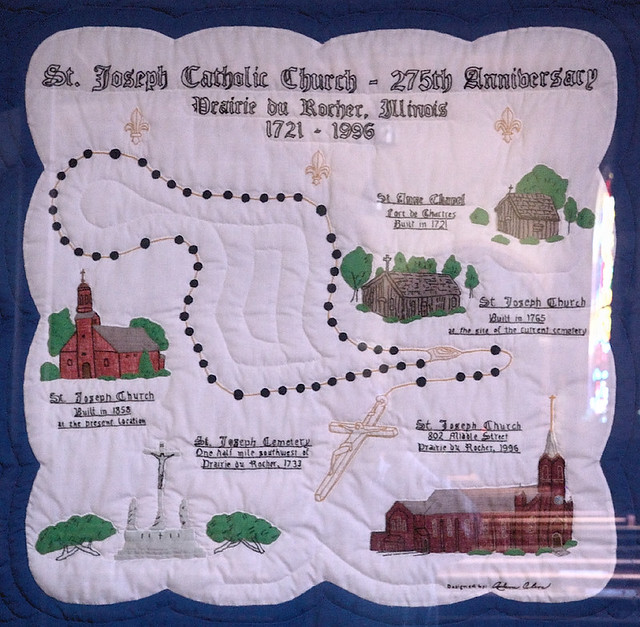
Saint Joseph Church, in Prairie du Rocher, Illinois, USA - history

A quilt showing the history of the parish is displayed in the back of the church.

Address:
802 Middle Street
Prairie du Rocher, Illinois 62277