
Some articles for the Eve of All Hallows' Day:
Traditional First Hallowmas Post
The Propriety Of Catholics' Celebrating Halloween
Are Scary Halloween Costumes Okay?
Memento Mori
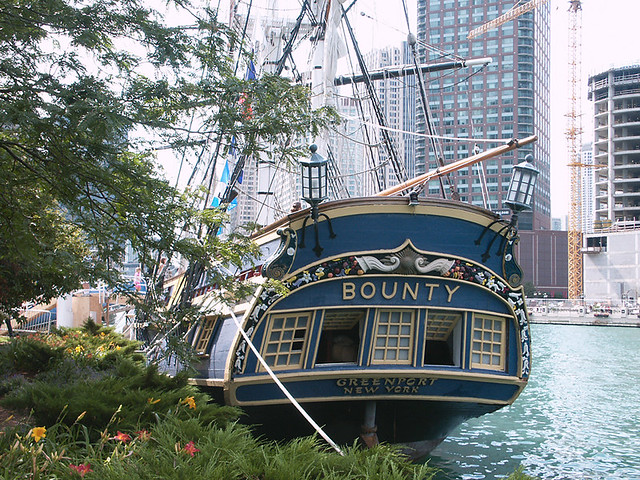
On October 25, 2012, the vessel left New London, Connecticut, heading for St. Petersburg, Florida, initially going on an easterly course to avoid Hurricane Sandy. On 29 October 2012 at 03:54 EDT, the ship's owner called the United States Coast Guard for help during the hurricane after she lost contact with the ship's master. The ship's master had reported she was taking on water off the coast of North Carolina, about 160 miles (260 km) from the storm, and the crew were preparing to abandon ship. There were sixteen people aboard. Vice Admiral Parker, USCG, reported the ship had sunk and fourteen people had been rescued from liferafts by two rescue helicopters. The storm had washed the captain and two crew overboard—one of the latter had made it to a liferaft, but the other two were missing. They wore orange survival suits complete with strobe lights, thereby giving rescuers some hope of finding them alive. Claudene Christian, one of the two missing crewmembers and a descendant of the original Bounty's Fletcher Christian, was found by the Coast Guard. She was unresponsive, and rushed to a hospital where she was pronounced dead.
The other missing crew member was long time Captain Robin Walbridge.
Bounty's last reported position was 33°54′N 73°50′W.
THE UNITED STATES is not a Christian country; this claim can be substantiated first by examining the beliefs of most of her Founding Fathers, and secondly by the nature of the political process itself: can true Christian discipleship exist within a man (or woman!) who desires the power invested in the U.S. government, and more importantly, is willing to do the vile things that are required to get elected?
...Much of how you judge the Founders’ intentions and the historical record of religion and public life in American history depends upon what you mean by religion. Ferrara convincingly argues that the Founders were more or less Masonic deists to a man, with no desire to see anything like a robust, orthodox Christianity, even of the Protestant variety, shaping public life. They certainly believed that the health of the republic depended upon a disciplined, moral citizenry and believed that religion—at the very least, a belief in God and fear of damnation—was useful as a prop to support such a public morality. That the moral probity of eighteenth-century Masonic British gentry strikes many a conservative Catholic today as a rough approximation of a Catholic world view should be troubling to Catholics, whatever their politics. The only God that the Founders acknowledged as having public standing was, as Ferrara’s title suggests, the God of Liberty.This does not mean that Catholics ought not be patriotic, for patriotism is direct result of the cardinal virtue of justice, and is a form of filial piety. It simply means that we ought not to believe in the philosophical foundations and current legal theories of our great empire.
For Ferrara, Liberty is not a political ideal, but a rival faith, a false idol. His book is difficult reading for any Catholic, liberal or conservative, raised on the idea of the complete compatibility of Catholicism and the American Founding...
...Ferrara argues that the whole modern social contract tradition has been nothing less than an alternative foundational myth, a parody or perversion of the origins of human society found in the Book of Genesis. If traditional Christendom saw the purpose of political life to approximate, within the limits of our fallen nature, the City of God amidst the City of Man, the social contract tradition understands politics as a tool for protecting individual freedom, particularly through the instrument of rights. In public life, Catholics have been all too willing to accept this myth as a guide to political action—such as the grounding of pro-life politics in a “right to life....”Herein lies the problem. How can Catholics relate to the wider American culture? Protestants will not accept the teaching authority of the Church just as secularists will not accept the authority of the Bible. What mode of argument ought we use? For the time being, the bishops of the United States are using the language of the social contract, along with its notions of rights and duties, for at least that is language that is understood. But if those notions are false, this will lead to trouble in the future.
If Locke’s political philosophy is at fundamental odds with Catholicism in theory, it is at odds with itself in practice. The great philosopher of liberty significantly excluded Catholicism from his vision of religious tolerance, largely because, through the person of the pope, the Catholic Church still claimed to have some public authority over the rule of princes. The so-called “Glorious Revolution” that drove a legitimate Catholic king (James II) from the throne of England and secured Protestant rule was followed by a century long battle to bleed Catholicism from the people of Ireland through a series of draconian penal laws. The irony of coercion in the name of freedom was not limited to eighteenth-century Ireland or the French Revolution, but has characterized the reign of Lockean freedom in American history...The Original Sin of Eden is the original sin of the founding of the nation, and the American rejection of the actual original sin has led to other, greater sins. In American history, we usually find that great idealism is followed by great atrocity at the hands of the idealists themselves. The idealistic founding of the Republic was followed by a bloody war for independence (which was an unjust rebellion against a legitimate ruler); the liberation of slaves during the Civil War led to the genocide of the Indians; the New Deal led to the intentional bombing of civilians in World War II; and the Civil Rights movement led to the atrocity of abortion on demand. What future atrocities can we expect from our current round of idealists who seek novel rights and freedoms?
Any honest look at American history will show that negative liberty, “freedom from,” has consistently triumphed in its battle against positive conceptions of human flourishing and the common good... Catholics can work with the American system, but they first must realize what it is. When the Church converted the Roman Empire, it knew that it was dealing with a pagan institution... If Catholics are to be truly Catholic in America, and not just a branch office of the Church of Liberty, we need to first stand apart from a political tradition born in a revolt against the Catholic Church....This, he provocatively writes, is “a necessary declaration of Catholic independence.” However, we aren't going to start any bloody revolutions because of this, but rather pray for a conversion of hearts.
THE LORD GIVES, and the Lord takes away, says Job, in one of the more heartbreaking books of sacred scripture. The beauty of one day can lead to a devastating storm the next. God's answer to Job's lament is the sublimity of creation, which we ought to appreciate and fear, but never take for granted.