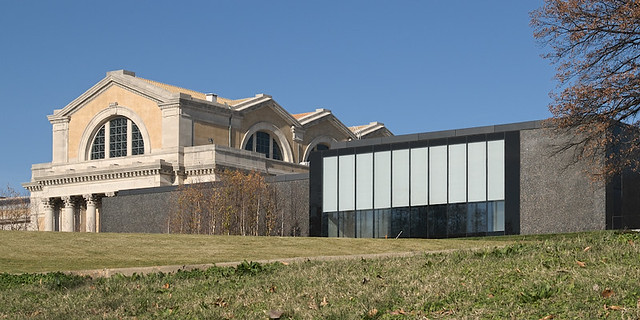
THIS PHOTO SHOWS the back of the
Saint Louis Art Museum, in Forest Park, Saint Louis, Missouri. We see on the left the original museum building, designed by
Cass Gilbert as the Palace of Fine Arts for the
Louisiana Purchase Exposition of 1904, which was modeled after the
Baths of Caracalla in Rome.
While we might think that it is odd to model a museum after a public swimming pool, please be aware that the original Baths had two public libraries: one in the Greek language, the other Latin; and that the structure was richly ornamented with top-quality sculpture and mosaics. It was intended to be at the center of the cultural life of Rome.
On the right hand side of the photo above, we see a massive new
addition to the museum, designed by
Sir David Alan Chipperfield in cooperation with the firm of HOK, which is scheduled to open to the public on June 29
th, 2013.
According to the museum website:
“It has been the Museum’s intention to construct a building appropriate for our time and achieve an architectural character that both stands on its own and complements the Cass Gilbert building, while taking advantage of the Museum’s spectacular site in Forest Park.”
“Appropriate for our time”? Superficially, it looks as if it could have been designed in the 1960s, but Chipperfield, the designer, is called “uncompromisingly modernist in outlook,” and
modernism in architecture is most associated with that decade; however popular culture is going through a phase of nostalgia for that time, so perhaps this is not surprising. The early 1960s were exceptionally optimistic times, giving us the progressive Kennedy presidency, the struggle against Communism, Vatican II, the civil rights movement, the space race, as well as the domination of modernism in architecture.
However, architectural modernism — in its goals and its aesthetics — fell strongly out of favor after 1972, largely in response to the failure and ultimate destruction of the
Pruitt-Igoe project in Saint Louis. This was a massive public works project, which gained international attention, that was designed to provide high-rise housing for workers near downtown. While many architects consider the original design to be good, it was implemented poorly via meddling by the federal government among other factors, most specifically due to a misunderstanding of human nature. This failure led to a reappraisal of modernism itself, and modernism's unrealistically optimistic idea that big problems could be solved with big solutions. This is in contrast to the traditional view that a good society can only be achieved if the individuals in society are good, via the promotion of individual virtue.
But please note that the designer of the museum expansion does not see his design in a prideful modernist manner; rather:
“The project seeks to create an unostentatious new wing of the existing museum which is modest in its architectural language and takes advantage of the museum's extraordinary setting as a ‘pavilion in the park’.”
Although the museum website states the the expansion complements the original building, I rather think that it clashes with it. If I had been asked for my opinion on the museum expansion, I would have suggested a grand and vibrant neo-Baroque structure, designed by one of the many superb architects from the
school of architecture at
Notre Dame. This complementary style of building would reflect the museum's intrinsic cultural mission of reclaiming ground lost to the barbarous hordes, as the original Baroque of the Counter-Reformation combated the iconoclasm and austerity of the revolutionaries of the 16
th century. Much of contemporary architecture today, most especially commercial retail properties and government buildings, are austere and iconoclastic to an extreme extent, and likewise, much of popular culture is tasteless to a degree almost unprecedented, and so the cultural mission is of great urgency.
HOK (formerly Hellmuth, Obata and Kassabaum), the ‘architectural firm of record’ of the museum expansion, was founded in Saint Louis in 1955 by three graduates of the
architecture school of
Washington University in Saint Louis, and has a long history of promoting modernism in architecture. Not only is HOK the largest architectural firm in the United States, the firm was also largely responsible for making mainstream the revolutionary
avant-garde modernist movement, a move that dismayed many progressives, since they considered it ‘selling out’. But lest we forget, if revolutionaries are successful, then
they become the new mainstream.
As earlier noted, the modernist movement fell out of favor, and serious doubts set in amongst intellectuals: was the great optimism of the 1960s misguided? Centralized urban planning led to the destruction of cities, poverty reduction programs increased poverty, efforts to promote racial harmony led to racial hatred, religious reforms led to an abandonment of religion, the promise of happiness via free love and recreational drugs instead led to misery, and the moon proved not to be a realm of wonders, but rather a cold, gray, dead rock. Modernism gave way to
postmodernism, which replaced optimism with cynicism, and replaced science with uncertainty. After the economic and political malaise of the 1970s, we find the first major expressions of postmodernism in the architecture of the prosperous, confident 1980s.
Down the hill and across a road from the museum is the postmodernist north entrance to the
Saint Louis Zoo, containing the Living World exhibit, designed by HOK. It dates from 1989:

Modernism in architecture was eventually considered to be excessively bland and uniform, noted for its monochrome color scheme, its rejection of ornament and its use of only simple geometric forms and, oddly enough, flat roofs, which seems to go against the modernist
desire for functionality. And so, modernism got the reputation of being joyless in its Puritanical utopianism, as illustrated
here. Contradicting the modernist pioneer
Ludwig Mies van der Rohe, who proclaimed that “less is more,” the postmodernist
Robert Venturi replied “less is a bore.” This zoo building shows a rejection of modernist principles, with its use of ornament, color, and a gabled roof.
Postmodern architects instead felt that they had the freedom to choose any style, color scheme, and ornament they desired, freeing themselves from the shackles imposed by modernism. Also of great importance was the postmodernists' sense of humor, which was in contrast to the grim seriousness of the modernists. When I first saw this zoo building, it made me smile! Although it is hard to tell from this photo, the building is ornamented with absurd sculpted heads of animals, which along with the bright colors and bold patterns, gives the building a cheerful, comical look.
But if we dig into the theories of postmodern philosophy, we find out that humor of postmodern art is ironic, even cynical, and could plausibly be construed to be a joke at the expense of the client and the general public. As earlier mentioned, the philosophy of postmodernism is based on cynicism and doubt: gone are the ideas of progress and even truth: there is no truth, and if there was truth we wouldn't know it, and if we knew the truth we could not communicate it. If you spend the time digging into the dense, difficult-to-read postmodernist theory, you will ultimately find out that postmodernism is indefinable, for it is nothing at all.
That fact about postmodernism
ought to give us pause.
![Portrait of a Cat I (Shilo) [EV=-4.5]](http://farm2.staticflickr.com/1282/4685475360_e89a7ba31e_z.jpg) An ironic, postmodernist photograph of a cat. I actually did point my camera at her, and pressed the shutter, but I knowingly set the exposure too high to actually capture any detail. But this is only a white rectangle; it has lost everything that makes it a photograph.
An ironic, postmodernist photograph of a cat. I actually did point my camera at her, and pressed the shutter, but I knowingly set the exposure too high to actually capture any detail. But this is only a white rectangle; it has lost everything that makes it a photograph.
Postmodernism first found favor with
avant-garde leftists, and it was appealing to them because of its marxist flavor, but the philosophy soon became mainstream, being adopted by major institutions, including business. But as postmodernism, at its core, is nothing, some works of postmodernist art attracted much criticism from working artists, who instead thought that the philosophy had gone too far. One example of this kind of art was simply a light bulb turning on and off in a gallery. Coupled with 1960s nostalgia, the pendulum of culture is now swinging back into modernism, a movement called by some ‘
remodernism’ or ‘the new sincerity.’ At least modernism stands for
something. In the political sphere, we have seen the return of the modernist idea that big problems can be solved by big government programs.
While radicals thought they were doing something new and different with postmodernism, Catholic thinkers understood that postmodernism was really a school of thought that took the assumptions already present in modernism more towards their bitter end. Postmodernism was in reality hypermodernism, and was a continuation of the mode of philosophical thought that gained prominence among heretics in the late middle ages.
In the 1907 encyclical of Pope Pius X,
Pascendi dominici gregis (“
Feeding the Lord's Flock”), modernism is called “the synthesis of all heresies,”
and although we might guess that postmodernism invented a few more heresies, that is probably not correct. The postmodernists themselves have pushed back the roots of postmodernism as far back as the 19
th century, even predating modernism itself, which is rather funny. Ultimately, every heresy can be traced back to the very beginning.
Heresies are not simply
wrong, for if they did not contain some truth, they would have been quickly rooted out as yet another crank theory worthy of no consideration. Heresies instead embrace some truths and deny others, and so move away from orthodoxy in one direction or the other. We especially find this in politics, where one party will embrace one particular heresy, while the opposing party embraces the opposite error.
Postmodernist architects were correct in seeing that modernism had imposed irrational restrictions on the practice of their art. Monochrome color schemes and iconoclasm were certainly wrong as universal principles of the art, but the postmodernists were themselves wrong when they ignored the theories of proportion, symmetry, and color that held sway for 2,500 years. Too many postmodernist buildings are badly proportioned: they look funny, awkward, and sometimes childish. A good measure of seriousness is not a vice.
The Gothic or Catholic style of architecture was both serious in its icons and altar, but yet was comical in its gargoyles and other ornamentation. It is possible to have both.
By no means can our contemporary architecture be convicted of having too much ornamentation or too much color, for it still errs on the side of nullity. Historically, this modern attitude extends at least as as far as the 15
th century. As western Europe started to discard its Catholic faith, at first slowly by the elite in the Renaissance, and then quickly in the Reformation, artists started looking towards ancient history for models of new art. While Protestants chose a literal interpretation of the Bible for inspiration, the more secular-minded selected ancient Greece and Rome.
The religious reformers focused on one of the Ten Commandments, prohibiting “graven images,” as an argument against architectural ornamentation, while the secularists admired the white Carrara marble sculptures that were found among the ancient ruins of antiquity, and used them as an argument against the use of color. These two streams of thought remained entwined ever since. While modernism got its start mainly in Europe, precedents can be found in the United States, particularly amongst radical sects who preferred severe, unornamented, and plain white meeting-houses as their churches.
Perhaps the religious reformers overlooked those passages of the Bible that show that the Jewish temple was richly ornamented, at the command of God. Perhaps they did not realize that the Temple was the prototype for the Church, worthy of emulation in every city in the world. Perhaps they failed to recognize that plain churches do not inspire the imagination, nor do they encourage widespread faith.
If reason, feelings, and the practice of art throughout the world in all ages are not enough to support the generous application of ornament and color to architecture, archeology has lately shown that ornament was used in the early Church, and color was used in the ornament of antiquity.
See the article
Bringing the Color Back to Ancient Greece, which shows a reconstruction of a finely painted statue. Please be aware that the modernist architect's desire for a monochrome palette started with the mistaken notion that the fine buildings, monuments, and sculpture of antiquity lacked varying color. It was believed that polychrome statues were a medieval barbarism, and that pure white sculpture was instead the norm and represented a higher aesthetic achievement. Only lately has this been debunked, but our aesthetic life has suffered for centuries. Even the old art museum building, more than a century old, is monochrome in its color scheme: I specially processed a photo of it, and was surprised to find that all of the stonework on it is of the same hue and nearly the same brightness; only the saturation of the coloring varies.
Back in 2003, the art world was shocked at the finding that sculpture of antiquity was actually painted, but for a while it was thought that they were painted garishly in the postmodern fashion. However, I suspected that this was not true and that these must have been more subtly painted: see the article
Common Errors About the Ancient World. Instead, it now seems that the painting were done rather finely, similar to what we find in the Church's polychrome statues.
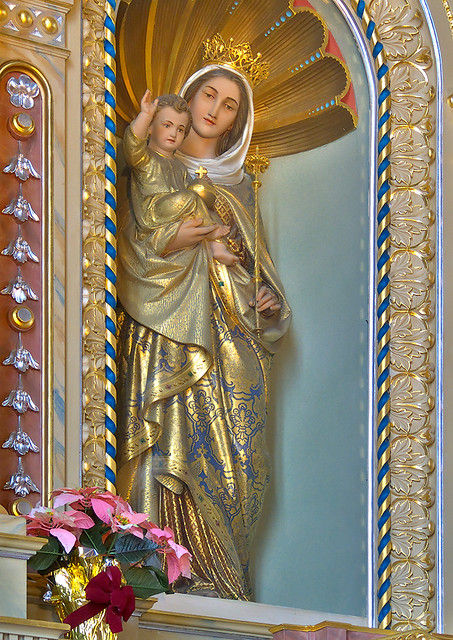 This richly polychromed statue of the Blessed Virgin and Christ Child was made for the Cathedral of Notre Dame in Paris, but ended up at the Shrine of Saint Joseph in Saint Louis.
As far as I can tell, every traditional culture on the face of the earth decorates its buildings in floral imagery, except for the culture of modernity. Who could possibly dislike flowers and foliage, and not want to see them grown or artistically depicted everywhere? Unfortunately, the products and philosophies of modernism belie a type of
gnostic tendency, showing a severe disregard for the material world, which has very unfortunate implications.
Cultural evangelization is difficult these days, largely for the fact that culture has become rather centralized and standardized, like just about everything else in our life, and it is closely linked the powerful in government, big business, media, and education. But our work can be like the mustard seed, which starts small and grows larger later. This kind of evangelization is important even though good architecture will not save the world, for we know that bad architecture will certainly harm it.