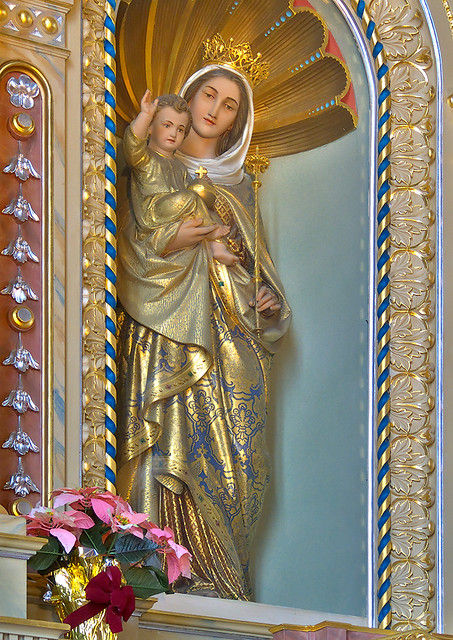
The town of Paducah was named by famed explorer William Clark after the Comanche tribe, then known by some other tribes as the Padoucas.
I visited Paducah a while back because I was accompanying a lady friend who wanted see the National Quilt Museum, located in that town near the riverfront. I will give a few thoughts on the museum on another posting.
We arrived at sunset, and though we had a long drive back to Saint Louis, I wanted to take some good photos of this church:
The church is Gothic revival, in the manner of the late Gothic style.
St. John Church
1932
The Dioecesis Owensburgensis was erected in 1937 from land taken from the Diocese of Louisville, and its current ordinary is Bishop William Francis Medley. This diocese, along with the dioceses of Covington, Knoxville, Lexington, Memphis, and Nashville, is suffragan to the Archdiocese of Louisville — originally the Diocese of Bardstown. This is the Church in Tennessee and Kentucky.
The nave of the church. Musicians are seen here preparing for Holy Mass.
St. John the Evangelist Catholic Church was founded in 1839 by a group of German Catholic immigrants who had settled in Western Kentucky several years earlier. These first parishioners were visited by Fr. Elisha J. Durbin who had been assigned the missions throughout the territory that today make up the diocese of Owensboro. Fr. Durbin’s headquarters was at Sacred Heart Church, in Union County, Kentucky and his missionary duties took him to several surrounding states. Accordingly, the privilege of Mass and the Sacraments was not available to the people of the St. John community on a regular basis for some time.
The first church, a log building, was raised by the parishioners under the direction of Fr. Durbin around 1849. The log church burned and was replaced by a larger frame structure in 1869 under the direction of Fr. Peter Haeseley. The frame church was used for sixty-three years, until the construction of the present church building in 1932-1933 during the pastorate of Fr. Paul Barrett. All three churches were located on the same site.
The tabernacle and crucifix.
The history continues:
Few changes occurred to our church since 1933. The main update occurred in the 1960’s following Vatican II which included the removal of the tall canopy and the high altar.
In 2003, with guidance from Fr. Bruce McCarty, the parish undertook a general renovation project consisting of substantial exterior and interior repairs and a general updating of building systems. It also included the construction of an addition to include handicapped accessible restrooms, a reconciliation room and sacristy. A concerted effort was made to maintain and enhance the architectural and artistic integrity of the structure while bringing it in line with the liturgical needs of a 21st century parish.
On February 19, 2006, a Mass of Thanksgiving and Dedication of Altar was held with The Most Reverend John J. McRaith, Bishop of Owensboro, as celebrant.
Two of the Stations of the Cross — Jesus Falls the Third Time on the right, and Jesus is Stripped of His Garments on the left.
Ornamentation in architecture has been largely a lost art since the popularization of the ideas found in Adolf Loos’ lecture of 1910, Ornament and Crime, where he claimed that the ornamentation of architecture was like the tattoos on degenerates and criminals of his age. But there is little that we need to take from the polemic of that “grumpy Marxist” other than his observation that ornament can make a building obsolete faster, as it goes out of style. True — what’s “up-to-date” is soon out-of-date — but if good taste and classic styling is used, then we needn’t worry about something going out of style any time soon — for it already is of the ages. This is the aim of the new American school of ecclesiastical architecture, coming out of the University of Notre Dame.
I particularly like the simple yet symbolic ornament depicted in this photo, behind the figures of Christ. We see a serpent and a sword, symbolizing the two failed martyrdoms of Saint John, who unlike all of the other Apostles lived to a ripe old age. We also see St. John’s symbol of the eagle, the Greek monogram for Christ, ιηϲ, and some vegetative ornament.
Confessional.
The blue light of dusk, mixed with the fluorescent lighting inside of the church confused my camera, as we can see in the photo of the nave above. Here I color-corrected this window to make it appear more natural. The windows here are largely simple — here we see some floral ornament along with a harp — a symbol of King David the Psalmist.
A sculpture of Saint John in the narthex. We see him here with a quill and book, symbolizing the Gospel he wrote; said Gospel is so full of soaring theology that the Fathers of the Church assigned him the symbol of the eagle. Artistic depictions of several of the Saints of the ancient church have distinctive facial features, which can be traced back to the earliest of sources. John is here depicted as a beardless youth.
Grief.
Two cemeteries are found outside of the church — this is from the older one, located across the street from the church.
ALL YE GOOD PEOPLE
AS YOU PASS BY,
AS YOU ARE NOW
SO WAS I,
AS I AM NOW
SO WILL YOU BE,
REMEMBER MAN
AND PRAY FOR ME.
FIFTY YEARS AGO TODAY, there passed one of the greats of the 20th century. But Clive Staples Lewis’ death went largely unnoticed, lost in the traumatic events of the day. Lewis was an apologist, novelist, popular writer, and essayist, beloved of Christians of all churches, denominations, and sects; but he was also an accomplished scholar.
Love and marriage are horribly confused, conflated, and misunderstood in our current age, which does not understand the forms and purposes of these things — or rather, our age doesn’t seem to understand the form and purpose of anything. It was on the topics of love and marriage that C.S. Lewis gained his academic fame, in his book The Allegory of Love: A Study in Medieval Tradition, dating from 1936. It was this book that showed that the Medieval literature on love was worthy of serious academic study: and it remains the starting point of much of contemporary scholarship.
Marriage is a human institution, closely tied to the law and specific human circumstances — but it is rooted in human nature — while love is universal. How these two things interrelate is explored in great and even shocking depth in the Medieval literature. It is said that one flaw in Lewis’ book is that he treats love as a literary phenomenon, and not as something real, which he later corrected in his more popular book The Four Loves. Another flaw in his book is his incorporation of modern literary theories, whose frameworks don’t quite fit the data, and today we likewise have ideological — Marxist, Darwinist, Postmodernist, or Calvinist — readings of the literature which might explain one or another narrow aspect of love fairly well, while failing to consider the entire whole in a satisfactory manner.
Studying Medieval love literature can be hazardous: its allegorical method can be overlooked, its explicit depictions may be shocking, its unromantic portrayals of romantic love can be disturbing, and its essential Catholicity is rejected by contemporary conservatives and liberals alike. But Lewis was onto something: understanding love in all of its aspects is of great value to us today, and in every age.
SOÛLARD, in French, means ‘drunkard’, and this name seems rather appropriate for the Soulard neighborhood of Saint Louis, Missouri, known for its numerous bars, as well as the riotous behavior of visitors during its annual Mardi Gras celebrations. But this near south-side neighborhood — largely delineated by Interstate 55 and South Broadway — has many charms.
This neighborhood gets its name from the colonial figure of Antoine Pierre Soulard (1766-1825). He was a Frenchman, who came to these shores fleeing the Revolution. He eventually became the King of Spain’s Surveyor General of Upper Louisiana — a vast land which included the Saint Louis area. After President Thomas Jefferson purchased the Louisiana territory — an act which doubled the size of the United States — it was Soulard who handed over this part of the territory to the American governor. After his retirement, Soulard tended to his orchard, which was located in this neighborhood which now bears his name.
Here are some photos I took this summer, in the Soulard neighborhood, during a walk around a couple of blocks, at sunset and dusk, near the historic Soulard Farmers Market.
Much of the architecture of this area dates from the second half of the 19th century through the first few decades of the 20th. Due to benign neglect, this neighborhood maintained its charm while other areas nearby were destroyed by modernization. The fury of ‘urban renewal’ throughout the nation subsided in the early 1970s — often attributed to the failure of the huge Pruitt-Igoe housing complex in north Saint Louis — and the beauty of the once-hated Victorian-era architecture was rediscovered.
Other neighborhoods in the city — particularly on the north side — are slowly disappearing, due to neglect which cannot be called benign. Recent in-fill housing in these areas tend to be rather disappointing, being largely suburban-style homes with little charm, character, or solidity.
Notice the ornate detail on this building, exceeding the quality of work that is done today; but this level of artistry is commonplace here.
Many buildings here have Mansard-style roofs. These are named after François Mansart, a royal architect of the Baroque period in France, who popularized this kind of steep roof, which allows for an additional occupiable story on buildings. The style experienced a revival, especially in Paris during the Second French Empire, and was widely copied in the English-speaking world, including here in Soulard. One of the disadvantages of the Mansard roof is that the top story is usually an undesirable place to live: hereabouts, it gets extremely hot under the roof during summer, while in Paris before the invention of elevators, the Mansard was a long climb up from street level, and so the Mansard, often the location of the lowest-rent apartments, became associated with starving artists and bohemians.
The 1960s saw another revival of the Mansard form, but the quality of the work tended to be bad — or cheap and tasteless — and it inspired the local blog Bad Mansard.
At the end of the street is the Soulard Farmers Market, which dates back to 1779. You can see the Gateway Arch to the right of the 1929 building, which is modeled after Brunelleschi's Ospedale deli Innocenti or Foundling's Hospital, in Florence.
The amenities of modern supermarkets are lacking here, likewise lacking is the middle-class who patronize those markets; rather, we find here mainly the poor and the wealthy. The form, organization, and economics of this market can be best called premodern, where the City leases out stalls here to farmers and merchants; similar arrangements can be found in the ancient cities in Europe and elsewhere.
In Soulard, it is the tops of buildings that tend to have most of the charm. I suspect that architectural details closer to the ground may have been destroyed or otherwise lost in the past century, and you still can see clues of shutters, balconies, and decoration that have been removed. Wood needs to be painted periodically otherwise it will rot, while much ironwork was scrapped during the Second World War to make steel for the war effort. Some buildings here have been fully restored, but most have not.
Home prices can be high here — note the expensive automobiles seen here — and decades ago, many of the old-time residents resented the intrusion of newcomers in the neighborhood who drove up rents and who had odd lifestyles.
A major source of Soulard's popularity is undoubtably its beauty, despite its high crime rate, and its many restaurants make it a popular area for weekday lunch.
By means of comparison, the artist David Claytondescribes the value of Boston's Beacon Hill neighborhood:
This past weekend I drove down to Boston from southern New Hampshire to meet a friend who was visiting for the weekend. As we walked around town we wandered into the Beacon Hill area. This is the old heart of the town and full of elegant 18th-century terraced homes. They are built in a variation of the style that in England we would call Georgian. I’m not sure what it is called here, perhaps ‘colonial’ style? These are right at the top end of the price range for property in Boston.
Why are they so sought after? Well location will have a lot to do with it certainly. You would probably pay a fortune for the ugliest shoebox here if it could take a bed. But I would say also that their beauty is a big factor too. Beauty adds value because it stimulates greater demand and pushes the price tag up. And why are they beautiuful? Two hundred years of New England weather softening the edges on the red-brick or cobblestone forms probably adds something. But it is more than this. The main reason, I suggest, is their harmonious proportions.
The buildings in Soulard were built over the better part of a century, and yet the structures tend to harmonize with each other, despite being of varying style. Undoubtably part of this is due to the requirement that all buildings were to be built of brick — this law came into force after a steamboat explosion led to the destruction of a sizable part of downtown — but also because the buildings harmonize with each other proportionately. All of this predates Le Corbusier and the Bauhaus, the early champions of Modernism, who discarded centuries of aesthetic wisdom.
This is the former Saint Elizabeth Settlement House, which was originally a Catholic orphanage.
What struck me about these houses is how simple and reproducible their design is. They have a simple symmetrical arrangement of windows, one above the other, and a pointy roof. There is some decorative work around the doors and the windows, but it could never be called flamboyant. If I knew about building materials then I reckon I could design one myself. Yet despite their simplicity they look good and it is as a result of the traditional proportionality.
Given this simplicity and the value that beauty adds to buildings, I am surprised that it hasn’t occurred to more developers and architects to study traditional proportion and use it, if only for economic reasons.
Look at the photos in this article. Notice how in every case the window size varies, storey to storey, so that the first is to the second as the second is the third and so on. When this rhythmical progression corresponds to the traditional pattern then the result is elegance. Sometimes the order changed around slightly so that it is not always the largest at the bottom. The dimensions of the first and second might be changed so the biggest storey is always the main living area. These architects didn’t play tricks – they put things where you expected them to be, so that the outward signs give an indication of the internal purpose. Similarly, the main door is always more prominent than the servants’ entrance. (You can’t count on this now. I was at an art gallery recently, which was a modern building made completely of reflective glass and the doorway was indistinguishable from any other panel. There was no indication through the external design where the door was. In fact it was placed offset to one side in a counter-intuitive position, presumably deliberately. I had to wait until I saw someone coming out before I knew where I could get in!)
Coming back to Beacon Hill, I am convinced that these houses looked just about as good the day they were built and if anyone chose to conform to these basic patterns today, then it would look good and sell at a high price. This has to be the simplest way for an architect to add greatest value for minimal investment of time and money. There is no need for pastiche – we are not bound slavishly to follow the decorative style of the period in every way, but provided the principles are adhered to, then here is way for modern architect to stand out from the crowd. The mathematics is relatively simple (I have presented it all in an article about proportionality, here).
When Soulard was originally developed, it was a true urban neighborhood in the traditional manner, where the various classes lived side-by-side, with stores and taverns on the corners, and blocks with factories alternated with blocks of housing and blocks with churches and schools. Public parks and amenities were found on the edges of the neighborhood, within easy walking distance.
Some would say that social harmony can be helped by architectural harmony, but the idea of architectural harmony, still seen in Soulard, has been largely lost elsewhere. We nowadays have ugly skyscrapers, products of excessive pride, towering overhead, or huge and featureless warehouses, or we have vast developments of identical, factory-produced homes or apartment complexes, made with inferior materials, little charm, and degraded taste. But harmony means neither discordant notes nor unison, but rather variety within a common key.
Discordant music became popular with the cultural elites, and discordant architecture soon followed, and the great cities of the United States soon fell apart from social disharmony. As good can come out of evil, perhaps this is for the best; industrialization forced the creation of large cities, filled with squalor. Perhaps it is best not to have large numbers of people living on top of each other. But something has been lost: the means of encouraging harmony even in unfortunate circumstances.
A closer view of Saint Elizabeth's.
A traditional neighborhood like this one both promotes democracy as well as private property — or, at least the traditional notions of such concepts, which are both quite specific and on a local scale. Today, both notions are far removed from their source, where decisions are made far away by strangers, and property may be taken arbitrarily by the well-connected.
While the mishmash of land uses found in Soulard would be rejected by most modern zoning laws, please consider that it was in such neighborhoods as this that many of the social problems of their day were solved. The gracious mansions of the business owners were just around the block from the simple but noble row houses of workers. They patronized the same stores and taverns, and would see each other in the same parks. In that day, there were few large housing projects for the poor nor were there significant exurban enclaves for the wealthy.
How much better can decisions be made if ordinary people debate amongst themselves, where opposition is man-to-man? While this system did lead to violence, at least it was between those who had a grudging respect for each other, unlike today. A Puritan-minded employer who felt the need to violently chastise an insolent subordinate was balanced by the fact that his employee lived down the block from him (and had lots of tough friends), and that there were plenty of other employers in the neighborhood to whom the employee could freely go. Likewise, an envious worker who otherwise would seek revenge, could see for himself what goes into making a successful or a failed business, for he would personally know many business owners. In this environment, the common good was more obvious to all.
Nowadays, how many factory owners live within walking distance of the their business and their employees? How many shopkeepers live above their stores? How many owners of businesses that you patronize do you personally know? How many people walk to work or walk to church? How many politicians are actually seen living in their own district? But in Soulard's heyday, these were the norm.
Sts Peter and Paul has a small congregation, but according to its website:
Every day from the 2nd through the 21st of each month, a free meal is served at our Parish Mid-Level Hall. These nutritious, tasty meals are served to the residents of the shelter, as well as to families and individuals in the Soulard area, who may be on limited or fixed incomes. We have between 80 and 200 guests who dine with us each day.
This house displays the flag of Quebec, flanked on both sides by the flag of the City of Saint Louis. Both flags feature the fleur-de-lys, recognizing that both were once part of the French Empire.
I remember my French grandmother enjoying visits to this neighborhood, for of all places in the City, this most reminded her of her home country.
The small yards found here are often nicely ornamented with flowers.
A decorative grille. Just because an object has a grim utilitarian purpose — in this case, keeping out intruders — that does mean that it has to lack good attractive design. This grille even has symbolic value — arrows are a sign of defense.
A dinosaur sculpture? I can’t explain it.
A decorative fountain with marigolds.
More flowers.
Many artists and members of the avant-garde live in this neighborhood. This is odd, since this traditional neighborhood is the antithesis of modernism, and obviously the architecture here is premodern. However, there is a deeper reason for this apparent disconnect. The philosophy of Existentialism, upon which much of modernity is built, posits and even encourages a definite opposition between the mind and the body, in a Cartesian or even a Gnostic-like manner; this can lead to an existential crisis, where the meaning of life is questioned. One way of coping with this kind of vertiginous crisis is through the search for authenticity. A neighborhood such as this, which is solidly anchored in the past, can help relieve a resident of the restless pursuit of novelty, along with the negative psychological consequences of that pursuit.
Also, it would be hard to point out a contemporary neighborhood which is better designed, but well-designed neighborhoods were once the norm, as any casual inspection of the many neighborhoods in this city will demonstrate.
The apartments and homes found here tend to be quite large by modern standards — not in land area, but certainly in square footage of livable area.
By the way, these images are made to look best at full resolution on a dark background, which can be found by clicking on each image. Reduced in size as seen here, these images look a bit rough.
This young woman asked me to take a picture with her beloved dog.
A ‘mosaic’ made of bottle caps at the International Tap House, which is known for its variety of beers on tap. It does not serve light beers, and only sells beers from small brewers, and so it can claim authenticity.
As I had just completed my latest book, in celebration I ordered a bottle of Pere Jacques ale, from Chicago's Goose Island brewery. The name comes from Father Jacques Marquette, S.J., who was an early missionary in French north America, who canoed past the future site of Saint Louis in 1673.
Outdoor dining at the window.
One major difference between Soulard in its prime and Soulard today is children; few are found here. The responsibility of heading a family and raising children — denigrated and unstable vocations in our time — if absent, definitely can change the character of a neighborhood. But this area still has great charms, and lessons to teach us today.
THERE SEEMS TO BE a common idea floating around that the rites of the church, and church buildings themselves, ought to be plain and simple, that the opulent art of the Church somehow goes against the teachings of Christ. This is sometimes followed by the idea that the Church ought to sell her art in order to feed the poor.
But the Old Testament clearly shows that the Tabernacle — the tent of meeting which held the Ark of the Covenant — was extremely elaborate, and that God Himself dictated how it was to be designed.
Also beautiful was the Temple in Jerusalem, which in Our Lord’s time was the largest and likely most elaborate religious structure in the entire Empire. Psalms praise the beauty of the Temple, as a place better than anywhere else. It was there that Christ frequently taught, and which was so holy that He drove out the moneychangers from it. Early Christians worshipped at the Temple until its destruction. Consider that Our Lord foretold that its destruction would be such a traumatic event that people would beg to be killed. Is it not fitting that with the New Testament, we now have a new Temple in every city of the world? And that these symbolic New Jerusalems are likewise elaborate and fitting for God’s glory?
Synagogues, where early Christians also worshiped, according to archaeological evidence, were highly ornate, as well as were the house churches in Rome. So were the catacombs.
One of the laws of Judaism is the ‘hiddur mitzvah’, which commands that the rites must be ornamented with extra effort and beauty in honor of the glory of God. Simply doing the bare minimum, taking a utilitarian view of the sacramental life, or only doing what is essential, ultimately may show a meanness of spirit. Clearly the idea of hiddur mitzvah was inherited by the early Christians, and this principle seems to be strongly rejected in our current utilitarian age.
If the Church sells off her art to feed the poor, wouldn’t the buyers of the art be in a far better position to feed the poor, since apparently they must have a great excess of disposable income to buy what is for them merely an aesthetic object, devoid of authentic spiritual value? Consider that the Church bought the art relatively inexpensively by hiring people to make it, and it has great value now merely due to great age. How about the rich simply giving the Church the money, so that she can feed the poor, as she has always done? Anyone can see church art simply by visiting churches: consider the spiritual harm that can come if that art is decontextualized and secularized — which, I suspect, is what a lot of folks actually want.
The Church has declared that iconoclasm is a heresy, that our churches are to be decorated ‘as a bride for her wedding’, as can be found in the Second Council of Nicaea and the Council of Trent. The Second Vatican Council affirms this:
“Very rightly the fine arts are considered to rank among the noblest activities of man’s genius, and this applies especially to religious art and to its highest achievement, which is sacred art. These arts, by their very nature, are oriented toward the infinite beauty of God which they attempt in some way to portray by the work of human hands; they achieve their purpose of redounding to God’s praise and glory in proportion as they are directed the more exclusively to the single aim of turning men’s minds devoutly toward God.”
The calls for plainness and nullity in the rites and buildings of the Church does not come from within the mind of the Church.
FROM THE ENCYCLICAL,Longinqua Oceani Spatia, ‘On Catholicism in the United States’, by Pope Leo XIII, from 1895:
4. Nor, perchance did the fact which We now recall take place without some design of divine Providence. Precisely at the epoch when the American colonies, having, with Catholic aid, achieved liberty and independence, coalesced into a constitutional Republic the ecclesiastical hierarchy was happily established amongst you; and at the very time when the popular suffrage placed the great Washington at the helm of the Republic, the first bishop was set by apostolic authority over the American Church. The well-known friendship and familiar intercourse which subsisted between these two men seems to be an evidence that the United States ought to be conjoined in concord and amity with the Catholic Church. And not without cause; for without morality the State cannot endure — a truth which that illustrious citizen of yours, whom We have just mentioned, with a keenness of insight worthy of his genius and statesmanship perceived and proclaimed. But the best and strongest support of morality is religion. She, by her very nature, guards and defends all the principles on which duties are founded, and setting before us the motives most powerful to influence us, commands us to live virtuously and forbids us to transgress. Now what is the Church other than a legitimate society, founded by the will and ordinance of Jesus Christ for the preservation of morality and the defence of religion? For this reason have We repeatedly endeavored, from the summit of the pontifical dignity, to inculcate that the Church, whilst directly and immediately aiming at the salvation of souls and the beatitude which is to be attained in heaven, is yet, even in the order of temporal things, the fountain of blessings so numerous and great that they could not have been greater or more numerous had the original purpose of her institution been the pursuit of happiness during the life which is spent on earth.
5. That your Republic is progressing and developing by giant strides is patent to all; and this holds good in religious matters also. For even as your cities, in the course of one century, have made a marvellous increase in wealth and power, so do we behold the Church, from scant and slender beginnings, grown with rapidity to be great and exceedingly flourishing. Now if, on the one hand, the increased riches and resources of your cities are justly attributed to the talents and active industry of the American people, on the other hand, the prosperous condition of Catholicity must be ascribed, first indeed, to the virtue, the ability, and the prudence of the bishops and clergy; but in so slight measure also, to the faith and generosity of the Catholic laity. Thus, while the different classes exerted their best energies, you were enabled to erect unnumbered religious and useful institutions, sacred edifices, schools for the instruction of youth, colleges for the higher branches, homes for the poor, hospitals for the sick, and convents and monasteries. As for what more closely touches spiritual interests, which are based upon the exercise of Christian virtues, many facts have been brought to Our notice, whereby We are animated with hope and filled with joy, namely, that the numbers of the secular and regular clergy are steadily augmenting, that pious sodalities and confraternities are held in esteem, that the Catholic parochial schools, the Sunday-schools for imparting Christian doctrine, and summer schools are in a flourishing condition; moreover, associations for mutual aid, for the relief of the indigent, for the promotion of temperate living, add to all this the many evidences of popular piety.
6. The main factor, no doubt, in bringing things into this happy state were the ordinances and decrees of your synods, especially of those which in more recent times were convened and confirmed by the authority of the Apostolic See. But, moreover (a fact which it gives pleasure to acknowledge), thanks are due to the equity of the laws which obtain in America and to the customs of the well-ordered Republic. For the Church amongst you, unopposed by the Constitution and government of your nation, fettered by no hostile legislation, protected against violence by the common laws and the impartiality of the tribunals, is free to live and act without hindrance. Yet, though all this is true, it would be very erroneous to draw the conclusion that in America is to be sought the type of the most desirable status of the Church, or that it would be universally lawful or expedient for State and Church to be, as in America, dissevered and divorced. The fact that Catholicity with you is in good condition, nay, is even enjoying a prosperous growth, is by all means to be attributed to the fecundity with which God has endowed His Church, in virtue of which unless men or circumstances interfere, she spontaneously expands and propagates herself; but she would bring forth more abundant fruits if, in addition to liberty, she enjoyed the favor of the laws and the patronage of the public authority.
Pope Leo reiterates the core fact of civic life, that a government cannot be good unless those who govern, and those who are governed, are also good — a happy state of affairs which is best found if all have religion. Democracy does not automatically produce a good government, if the people are wicked, but rather, virtue can flourish if left unencumbered by the State, since far too often grasping leaders wish to control all things, including religion.
But Leo also strongly states that this flourishing has, as a primary cause, the faithfulness of the Church to Christ, and the faithfulness of the people to the Church. For this reason, Pope Leo condemned the heresy of Americanism, which attempts to incorporate into the Church many American notions. Condemned American ideals include religious individualism, emphasis of the active over the contemplative life, ecumenism leading to indifferentism, the confusion of license with liberty, seeking democracy in Church governance, the confusion between the laity and clergy, and finally the idea of American particularism, which demands that Americans ought not be subject to the same strict disciplines as other Catholics.
Americanism did eventually spread explosively, most apparently in the 1960s, with devastating consequences, to both the Church and to the American Republic: religion is no longer a reliable source of virtue, and the State is increasingly encumbering the Church and limiting her freedom.
THE ROMANTIC MOVEMENT was an artistic, literary, and intellectual movement, centering on human emotions, which formed in response to the cold-hearted rationalism of the Enlightenment. As I wrote earlier, “Disgust with the poisonous fruits of rationalism — war, absolutism, poverty, industrial ugliness, and slavery — led to the Romantic movement, which emphasized feelings and emotion at the expense of the intellect.”
We usually remember the Romantic Movement for the exquisite art it produced, which was often full of deep emotion and great beauty. It is from the Romantic Movement that we got the great Gothic Revival, which brought church architecture towards a more Catholic feeling.
But the emotions expressed in Romantic art ranged further than love and the attraction towards beauty. The Romantics also used the emotion of fear, which we find in Gothic romance. The Romantic novelists understood horror, which is the emotional shock and revulsion impressed upon us by suffering and carnage. But more effective in literature, they discovered, is the emotion of foreboding or dread, of being tortured by one’s own imagination over possible future horrors: this emotion they called terror.
The Romantic movement was more than just an artistic movement, it also was political. Likewise, the Enlightenment was also political, and it lead to the absolutist state. Constitutional republicanism, in the forms cemented in the American and French Revolutions, got its start on the cusp between Enlightenment and Romanticism, a time period when older ideas had been largely digested and others were being rediscovered. The American revolution definitely was influenced by Enlightenment ideas, while the French revolution also incorporated Romantic notions.
Terrorism, in its modern political sense, got its name from the French Revolution, during the “Reign of Terror” or la Terreur, when the Revolution turned inward, killing the revolutionaries themselves in great numbers. Thousands of government terroristes roamed the country, often seeking those who weren’t revolutionary enough, leading people to live in constant terror of being suspected. This forced the more moderate revolutionaries to support the violent regime at the threat of being convicted themselves. This only ended when the leader of the group, Maximilien de Robespierre, was himself guillotined.
The execution of Robespierre and his followers. Note the people dancing for joy. [source]
Heterodox ideas lead to heterodox means to heterodox ends. As the world fell away from orthodoxy in philosophy and religion, it fell away from orthodox morality, including in politics and war. Modern terrorism, like we recently suffered in Boston, is a result of this heterodoxy. Bad ideas can have very bad consequences.
War in Christendom
Chronicles of medieval warfare are fascinating because the Christian character often shines through. While brutality has always occurred, with the Crusades being held up as an example, we find many instances where great courtesy is extended to opponents, where fighting is limited, and where the sides put forth great effort to avoid bloodshed. We even find this in the Crusades, and on both sides. If you believe that your opponent is made in the Image and Likeness of God, that killing is a mortal sin only justifiable in self-defense and in defending the weak in times of immediate danger, that innocents have a right to life, and that no one should be dealt an unprovided death, then certainly warfare and bloodshed is minimized, despite our fallen nature due to Original Sin.
Consider the famed sword fight scene from the 1987 comedy film, The Princess Bride:
This film clip would make no sense whatsoever if we did not have a remembrance of the nobility of Christendom.
While this is an exaggerated piece of fiction for comic effect, it does show a Catholic understanding of courtesy and honor between the fighters. The Spaniard, as a bodyguard, has a duty to protect his employer, while the Englishman is attempting to rescue an innocent, and so they fight. They are not enemies and they have no personal reason to have a dispute, although fight they must. There is no hint of animosity between the two because of religion, nationality, social class, privilege, or ethnic origin — things which are so much a part of disputes today, and which get dissected in great detail by our contemporary media.
At one time, a Christian king would have a dispute with a monarch of another land, and would take up arms in the name of justice; his followers would support him due to loyalty, but the dispute was the king’s and the king’s alone. Certainly it had little or nothing to do with the vast bulk of the king’s subjects, the peasantry, who generally had very low levels of taxation, and did not have to suffer from national conscription. Warriors of that period were sometimes greedy for the spoils of war, but often would agree not to pillage. Although they loved to fight, they were usually fighting for personal honor and loyalty and not riches: after all, honor gives greater happiness than wealth. They certainly did not fight for their country or other modern abstract concepts which arose largely during the Romantic period.
Modern War
The last major war which had a significant Christian moral component to it was World War I; while that war was brutal due to modern weaponry, very often the opposing sides in the trenches would refuse to fight each other. Why would they? They had no personal animosity against the other side, considering them fairly decent chaps. After all, lobbing chemical weapons over to the other side with artillery is hardly an honorable way to fight.
Also, consider that civilian casualties in WWI were historically low for warfare in the 20th century. Innocents, particularly children, are not morally valid targets for warfare, and civilians, who typically provide at most remote material cooperation in their nation’s affairs, are also not valid targets. This moral principle was widely accepted by the combatants in that war.
As the century progressed, the number of civilian casualties as a percentage of the total has tended to increase greatly. Were it not for the Spanish Influenza epidemic, the civilian percentage for WW I would have actually been much smaller: these statistics do take into account indirect casualties due to the hardships of wartime, such as greater incidence of disease and famine. The percentage of total war deaths suffered by civilians has gotten somewhat smaller at the end of the last century and in the 21st century, believed to be due to more precise weapons and tactics.
One of the side-effects of the devastation of the First World War was a loss of faith; and this loss of faith ironically led to even greater devastation during the Second World War, when civilians were directly targeted or disregarded. Moral opinions changed, repudiating the orthodox regard that is to be held towards innocents.
Terrorism attempts bring the percentage to 100%, where all casualties are civilian. We saw this disregard for civilians in the Boston bombings. But why were civilians even considered a target? If the surviving, nominally Islamic and Chechen-descent suspect of the bombings had a military target in mind, would it not have been in Russia? Chechens have been in conflict with Russia since the 19th century, with several major wars being fought on that territory in recent years. Why were civilians targeted? They had nothing to do with what happened in Russia, and the typical American civilian certainly is doing nothing against Islam. They bombers didn’t even take credit for what they did.
Romanticism and Terrorism
As earlier mentioned, Romanticism developed in opposition to the Enlightenment and the poisonous fruits of that ideology, focusing on feelings at the expense of impersonal rationality. Certainly the Enlightenment never completely went away, and it was revived after World War II — because it does tell some truth — and the same can be said for Romanticism, which saw a revival in the 1960s counterculture. These neo-Romantics eventually gained power and have subsequently reshaped society into our current form.
Terrorism as a means of warfare developed after the French Revolution, particularly with many anarchist groups adopting the tactic. There were earlier groups who used terror tactics, such as the first-century Sicarii (literally, ‘dagger-men’) in Palestine and the twelfth-century Assassins (Ḥashshāshīn, literally, ‘marijuana smokers’) in the Middle East. They would use daylight public killings of political opponents as a psychologically effective means of instilling terror in enemies, as well as eliminating them. But modern terrorism, as developed in the nineteenth century, does not target specific powerful individuals, but rather, the general public. There are a number of reasons why this might be true.
Romanticism is based on feelings, and these days we often hear someone saying “I feel that…” rather than “I think that…” What is problematic is not that feelings are considered to be a valid — feelings do have some moral validity, when judged by the intellect, but rather that feelings are promoted as being the primary means of determining moral action. Consider that the early psychiatrist, Sigmund Freud, called the intellect the ’superego’ and made it primarily an unconscious product of parents, teachers, and the culture, rather than being a consciously active part of a person. If two people feel love for each other, as goes modern thinking, then sexual activity between them is moral, no matter how unreasonable the act may be. You may not like some other people or groups: you might find their hair styles ridiculous, their food unpalatable, or whatever. Or, you might feel that your own family and neighbors are unlovable. And so, your feelings of dislike are a valid reason for attacking these others. But since we all have our own personal feelings, how can we judge someone else’s actions?
From the German Romantic idea of Weltanschauung, we get the English phrase ‘world view,’ where all of reality is determined by subjective perceptions. Today, we hear people say, “Well, that is true for you, but not for me,” and so truth is considered to be relative to someone’s world view. This is contrasted with orthodox belief that there is a single objective reality for all of us, although admittedly, the truth can be difficult to find.
Nationalism and moral relativism were invented by the Romantics. It was felt that the worldview of the ‘genius of a nation’ permeated its people, and so history became closely linked to distinct places and peoples, and specific ‘great men’ who shaped and dominated these. These Romantic views made history relative to specifics with no overarching themes transcending time, place and persons, and so has much in common with postmodernism. The Romantics saw themselves as being inspired by the ‘spirit of the times’ (or Zeitgeist, in the original German), which blows one direction at one time, and in another direction in another, and so they tend to reject the universal objective morality which is promoted by the Church and some other religions and philosophical systems. However, who determines which way the spirit of the age is blowing? As it turns out, young radicals will often harshly criticize the radicals of the previous generation.
Calvin and Hobbes by Bill Watterson; April 9, 1989
From the Romantics we get the notion that “the ends justify the means” — despite the fact that means are ends unto themselves — and so they ultimately repudiate morality while trying to lay claim to an objective morality. This inverts the traditional Church teaching that a good society can only be good if the people who make it up are good. Goodness permeates culture via many small, good acts, and it is absurd to imagine that many great bad acts can lead to goodness. Even the Enlightenment understood the value of the Golden Rule, but this was rejected by the Romantics.
Romantic nationalism was a key idea in both racism and Fascism that became quite prominent later on. But a parallel worldview, regarding social classes instead of nations or races, led to Marxism. Instead of a genius permeating a nation, the same kind of genius instead permeates the proletariat or the avant-garde. Under these ideologies, violent conflict became easily justifiable, and they both repudiated the fact that some people are innocent. Simply belonging to the wrong group makes you a target for attack.
Modern terrorism, therefore, is descended from the ideas of the Romantic movement, which can be summarized:
Terror is an effective device for overcoming a person, even more so than horror.
Moral obligations flow from feelings.
Personal identity is found in race, nation, or class, and
Bad feelings naturally occur between these groups, but,
We shouldn’t judge someone else’s feelings, and so,
Conflict between these groups is inevitable or even desirable.
The ends justify the means, and so,
Terrorism against members of other groups is an effective or even desirable means of conflict.
Terrorism works better if the perpetrator is unknown, because that will cause the enemy to tear itself apart with the fear and uncertainty of terror.
Following the lead of the French Revolution, other Romantically-inspired regimes have used terror practices against their own citizens, particularly in the Soviet Union and Nazi Germany. Arrests and beatings were often done in a seemingly capricious manner, instilling fear in the populace that they may be next, while keeping them uncertain as to the cause of the arrests, leading to extreme caution. This is in contrast to operating under the rule of law, where there is a clear line of demarcation between lawful and criminal behavior, and where arrests are made according to due process. One romantic revolutionary strategy was to overburden the due process system so much that the population clamored for relaxation of the rules.
A ‘strategy of tension’ was used in Greece, Turkey, and Italy in the 1960s and 70s, consisting of terror attacks orchestrated by the governments but falsely attributed to other groups, in order to make the population agree to greater government control. Due to psychological effects and the essential uncertainly of terror, it doesn’t matter who perpetrates the attacks, and since the state and its enemies all perversely stand to gain from these acts, this gives incentive to more of such attacks in the future.
In the United States, there have been numerous innovations in the law since the 1960s which inject a measure of uncertainty and even fear in the population — including extraordinary damages awarded in lawsuits, relaxation of the rules of evidence, the creation of crimes based on hate, and the Patriot Act, CISPA, and related legislation — leading us to act more cautiously, misplace blame, and to support the government reflexively out of fear.
Romanticism and Religion
During the Reformation, the doctrine of sola scriptura was developed, the idea that the faith is entirely contained within sacred scripture. This was extended to the idea that every individual reading sacred scripture would be guided by the Holy Spirit to understand the meaning of scripture. But people understand scripture differently! This destroys the unity of Christianity and the unity of creation, but it was embraced by the Romantics who interpreted the spirit as being capricious and always-changing, and has led to the conflicts that have plagued us since.
The Church, and culture as a whole, does not exist here on earth in a vacuum, and intellectual trends have a great effect on religion, whether we want them to or not. We find Romantic notions of nationality and class in the church in the history of the past century or so. Antisemitism became quite prominent in church thinking during the first part of the twentieth century, and Liberation Theology became likewise fashionable in the second half of the same century — although both trends were censured by the magisterium.
Pope John the XXIII said that it was time to open the windows of the Church to let in some fresh air, and through these open windows blew Enlightenment and Romantic notions found in the Zeitgeist of the 1960s, which we call Modernism. Perhaps it was through one of these fissures that “the smoke of Satan has entered the temple of God,” as observed by Pope Paul VI. When people refer to the “spirit of Vatican 2,” they are not referring to the actual texts of the Council, nor to the Holy Spirit, but rather the zeitgeist, or the spirit of the age, whose winds have shifted directions on many occasions since, and clearly many of the reforms of that era had a Romantic flavor to them. For example, Liberation Theology supported the use of terrorism in the struggle against social injustice, and some of the new ecclesial movements used highly suspect methods of manipulating the feelings of their adherents.
Many of the facts of nature and of the human person discovered by the heretical movements of the past several centuries are true even if the ideologies behind them are not, and for this reason we cannot reject everything that comes from outside of Holy Mother Church: to do so would be acting against the virtues of science and wisdom. But they also must not be accepted uncritically, but be judged accordingly, and so this is why the hermeneutic of continuity is important. Discernment is also important: is the Barque of Peter being sped on its journey by the gentle breeze of the Holy Spirit, or by the changing tempests of the zeitgeist? (Let’s not forget that in ancient symbolism, the Ship of the Church was rowed by the laity, with the Bishops and clergy acting as the ship’s officers. In case of stormy zeitgeists, Christ is symbolized as the ship’s anchor, protecting the Church from smashing on the rocks.) Clearly, the Church must understand the zeitgeist in order to defend against it, but not to be swayed by it.
We often think that Islam is a primal religion, born in the sands of Arabia, and to this day keeping true to its roots. But like Catholicism, Islam is also tossed about by the winds of change, and has also been greatly influenced by modern ideas. The fastest-growing offshoot of that religion has been greatly overwhelmed by modern ideas, and is quite unlike the richly ornamented and historically-rooted Islam found before modernity. It is from this offshoot that we find much of the terrorism of our current age. But even domestic terrorists of recent decades often have come from similar unorthodox nominally Christian sects. While these groups are often derided as being ‘fundamentalist’ we ought to consider that ideologically they have much in common with liberal religion: both kinds of sects are not historically rooted, but rather emphasize current events; they both tend to be iconoclastic, with plain white meeting-rooms, where their liturgies — if we can call them that — do not engage all of the senses. These groups encourage action which goes far beyond the boundaries of the universal moral law, including the Just War doctrine.
Solution to Terrorism
No law enforcement or military action can stop terrorism without becoming the source of terror itself, for as we see, terrorism is a problem of bad philosophy, misguided morals, and the splintering of humanity into us versus them, and it can appear wherever anyone disregards the moral law. This is also a problem of bad leadership: as long as the ideology of modernism is accepted and promoted by the government and the culture, the problem will not go away. Sadly, terrorism might even be desired.
Christ Pantocrator.
The solution is the same as it always has been: penance, include prayer, fasting, and almsgiving; living a moral life (and I am preaching to myself here); loving your enemies even if you don’t like them; being a good example, using common courtesy in all occasions, being a good citizen, preaching the Good News, having faith, hope, and charity; seeking truth, goodness, and beauty; fearing God, not man; protecting the innocent, instructing the doubtful, and living by the Golden Rule. You don’t have to be a Catholic to do these things, but by grace it helps.
RECENTLY, I attended a lecture given by political journalist George Will, in Graham Chapel at Washington University in Saint Louis, where he argued favorably about the importance of religion in civic life. Following a glowing introduction from former United States Senator John Danforth, Mr. Will, despite being a prominent conservative, received a warm reception from the crowd in this university known for its liberalism. Will's style is professorial and not argumentative, and he presented his case using factual evidence, not lowering himself to using ad hominem attacks; in his genteel manner, he seems much like his mentor, the late William F. Buckley, Jr., and rather unlike the conservative — but quite confrontational — talk show host Rush Limbaugh.
Graham Chapel, the venue for the lecture. Although called a chapel, this building is not set apart for sacred worship, but is used mainly for concerts and lectures. The university was founded by liberal Protestant clergy and wealthy businessmen. More of my photos of architecture on the campus can be seen here.
Will talked about how progressivism differs from conservatism. Initially he focused on the person of Woodrow Wilson, president of the United States (1913-1921), and leading Progressive, who radically expanded the role of government in the republic. According to Will, the Founding Fathers of the country feared the tyranny of majorities in a democratic state, and so placed in the Constitution a system of checks and balances to protect the rights of minorities. According to Will, thanks to the writings of Niccolò Machiavelli, Martin Luther, and Thomas Hobbes, the author of the book Leviathan, the Founders knew how to put together a good government (despite all three being highly problematic authors, especially for Catholics). It seems that history, to George Will, started in the Renaissance, and nothing from the age of Christendom seems to be of value to him. The progressives however, ignore history as irrelevant, and thought that the process of evolution, shaped by democracy in the U.S., had bred-out the bad tendencies of human nature, and that there should no longer be a fear of the majority or of strong leaders.
Mr. Will repeated the belief of the Founders that a good republic rests on civic morality, which is promoted by religion, and therefore we ought not fear the influence of the religious on political culture. England, he noted, was ravaged cheap gin, but it was not politics but rather John Wesley and Methodism that saved her. Will — when responding to a comment about the possibility of the religious Right turning the U.S. into a theocracy like Iran — stated that religious conservatives in the U.S. traditionally are ‘quietist’ regarding politics, until they are forced to become politically active to protect their rights. Indeed, religion once had an influential role in the political life of the U.S., but led by liberal Christians such as Wilson and Martin Luther King.
But to Will, an agnostic, it seems that any religion will do, and he backed up his belief in indifferentism by a number of quotes from the Founders. [However, a friend of mine who also attended the lecture knew of contradictory quotes from the same men, who rather seemed to think that any Christian religion would do.] Recall that the Founders feared the tyranny of the majority: they particularly feared a majority of any particular religion; so while they promoted religion in general, they wanted a radical Protestant kind of religion, one that was unorganized and chaotic, and therefore, not a threat to the State.
Religious liberty is often promoted as a core belief of the American republic, but precisely what this liberty means to the political elites of the country is questionable. The Left typically defines this as ‘freedom from’ religion, similar to the French policy of laïcité, which seeks to free the people from the burdens of morality and “superstition,” which we see here. To the Left, it is the duty of religion, if it is allowed to exist at all, to conform to the desires of the State, and the State is more than willing to regulate or exterminate religions to reach these goals.
But the attitude of the elites of the political Right, if we consider Mr. Will's opinions to be common, is more benign but also harmful. To them, the role of religion is limited to building up the civic virtue of the citizenry, and so therefore is a means to an end instead of something valuable in itself, and as we have seen, no one religion is allowed to become an majority. It appears that a divide-and-conquer strategy is used often, typically by splitting religions along political lines, as has occurred often in U.S. history. Christ, who is the same yesterday, today, and forever (Heb. 13:8), is instead seen as a changeable political hack.
Both the Left and Right encourages infiltration of religions: nonbelievers are strongly encouraged to be members of a church, and to take an active part in governing them, despite their lack of faith. This is seen as being respectable, traditional, or even conservative or progressive according to various viewpoints. In my youth, I even recall government-sponsored public service announcements that encouraged people to “attend the church or synagogue of your choice.” Historically, the non-believer Presidents George Washington and Thomas Jefferson were regular church attendees, as is our current president, who according to his autobiography is also a non-believer. Former presidents Bill Clinton and Jimmy Carter actually started their own religion, the New Baptist Covenant, although I know nothing of these men's religiosity. However, the most conservative president in recent memory, Ronald Reagan, did not attend church at all. Coldness is perhaps better than being lukewarm (Rev. 3:16)?
The U.S. is a good place to be a member of a small or fringe religion, for the kind of freedom of religion found here allows small groups to flourish with little explicit pressure either from government or from the culture in general. Orthodox Christians, Jews, small Protestant sects, and even New Age religionists find themselves here a pleasant land where they can do as they will. Unlike other countries, they do not have to register with a department of government (although they might have to submit paperwork to be recognized as a 501(c)(3) non-profit organization), nor do they normally have to deal with hostile, violent crowds.
But what is good for a small religion does not work for Catholicism, which claims universality. Offering services once a week is a simple thing that is barely regulated (unlike what is found in Canada or China). Doing other things, things which we are compelled to do out of love of neighbor, such as education and health care, are not so simple, and the State has been grasping for these, first with the public schools and now with the health care mandate. In this, conservatives and progressives agree: the Church must be restricted. Be aware that the state cared little about these until the Church brought them to these shores, and the public school system was created specifically to counter the Catholic schools. But as Catholic schools declined, the state-owned schools also declined with them, and if Catholic hospitals are allowed to fall, then health care in general will also fall. Few of those who rule the State know why these things are good and what they are for. Reproductive ‘health’ (meaning abortion on demand) and the economics of chronic health care are not valid or moral reasons for state control of hospitals.
Many traditional Catholics long for the days when powerful monarchs, such as the Kings of France and Spain actively promoted the Faith, especially since atheistic regimes now rule much of the world. But realize that these monarchs often tightly controlled the Church, by appointing her bishops and regulating her religious orders, and the situation was even worse in Russia, where the Tsars took over the role of the local Patriarch of the faith. When atheists took control of those states, they continued the policies of state control over religion. Even to this day, the secularistic government of France has a role in the selection of Catholic bishops.
In history, the ultramontanes strongly supported the role of the Papacy over local sovereigns. But some asked, why should Catholics support a weak Pope when they had a king who was powerful enough to get things done? We find this attitude even among the faithful today, putting too much trust in the princes and powers of the world. But the ultramontanists were right, as was affirmed by the First Vatican Council. An unrooted Christianity will soon find itself subverted to one political ideology or another, even in the United States, but an ultramontane attitude, leading to an integral and activist Catholicism, is the best remedy.
ONE OF THE CORE principles of modernism is ‘Cartesian dualism,’ the philosophical theory that the spiritual mind of man is divorced from the material human body. We see the practical results of the belief in this divorce in political practice, where material concerns are tightly and comprehensively regulated by the state, while the soul is seen as being completely free from all considerations, even regarding morality, which we find in political rhetoric considering freedoms and rights. According to the notorious ‘mystery passage’ of the Casey decision, the Supreme Court of the United States stated: “At the heart of liberty is the right to define one's own concept of existence, of meaning, of the universe, and of the mystery of human life”; Besides being metaphysically absurd, this passage has been subsequently used to devise novel rights.
The fact that people do make up various theories of the meaning of life should not mean that all these theories are right: we are all free to make up our own theories of gravitation, but we know that there are very few theories of gravity that are even close to be plausibly correct. The orthodox view instead sees the material body and spiritual soul integrated into the human person; in the order of creation, we sit midway between the purely material animals and the purely spiritual angels.
It is quite odd, but it is quite common for men of science — pure materialists, one would think — to be attached to strange, occult and unorthodox spiritualism. Perhaps this is a consequence of the modern divorce between the soul and body.
Modern Cartesian man often has a feeling of unreality; he feels that he is a ghost wandering in a material cosmos, for that is a consequences of the theory that we are ghosts in a machine. But we know that we are one person, and not two. It has been noticed that there are some circumstances when modern men snap back into reality, when they realize who they are. The late southern Catholic writer, Walker Percy, noted that both sex and violence pull us back into the real; the normal Cartesian disembodied state snaps back into reality when something really important happens, especially if that something is violent, cataclysmic, or involves the basest of animal passions.
Everyone who remembers the attack on Pearl Harbor, or the assassination of President Kennedy, or the destruction of the World Trade towers, or times of more personal tragedy, can likely recall in vivid detail what they were doing at that time when they first heard of the news. They, suddenly, were pulled back into what is real. In the aftermath of such disasters, all that is truly good in human nature suddenly flourishes: people show love and concern for each other, people appreciate what they have, they see the world about themselves with a new clarity; drug addicts no longer feel the need to get a fix, and abortionists have no clients.
Sadly, this clarity of life and the new appreciation of reality does not last, and modern men go back into their disembodied, ghostly Cartesian state. But perversely, this means that people look forward to the next disaster because it makes them feel real. Percy argues that this is the reason why people are fascinated by news reports on tragedies, and I suspect this may be a reason why people find end-of-the-world predictions so compelling or even desirable. This can lead to gnostic-like thinking, where people are so alienated from the material world that they seek to chastise or even destroy it.
The Church has always been inflexible in holding to the doctrine of the Trinity, because it is the center of our Faith. But it is also psychologically necessary: the season of Christmas reminds us in a vivid, concrete way that Christ is God Who took on human flesh to save us. The material world is not a mistake, but was made very good; its is not a prison house for the soul but is an essential part of what we are; although fallen it has been sanctified.
One of the delights of the Catholic faith is its liturgical year, and its cycle of festivals, where one mystery of the faith is celebrated on one day, and other mysteries are celebrated on other days or during other seasons. But some modernist theologians insist that all of the mysteries ought to be celebrated simultaneously, all of the time, as if a Christian would forget about Good Friday on Christmas Eve. But does this not seem excessively spiritualistic, denying the right ordering of things in time? Is this a sign of the modern Cartesian mentality?
The public festivity of religious holidays therefore signals an orthodox understanding of the importance of the material world.
...if you do not like what is sentimental and ceremonial, do not celebrate Christmas at all. — G.K. Chesterton
The commercial and tangential aspects of Christmas — those aspects which have nothing to do with the Incarnation of God in Bethlehem — are as criticized in our culture as they are celebrated, as we see in the well known television program A Charlie Brown Christmas, based on the characters from Charles Schultz's Peanuts comic strip, from 1965:
The animation and audio quality are rather poor, and the creative decision to use children for the voices (several of whom were too young to read the script) gives this a rather choppy quality. CBS executives thought that the Jazz soundtrack by Vince Guaraldi was unsuitable for a children's program. The executives believed that the show would be a flop; rather, it turned out to be one of the most successful television programs of all time.
The show starts with the protagonist, Charlie Brown, being depressed over the commercialism of Christmas, and even his dog Snoopy falls into this, decorating his doghouse in order to win a contest. Brown asks “What is the true meaning of Christmas?” and he is answered by his friend Linus:
‘And there were in the same country shepherds abiding in the field, keeping watch over their flock by night. And, lo, the angel of the Lord came upon them, and the glory of the Lord shone round about them: and they were sore afraid. And the angel said unto them, Fear not; for, behold, I bring you tidings of great joy, which shall be to all people. For unto you is born this day in the city of David a Savior, which is Christ the Lord. And this shall be a sign unto you: Ye shall find the babe wrapped in swaddling clothes, lying in a manger. And suddenly there was with the angel a multitude of the heavenly host praising God, and saying, Glory to God in the highest, and on earth peace and goodwill towards men.’
...That's what Christmas is all about, Charlie Brown.
The studio executives thought that quoting sacred scripture was unsuited for television, but Schultz fought to keep it in. As far as I can remember, this is one of the few popular mainstream Christmas programs that actually mentions Christ.
While we might think that it is odd to model a museum after a public swimming pool, please be aware that the original Baths had two public libraries: one in the Greek language, the other Latin; and that the structure was richly ornamented with top-quality sculpture and mosaics. It was intended to be at the center of the cultural life of Rome.
On the right hand side of the photo above, we see a massive new addition to the museum, designed by Sir David Alan Chipperfield in cooperation with the firm of HOK, which is scheduled to open to the public on June 29th, 2013.
According to the museum website:
“It has been the Museum’s intention to construct a building appropriate for our time and achieve an architectural character that both stands on its own and complements the Cass Gilbert building, while taking advantage of the Museum’s spectacular site in Forest Park.”
“Appropriate for our time”? Superficially, it looks as if it could have been designed in the 1960s, but Chipperfield, the designer, is called “uncompromisingly modernist in outlook,” and modernism in architecture is most associated with that decade; however popular culture is going through a phase of nostalgia for that time, so perhaps this is not surprising. The early 1960s were exceptionally optimistic times, giving us the progressive Kennedy presidency, the struggle against Communism, Vatican II, the civil rights movement, the space race, as well as the domination of modernism in architecture.
However, architectural modernism — in its goals and its aesthetics — fell strongly out of favor after 1972, largely in response to the failure and ultimate destruction of the Pruitt-Igoe project in Saint Louis. This was a massive public works project, which gained international attention, that was designed to provide high-rise housing for workers near downtown. While many architects consider the original design to be good, it was implemented poorly via meddling by the federal government among other factors, most specifically due to a misunderstanding of human nature. This failure led to a reappraisal of modernism itself, and modernism's unrealistically optimistic idea that big problems could be solved with big solutions. This is in contrast to the traditional view that a good society can only be achieved if the individuals in society are good, via the promotion of individual virtue.
But please note that the designer of the museum expansion does not see his design in a prideful modernist manner; rather:
“The project seeks to create an unostentatious new wing of the existing museum which is modest in its architectural language and takes advantage of the museum's extraordinary setting as a ‘pavilion in the park’.”
Although the museum website states the the expansion complements the original building, I rather think that it clashes with it. If I had been asked for my opinion on the museum expansion, I would have suggested a grand and vibrant neo-Baroque structure, designed by one of the many superb architects from the school of architecture at Notre Dame. This complementary style of building would reflect the museum's intrinsic cultural mission of reclaiming ground lost to the barbarous hordes, as the original Baroque of the Counter-Reformation combated the iconoclasm and austerity of the revolutionaries of the 16th century. Much of contemporary architecture today, most especially commercial retail properties and government buildings, are austere and iconoclastic to an extreme extent, and likewise, much of popular culture is tasteless to a degree almost unprecedented, and so the cultural mission is of great urgency.
HOK (formerly Hellmuth, Obata and Kassabaum), the ‘architectural firm of record’ of the museum expansion, was founded in Saint Louis in 1955 by three graduates of the architecture school of Washington University in Saint Louis, and has a long history of promoting modernism in architecture. Not only is HOK the largest architectural firm in the United States, the firm was also largely responsible for making mainstream the revolutionary avant-garde modernist movement, a move that dismayed many progressives, since they considered it ‘selling out’. But lest we forget, if revolutionaries are successful, then they become the new mainstream.
As earlier noted, the modernist movement fell out of favor, and serious doubts set in amongst intellectuals: was the great optimism of the 1960s misguided? Centralized urban planning led to the destruction of cities, poverty reduction programs increased poverty, efforts to promote racial harmony led to racial hatred, religious reforms led to an abandonment of religion, the promise of happiness via free love and recreational drugs instead led to misery, and the moon proved not to be a realm of wonders, but rather a cold, gray, dead rock. Modernism gave way to postmodernism, which replaced optimism with cynicism, and replaced science with uncertainty. After the economic and political malaise of the 1970s, we find the first major expressions of postmodernism in the architecture of the prosperous, confident 1980s.
Down the hill and across a road from the museum is the postmodernist north entrance to the Saint Louis Zoo, containing the Living World exhibit, designed by HOK. It dates from 1989:
Modernism in architecture was eventually considered to be excessively bland and uniform, noted for its monochrome color scheme, its rejection of ornament and its use of only simple geometric forms and, oddly enough, flat roofs, which seems to go against the modernist desire for functionality. And so, modernism got the reputation of being joyless in its Puritanical utopianism, as illustrated here. Contradicting the modernist pioneer Ludwig Mies van der Rohe, who proclaimed that “less is more,” the postmodernist Robert Venturi replied “less is a bore.” This zoo building shows a rejection of modernist principles, with its use of ornament, color, and a gabled roof.
Postmodern architects instead felt that they had the freedom to choose any style, color scheme, and ornament they desired, freeing themselves from the shackles imposed by modernism. Also of great importance was the postmodernists' sense of humor, which was in contrast to the grim seriousness of the modernists. When I first saw this zoo building, it made me smile! Although it is hard to tell from this photo, the building is ornamented with absurd sculpted heads of animals, which along with the bright colors and bold patterns, gives the building a cheerful, comical look.
But if we dig into the theories of postmodern philosophy, we find out that humor of postmodern art is ironic, even cynical, and could plausibly be construed to be a joke at the expense of the client and the general public. As earlier mentioned, the philosophy of postmodernism is based on cynicism and doubt: gone are the ideas of progress and even truth: there is no truth, and if there was truth we wouldn't know it, and if we knew the truth we could not communicate it. If you spend the time digging into the dense, difficult-to-read postmodernist theory, you will ultimately find out that postmodernism is indefinable, for it is nothing at all. That fact about postmodernism ought to give us pause.
An ironic, postmodernist photograph of a cat. I actually did point my camera at her, and pressed the shutter, but I knowingly set the exposure too high to actually capture any detail. But this is only a white rectangle; it has lost everything that makes it a photograph.
Postmodernism first found favor with avant-garde leftists, and it was appealing to them because of its marxist flavor, but the philosophy soon became mainstream, being adopted by major institutions, including business. But as postmodernism, at its core, is nothing, some works of postmodernist art attracted much criticism from working artists, who instead thought that the philosophy had gone too far. One example of this kind of art was simply a light bulb turning on and off in a gallery. Coupled with 1960s nostalgia, the pendulum of culture is now swinging back into modernism, a movement called by some ‘remodernism’ or ‘the new sincerity.’ At least modernism stands for something. In the political sphere, we have seen the return of the modernist idea that big problems can be solved by big government programs.
While radicals thought they were doing something new and different with postmodernism, Catholic thinkers understood that postmodernism was really a school of thought that took the assumptions already present in modernism more towards their bitter end. Postmodernism was in reality hypermodernism, and was a continuation of the mode of philosophical thought that gained prominence among heretics in the late middle ages.
In the 1907 encyclical of Pope Pius X, Pascendi dominici gregis (“Feeding the Lord's Flock”), modernism is called “the synthesis of all heresies,”and although we might guess that postmodernism invented a few more heresies, that is probably not correct. The postmodernists themselves have pushed back the roots of postmodernism as far back as the 19th century, even predating modernism itself, which is rather funny. Ultimately, every heresy can be traced back to the very beginning.
Heresies are not simply wrong, for if they did not contain some truth, they would have been quickly rooted out as yet another crank theory worthy of no consideration. Heresies instead embrace some truths and deny others, and so move away from orthodoxy in one direction or the other. We especially find this in politics, where one party will embrace one particular heresy, while the opposing party embraces the opposite error.
Postmodernist architects were correct in seeing that modernism had imposed irrational restrictions on the practice of their art. Monochrome color schemes and iconoclasm were certainly wrong as universal principles of the art, but the postmodernists were themselves wrong when they ignored the theories of proportion, symmetry, and color that held sway for 2,500 years. Too many postmodernist buildings are badly proportioned: they look funny, awkward, and sometimes childish. A good measure of seriousness is not a vice.
The Gothic or Catholic style of architecture was both serious in its icons and altar, but yet was comical in its gargoyles and other ornamentation. It is possible to have both.
By no means can our contemporary architecture be convicted of having too much ornamentation or too much color, for it still errs on the side of nullity. Historically, this modern attitude extends at least as as far as the 15th century. As western Europe started to discard its Catholic faith, at first slowly by the elite in the Renaissance, and then quickly in the Reformation, artists started looking towards ancient history for models of new art. While Protestants chose a literal interpretation of the Bible for inspiration, the more secular-minded selected ancient Greece and Rome.
The religious reformers focused on one of the Ten Commandments, prohibiting “graven images,” as an argument against architectural ornamentation, while the secularists admired the white Carrara marble sculptures that were found among the ancient ruins of antiquity, and used them as an argument against the use of color. These two streams of thought remained entwined ever since. While modernism got its start mainly in Europe, precedents can be found in the United States, particularly amongst radical sects who preferred severe, unornamented, and plain white meeting-houses as their churches.
Perhaps the religious reformers overlooked those passages of the Bible that show that the Jewish temple was richly ornamented, at the command of God. Perhaps they did not realize that the Temple was the prototype for the Church, worthy of emulation in every city in the world. Perhaps they failed to recognize that plain churches do not inspire the imagination, nor do they encourage widespread faith.
If reason, feelings, and the practice of art throughout the world in all ages are not enough to support the generous application of ornament and color to architecture, archeology has lately shown that ornament was used in the early Church, and color was used in the ornament of antiquity.
See the article Bringing the Color Back to Ancient Greece, which shows a reconstruction of a finely painted statue. Please be aware that the modernist architect's desire for a monochrome palette started with the mistaken notion that the fine buildings, monuments, and sculpture of antiquity lacked varying color. It was believed that polychrome statues were a medieval barbarism, and that pure white sculpture was instead the norm and represented a higher aesthetic achievement. Only lately has this been debunked, but our aesthetic life has suffered for centuries. Even the old art museum building, more than a century old, is monochrome in its color scheme: I specially processed a photo of it, and was surprised to find that all of the stonework on it is of the same hue and nearly the same brightness; only the saturation of the coloring varies.
Back in 2003, the art world was shocked at the finding that sculpture of antiquity was actually painted, but for a while it was thought that they were painted garishly in the postmodern fashion. However, I suspected that this was not true and that these must have been more subtly painted: see the article Common Errors About the Ancient World. Instead, it now seems that the painting were done rather finely, similar to what we find in the Church's polychrome statues.
This richly polychromed statue of the Blessed Virgin and Christ Child was made for the Cathedral of Notre Dame in Paris, but ended up at the Shrine of Saint Joseph in Saint Louis.
As far as I can tell, every traditional culture on the face of the earth decorates its buildings in floral imagery, except for the culture of modernity. Who could possibly dislike flowers and foliage, and not want to see them grown or artistically depicted everywhere? Unfortunately, the products and philosophies of modernism belie a type of gnostic tendency, showing a severe disregard for the material world, which has very unfortunate implications.
Cultural evangelization is difficult these days, largely for the fact that culture has become rather centralized and standardized, like just about everything else in our life, and it is closely linked the powerful in government, big business, media, and education. But our work can be like the mustard seed, which starts small and grows larger later. This kind of evangelization is important even though good architecture will not save the world, for we know that bad architecture will certainly harm it.
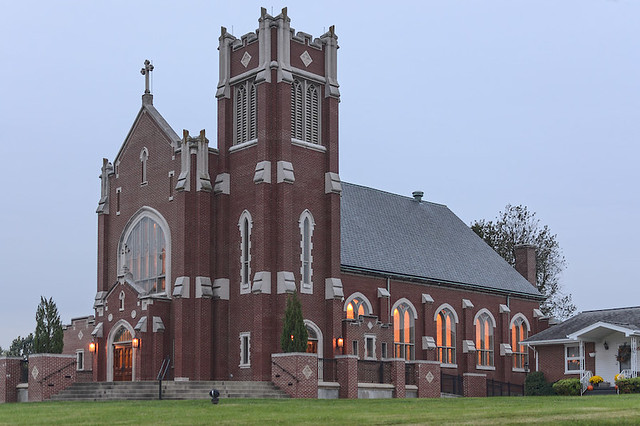
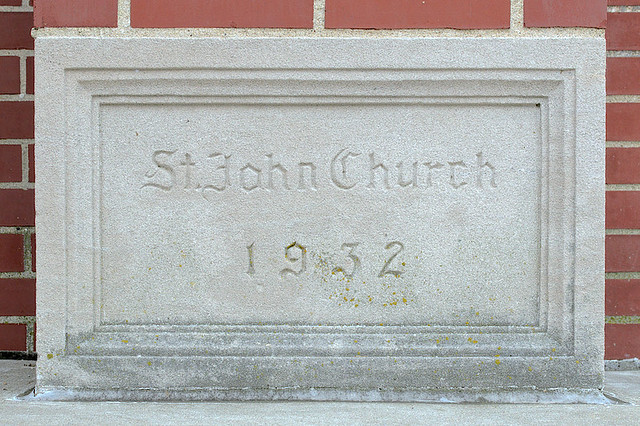
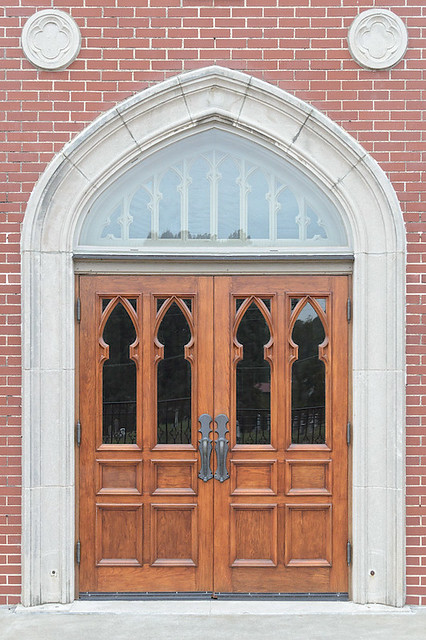
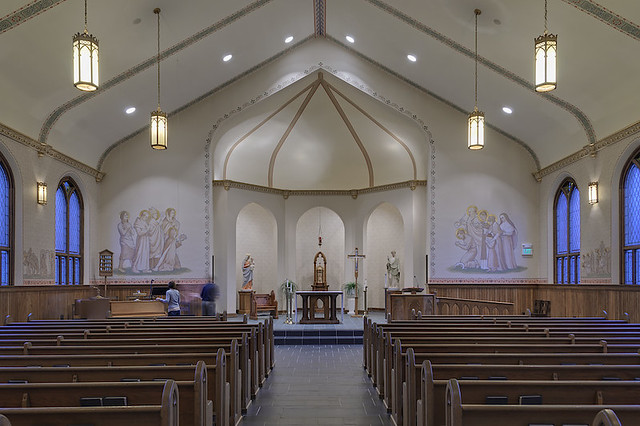
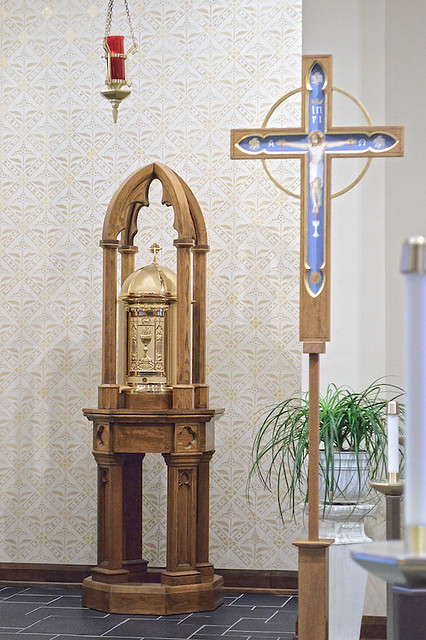
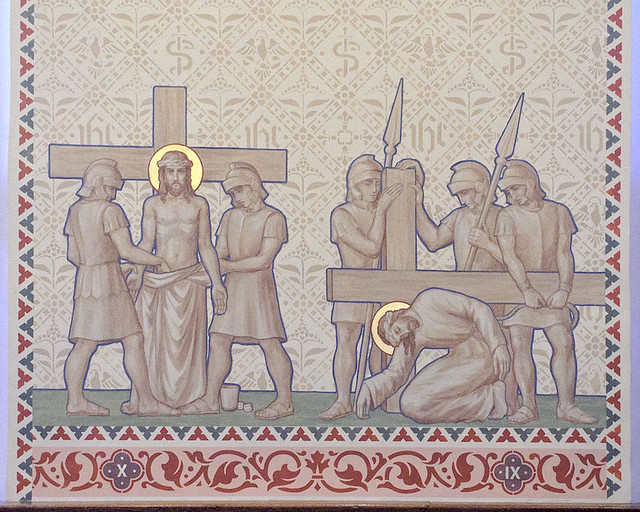
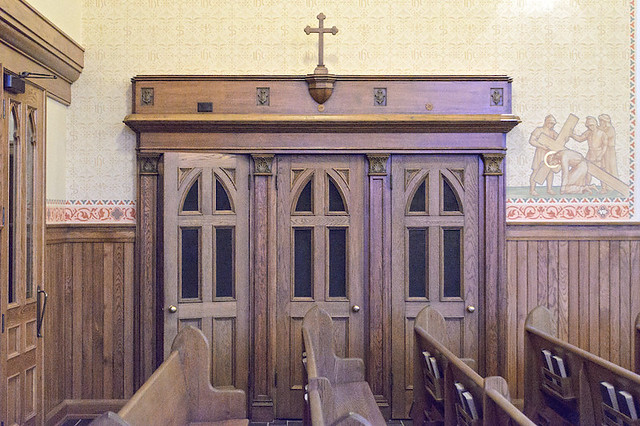
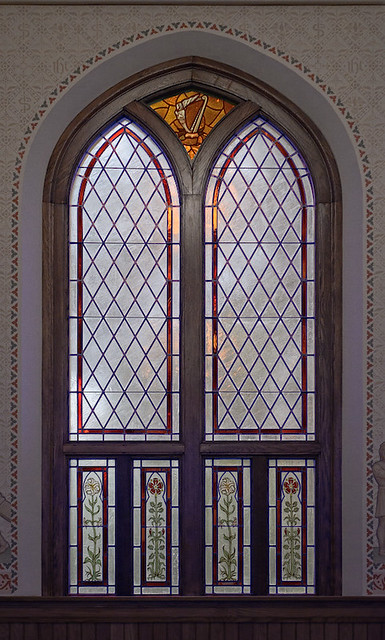
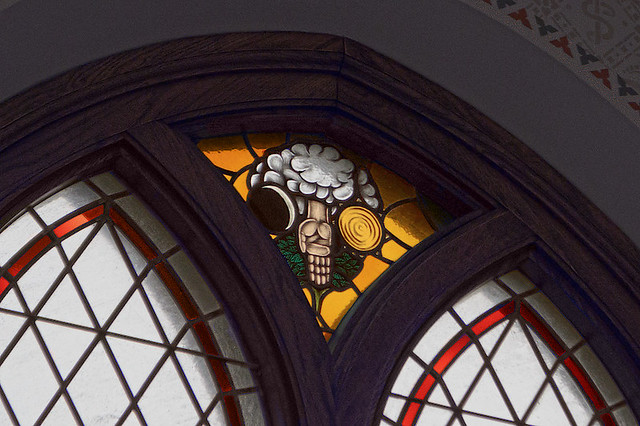
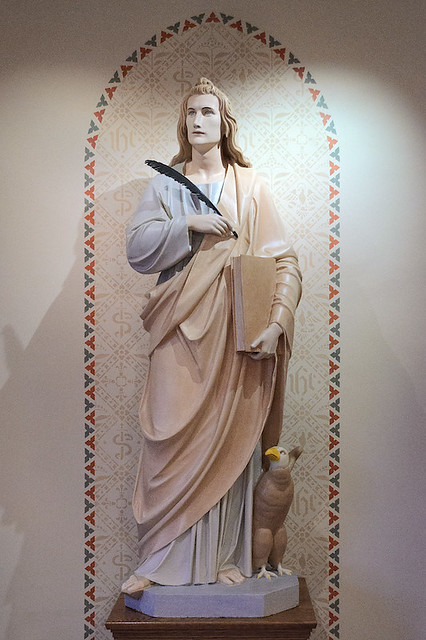

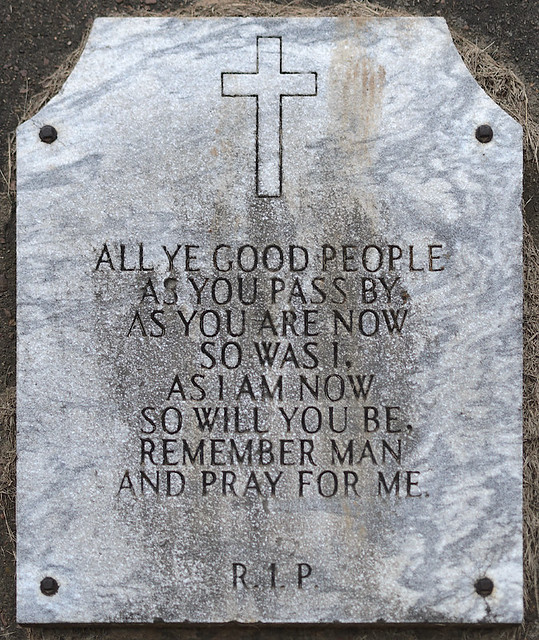


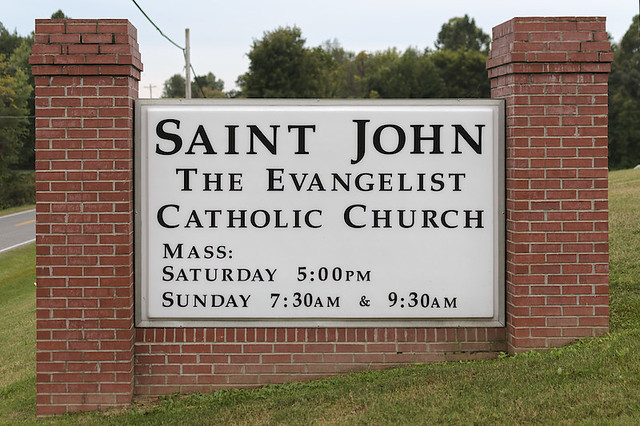




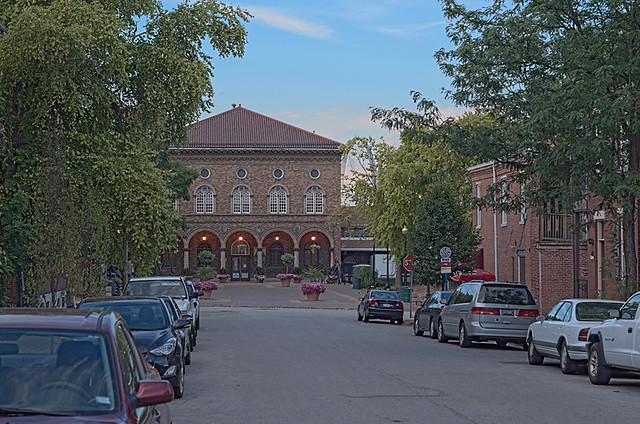





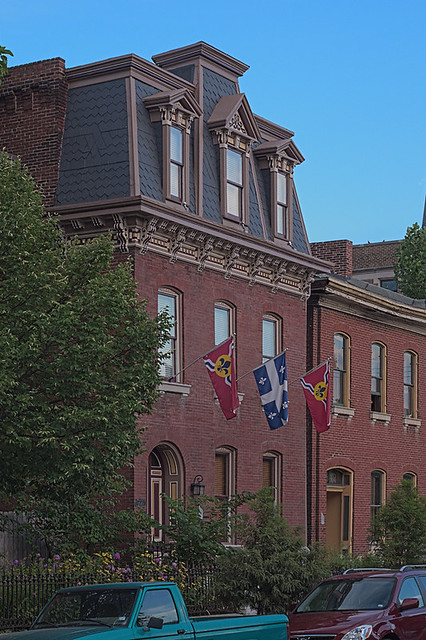








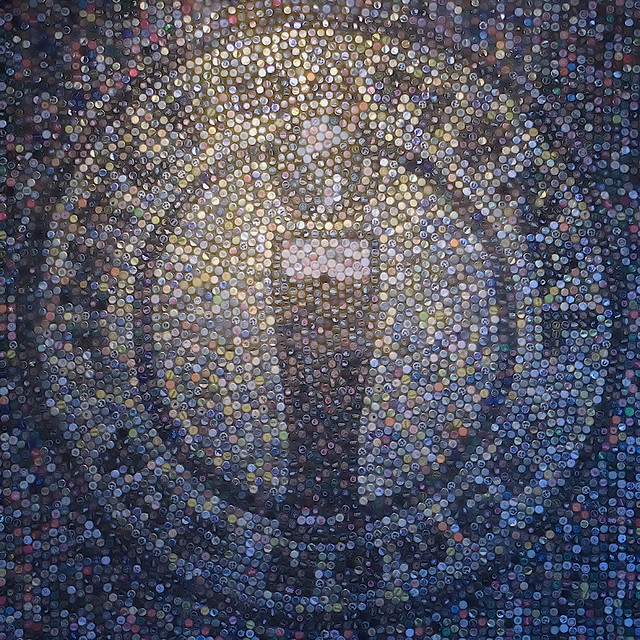




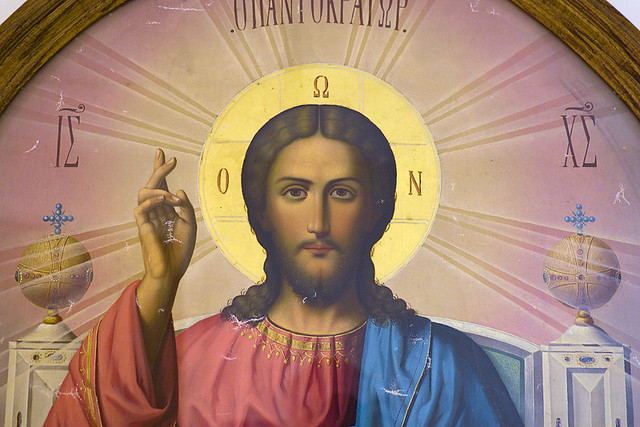
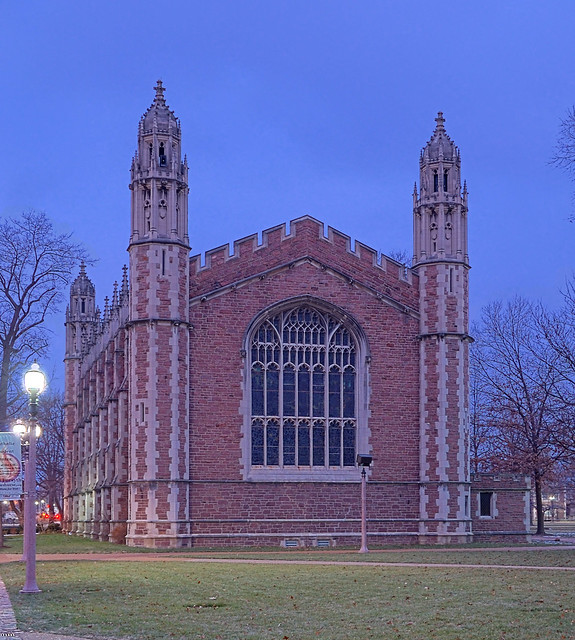
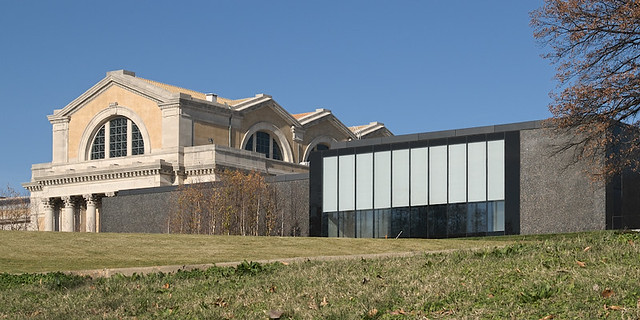

![Portrait of a Cat I (Shilo) [EV=-4.5]](http://farm2.staticflickr.com/1282/4685475360_e89a7ba31e_z.jpg)