Pages

Thursday, September 08, 2005

Photos of Old Saint Ferdinand's Shrine in Florissant, Missouri


Old Saint Ferdinand's Shrine, built in 1819-1821, is believed to be the oldest Catholic church between the Mississippi River and Rocky Mountains. The facade and belltower date from 1881; the interior was renovated in 1966 after a fire. It is no longer a parish church, but remains consecrated, however, the Blessed Sacrament is not reserved here. This is a log building, with a brick exterior. This is the first place where Saint Rose Philippine Duchesne had a school in the Saint Louis area, before she moved to Saint Charles, Missouri. The Jesuit missionary Peter De Smet was ordained here. Under the altar is a wax effigy containing the relics of Saint Valentine.

Florissant is one of the oldest communitites in Missouri, in north Saint Louis County, and is located about 17 and a half highway miles northwest of downtown Saint Louis City. The streets in Old Town Florissant have Saints' names. Many historic buildings, including one dating from 1790, still exist in this neighborhood.


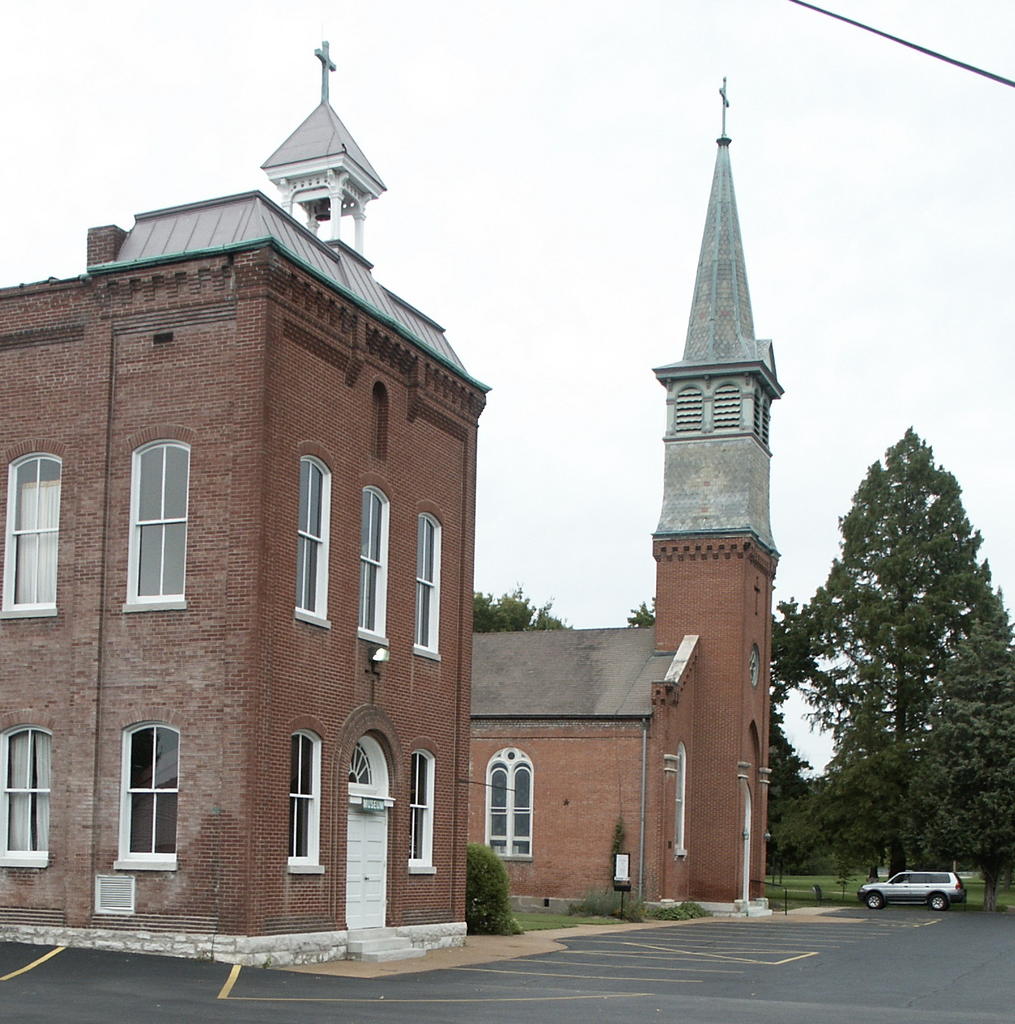
The old school, built in 1888, is now a museum


The rectory, built in 1840


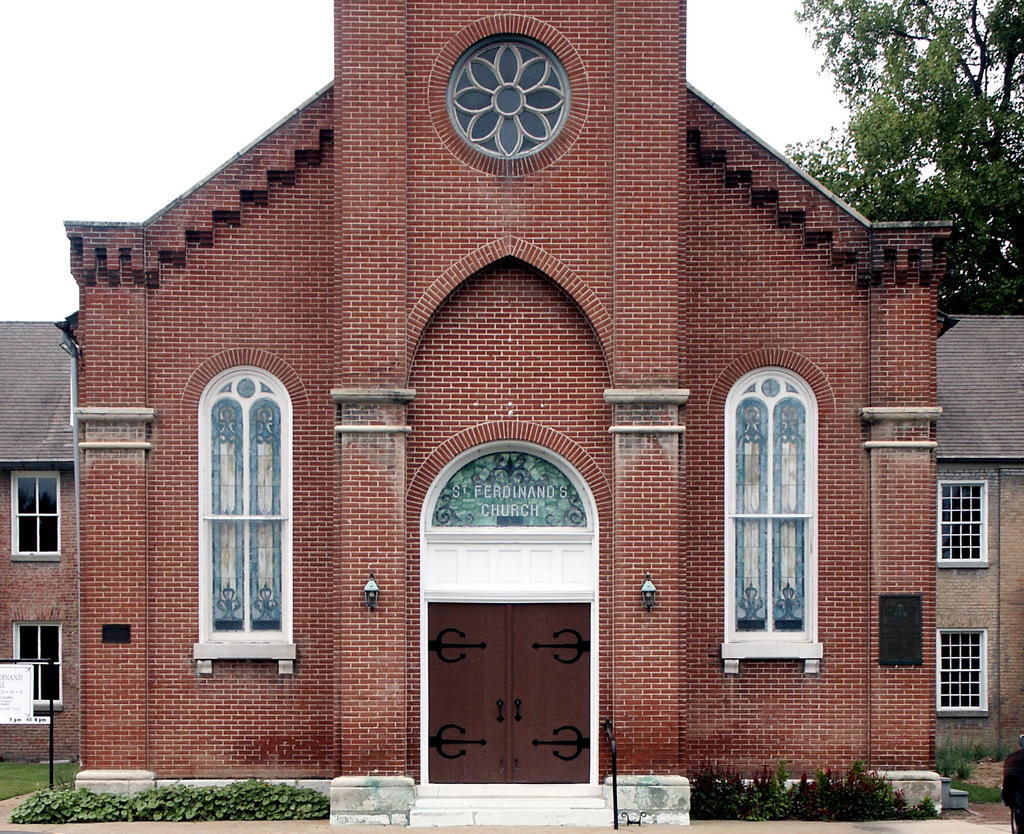
The facade of the church. The marker to the right of the entrance reads:

THIS CHURCH WAS BUILT IN 1821,
AT THE THEN FRONTIER OF OUR BELOVED LAND
AND
DEDICATED TO THE
SACRED HEART OF JESUS
WITH
ST. FERDINAND AND ST. JOHN REGIS
AS SECONDARY PATRONS

THE ST. LOUIS GENERAL ASSEMBLY
FOURTH DEGREE
KNIGHTS OF COLUMBUS
AFFECTIONATLY PLACED THIS MARKER
ON JUNE 14TH 1925.


The convent, built in 1819, is where Mother Rose Philippine Duchesne lived from 1819 to 1827 and from 1834 to 1840.


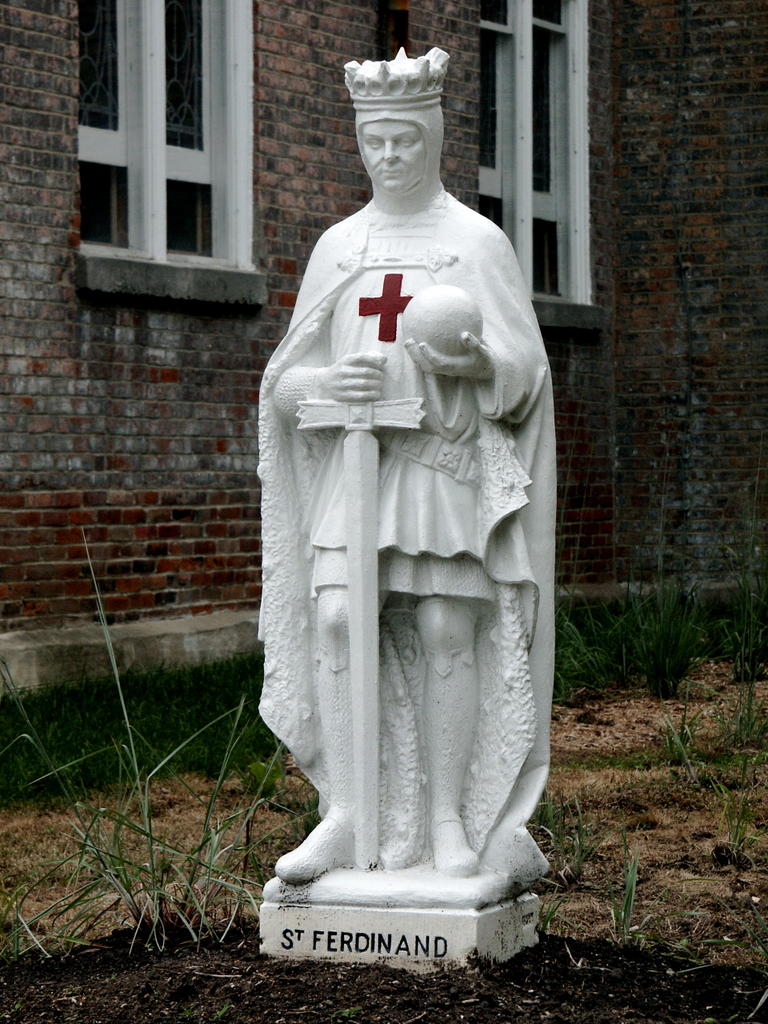
Statue of Saint Ferdinand, in front of the convent


Statue of Mother Duchesne


Behind the church


Back of the convent, showing what appears to be an old well


The garden behind the rectory


Coldwater Creek, near the church


The area adjacent to the Shrine is Spanish Land Grant Park, and contains the remains of the early settlers of Florissant. The graves are unmarked. A monument reads:


FLORISSANT

FRENCH TRAPPERS DISCOVERED THE FERTILE VALLEY FORMED BY
THE RIVIERE DE BICHE AND CALLED IT FLEURISSANT. THEY STAYED TO
TILL THE RICH SOIL AND BUILD A VILLAGE HERE ON THE EAST BANK
OF THE STREAM THE AMERICANS WOULD LATER CALL COLDWATER
CREEK THE COMMON FIELDS STRETCHED FROM THE WEST BANK TO
THE MISSOURI RIVER WHILE THE COMMONS SURROUNDED THE
VILLAGE ON THE REMAINING THREE SIDES. WHEN THE LAND WAS
TRANSFERRED TO SPAIN, THE VILLAGE WAS KNOWN AS SAN
FERNANDO AND IN 1786 FRANCOIS DUNEGANT WAS NAMED THE
MILITARY AND CIVIL COMMANDANT OF THE VILLAGE.

ERECTED BY
THE BUSINESS AND PROFESSIONAL WOMEN'S CLUB
OF FLORISSANT
IN CELEBRATION OF 200 YEARS OF GOVERNMENT
ON OCTOBER 19, 1986


Address:
1 Rue St. Francois
Florissant, MO 63032


Phone: 314-837-2110

The shrine is open on Sundays 1-4 PM, April thru December.


Newer photos of the shrine can be found here, here, and here.

Lay Eucharistic Conference to be held October 1st, 2005

The conference, "The Feast of Faith: The Eucharist in the Thought of Pope Benedict XVI", will be given by Rev. C. Eugene Morris, on Saturday, October 1st, 2005, at the Cardinal Rigali Pastoral Center in Shrewsbury, Missouri.

Fr. Morris is Director of Worship and Assistant Professor of Sacramental Theology at Kenrick-Glennon Seminary in the Archdiocese of Saint Louis, and is host of the show "Sacraments, Sacramentals and the Sacramental Life of the Church" on Covenant Network Catholic radio (AM 1080 WRYT and AM 1460 KHOJ)

Schedule:

9:00 AM, Holy Mass
10:00 AM, Refreshments
10:30 AM, Talk
11:45 AM, Lunch
1:00 PM, Talk
2:00 PM, Eucharistic Adoration and Benediction
3:00 PM, End of conference

Registration fee is $15 and includes refreshments and a box lunch. Payment must be received by Wednesday, September 21st.

Send name, address, phone number and check, payable to Archbishop's Committee On Eucharistic Adoration, to:

Archbishop's Committee On Eucharistic Adoration
6603 Christopher Dr.
St. Louis, MO 63129

For further information, contact Mary or Rose at (314) 846-8207 x200

Location:
Cardinal Rigali Center
20 Archbishop May Drive
Saint Louis, MO 63119

Sunday, September 04, 2005

Presentation on Cloning Given at Cardinal Rigali Center

"Stem Cells and Cloning: Facts vs. Fiction" was held at the Cardinal Rigali Center in Shewsbury, Missouri, on Tuesday, August 30th, 2005. Principal speakers were John F. Morris, Ph.D., and Wesley J. Smith, J.D., and attendees included Archbishop Burke and numerous priests, professionals, and civic leaders of the diocese. This presentation was sponsored the St. Louis Archdiocesean Respect for Life Apostolate and Missouri Right to Life.

Dr. Morris' presentation provided a scientific view of cloning, and various misconceptions about cloning that are portrayed by the media and prominent politicians. He talked about stem cells, which are primitive cells found in the body which can grow into various organ tissue, such as heart, brain, muscle, etc. The cells can be collected and coaxed into various tissues for the treatment of, for example, heart disease. Adult stem cells are not necessarily taken strictly from an adult, but are also present in umbilical cords, baby teeth, and so forth; these types of cells are limited in that they cannot grow into any arbitrary cell, but only into restricted types, based on where the stem cells were taken. However, adult stem cell research has been very successful, leading to numerous cures in both animals and humans. But because adult stem cells can't be coaxed into any arbitrary cell type, researchers want to do research on embryonic stem cells, which may grow into any type of cell found in the body.

The moral problem is that to get embryonic stem cells, an embryo has to be destroyed. Embryos are human life in a very early stage of development. A scientific problem is that stem cells taken from any random embryo will probably be rejected by the patient, or become a tumor, since the genetic code of the patient and embryo are different. So far, all embryonic stem cell research has failed to provide effective treatment of disease in either animals or humans.

This gives rise to researchers' desire to clone the patient: creating an embryo identical to the patient, from which stem cells may be harvested. Since cloning has become controversial in the public mind, pro-cloning researchers have developed a new name, somatic cell nuclear transfer, or SCNT to describe the cloning process. Beware of any group that has to change the names of things regularly!

However, even cloning doesn't create an exact genetic equivalent, since the egg cell itself has its own genetics and composition, different from the patient's mother. Another problem is that these eggs have to be taken from healthy young women, and in large numbers. This could lead to exploitation of these donors, not to mention the negative medical side-effects of this collection, especially if this cloning becomes widespread.

Missouri Governor Matt Blunt stated his support for cloning by saying that a cloned embryo is not human because it wasn't formed by a sperm and egg, even though a clone could eventually develop into a fully adult human. And a voter, Mr. Governor. So Dolly the Sheep, the first cloned large mammal, wasn't really a sheep? In fairness, though, the governor has a good record on Pro-Life issues, and only recently has this science developed, and only recently has the philosophy of the Culture of Death been understood as encompassing such areas as cloning. Gov. Blunt needs to think more about the moral implications of this research.

Some researchers say that a cloned embryo is not really human because it was created with the intention of destroying it before it develops into an adult human. They call this "therapeutic cloning" instead of "reproductive cloning", although the cloning process is the same. This is a ridiculous argument, and inconsistent. Scientists, especially biologists, deny teleology, or the 'Final End' of things, but here they are using teleology to justify themselves. And saying that another human can define the Final End of another human, even a tiny one in early development, strikes me as arrogant to the extreme, and even sacrilegious, making oneself God.

Wesley Smith's presentation was about the philosophy of the Culture of Death. He was a longtime friend, coauthor, and collaborator with Ralph Nader, who is apparently quite sincere, whether or not you agree with his politics,

Smith is a man on fire. He shows righteous indignation and anger at the Culture of Death. He stated his speech with a story about how he originally was mainly interested in euthanasia issues: but someone invited him to go to breakfast the next day, and meet with some people who were interested in the problem of cloning, insisting that after breakfast he would write a book against cloning. Smith says that he wasn't interested in that subject, just euthanasia. However, at the breakfast, he found out that abortion, euthanasia, cloning, and animal rights are all share the same negative philosophy of humanity. And yes, he did write a book on the subject.

In his study of medical ethics, he has discovered that the mainstream of ethicists make a distinction between a "human" and a "person". A "human" is determined by biology, so embryos, infants, or a man in a coma are humans. A "person", however, is a moral agent, capable of making moral choices, and therefore is given value by others. These views come from secular materialism which denies the Spirit and objective values; and from Utilitarian philosophy, that seeks the greatest good for the greatest number of persons. In this theory, an intelligent animal, advanced computer program, or a space alien landing on Earth can all be considered persons, while infants, and humans in comas are not. Smith said that if ever he meets a space alien, then he will decide if it is a person or not, but thinks that such speculation is not helpful, and instead thinks that this new ethics will lead to atrocity.

Catholic thinking says that all humans are persons, and this dignity is innate, and not just given value by other humans.

Smith says that all of the Pro-Life problems today come from this new ethics, where professional ethicists, judges, and politicians determine whether or not someone is a person and if they deserve rights or death.

Under the new system, all manner of killing is justified, and isn't really limited to extreme cases.

Friday, September 02, 2005

Procession in Times of Tribulation

From the Roman Ritual, 1964

All: Ant. Rise up, O Lord, and help us, * and deliver us for your
name's sake.

P: We have heard, O God, with our own ears * the things which our
fathers told us.

All: Glory be to the Father, and to the Son, * and to the Holy
Spirit.

P: As it was in the beginning, is now, and ever shall be, * world
without end. Amen.

All: Ant.: Rise up, O Lord, and help us, * and deliver us for
your name's sake.

P: Lord, have mercy on us.
All: Lord, have mercy on us.
P: Christ, have mercy on us.
All: Christ, have mercy on us.
P: Lord, have mercy on us.
All: Lord, have mercy on us.

P: Holy Mary, Mother of God.
All: Pray for us.
P: Saint Michael,
All: (etc.)
Holy angels of God,
Saint Joseph,
Saint John the Baptist,
Saint Peter and Saint Paul,
Saint Andrew,
Saint John,
Saint Mary Magdalene,
Saint Stephen,
Saint Ignatius,
Saint Lawrence,
Saint Perpetua and Saint Felicity,
Saint Agnes,
Saint Gregory,
Saint Augustine,
Saint Athanasius,
Saint Basil,
Saint Martin,
Saint Benedict,
Saint Francis and Saint Dominic,
Saint Francis Xavier,
Saint John Vianney,
Saint Catherine,
Saint Theresa,
All you saints of God,

P: Lord, be merciful,
All: Lord, save us.
P: From all harm,
All: (etc)
From every sin,
From all temptations,
From everlasting death,
By Your coming among us,
By Your death and rising to new life,
By Your gift of the Holy Spirit,

P: Be merciful to us sinners,
All: Lord, hear our prayer.
P: Guide and protect Your Holy Church,
All: (etc)
Keep our Pope and all the clergy in faithful service to Your Church.
Bring all people together in trust and peace.
Strengthen us in Your service.

Amen.

P: Our Father (the rest inaudibly until:)
P: And lead us not into temptation.
All: But deliver us from evil.

Then psalm 19 is said; or in place of it psalm 90.

May the Lord hear thee in the day of tribulation: may the name of the God of Jacob protect thee. May he send thee help from the sanctuary: and defend thee out of Sion. May he be mindful of all thy sacrifices: and may thy whole burnt offering be made fat. May he give thee according to thy own heart; and confirm all thy counsels.

We will rejoice in thy salvation; and in the name of our God we shall be exalted. The Lord fulfill all thy petitions: now have I known that the Lord hath saved his anointed. He will hear him from his holy heaven: the salvation of his right hand is in powers. Some trust in chariots, and some in horses: but we will call upon the name of the Lord our God. They are bound, and have fallen; but we are risen, and are set upright. O Lord, save the king: and hear us in the day that we shall call upon thee.

P: God is our refuge and our strength.
All: A helper in all tribulations.
P: Lord, save your servants.
All: Who trust in you, my God.
P: O holy God! O holy strong One! O holy immortal One!
All: Have mercy on us.
P: Help us, O God, our Savior.
All: And deliver us, O Lord, for the glory of your name.
P: Lord, heed my prayer.
All: And let my cry be heard by you.
P: The Lord be with you.
All: May He also be with you.

Let us pray.
Almighty God, do not disdain your people who cry to you in their affliction, but for the glory of your name be pleased to help us who are so sorely troubled. Show us, O Lord, your inexpressible mercy, blot out our transgressions, and graciously deliver us from the condemnation they deserve.

We entreat you, Lord God, grant us, your servants, the enjoyment of lasting health of body and mind; and by the glorious intercession of blessed Mary, ever a Virgin, free us from present sorrow and give us everlasting joy.

Graciously hear us, O Lord, in our tribulation, and turn away the stripes of your wrath which we justly deserve. God, our refuge and our strength and source of all goodness, heed the holy prayers of your Church, and grant that we fully obtain whatever we ask for in faith; through Christ our Lord.

All: Amen.

Virtue is Lacking

In the very first sentence of Plato's Dialogue of Meno, Socrates is asked by Meno, "Can you tell me, Socrates, whether virtue is acquired by teaching or by practice; or if neither by teaching nor practice, then whether it comes to man by nature, or in what other way?"

In other words::
1) Virtue can be taught; or
2) Virtue is gained by practice; or
3) Virtue is a part of human nature; or
4) Virtue is against human nature

All of the philosophies of the world created since this dialogue was written in about 380 B.C. have generally assumed just one or another of these four views of virtue and human nature.

The chaos now in New Orleans due to Hurricane Katrina shows the great and horrible flaws in American culture. Rioting, gunfire, rape, looting, gang warfare, and general lawlessness rule the day in the city.

Understandably, these people are starving, dying of thirst, and many need urgent medical care and general sanitation. I would think that stealing food when starving is not sin, or even a crime; for justice demands this. But the situation goes far beyond this, people are settling old scores and violently doing whatever they want, with no regard for others.

Some would say that desperate times call for desperate measures, but a virtuous person does not act with desperation, but keeps his emotions in check.

Much of the political Left in the United States thinks that virtue is a part of human nature, and that only society makes people act contrary to virtue. People with this point of view do not blame the people who are causing chaos in New Orleans, saying that they are just responding to social injustice. Likewise, the hurricane itself is seen as being caused by the injustices of current political system, due to global warming and the lack of government spending on infrastructure in ethnic minority cities. Ironically, both Leftist Europeans and radical Islamicists are delighting in their schadenfreude, saying that the United States is getting what it deserves, because of the war in Iraq and America's cultural and economic hegemony.

Much of the political Right in the United States thinks that virtue is against human nature, and that vigorous law enforcement is needed to keep order. They want to use the military to impose order on the rioters, with shoot-on-sight orders against looters. Overwhelming force is needed to control the people who are acting like animals.

Why won't we, or why can't we just teach and encourge people to do the right thing, with no need for either reward or punishment? To do what is right just because it is the right thing to do? Why must we make excuses for those who don't do what is right? Why must we always resort to force against those who get out of line?

American culture says that virtue is either a part of human nature or is against it. This goes very well with American public philosophy and religion, which was originally Puritan. The Puritans thought that a man's salvation was predestined, and that a man can actually know, with certainty, whether he is saved or not. The elect, saved, or elite knew that the others were damned and needed force to keep them in order. The more enlightened of that group, such as the Universalists, think that all are saved, in a democratic fashion, and all bad behavior is to be excused as a failure of society. So where does virtue fit in here? Is it even relevant in this worldview? American Catholics, Neo-Conservative and Liberal alike, unfortunately subscribe to these views, for both views stem from the same source, which unfortunately is not Catholicism.

The Catholic view of man is that he is good, but wounded. He has the Moral Law written deep in his heart, but that we ignore this in-built morality by pride and weakness of will. We can teach about virtue, and there are ways to strengthen good moral behavior so that we can become more virtuous. Catholicism teaches about the rewards and punishments of good and bad behavior, but above all, she teaches that we should love the Good for its own sake, and do right for its own sake.

The Puritan Ethic is the Work Ethic, which revolves around the gain or support of either money or power. This is not the Catholic Ethic, which gives force to all of the virtues, both natural and supernatural. A Catholic is not certain of his salvation, and must be virtuous, in every way possible.

Meno asks Socrates if virtue can either be taught or gained by practice. Contemporary American culture ignores these questions, for several reasons. Virtue is certainly not taught in American schools, neither in public schools nor in most Catholic schools. Virtue is not practiced, either, as is well-demonstrated here.

Virtue, which is inseparably linked to morality, is not taught in public schools because it is believed to be too closely tied to religion, and Thomas Jefferson's "high wall of separation between Church and State" is not to be breached. But a truly 'multicultural' education would see that virtue is seen in almost identical ways by all of the great cultures of the world, and is indeed a part of what can be called 'ancient wisdom'. This, however, is not the goal of multicultural teaching, which instead mainly desensitizes students about sexual and cultural immorality and purposefully alienates them from their received religious background. Even our legal system, under the philosophy of "Positive Law", denies that the law should be moral.

The great cult of individuality, where every man is King and Pope, (and even God, in New Age thinking), is what is taught in schools today. Self-Esteem is worshiped. "I will not serve" is the attitude that develops, and so force will be inevitably needed to keep people in line.

C.S. Lewis describes humanity as a fleet of ships on the sea. They have three different sets of sailing orders: how each ship is to keep afloat, how the ships should cooperate with each other, and where the ships are headed. The last, which describes the End of man, is far too close to religion for comfort, so we substitute a nebulous New Age "Self-Actualization", or Conquest of Nature (including Human Nature), or Success as the End of mankind. We do not teach how the ships should cooperate; so force is needed to keep them in line. Likewise, how the ships should be kept afloat is not taught, for everyone should follow their own conscience, ill-formed as it may be.

Moral Relativists on the Left say that there are no objective virtues, and instead people should do whatever they think is right, and that any teaching of virtue, even in a rational Socratic manner, is imposing moral views on students. Captains of Industry on the Right think that the Classical Virtues, which emphasizes Justice and Temperance, will deprive them of their riches and their revenue streams. Even governments of all types are now filled with greed, maximizing tax revenue from gambling and other vice.

Puritan values have left our country rich, powerful, but also impoverished. Enlightenment values have made us selfish and egotistical. Marxist values have divided our nation into struggling factions within our institutions and families. New Age values have made us demonic. The Classical Virtues of Plato and Aristotle, amplified and expanded on by the Church have been nearly forgotten, but the spark is still alive.

Socrates was battling against the moral relativists, against the rich and powerful, and against the immoral. Plato, who wrote his dialogues, showed very plainly that Virtue can be objectively known, even though it was hard to do, and that even the wicked could be brought to a rational understanding of justice. The Church, which recognized the truth of both faith and reason, uses the ideas of these classical philosophers in its moral system. Sadly, modern sects deny reason at times, or deny objective truth. But Catholics know that virtue can be studied, in a rational manner, and not be tied to religion.

The chaos in New Orleans is due to lack of virtue.

It is up to Catholics, who almost alone in the United States still have a vestige of teaching and practice in Virtue. it is lost nearly everwhere else, so we have to get to work! All that is needed now is a few saints in the world.