Friday, December 16, 2005
Congratulations
Congratulations are due to Joe Carter; his site, Evangelical Outpost, won the 2005 Weblog Awards.


Thursday, December 15, 2005
Photos of the Interior of the Cathedral Basilica of Saint Louis
Here are some photos of the interior of the Cathedral Basilica of Saint Louis. Please click on any photo for a larger version.
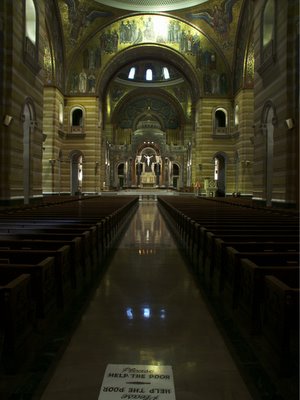
The nave of the Cathedral. The church exterior is in the sturdy Romanesque style, while interior is lined with mosaics and is in the Byzantine style. Eastern Christians call the gold background of the mosaics "the light". While this church proclaims the glory of God, we must also serve each other. "Please help the poor."
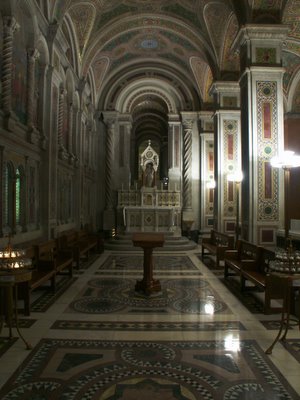
All Saints Chapel.
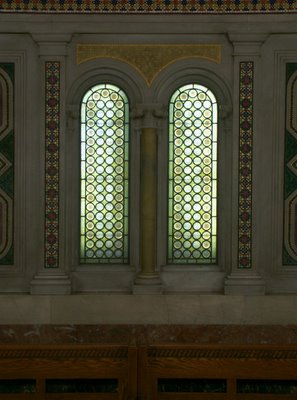
Window in All Saints Chapel.
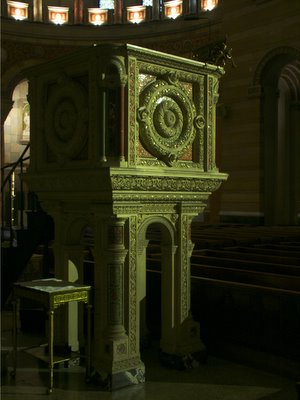
The pulpit.
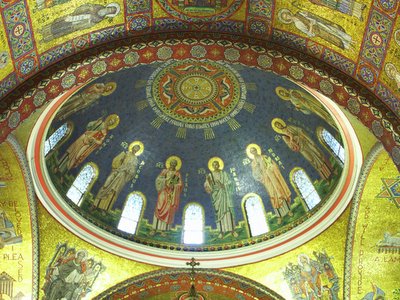
The Sanctuary dome. It contains mosaics of the Apostles.
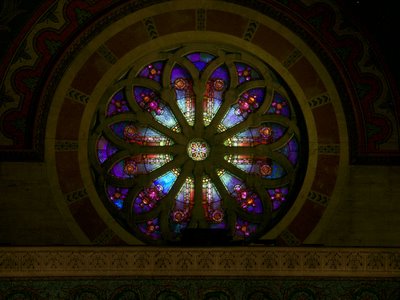
The south rose window.
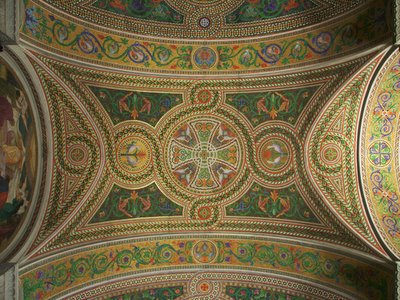
Mosaics on the ceiling of Our Lady's Chapel.
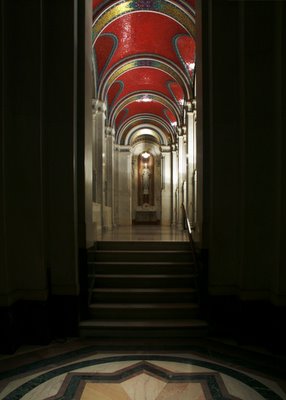
East ambulatory. The red ceiling continues into the Blessed Sacrament Chapel, and signifies Christ's blood.
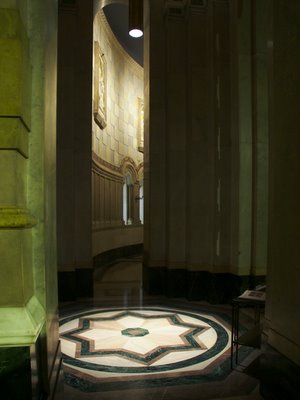
Walkway around the perimeter of the east transept.
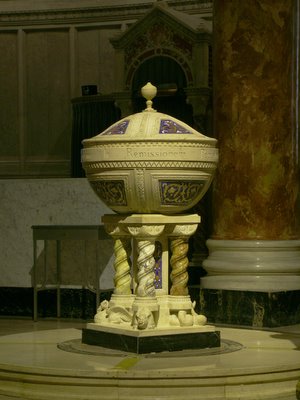
The baptismal font, located in the east transept.
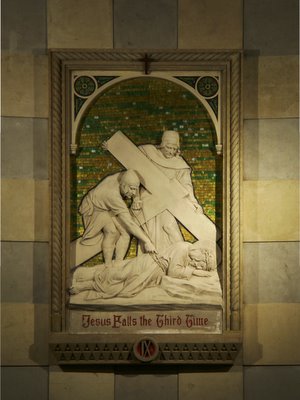
A Station of the Cross. Jesus falls the third time. The Stations are located high up in the transepts.
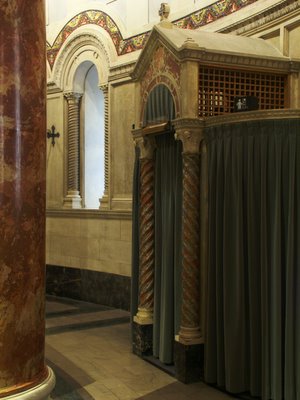
A confessional in the east transept.
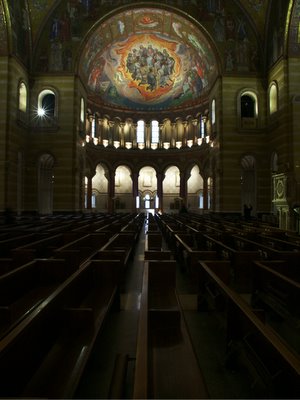
The west transept. The mosaics in the transepts were the last to be completed, these done in 1988.
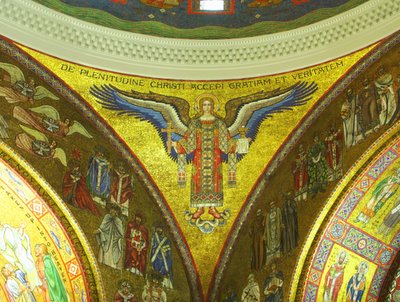
Mosaic of an angel in the west transept.
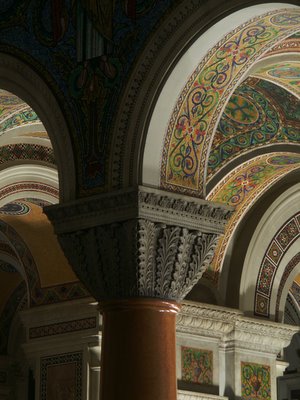
A detail of a column capital.
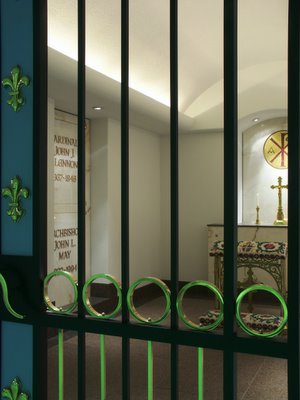
Under the church are the tombs of the bishops of Saint Louis.
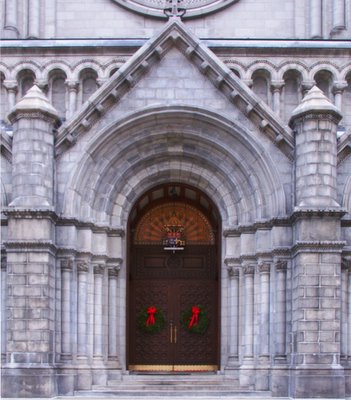
The center front door of the Cathedral.
For more photos of the cathedral, see my article Photos of Some Side-Chapels of the Cathedral Basilica of Saint Louis.

The nave of the Cathedral. The church exterior is in the sturdy Romanesque style, while interior is lined with mosaics and is in the Byzantine style. Eastern Christians call the gold background of the mosaics "the light". While this church proclaims the glory of God, we must also serve each other. "Please help the poor."

All Saints Chapel.

Window in All Saints Chapel.

The pulpit.

The Sanctuary dome. It contains mosaics of the Apostles.

The south rose window.

Mosaics on the ceiling of Our Lady's Chapel.

East ambulatory. The red ceiling continues into the Blessed Sacrament Chapel, and signifies Christ's blood.

Walkway around the perimeter of the east transept.

The baptismal font, located in the east transept.

A Station of the Cross. Jesus falls the third time. The Stations are located high up in the transepts.

A confessional in the east transept.

The west transept. The mosaics in the transepts were the last to be completed, these done in 1988.

Mosaic of an angel in the west transept.

A detail of a column capital.

Under the church are the tombs of the bishops of Saint Louis.

The center front door of the Cathedral.
For more photos of the cathedral, see my article Photos of Some Side-Chapels of the Cathedral Basilica of Saint Louis.
Korean Cloning Results Apparently Faked
See the article American Co-Author Wants His Name Off Stem Cell Paper, By Nicholas Wade, published December 14, 2005. Note that this link requires registration on the New York Times web site.
Thanks go to Dr. Robert Onder—physician, bioethics lecturer, and good friend—for sending me this link.
NOTE: Here is the researcher's response to accusations of fraud, from Reuters: South Korean scientist denies faking cloning study.
After several days of serious accusations about the validity of a prominent article on the cloning of human cells, the senior author, Gerald Schatten of the University of Pittsburgh, has asked for his name to be removed as co-author, the editors of the journal Science said yesterday...However, many of the photos in the article proved to be duplicates or photos of different parts of the same cell culture. Also, DNA analysis of supposedly different stem-cell lines were actually identical. This would indicate that the researchers failed to do what they had claimed.
The report was hailed as the first step toward the goal of treating people with their own tissues, generated through embryonic cells...
If this were true, critics say, the paper would not have any evidence that the cell colonies came from the donors or that Dr. Hwang ever performed any successful nuclear transfer experiments...Science, according to Aquinas, is a virtue of the intellect, which attempts to conform the intellect to reality. Lying does not serve science. However, this scientific research is immoral, since it involves the killing of human embryos.
The promise of Dr. Hwang's Science paper is that it seemed to make the long-sought goal of therapeutic cloning quite practical by using only 10 or so human eggs per patient, compared with the 242 used in his 2004 experiment. If the article should turn out to have been fabricated, it would "give a black eye to science in general," Dr. Gearhart said.
Thanks go to Dr. Robert Onder—physician, bioethics lecturer, and good friend—for sending me this link.
NOTE: Here is the researcher's response to accusations of fraud, from Reuters: South Korean scientist denies faking cloning study.
Wednesday, December 14, 2005
John Cassian on Fasting
John Cassian (ca. 360 - ca. 435) introduced Eastern monasticism into the West. One of this books, the Institutes (written about 425-428) discusses the way of life of monks in Egypt, and includes chapters on the eight principal vices.
In the Advent and Christmas seasons, gluttony is one of the most well-practiced of the vices. Cassian has quite a bit to say about fasting:
These suggestions are suitable for most, but not all people. We also need to be aware of the problems of anorexia and related disorders. Here, fasting is taken to an extreme, and is not done in a prudent way. These disorders are a form of scrupulosity, and require an extraordinary amount of direction and treatment.
In the Advent and Christmas seasons, gluttony is one of the most well-practiced of the vices. Cassian has quite a bit to say about fasting:
- There is no single standard for fasting that applies to everybody. Age, sex, sickness, and individual constitution all need to be considered.
- Virtues are not evenly distributed among persons, and that includes the practice of fasting.
- We do have a shared goal, however: the avoidance of overeating and filling our stomachs.
- A single day's fast is more beneficial for purity than those extended over longer periods. This is because the break-fast meal may be too large causing listlessness and sloth; also extreme hunger can cause sluggishness in the spiritual exercises.
- A plain diet of either greens or bread may not agree with everyone, so some variation among persons is expected.
- We are also not to be led astray by the pleasures of the palate.
- Both the variety of food and the quantity eaten can lead to unchastity.
- Wine leads to drunkenness, but also too much water or any kind of food can lead to a drowsy, stupified mind.
- Cassian says that the Sodomites got on their path of destruction by eating a surplus of bread. Gluttony is a simple, common vice that can lead to much greater evil.
- Food is needed to support life. It is not for making us slaves of our desires. We need to eat moderately enough to sustain health.
- Delicate foods are permissible if they are healthy and taken in moderation.
- Stop eating while you are still hungry.
- Fasting will not make you holy. Other virtues are also required for purity: humility and lack of a desire for money; and freedom from anger, despair, self-esteem, and pride.
- Fasting and self-control can purify a person who has restraint and moderation.
- Chastity is difficult with a full stomach.
- A person who gives in to bodily desires is a slave; freedom comes from self-control.
- Control of gluttony is similar to the preliminary contests that decides who gets to compete in the Olympic Games. The Christian athlete, like the Olympic athlete, must first of all control his own flesh.
- We gain control of our stomachs not only through fasting, but by hard work, keeping vigils, and spiritual reading, as well as the fear of Hell and the desire for Heaven.
- The person who fasts must only eat at fixed times, and never at any other time. He should also get an adequate amount of sleep.
- A person who fasts needs to simultaneously do a spiritual fast, where anger, envy, and slander are to be avoided.
- The Egyptian monks would stop fasting at once if a visitor arrives and needs to eat. Charity to a fellow person is far more important than fasting, which can be done anytime.
- Some monks made a practice of never eating alone, but only in community. This helps the practice of fasting.
- Some never eat during daylight hours.
These suggestions are suitable for most, but not all people. We also need to be aware of the problems of anorexia and related disorders. Here, fasting is taken to an extreme, and is not done in a prudent way. These disorders are a form of scrupulosity, and require an extraordinary amount of direction and treatment.
Tuesday, December 13, 2005


Subscribe to:
Posts (Atom)
