Sometimes we feel as if we have a right to having a happy Christmas. The reason of the season is of course celebrating the birth of Jesus, but a reflection of the liturgy for the Advent and Christmas seasons give us a more balanced picture of both salvation history and what is yet to come.
The readings from the Prophet Isaiah of this season are sobering. The people of Israel are worshiping false idols, consulting with fortunetellers, and given to drunkeness, adultery, and sodomy. They are greedy in their riches and unjust to the poor. They are falsely pious hypocrites in the Temple and Synagogues. This is a condemnation of us all; both Left and Right.
Today is the feast of Saint Stephen, the first martyr, killed for proclaiming the Gospel. This is not a pleasant reminder of the difficulties of the Christian life; however, his persecutor, Saul, later became the great apostle to the Gentiles, Paul.
On Tuesday is the Feast of Saint John, Apostle and Evangelist, who was the beloved disciple of our Lord, and was the only male follower to remain faithful to him at the Crucifixion—the others having run and hid. Only the holy women and this boy kept the faith; not the Apostles nor even Saint Peter, the first Pope, remained true under this first persecution. John's later life was very difficult, and while not martyred, he suffered torture and imprisonment.
On Wednesday is the Feast of the Holy Innocents, commemorating the slaughter of the children of Bethlehem by Herod, in his attempt to kill the Messiah, and also we read about the killing of the male children of the Hebrews by Pharaoh.
On Friday we celebrate the Feast of the Holy Family, added to the calendar by Pope Benedict XV in 1921. Dom Augustine Oppenheimer gave a homily on this feast last year where he said that this Pope Benedict explicitly added this feast in opposition to the destruction of family life that was occurring at that point in history, and which has yet to be reversed. This feast symbolizes Christian family life. The Blessed Virgin Mary, the greatest of all creatures, is subject to Saint Joseph, while Jesus, the Incarnate God, is subject to both.
This season is not just a time of recalling the wait for the birth of the Christ Child, but also a waiting for the return of Our Lord in glory in the future and the end of the world. This theme of destruction is very appropriate in the northern hemisphere with the coming of winter, but Pope Benedict XVI makes the point that it is appropriate symbolism with the coming of summer in the southern hemisphere, with the hope of a new world to come. It is for this reason that we should not have too high expectations for a fun Christmastime, as is the secular custom. Pain and sorrow exist in all seasons of the year, and we should reflect on that during this time also, but we know that joy and gladness will eventually conquer the sorrow.
The Jews had hoped for a Messiah who would end their subjugation to the Roman Empire. Jesus was not the Messiah they had hoped for, and so many rejected him. All seemed lost; after the Crucifixion, the rituals of the Temple failed, and soon the Temple itself was destroyed, never to be rebuilt, and the Jews themselves were slaughtered and the survivors were scattered across the face of the earth. The conquering Messiah hoped for by the Jews is yet to come, but we Christians hope and tremble with fear at His return.
Monday, December 26, 2005


Christmas
I hope everyone had a merry Christmas.
I was blessed to be able to share Christmas with my family.
I was blessed to be able to share Christmas with my family.
Thursday, December 22, 2005
Photos of Saint Vincent de Paul Chapel
The Cardinal Rigali Center is the home of many offices of the Archdiocese of Saint Louis, and is a former seminary. Inside is the beautiful Saint Vincent de Paul Chapel, done in the Gothic style. I was kindly given permission to photograph in here. I was not the only one here with this mission: some visiting Sisters, after they prayed the Divine Office in this chapel, were also taking numerous pictures.
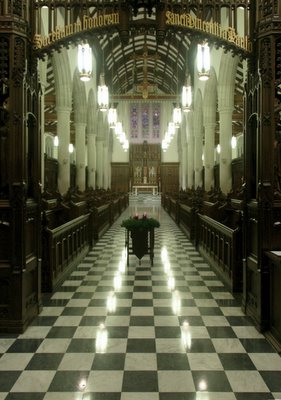
The chapel from the entrance. The pews are in antiphonal form; long rows on opposite sides of the aisle face each other. This design derives from the ancient practice of monks chanting alternate verses of the Psalms of the Divine Office: one side chants a verse, the other side chants the next, and so forth. Some Modern churches have used this design as an alternative to seating-in-the-round.
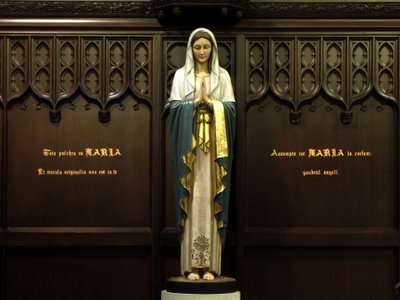
Statue of the Blessed Virgin Mary. Surrounding the entire chapel are panels of richly carved wood, with quotes from Scripture in gold Gothic lettering.
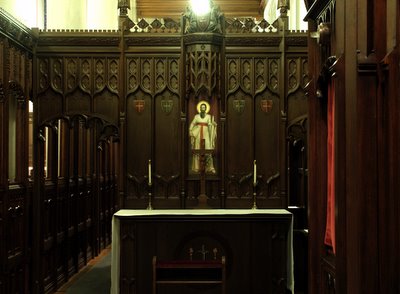
A side altar in the chapel.
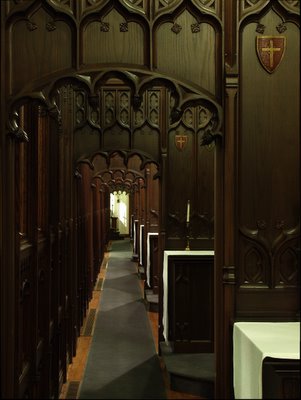
This building was once a seminary; there are a dozen side altars in this chapel. The Church now allows concelebration and no longer requires priests to say Mass daily, so the practice of building side-altars has nearly disappeared. That is a shame; for the intimacy of a side-altar Mass, especially a weekday Mass with few communicants, is hard to match.
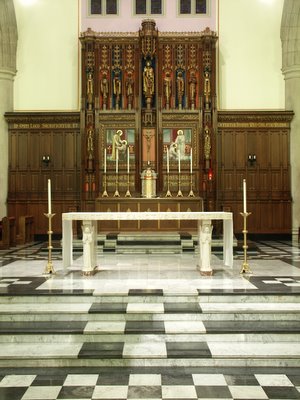
The High Altar.
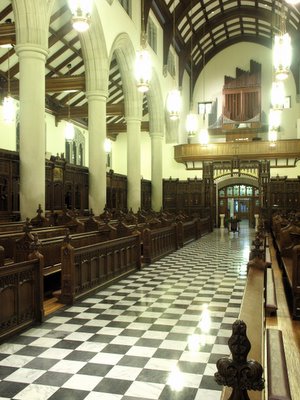
View down the aisle.
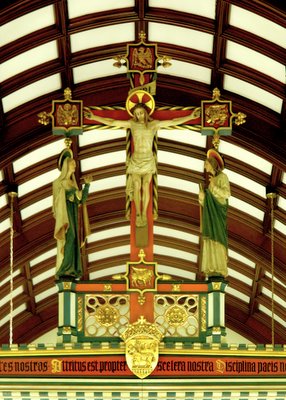
The crucifix. It is high up in the middle of the chapel.
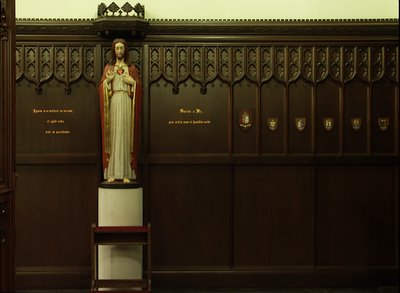
Statue of the Sacred Heart of Jesus. Coats of arms of notable churchmen are displayed on the walls of the chapel.
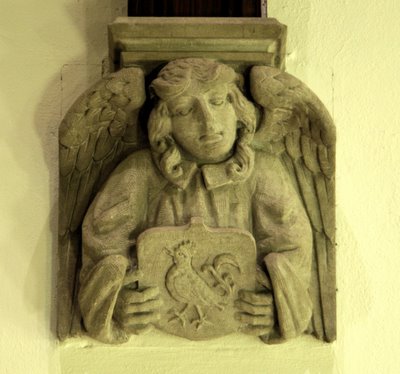
Each arch from the ceiling abuts to a carving of an angel.

The chapel from the entrance. The pews are in antiphonal form; long rows on opposite sides of the aisle face each other. This design derives from the ancient practice of monks chanting alternate verses of the Psalms of the Divine Office: one side chants a verse, the other side chants the next, and so forth. Some Modern churches have used this design as an alternative to seating-in-the-round.

Statue of the Blessed Virgin Mary. Surrounding the entire chapel are panels of richly carved wood, with quotes from Scripture in gold Gothic lettering.

A side altar in the chapel.

This building was once a seminary; there are a dozen side altars in this chapel. The Church now allows concelebration and no longer requires priests to say Mass daily, so the practice of building side-altars has nearly disappeared. That is a shame; for the intimacy of a side-altar Mass, especially a weekday Mass with few communicants, is hard to match.

The High Altar.

View down the aisle.

The crucifix. It is high up in the middle of the chapel.

Statue of the Sacred Heart of Jesus. Coats of arms of notable churchmen are displayed on the walls of the chapel.

Each arch from the ceiling abuts to a carving of an angel.
Wednesday, December 21, 2005
Photo of Saint John Apostle and Evangelist Church

St. John's is the parish church of downtown Saint Louis.
Saturday, December 17, 2005
Photo of Saint Gabriel the Archangel Church and Francis Park

A photo of Francis Park, in Saint Louis, Missouri. At the base of the hill to the right is Tamm Avenue Spring, which is well-lit at night, has masses of floral plantings, park benches, and stone bridges running across the tiny spring branch; the spring runs year-round and has a water temperature of about 60 degrees. In the background is the spire of Saint Gabriel the Archangel Church.
Subscribe to:
Posts (Atom)
