Friday, January 06, 2006
Saint Francis de Sales Oratory Newsletter Available Online.
Online newsletter for Saint Francis de Sales Oratoryi: http://www.institute-christ-king.org/resources/StLChristmasMessenger.pdf. The Oratory holds one of the Traditional Latin Masses in the Saint Louis, Missouri area. It includes times of numerous special Masses to be held in the near future.


Wednesday, January 04, 2006
Photo of Saint Joseph Shrine, Saint Louis, Missouri
Here is the facade of Shrine of Saint Joseph, located in the near north side of the City of Saint Louis.
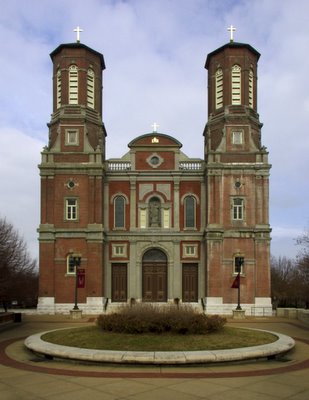
This church was located in what became a gritty industrial area, was in disrepair, and was to be demolished. A large effort by local Catholics restored this church to glory. You still occasionally see the once-familiar black and white "Friends of Saint Joseph Shrine" bumperstickers on older automobiles. The Shrine is now surrounded by townhouses.
Jesuits founded this parish, and it was dedicated in 1846. This is the only site in the Midwestern United States with an authenticated miracle. This led to the canonization of Saint Peter Claver.
Sunday Masses at 11:00 a.m.
First Friday Mass at Noon
Every Second Sunday: St. Padre Pio Devotion and Rosary before Mass; Benediction after Mass
Every Third Sunday: Choir Sings Mass in Latin
Address:
1220 North 11th Street
Saint Louis, MO 63106
Photo taken on January 1st, 2006.
Photos of Christmas Decorations at the Basilica of Saint Louis, King of France
Photos of the Basilica of Saint Louis, King of France, popularly called the Old Cathedral, located up on a terrace near the banks of the Mississippi River in Saint Louis, Missouri. Click on any photo for a larger image.
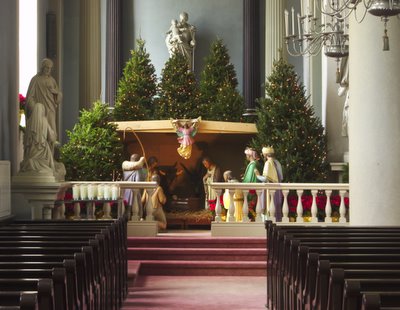
The altar of Saint Joseph. The nativity figures date from 1866, are made of cast iron, and have been used every year since then. The figures were purchased as a thanksgiving for the end of the Civil War and for the return of the soldiers.
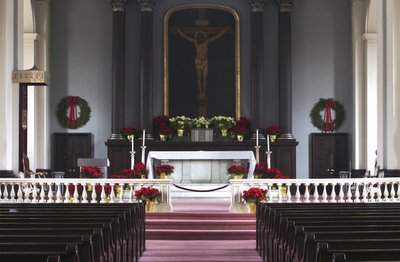
The main altar.
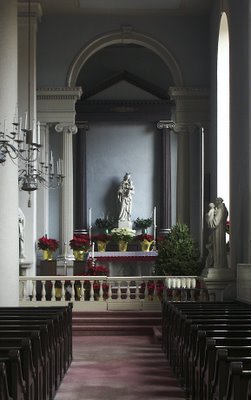
The altar of the Blessed Virgin Mary.
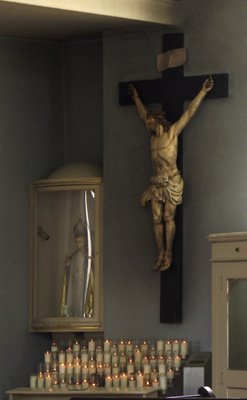
This crucifix used to be on the main altar, now a painting is in its place.
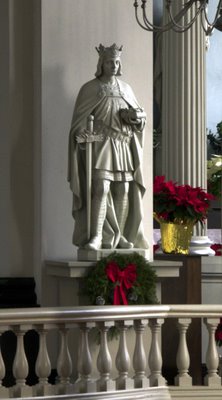
Saint Louis, King of France, crusader, patron of hospitals and universities, dispenser of justice, and friend of the poor.
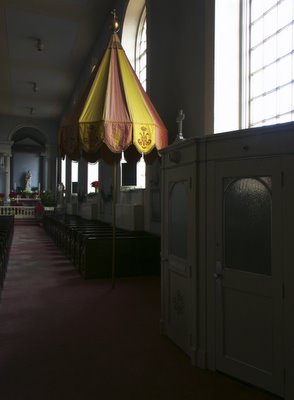
The ubellina tells us that this is a minor basilica. The yellow color is a symbol of the Pope, while the red is a symbol of Rome.
Photo taken on January 1st, 2006, the Solemnity of Mary, Mother of God.

The altar of Saint Joseph. The nativity figures date from 1866, are made of cast iron, and have been used every year since then. The figures were purchased as a thanksgiving for the end of the Civil War and for the return of the soldiers.

The main altar.

The altar of the Blessed Virgin Mary.

This crucifix used to be on the main altar, now a painting is in its place.

Saint Louis, King of France, crusader, patron of hospitals and universities, dispenser of justice, and friend of the poor.

The ubellina tells us that this is a minor basilica. The yellow color is a symbol of the Pope, while the red is a symbol of Rome.
Photo taken on January 1st, 2006, the Solemnity of Mary, Mother of God.
Sunday, January 01, 2006
Fr. Biondi Named Citizen of the Year
Father Lawrence Biondi of the Society of Jesus, and president of Saint Louis University, has been named Citizen of the Year for 2005 by the Post-Dispatch.
See this article from the St. Louis Post-Dispatch.
Praise
Fr. Biondi has gained universal acclaim for beautifying the university campus in recent years, converting asphalt lots to parks with fountains, statuary, vegetation, and distinctive fencing. Like so many other urban institutions, SLU suffered greatly during the 1970s, with the drastic decline of its surrounding neighborhood, and a great increase in crime. The recent changes mean that the university is a center of renewal for the entire neighborhood, with many new businesses opening up nearby.
Criticism
Fr. Biondi, however, is not universally loved. The university tries too hard to recruit and cater to non-Catholic students; SLU is now known for offering a good secular education, but not a Catholic education. The Aquinas Institute of Theology, on the SLU campus, is rumored to give a loose, subjective, and politically-correct type of religious education popular since the 1960s. Also, there seems to be too much of an emphasis on raising money, as SLU alumni must certainly know, with constant appeals for donations.
SLU's campus artwork, as seen in the new outdoor statuary and in its museums is secular, Modernistic, and not Christian. Notably, the Post-Dispatch generally has glowing reviews of the art at SLU. A recent Post article on the school's Museum of Contemporary Religious Art was entitled 'Inside the Pantheistic Mind of MOCRA'. Although the Post doesn't understand the definition of the word 'pantheistic' (they should have used the word 'indifferentist'), it rightly characterized the artwork there as completely lacking Catholic character.
But it's not all bad
In fairness, I must say that the Collection of the Western Jesuit Missions at SLU is quite different. It documents the Jesuit missionary work with the Indians in the western United States during the 19th century. It represents the best of the Jesuit Order, whose members endured great hardship and suffering to spread the Gospel.
The future of SLU
SLU used to have a board of trustees made up completely of Jesuits. But in 1967, following the secularization trend of the Church of that era, 15 of the total 28 trustees were open to laymen. Whether or not this is a good thing in principle, it did lead to a great secularization of the university. The university moved away from Catholicity, and attempted to appeal to students without regard to religious background; while this was successful, it also lost appeal among Catholics: why go to SLU when Washington University is better? If there is nothing particularly Catholic about SLU, then why bother? In trying to be all things to all people, SLU is known for the leftist, relativist teaching of many of its faculty and its 'businesslike' management and emphasis on income.
It might be in the best interest of souls if the university would rediscover its Catholic roots, and provide a strong intellectual and religious formation for its students. University education is a Catholic idea. Secular universities end up being either trade schools, expensive babysitting services, bar and brothel districts, or political reeducation camps. A Catholic education is for encouraging virtue.
Subscribe to:
Posts (Atom)
