

Sunday, July 04, 2010


Thursday, July 01, 2010
“St. Francis de Sales Oratory Wins Golden Brick Award”
FROM AN ARTICLE at Tradition For Tomorrow, the restoration website of Saint Francis de Sales Oratory, in Saint Louis, Missouri:
Here are some of my photos of the convent, from August 2009:


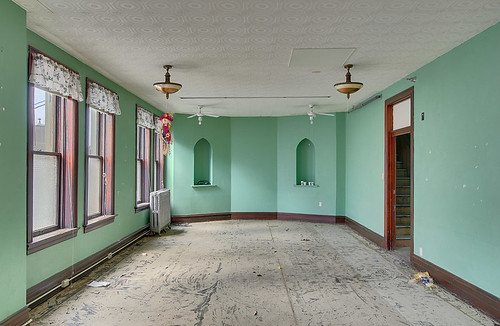


These are from January of this year:


And June:


The project which won this year’s award was the renovation of the Convent building at St. Francis de Sales. After years of disuse and neglect, the Convent was in a seriously dilapidated condition. In an effort to make the building habitable by the Sister Adorers of the Royal Heart of Jesus Christ Sovereign Priest, renovation began in August of 2009. It involved complete cleaning, stripping and refinishing of old floors, complete overhaul of the kitchen, the foyer and several rooms, repair of broken windows and window frames, re-plumbing of sinks and bathrooms, installation of new cabinetry and light fixtures, and repainting of walls and moldings.Click here for the full article.
Here are some of my photos of the convent, from August 2009:
These are from January of this year:
And June:
Daniel Mitsui
LAST SUNDAY, I had the privilege of again meeting Daniel Mitsui, his wife Michelle, and baby Benedict. Daniel has recently become a full-time artist and illustrator, and has a wide selection of prints and original works. You can see examples of his work, and his writings on art theory and history, at his web log, The Lion and the Cardinal.

Fort Bellefontaine
ABOVE THE MISSOURI River, in northern Saint Louis County, is the site of what was the westernmost military outpost of the United States, Fort Bellefontaine.

A nearby pond called “Spanish Lake” serves as a reminder that this territory was once the realm of King Charles III of Spain. Once French territory, this region was gained by Spain, which in 1767 ordered two forts to be built on the opposite shores of the mouth of the Missouri River. The intention was to deter the English, who were making incursions up the Missouri River. Antonio de Ulloa, the Spanish governor in New Orleans, had no clear idea of the specific conditions of this area, which is often flooded: the local commander, Captain Don Franciso Rui, built only one fort near here, and another in the village of Saint Louis.
Primary documents of this era, translated into English, can be found in the book The Spanish Regime in Missouri, edited by Louis Houck.
In 1803, the United States gained possession of this territory via the Louisiana Purchase. The northern part of the territory was defined as the watershed of the Missouri River, and much of the Indian population lived along that river and its tributaries. The various tribes requested access to manufactured goods in exchange for furs, and so the government set up a trading post here in 1805. Rudolph Tiller was the factor (or Indian agent) in charge of trade, while Captain Thomas Hunt served as military commander.
The original fort was located at the base of the bluffs, but was swept away by flooding, and so was rebuilt higher. The name of the fort, Belle Fontaine, means ‘beautiful spring’, and it gets its name from a beautiful, cold-running spring flowing out of a small cave down below. Coldwater Creek flows into the river at this site, and that creek is also spring-fed.
The Fort served as regional military headquarters during the War of 1812. It served as a military base until 1826, when it was replaced by Jefferson Barracks. For a while afterwards, Bellefontaine acted as a military arsenal, until completion of the new arsenal in the City of Saint Louis. More history of the fort can be seen here.
The area became a public resort in the 1930s, and the crumbling remains of Works Progress Administration structures are visible, including the Grand Staircase — the top of which is seen above. There are few if any obvious remains of the fort, and it is now the site of a boys' home, owned by the State of Missouri. Visitors to the fort site need to check in with a guard at the front entrance. The best way into the fort is by taking Broadway northbound; at the city limits the road changes its name to Bellefontaine and then goes directly to the site.
Subscribe to:
Posts (Atom)
