Pages

Monday, June 11, 2012

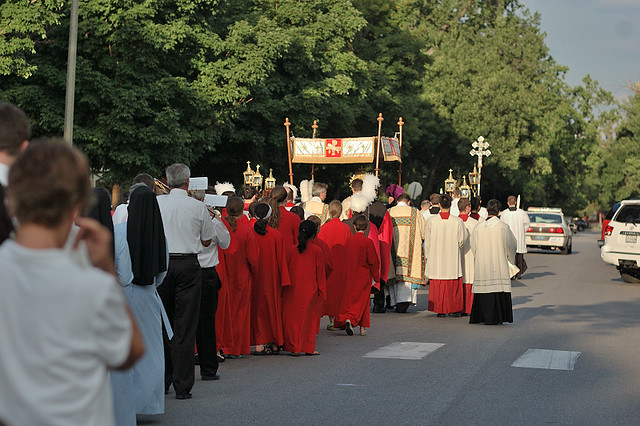
Photos from the Corpus Christi Procession at the Cathedral Basilica of Saint Louis

“I AM the bread of life. Your ancestors ate the manna in the desert, but they died; this is the bread that comes down from heaven so that one may eat it and not die. I am the living bread that came down from heaven; whoever eats this bread will live forever; and the bread that I will give is my flesh for the life of the world.” — from The Bread of Life Discourse, John 6.

Here are photos from the Corpus Christi procession, held at the Cathedral Basilica of Saint Louis, on Sunday, June 10th, 2012, presided by Archbishop Carlson.

Cathedral Basilica of Saint Louis, in Saint Louis, Missouri, USA - 2012 Corpus Christi Procession - 1

Jesus, my Lord, my God, my All,
How can I love thee as I ought?
And how revere this wondrous gift,
So far surpassing hope or thought?
Sweet Sacrament, we thee adore!
Oh, make us love thee more and more.

Cathedral Basilica of Saint Louis, in Saint Louis, Missouri, USA - 2012 Corpus Christi Procession - 2

O thou our reminder of Christ crucified,
Living Bread, the life of us for whom He died,
Lend this life to me then; feed and feast my mind,
There be thou the sweetness man was meant to find.

Cathedral Basilica of Saint Louis, in Saint Louis, Missouri, USA - 2012 Corpus Christi Procession - 3

O Jesus, we adore you,
Our victim and our priest,
Whose precious blood and body
Become our Sacred feast.

Cathedral Basilica of Saint Louis, in Saint Louis, Missouri, USA - 2012 Corpus Christi Procession - 5

Fair are the meadows, Fair are the woodlands,
Robed in flow’rs of blooming spring;
Jesus is fairer, Jesus is purer,
He makes our Sorro’ing spirit sing.

Cathedral Basilica of Saint Louis, in Saint Louis, Missouri, USA - 2012 Corpus Christi Procession - 6

O for a heart to praise my God,
A heart from sin set free,
A heart that always feels thy blood
So freely shed for me.

Thursday, June 07, 2012

Can’t find a job?

THE ECONOMY IS tanking again.

There are some people who say this doesn’t matter much. Some clever traders tell us that they can earn as much during a down economy as they can during an up one, so they don’t care about the state of the economy. But this is only true insofar as we haven’t hit bottom yet, for as they throw people out into the streets, and downsize companies, they eventually make things worse for themselves too. They may end up owning an entire city, but it will be a city in ruins, and they may eventually find it hard to find even a few loyal subjects who will do their bidding.

Others, of the more idealistic and revolutionary mindset think that worse is better, for the Revolution will never come unless the people are desperate. These, too, are shocking in their disregard for others. Would-be revolutionaries are also clever, but they too may have a bitter fate when things hit bottom, and the people realize that it was the revolutionaries themselves who turned a minor crisis into a disaster.

They are heartless and cruel, but that is common in modern thinking and its theories that deny love, such as utilitarianism and Marxism. So let us keep in mind that some people, even very educated, wealthy, or powerful people, due ultimately to pride, greed, hatred, or envy, want things to get worse.

But the problem is simple: people naturally need food, clothing, shelter, and comforts, for themselves and for those whom they love, and our current economy, for many people, is making this exceptionally difficult. Being unable to find a job, many are becoming dependents, or turning to a life of crime, or getting into debt, or worse. People turn to government, but government can’t provide services if people don’t have jobs and pay taxes. Lack of jobs means that everyone suffers, except for the few mentioned above, who subscribe to evil philosophies.

A preponderance of job seeking these days, I’ve heard, is done electronically, which leads to some problems.
  • Employers say it is difficult to find qualified people for positions, and this is harming the economy.
  • This is despite the fact that employers are inundated with a huge number of resumes for open positions, from people who are desperate for work.
  • Employers have downsized their Human Resources departments, or have outsourced them to other companies, in order to reduce costs.
  • Employers, for efficiency, use software filters to wade through the resumes, and these filters are based on criteria they choose ahead of time. The filters may not be devised by knowledgeable people.
  • Employers' job filters are very explicit — only those resumes that have certain keywords will pass the filter. Wanting to avoid job training costs, employers will often demand specific job skills and experience. Learning on the job, except for unpaid internships, is very rare these days.
  • Job hunters, knowing about the employers’ filters, pepper their resumes with keywords hoping to pass the filters. Knowing that they can learn quickly, and have skills that are transferrable, job hunters will include skills that they may only be somewhat familiar with, knowing that the employer probably won’t be able to notice the difference.
  • Employers, knowing that job hunters pepper their resumes with keywords, set the threshold on their filters very high, allowing only a small percentage of resumes to pass.
  • The few resumes that do go past the filters are either, by miracle, perfect job candidates, or more likely, are dishonest, claiming experience they did not have.
  • Employers therefore include honesty detectors on their software filters, or make applicants take an online honesty test during the application process, which attempts to detect lying.
  • The honesty filters are set with a very low tolerance for lying, rejecting too many ordinary, but generally honest people, while still passing very good liars. Validity testing shows that a large percentage of those tested as being liars are not — between 40% to over 90%, while up to perhaps half or more of the liars pass the test as being honest. The tests are considered statistically valid because they typically detect honest people as being honest, but clearly they are problematic.
  • Honesty test results are sometimes adjusted to prevent outcome bias, so some identifiable groups are basically given a free pass, and other groups are judged more harshly, leading, inevitably, to an even higher percentage of dishonest people passing the filter.
  • Success in the job market these days, according to some, is knowing how to game the job system. Note that this does not necessarily have much to do with actually being able to do the job. The system is encouraging people to be dishonest.
This article tells of a company that had 25,000 applicants for a standard engineering position — and yet the Human Resources department said none were qualified. That is hardly possible. Something is broken, and the people in charge are not acting rationally.

Unfortunately, business has no interest in spending more money on good hiring practices, and governments led by social democratic parties have a vested interest in expanding their pool of dependents, as is found in the unemployed. But these tendencies make things worse overall.

Until now, it appears that governments have attempted to buoy the world economy by ‘quantitative easing,’ which is a new way of saying ‘printing money.’ This is a basic method used in Keynesian economics to avoid the severe deflation in prices that used to normally happen after the collapse of the periodic business cycle.  But if the money only circulates among those who already have it, and if the money just goes after purchasing the goods that already exist, then this extra money will simply turn into inflated prices rather than giving unemployed people new jobs. We see this inflation particularly with food and fuel prices, which unfortunately are basic necessities for both the employed and unemployed. There will be a huge temptation by governments to fund social welfare programs by merely printing money — which is currently not possible in Europe because of the discipline of the Euro common currency — but this would only mean even more money chasing the same small pool of goods, causing severe inflation, and will not significantly increase production. More people will have money, but the money will be worthless, for there will be very little to purchase: this was the case in planned economies in the Communist era; everyone had plenty of cash, but had to waste hours every day standing in line to get whatever goods that happened to be available.

The only thing worse than not having a job is to become a slave to a job while being unable to purchase anything with the wages. We must avoid solutions to our economic woes that will put people to work without allowing them to personally prosper.

Human beings are made in the Image and Likeness of God, and so we have a sacred duty to help our fellow man. But modern philosophies reject this notion and instead see us as replaceable cogs in the machine of society, which get us into problems like we are currently experiencing. As society becomes more secularized, the problems get worse. The modern idea is that man can save humanity by putting together scientifically designed systems of government and business, and this Pelagian idea, the idea that man can save himself, is very popular. But the consequence of the heresy of Pelagianism is that our systems severely punish people who don’t live up to expectations, as we see with our high level of unemployment and our bulging prisons. We see this in a brutal fashion in class conflict, where entire groups of people are persecuted or even wiped out because they aren’t good enough. Mercy is not a modern virtue.

I would suggest that Catholics start acting like Catholics, in both business and government. Seeing people as individuals, and not as data encoded on a resume or as members of some class, would be a good start.

Saturday, June 02, 2012

Trinity Sunday

ON TRINITY SUNDAY of 2003, I entered into the Church, at Saint Gabriel the Archangel Church, in Saint Louis, with my first Confession, Confirmation, and Communion. I have a special fondness for that feast day.

Saint Gabriel the Archangel Roman Catholic Church, in Saint Louis (Saint Louis Hills neighborhood), Missouri, USA - view of church and rectory at sunset

Saint Gabriel the Archangel Church.

But alas! Many Catholic humorists call this feast day ‘Heresy Sunday,’ because of the wide variation of explanation of the Most Holy Trinity heard from pulpits. Well, it is a difficult doctrine, hard to even begin to understand, and even the great Saint Patrick, evangelist of Ireland, perhaps got the doctrine wrong with his clover leaf.
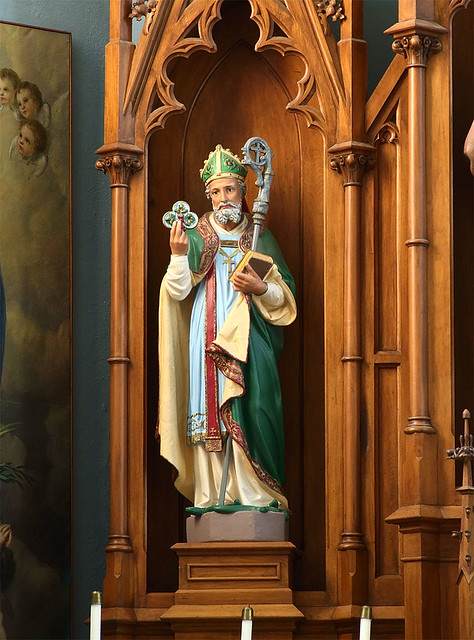
Saint Joseph Roman Catholic Church, in Chenoa, Illinois, USA - Saint Patrick.jpg

Saint Patrick, with cloverleaf-shaped symbol of the Trinity, at Saint Joseph Church, in Chenoa, Illinois.

While we sometimes hear odd, even heretical explanations of the Trinity, another view is that the Most Holy Trinity is a mystery. We find a bit of this in the Catechism of the Catholic Church (1997):
237 The Trinity is a mystery of faith in the strict sense, one of the “mysteries that are hidden in God, which can never be known unless they are revealed by God“. To be sure, God has left traces of his Trinitarian being in his work of creation and in his Revelation throughout the Old Testament. But his inmost Being as Holy Trinity is a mystery that is inaccessible to reason alone or even to Israel's faith before the Incarnation of God's Son and the sending of the Holy Spirit.
This is true, and the Catechism also draws from many other threads of the Church’s thought over the millennia. This mystery can be likened to navigating through a fog — fog veils our senses, and so if we want to reach our destination, we must trust our roadmap; likewise, if we want to reach our heavenly destination, we must trust revelation even though our interior sense of our intellect is likewise veiled. Because “we see through a glass darkly,” many think that an understanding of heavenly things is unimportant, and that we ought to instead concern ourselves with only worldly things. Rather, I think, this means that the spiritual life can be difficult, because our vision is clouded. We still must urgently try to reach our destination whether or not the fog meets our own personal standards for transparency.
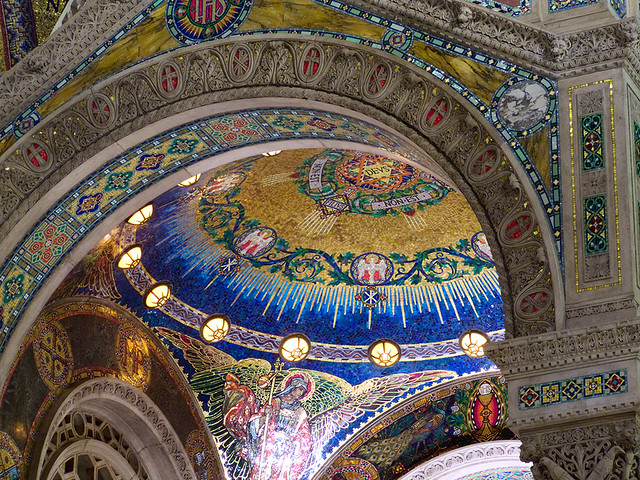
Cathedral Basilica of Saint Louis, in Saint Louis, Missouri - baldachino detail.jpg

A symbol of the Trinity is found above the altar at the Cathedral Basilica of Saint Louis. This formulation is found in many traditional baptismal fonts.

Nominalism is a philosophy, very sophisticated and very common today, that typically is said to have been invented in about the late middle ages, but which can be traced back to the Fall of Man. Nominalism, in its most extreme form, states that any two objects with the same name share nothing in common with each other except for their name. I have several cats, and a strict nominalist will say that they have nothing in common with each other, and even will reject the notion that they resemble each other in any way, even though they all look like cats to me (and likely to anyone else who sees them). This is almost complete skepticism, for it ultimately rejects both reason and experience. It is easy being a skeptic, and we can say that this philosophy is a roundabout way of justifying lying. Skepticism is not always wrong, but we should not throw the baby of truth out with the untruth of the dirty bathwater.

Nominalism was the philosophy of Luther and of many in the Reformation, this being common in Catholic schools after the devastation of the Black Death, which killed off most of the scholars of the Medieval period. We can see how taking this philosophy to its bitter end is harmful, especially in relationship to the doctrine of the Trinity, but also when it comes to all rational thinking. Most Protestant denominations, even those who preach the Bible alone, do accept the doctrine of the Trinity. But those who trusted the philosophical foundations of the Reformation more than revelation came to the false conclusion that the Trinity is three gods, and rightfully found this repugnant. They rejected revelation and instead turned to unitarianism, leading some eventually into agnosticism or athieism. We find this in Islam, whose adherents sometimes call us ‘polytheists,’ perhaps for similar philosophical reasons.

But traditional Christian philosophy tells us of a great, invisible, underlying unity in ultimate reality, which has its source in a spiritual, nonmaterial reality, which ultimately derives from God, Who is one and undivided yet Triune.  Oddly enough, it was pagan philosophers who wrote down much of this philosophy, although Jewish theologians tell us that this line of thinking also came down to us through orthodox Jewish oral tradition. Some Fathers of the Church, such as Saint Justin Martyr, Saint Augustine, and Saint Ambrose, tell us how this good philosophy helped them understand certain aspects of revelation.

We even find an underlying unity in the material world. While a strict nominalist may say that each cat is an absolutely unique individual having nothing whatsoever to do with each other besides the name ‘cat,’ he may also say that each cat is merely made up of atoms, thinking that this explains everything. But we can prove experimentally (as well as derive from accepted theory) that the elementary particles that make up atoms are indistinguishable in principle: all electrons absolutely share in a single electron nature, and so strict nominalism cannot be true. And what goes for elementary particles must also go for cats and humans, although certainly to a less obvious degree due to complexity.

There is an underlying unity, even found in the material world, which extends upwards to the spiritual realm and towards God, and I think that this mystical unity, although mysterious to us, helps us to better explain the Trinity.

The Anglican writer, Dorothy L. Sayers (1893–1957), wrote an excellent book, The Mind of the Maker (1941), which compares mistakes or conceits in writing fiction to heresies in Trinitarian doctrine.  Going through the Creeds of the Church, Sayers shows how well-known heresies, which deny one or another of the clauses of the Creeds, correspond to specific errors in writing, which produce unsatisfactory results. This method is justified by the goodness of God, Who made us in His Image and Likeness. As Sayers wrote “The Christian affirmation is, however, that the Trinitarian structure which can be shown to exist in the mind of man and in all his works is, in fact, the integral structure of the universe, and corresponds, not by pictorial imagery but by a necessary uniformity of substance, with the nature of God, in Whom all that is exists.” I recommend this book because it is both instructive and entertaining, especially for writers.
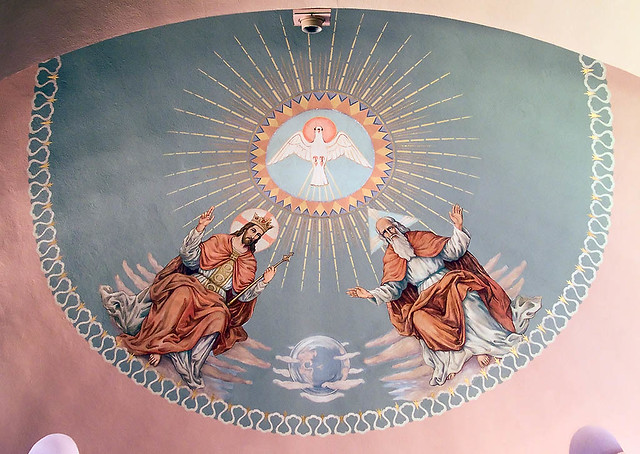
Sacred Heart Roman Catholic Church, in Crystal City, Missouri, USA - painting of trinity.jpg

A symbolic, and non-literal, representation of the Trinity, painted above the sanctuary, at Sacred Heart Church, in Crystal City, Missouri. This nevertheless has archetypal truth, useful to the human imagination. Photo taken in October, 2007.

It’s been said, humorously, that one cannot write about the Trinity without being a material heretic.  I hope I haven’t written too much heresy here! Enjoy your Sunday!
Thursday, May 31, 2012

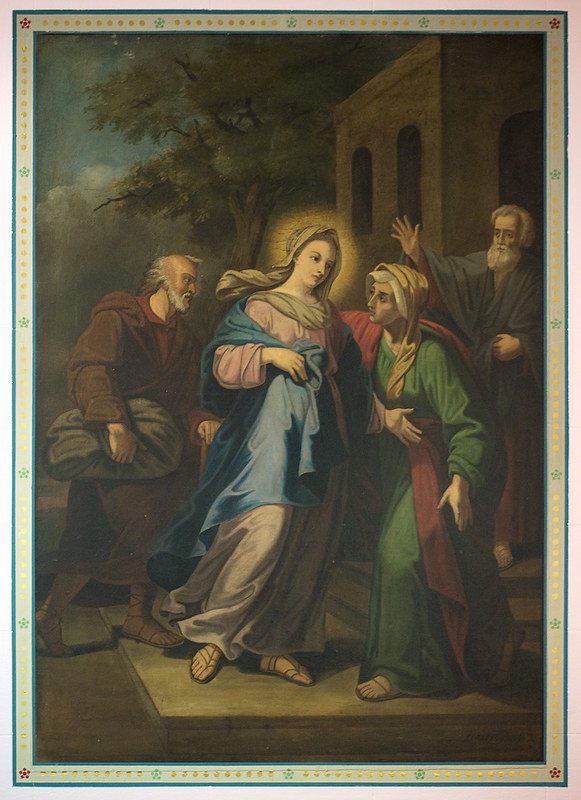
Visitation:Saint Ann Shrine Roman Catholic Church in Saint Louis, Missouri, USA - painting of The Visitation

At Visitation/Saint Ann Shrine, in Saint Louis, Missouri. Photo taken July, 2010.

Tuesday, May 29, 2012