Pages

Monday, July 16, 2012

Announcements

THE NEXT BOOK with my photography will be out this fall.

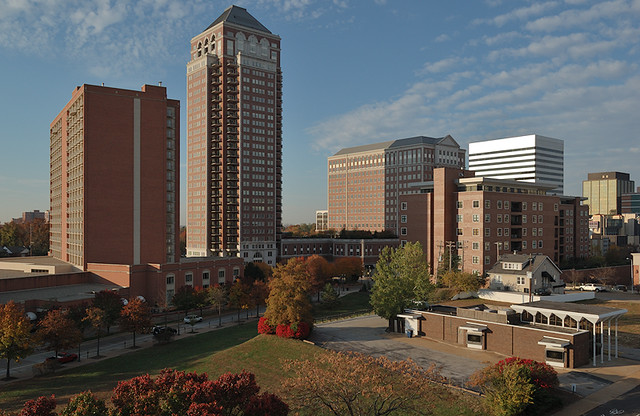
Clayton skyline

Commissioned by the City of Clayton, the county seat of Saint Louis County, Missouri, this book will feature my photography of Clayton’s neighborhoods, businesses, nightlife, parks, and churches. Authored by Mary Delach Leonard with Melinda Leonard, you can pre-order an autographed copy of the book here.

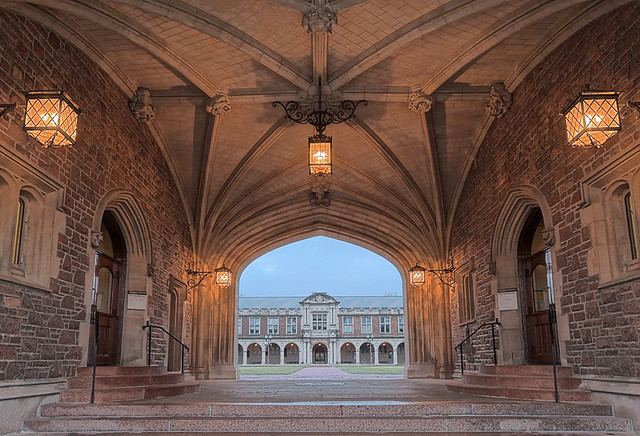
If you are visiting Clayton, you may want to patronize the new BlackFinn restaurant, located nearby at the Galleria. The dining room decor includes one of my fine-art architectural photos:

Washington University, in Saint Louis, Missouri, USA - view from Brookings Hall archway

You can purchase one of my books by clicking on the buttons appearing on the sidebar.

Sunday, July 15, 2012

Faith and Quantum Mechanics

AT THE HEART of all things are problems that are ultimately philosophical and religious. This is despite modernity’s avoidance of philosophy and religion, for these are basics that permeate all of reality whether or not someone likes it. Every intellectual system that makes claims — and certainly all do — is ultimately a metaphysical system, and so is inherently saying something about religion.

See the article Does Quantum Physics Make it Easier to Believe in God? From that article:
Materialism is an atheistic philosophy that says that all of reality is reducible to matter and its interactions. It has gained ground because many people think that it’s supported by science. They think that physics has shown the material world to be a closed system of cause and effect, sealed off from the influence of any non-physical realities --- if any there be. Since our minds and thoughts obviously do affect the physical world, it would follow that they are themselves merely physical phenomena. No room for a spiritual soul or free will: for materialists we are just “machines made of meat.”
And so, I’ve noticed that religion and science tend to be more tightly intertwined than we may suspect, and despite the efforts of modern theorists of science. The materialism noted in the quote above was more found in the older, Newtonian physics than what we find in the newer Quantum mechanics.

During the Reformation, the new religions tended to deny human free will and instead embraced a narrow kind of predestination: that before the beginning of time, God created some humans to be saved and others to be damned. This view became widely accepted among Protestant groups, and even among many Catholics, although this was eventually declared heretical. With this religious view, which became most codified in Deism, it is pretty obvious that a completely deterministic physics would not be far behind, and we eventually found this with Newtonian mechanics.

Under Newton’s theory of motion, the initial conditions of a system — even the entire cosmos —determines completely its subsequent motion for all eternity, and this physics corresponded well to the kind of predestination being promulgated by the various reformed religions. Taking this theory seriously led to Deism, where God created the cosmos according to a pre-determined plan, and then did nothing whatsoever afterwards — not even revealing Himself to the world through his Son. Atheistic materialism itself developed from the idea that there was no ‘initial condition’ of the cosmos, that is, from the idea that the cosmos always existed: however, some philosophies of antiquity posited an eternally-existing cosmos along with an equally eternal Ultimate Deity.

While the physicist Albert Einstein (1879–1955) is known more for his Special and General Theories of Relativity, he gained fame initially, in the year 1905, by mathematically demonstrating the quantum hypothesis — the theory that energy is transferred in discrete, and not continually varying, quantities. This theory was a major crack in the Newtonian framework, and eventually led to the theory of Quantum Mechanics.

Einstein developed his theories with scholastic methods — modes of reasoning more associated with Medieval friars such as Saints Bonaventure, Albert the Great, and Thomas Aquinas. But, as Pope Benedict XVI said:
”Yet the human mind invented mathematics in order to understand creation; but if nature is really structured with a mathematical language and mathematics invented by man can manage to understand it, this demonstrates something extraordinary. The objective structure of the universe and the intellectual structure of the human being coincide; the subjective reason and the objectified reason in nature are identical.”
This scholastic reasoning is unreasonably effective, which is something that we ought to keep in mind, especially in light of more modern theories that place all their hope in purely human and skeptical observation of things, and not in things that are larger. But we must be humble enough to realize that human reasoning is much more effective with simple systems, such as physics, and will be less satisfactory when dealing with the complexities of biology and human psychology. But this observation of complexity is in line with the old scholastic notion of the Great Chain of Being, where physics can be found at the far bottom end of the chain, and so is inherently more easily understandable.

Einstein’s Theories of Relativity posit that space and time are not absolute — these being axioms of the old Newtonian physics — but are contingent on something else even more basic, and so are ultimately malleable and changing. But this was something understood even by the ancient rabbis before Christ, that space and time are creatures of God as are we, something made and not perfect unto themselves. Einstein, although a non-practicing Jew, still used the scholastic methods of his forefathers: he knew, ahead of time, that his theories were largely correct, and that the experiments that seemed to contradict his results had to be wrong. Skeptics can doubt as much as they like, but they can never advance science.

Quantum mechanics changes things even more. Like the equations of Newton, quantum theory is deterministic in structure, yet produce results that are only probabilistic in outcome. The theory is rational, it posits true reasons for observations, and yet the future remains for us unknowable. The acceptance of this theory, as you might imagine, led many physicists away from a purely materialistic and atheistic world-view, for the theory shows that transcendence is intrinsic to the laws of nature. Now, this theory in and of itself is not completely convincing, and there are many wildly diverging philosophical opinions on the meaning of quantum mechanics, but it is more consistent with the wider Catholic view of the world than what we found under Newton.

UPDATE: having been in a hurry to get to Mass this morning, I didn’t get to the main point of this article.  The recent claim of the discovery of the Higgs Boson is of major theoretical importance, because it is the final piece required to complete what physicists call the “Standard Model,” a theory which unifies under one consistent umbrella the forces of nature which lead to electricity, magnetism, light, radio waves, nuclear energy, and certain forms of radioactivity. While important, it still leaves out an explanation of gravity. I wrote some more about this here.
Thursday, July 12, 2012

Newsletter from the Oratory


SAINT FRANCIS DE SALES ORATORY
EMAIL NEWSLETTER

2653 Ohio Avenue
Saint Louis, Missouri 63118
www.institute-christ-king.org
www.TraditionForTomorrow.com
314-771-3100
July 12, 2012


INSTITUTE ORDINATIONS – ABBE MATTHEW WEAVER
FATHER HERMANN 25TH ANNIVERSARY
HOMERUN DERBY – CHOIR CAMP
SUMMER AT THE ORATORY – SCRIP
UPDATE, CANON WIENER


Dear Faithful and Friends of St. Francis de Sales Oratory,


ORDINATIONS IN GRICIGLIANO

Ordinations 2012
Last week at the Institute’s priestly ordinations in the magnificent Sts. Michele e Gaetano Church in Florence, Holy Mother Church gained five new priests. Holy Orders was conferred upon these five men by His Eminence, Raymond Leo Cardinal Burke, on July 5. Grateful always to God’s bounteous provisions, the Institute invites all faithful and friends of the Institute to share in our great joy in introducing: Canon Alexis d’Abbadie d’Arrast, Canon Jorge Arrasate Iragui, Canon Alban Denis, Canon Sébastien Goupil, and Canon Louis Valadier. Deo Gratias!

This important week began with the reception of cassock and tonsure by the “First Years.” Minor orders of porter, lector, exorcist, and acolyte followed for many other seminarians. All told, sixteen Americans were among the forty seminarians who received minor orders. On July 4, His Excellency, the Most Reverend Alexander K. Sample, Bishop of Marquette, Michigan, ordained five seminarians to the diaconate, and ten new subdeacons. Among these new subdeacons are five from the United States. Please support them, most importantly with your prayers, for the glorious but arduous road ahead for our future priests.

Photos of the ordinations will be available for viewing on our website soon. In the meantime, we are pleased to show a preview photo taken by one of the families who attended the subdiaconate ordinations.


ABBE MATTHEW WEAVER FOR THE SUMMER

Abbe Weaver
After the ordinations festivities in Gricigliano, and before a new academic year begins at the Seminary, the Institute’s seminarians generously give up some of their summer vacation to assist at an Institute apostolate. The seminarians are able to work alongside Institute priests in their ministry, and to meet the faithful for whom they pray every day at the Seminary. This summer, the Oratory is delighted to welcome Abbé Matthew Weaver. Abbe Weaver is originally from Cleveland, Ohio, and has just completed his first year. He had just received his cassock and the first clerical tonsure last week at Ordinations in Gricigliano. Welcome to St. Louis, Abbe Weaver! We look forward to get to know you this summer.


FR. JEAN-PIERRE HERMAN 25TH ANNIVERSARY CELEBRATIONS

Father Herman with Canon Talarico, Canon Gardner and Abbe Alex
Last Sunday, July 1st, the Oratory marked a special milestone in the priestly life of one of our members: Father Jean-Pierre Herman, who celebrates his 25th Ordination Anniversary. Originally from Belgium, Fr. Herman was received as an affiliate priest of the Institute in 2011 at the Canons’ Retreat here in St. Louis. This past year he has been welcomed by the community at Old St. Patrick’s Oratory in Kansas City, as well as at St. Francis de Sales Oratory here in St. Louis. We are most grateful for his presence in our apostolates, and for the opportunity to celebrate his twenty-five years dedicated to the service of Holy Mother Church.

Following the 10:00 AM Solemn High Mass celebrated by Fr. Herman in the Oratory, made more glorious by the music sung by our choirs, (Louis Vierne's Messe solennelle), a joyous reception was prepared for Fr. Herman in the hall. Joined by the faithful, Fr. Herman recalled in thanksgiving his priestly ordination twenty-five years ago, and received a gift presented by Canon Talarico on behalf of the Institute and the faithful. 


“HOMERUN DERBY” THIS SUNDAY!

Canon Talarico with Abbe Alex
Join us this Sunday, July 15, for the first ever Oratory Home Run Derby. It will be great fun for the participants and spectators alike! If you're interested in participating please contact the Rectory office at 314-771-3100. We look forward to seeing all of you there!

"It is a failing to be so harsh and rigid that we will not allow ourselves or others to indulge in any recreation. Air and exercise, cheerful games, music, field sports, and the like are such innocent amusements that they only require to be used with ordinary discretion." -- St. Francis de Sales


HELP SUPPORT THE INSTITUTE’S MUSIC CAMP

Canon Huberfeld with choristers
As in past years there has been an excellent response to the Institute’s third annual choir camp! The girl's dormitory filled up very quickly and there are currently only five available spots for boy choristers.The tuition for choir camp underwrites a large portion of the necessary expenses: faculty stipends, musical material, camp counselors, room and board for 50 people. However, to make this unique & affordable for choristers to attend, we must ask that you prayerfully consider making a donation to help underwrite the remaining balance of $4,000.00.
These chorister children will be soliciting donations after Masses this Sunday, July 15th. They will be offering thank you gifts to kind-hearted donors.
For any donation: A carnation flower or St. Francis de Sales Oratory pen
For donations of $25.00: A CD of the Institute Choir
For donations of $50.00 or more: A beautiful framed image of the Sacred Heart of Jesus

May God bless you for your charity!


SUMMER AT THE ORATORY, AUGUST 19, 2012

Our annual “Summer at the Oratory” event, celebrating the patron saint of our city, King Saint Louis IX, will take place on Sunday, August 19. The afternoon will be great fun for the entire family and an opportunity to build new friendships! This year, we are introducing a stupendous raffle to the banquet of activities offered. A wide array of excellent prizes has already been assembled for this summer’s event: vacation package, gift certificates, winery & brewery tours, and $$$, just to name a few. The raffle tickets will be available for purchase after both Sunday Masses in the Church Hall or by calling the office. The much-loved favorites will be there too: terrific barbeque, beer, live jazz music, silent auction, country market, horse rides, and games--who doesn’t love a good dunking booth & the ever popular pig races! Mark your calendars, and spread the word among family and friends!


SCRIP PROGRAM UPDATE
So far, over $4,100 has been raised for St. Francis de Sales through the scrip program! As a thank you gift for participating, each time you purchase scrip, your name will be entered in a monthly drawing for a free gift card. For even more convenience, please consider using the "ScripNow" option offered by more than 59 retailers. ScripNow is available 24 hours a day and in $10 increments, it is easy to customize your Scrip purchase. The reloadable option and The American Express Gift card have also been well received by participants for their ease of use and versatility.

Thank you for your participation and once again if you have any questions at all please ask contact Gretchen Clinton at 
sfdsscrip@gmail.com. Volunteers for the scrip table after Sunday Masses would be appreciated. If you are able to help out with this occasionally please contact Gretchen.


CANON WIENER UPDATE AND CONTACT INFORMATION
With your many prayers, Canon Wiener is continuing to make good progress in his recovery. Thank you! He has received two rounds of chemotherapy and is preparing for the third later this month. Please keep up your prayers for the complete and timely recovery back to good health for Canon Wiener. He is at the moment unable to respond to emails. You are welcome to write a card or a letter to Canon at the postal address below.

Canon Michael Wiener
Institut Christus Konig
Feuerwehrheimstrasse, 40
D-83457 Bayerisch Gmain
Germany


Faithfully yours in Christ the King,
Canon Matthew Talarico

St. Francis de Sales Oratory

Friday, July 06, 2012

“Don’t hate me because I’m beautiful...”

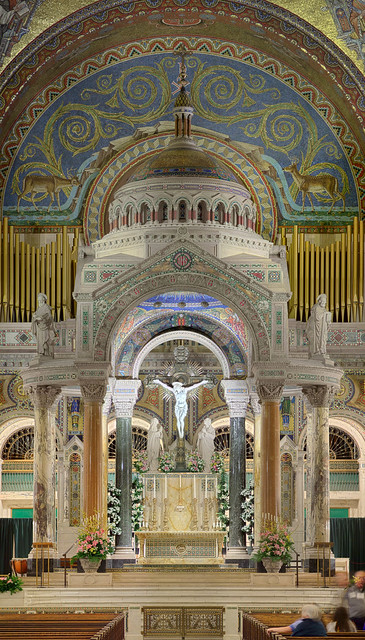
Cathedral Basilica of Saint Louis, in Saint Louis, Missouri, USA - large view of high altar 4

Photo taken at the Cathedral Basilica of Saint Louis.

Click for the article Don’t Hate Me Because I’m Beautiful… over at the Crescat.

Jewish law is well known for having many precise rubrics for the sacramentals of their rites, and Catholicism, which came from this tradition, retains many of these sacramental principles. But simply fulfilling the basic minimum requirements, a utilitarian sense of only observing the bare essentials of these rites, shows a certain meanness of spirit. In Jewish theology, there is the principle of “hiddur mitzvah,” which states that generosity towards the Lord is shown when an extra effort, especially a sense of beauty, is added to the rites. According to one source:
Beauty enhances the mitzvoth [commandments] by appealing to the senses. Beautiful sounds and agreeable fragrances, tastes, textures, colors, and artistry contribute to human enjoyment of religious acts, and beauty itself takes on a religious dimension. The principle of enhancing a mitzvah through aesthetics is called Hiddur Mitzvah.
Historically, this principle, although largely unwritten, was a core part of Catholicism as evidenced by the huge number of elaborate and beautiful churches.  Until our current age, the Church made a great effort in making the liturgy beautiful. The incorporation of Greek philosophy into Catholicism also gives us a solid reason for knowing why beauty has a religious dimension, for the Lord is beauty itself.

Essentialism and utilitarianism has become a part of our culture, and since they say “beauty is in the eye of the beholder” and so subjective, the Beautiful has been excluded from large numbers of our churches, and indeed in life in general.

As the Crescat says, you shouldn’t give a toilet plunger to your beloved on Saint Valentine’s Day, no matter how much it is needed or how useful it is.

Wednesday, July 04, 2012

Chesterton On America

OBERSERVATIONS ON the United States, from the famed English writer and Catholic convert G.K. Chesterton (1874-1936), from his book What I Saw in America (1922):
America is the only nation in the world that is founded on a creed. That creed is set forth with dogmatic and even theological lucidity in the Declaration of Independence; perhaps the only piece of practical politics that is also theoretical politics and also great literature. It enunciates that all men are equal in their claim to justice, that governments exist to give them that justice, and that their authority is for that reason just. It certainly does condemn anarchism, and it does also by inference condemn atheism, since it clearly names the Creator as the ultimate authority from whom these equal rights are derived. Nobody expects a modern political system to proceed logically in the application of such dogmas, and in the matter of God and Government it is naturally God whose claim is taken more lightly. The point is that there is a creed, if not about divine, at least about human things.
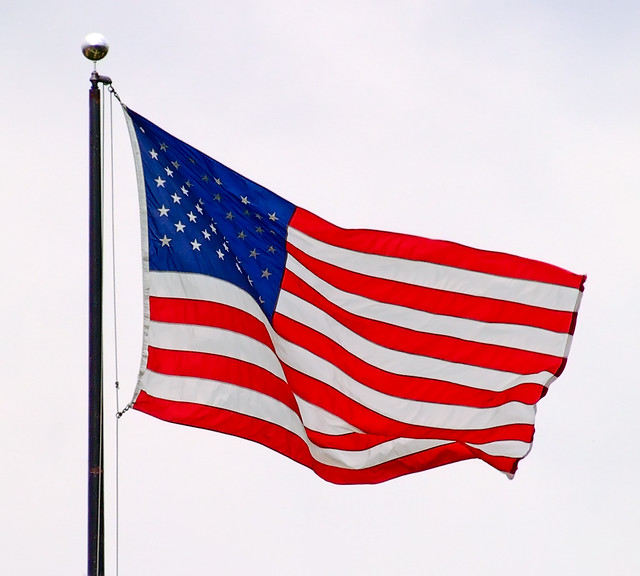
flag
But citizenship is still the American ideal; there is an army of actualities opposed to that ideal; but there is no ideal opposed to that ideal. American plutocracy has never got itself respected like English aristocracy. Citizenship is the American ideal; and it has never been the English ideal. But it is surely an ideal that may stir some imaginative generosity and respect in an Englishman, if he will condescend to be also a man... 
But the point is not that nothing exists in America except this idea; it is that nothing like this idea exists anywhere except in America. This idea is not internationalism; on the contrary it is decidedly nationalism. The Americans are very patriotic, and wish to make their new citizens patriotic Americans. But it is the idea of making a new nation literally out of any old nation that comes along. In a word, what is unique is not America but what is called Americanisation. We understand nothing till we understand the amazing ambition to Americanise the Kamskatkan and the Hairy Ainu. We are not trying to Anglicise thousands of French cooks or Italian organ-grinders. France is not trying to Gallicise thousands of English trippers or German prisoners of war. America is the one place in the world where this process, healthy or unhealthy, possible or impossible, is going on. And the process, as I have pointed out, is not internationalisation. It would be truer to say it is the nationalisation of the internationalised. It is making a home out of vagabonds and a nation out of exiles...
Chesterton, however, saw that the United States in his age was already corrupted:
But when I say that the Republic of the Age of Reason is now a ruin, I should rather say that at its best it is a ruin. At its worst it has collapsed into a death-trap or is rotting like a dunghill. What is the real Republic of our day as distinct from the ideal Republic of our fathers, but a heap of corrupt capitalism crawling with worms; with those parasites, the professional politicians? I was re-reading Swinburne's bitter but not ignoble poem, 'Before a Crucifix,' in which he bids Christ, or the ecclesiastical image of Christ, stand out of the way of the onward march of a political idealism represented by United Italy or the French Republic. I was struck by the strange and ironic exactitude with which every taunt he flings at the degradation of the old divine ideal would now fit the degradation of his own human ideal. The time has already come when we can ask his Goddess of Liberty, as represented by the actual Liberals, 'Have you filled full men's starved-out souls; have you brought freedom on the earth?' For every engine in which these old free-thinkers firmly and confidently trusted has itself become an engine of oppression and even of class oppression. Its free parliament has become an oligarchy. Its free press has become a monopoly. If the pure Church has been corrupted in the course of two thousand years, what about the pure Republic that has rotted into a filthy plutocracy in less than a hundred?
O, hidden face of man, whereover
The years have woven a viewless veil,
If thou wert verily man's lover
What did thy love or blood avail?
Thy blood the priests make poison of;
And in gold shekels coin thy love.
Which has most to do with shekels to-day, the priests or the politicians? Can we say in any special sense nowadays that clergymen, as such, make a poison out of the blood of the martyrs? Can we say it in anything like the real sense, in which we do say that yellow journalists make a poison out of the blood of the soldiers?

But I understand how Swinburne felt when confronted by the image of the carven Christ, and, perplexed by the contrast between its claims and its consequences, he said his strange farewell to it, hastily indeed, but not without regret, not even really without respect. I felt the same myself when I looked for the last time on the Statue of Liberty....