Pages

Thursday, August 02, 2012

On the Character of Saint Francis


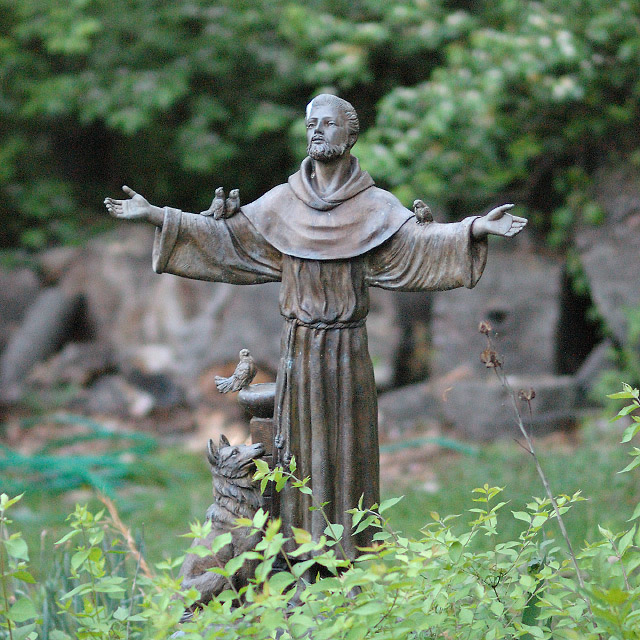
Benedictine Monastery, in Creve Coeur, Missouri, USA - statue of Saint Francis of Assisi

“My God and my All.”
FOR A LONG TIME, I’ve been reading a biography of Saint Francis of Assisi — typically only a paragraph or two before falling asleep — and I finished the book last night. As today happens to be the day of the famed Portiuncula privilege, gained by Saint Francis, I thought I would post this from the biography:
Our blessed Father was agreeable to all. Joy, serenity, kindness, and modesty, were perceptible in his countenance. He was naturally mild and affable, compassionate, liberal, prudent, discreet, gave sound advice, was faithful to his word, and full of courage; he was easy in his manners, accommodating himself to all sorts of tempers; he was all to all, he was a saint among the saintly, and among sinners, as if he was one of them; his conversation was graceful, and his manner insinuating; clear in his reasoning, energetic and compliant in matters of business; and, finally, simple in his actions and words.
Such a character, worthy of imitation! The book continues, explaining the nature of Francis’ simplicity:
We must receive in their true sense what was understood in saying that “he was simple in his actions and words.” The term simplicity has two significations in English.—Firstly it is used to describe a person of little mind, narrow-minded, dull, not well informed, weak and credulous; it is also used to express candor, ingenuousness, and uprightness; to describe a person who is natural, without artfulness. It is in this sense that it is said that the greatest geniuses are the most simple; enemies of subtlety and trick, which are only appropriate to narrow minds. The simplicity of the just, in Scriptural language, is true virtue, solid without drawback, purity of heart, uprightness of intention; in opposition to every sort of duplicity or disguise—everything that St. Paul calls “the prudence of the flesh; the wisdom of this world.” St. Gregory so explains it. This does not exclude prudence, but only malice and double dealing. Our Blessed Lord warns us “to be prudent as serpents, and simple as doves.” St. Paul says: “I would have you to be wise in good, and simple in evil.” Every Christian must be simple in faith, submitting himself purely and simply to the decisions of the Church, without any endeavor to elude them by crafty evasions, as some do in so scandalous a manner; simple in the intercourse of society, being frank and sincere, doing injury to no one; simple in devotion, going straight to God; following the way pointed out by the Gospel; not resembling those of whom the wise man says: “They go two ways, and have two hearts,” the one for God, and the other for the world.

Such was the simplicity of St. Francis. He was simple because he had no other intention in his mind, no other movement in his heart, than to be conformed to Jesus Christ. In order to imitate His poverty, His humility, His sufferings, all His virtues, he did many things far above the ordinary rules of human wisdom; and, as to his language, it was formed on that of the Gospel.

St. Francis was simple, but he had great qualities of mind and heart; and his simplicity was a perfection in him—not a defect. If it induced him to do things of which human prudence disapproves, it was because he was guided by Divine light; it was because he sought to be despised by the world, to render himself more conformable to Jesus Christ. Men of his age were not deceived by it; they discovered the principle which made him act and speak with such simplicity. His constant endeavor to humble himself, and draw on himself contempt, only gave them a greater esteem for his person, and they loaded him with honors. If our age deems itself wiser, what reason has it for not doing similar justice?


— THE LIFE AND LEGENDS OF SAINT FRANCIS OF ASSISI, TRANSLATED FROM THE FRENCH OF FATHER CANDIDE CHALIPPE, O.F.M., REVISED AND RE-EDITED BY FATHER HILARION DUERK, O.F.M.

Tuesday, July 31, 2012

Feast of Saint Ignatius of Loyola

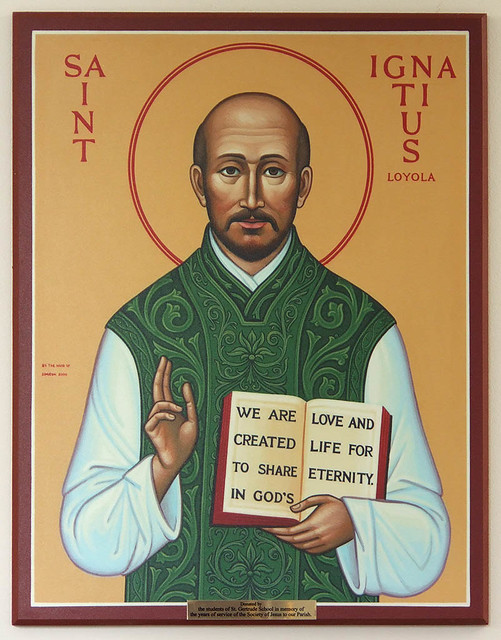
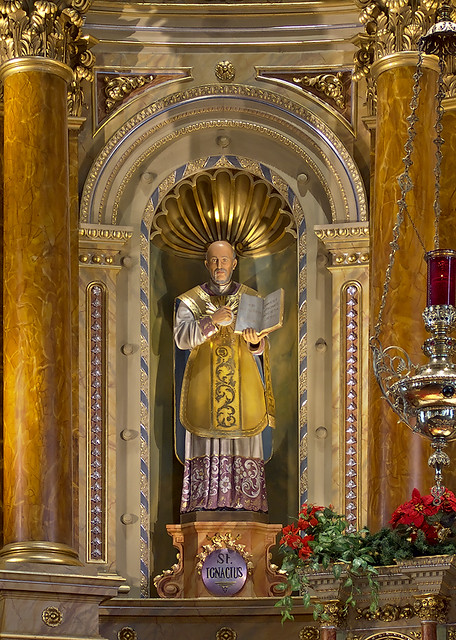
Saint Gertrude Roman Catholic Church, in Krakow, Missouri, USA - icon of Saint Ignatius Loyola.jpg

Icon at Saint Gertrude Church, in Krakow, Missouri. Photo taken in May, 2007.

“Up to his twenty-sixth year the heart of Ignatius was enthralled by the vanities of the world. His special delight was in the military life, and he seemed led by a strong and empty desire of gaining for himself a great name. The citadel of Pampeluna was held in siege by the French. All the other soldiers were unanimous in wishing to surrender on condition of freedom to leave, since it was impossible to hold out any longer; but Ignatius so persuaded the commander, that, against the views of all the other nobles, he decided to hold the citadel against the enemy…”

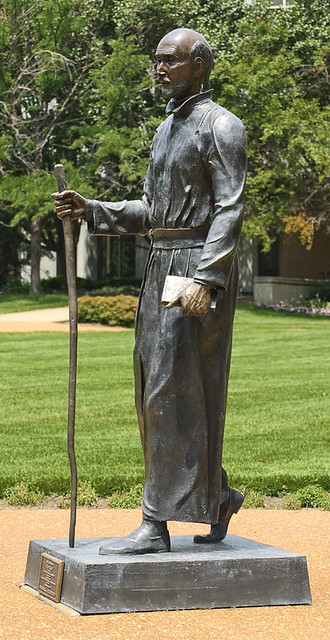
Statue of Saint Ignatius Loyola ("The Pilgrim" by Vicki Reid), at Saint Louis University, in Saint Louis, Missouri, USA

Statue of Saint Ignatius of Loyola (“The Pilgrim” by Vicki Reid), at Saint Louis University, in Saint Louis, Missouri. Photo taken in June, 2009.

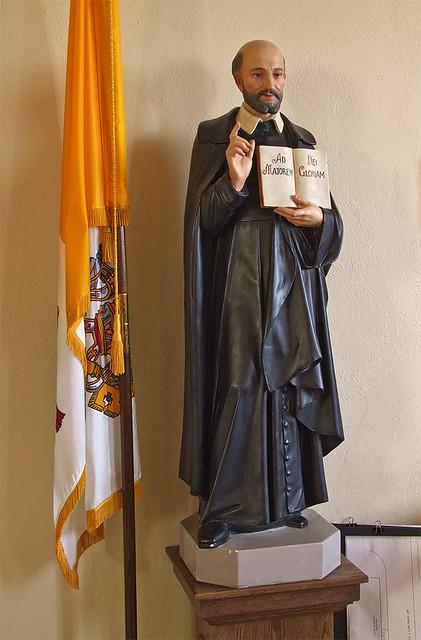
Saint Ignatius Loyola Roman Catholic Church, in Concord Hill, Missouri, USA - statue of Saint Ignaius.jpg

At Saint Ignatius Loyola Church, in Concord Hill, Missouri. Photo taken in July, 2007.

Ignatius was severely wounded in battle, and was captured by the French. However, his captors admired Ignatius for his great courage.  He then had to spend much time in recovery:

“As Ignatius had a love for fiction, when he found himself out of danger he asked for some [chivalric] romances to pass away the time. In that house there was no book of the kind. They gave him, instead, “The Life of Christ” by Ludolph, the Carthusian, and another book called the “Flowers of the Saints,” both in Spanish. By frequent reading of these books he began to get some love for spiritual things. This reading led his mind to meditate on holy things, yet sometimes it wandered to thoughts which he had been accustomed to dwell upon before.

“Among these there was one thought which, above the others, so filled his heart that he became, as it were, immersed and absorbed in it. Unconsciously, it engaged his attention for three and four hours at a time. He pictured to himself what he should do in honor of an illustrious lady, how he should journey to the city where she was, in what words he would address her, and what bright and pleasant sayings he would make use of, what manner of warlike exploits he should perform to please her. He was so carried away by this thought that he did not even perceive how far beyond his power it was to do what he proposed, for she was a lady exceedingly illustrious and of the highest nobility.

“In the meantime the divine mercy was at work substituting for these thoughts others suggested by his recent readings. While perusing the life of Our Lord and the saints, he began to reflect, saying to himself: "What if I should do what St. Francis did?" "What if I should act like St. Dominic?" He pondered over these things in his mind, and kept continually proposing to himself serious and difficult things. He seemed to feel a certain readiness for doing them, with no other reason except this thought: "St. Dominic did this; I, too, will do it." "St. Francis did this; therefore I will do it." These heroic resolutions remained for a time, and then other vain and worldly thoughts followed. This succession of thoughts occupied him for a long while, those about God alternating with those about the world. But in these thoughts there was this difference. When he thought of worldly things it gave him great pleasure, but afterward he found himself dry and sad. But when he thought of journeying to Jerusalem, and of living only on herbs, and practicing austerities, he found pleasure not only while thinking of them, but also when he had ceased.

“This difference he did not notice or value, until one day the eyes of his soul were opened and he began to inquire the reason of the difference. He learned by experience that one train of thought left him sad, the other joyful. This was his first reasoning on spiritual matters. Afterward, when he began the Spiritual Exercises, he was enlightened, and understood what he afterward taught his children about the discernment of spirits. When gradually he recognized the different spirits by which he was moved, one, the spirit of God, the other, the devil, and when he had gained no little spiritual light from the reading of pious books, he began to think more seriously of his past life, and how much penance he should do to expiate his past sins.”
— From The Autobiography of St. Ignatius: The Account of his Life dictated to Father Gonzalez by St. Ignatius

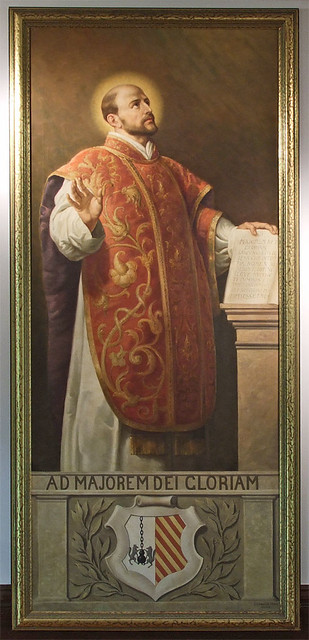
Saint Louis University Art Museum, in Saint Louis, Missouri - Collection of the Western Jesuit Missions - painting of Saint Ignatius Loyola.jpg

At the Collection of the Western Jesuit Missions, Saint Louis University Museum of Art. Photo taken in December, 2006.

Saint Joseph Shrine, in Saint Louis, Missouri, USA - statue of Saint Ignatius Loyola

At the Shrine of Saint Joseph, in Saint Louis. Photo taken January, 2008.

Monday, July 30, 2012

Aunt Blanche, R.I.P.

Please pray for the repose of the soul of Blanche Peterson.


Officium defunctorum by Tomás Luis de Victoria (1605), including one of the readings from the Office of the Dead at Matins, followed by the Missa Defunctorum.

The reading here is from the sorrowful Book of Job (10:1-7):
1 Tædet animam meam vitæ meæ; dimittam adversum me eloquium meum : loquar in amaritudine animæ meæ.
2 Dicam Deo : Noli me condemnare; indica mihi cur me ita judices.
3 Numquid bonum tibi videtur, si calumnieris me, et opprimas me opus manuum tuarum, et consilium impiorum adjuves?
4 Numquid oculi carnei tibi sunt? aut sicut videt homo, et tu videbis?
5 Numquid sicut dies hominis dies tui, et anni tui sicut humana sunt tempora,
6 ut quæras iniquitatem meam, et peccatum meum scruteris,
7 et scias quia nihil impium fecerim, cum sit nemo qui de manu tua possit eruere?

1 I will give myself up to complaint; I will speak from the bitterness of my soul.
2 I will say to God: Do not put me in the wrong! Let me know why you oppose me.
3 Is it a pleasure for you to oppress, to spurn the work of your hands, and shine on the plan of the wicked?
4 Have you eyes of flesh? Do you see as mortals see?
5 Are your days like the days of a mortal, and are your years like a human lifetime,
6 That you seek for guilt in me and search after my sins,
7 Even though you know that I am not wicked, and that none can deliver me out of your hand?
From the Missa Defunctorum, (John 6:51-54):
51 Ego sum panis vivus, qui de caelo descendi. Si quis manducaverit ex hoc pane, vivet in aeternum: et panis, quem ego dabo, caro mea est pro mundi vita.
52 Litigabant ergo Judaei ad invicem, dicentes: Quomodo potest hic nobis carnem suam dare ad manducandum?
53 Dixit ergo eis Jesus: Amen, amen dico vobis: nisi manducaveritis carnem Filii hominis, et biberitis ejus sanguinem, non habebitis vitam in vobis.
54 Qui manducat meam carnem, et bibit meum sanguinem, habet vitam aeternam: et ego resuscitabo eum in novissimo die.
51 “I am the living bread that came down from heaven; whoever eats this bread will live forever; and the bread that I will give is my flesh for the life of the world.”
52 The Jews quarreled among themselves, saying, “How can this man give us [his] flesh to eat?”
53 Jesus said to them, “Amen, amen, I say to you, unless you eat the flesh of the Son of Man and drink his blood, you do not have life within you.
54 Whoever eats my flesh and drinks my blood has eternal life, and I will raise him on the last day.”

Thursday, July 26, 2012

Julian the Apostate

ON THIS DAY, in the year of Our Lord 363, the Roman Emperor Flavius Claudius Julianus Augustus, called ‘the Apostate,’ gained his eternal reward.

Julian the Apostate is known for having repudiated Christianity in favor of an eccentric version of a philosophized Roman paganism. But like many Christians today, raised under a heretical interpretation of the religion, his attachment to the Holy Catholic Faith was weak and he ended up rejecting it.  How many today claim to be delighted by the eccentric reforms which were supposed to have been required by the Council, yet never themselves darken the door of a Church, ending up completely outside of the Church? How many people today, especially powerful people, are repulsed by the yoke of Christ, and instead piece together their own religion, one completely pleasing to them?

Among his policies included the Imperial support of schools, hospitals, and charities; not out of a love for learning, the sick, and the poor, but rather to break the back of the Catholic Church, who provided most of those services in the Empire. This is a kind of robbery, because the sick and the poor are the treasure of the Church. He sought to eliminate all Christian influence on political life, and worked hard to provoke schism and heresy within the Church, using the effective policy of ‘divide and conquer.’

The direct persecution of Christians, he knew, would not work, for the blood of the martyrs is the seed of the Church; rather, he attacked Christ indirectly, by harassing and marginalizing Him. For this reason, Julian the Apostate is admired and imitated today by those who hate Christ. This kind of persecution, a new one in its day, ended with Julian, but it appears to have been revived once again in our own day.

Wednesday, July 25, 2012

Cinema and Censorship

SOME THINK THAT film is an inferior medium — compared to say, written novels — mainly because 90 or so minutes is hardly enough time to cover the material in even a short novella. But no one denies that film is a powerful medium: its immersive quality means that impressions flow directly into our minds, bypassing our critical faculties. The little gatekeeper to our soul, who actively scrutinizes ideas as we read them on a page, is seemingly asleep when we are in a darkened theater watching a film. So cinema can be a two-edged sword — potentially a great good or a great evil.

But in a civil society, should not power come with greater responsibility? Those who have great means have a far greater moral culpability than the rest of us. Cinema is very powerful, but who has the right or the responsibility to regulate this power?

Early commercial cinema tended to be sensational, and it seemed that films with racy or violent content sold well, and this led to an industry-wide trend to embrace this lowest-common-denominator content, as studio executives were not willing to lose business to their competitors. But children and youth were observed to directly imitate the evil things they saw at the movies, and this led Progressive Era reformers to demand government censorship of the media. Eventually, government censorship boards were set up in many states and municipalities in the United States. The censors had the power to cut out scenes or even to deny licenses to films, preventing them from being shown in their jurisdiction. Ironically, this censorship had an effect that was not intended — Hollywood made films that were even more sensational, salacious, and violent, hoping that some would make it past the censors, and many did.

But this is hardly a good way to do business and it compromises the artistic integrity of a film. Besides, is government the best institution to ensure the morals of youth? A better solution would be for the industry to regulate itself in cooperation with associations of cinema-goers, avoiding the heavy-hand of government.

Dawn Eden discusses this self-regulation of cinema in her article "Dark Knight" and the soul: The Catholic Church's prophetic warnings about the toxic effects of cinematic violence. She discusses the role of Fr. Daniel A. Lord S.J., who wrote the self-regulating code used by Hollywood cinema from the 1930s through the 1960s.  Lord reportedly wrote one of Pope Pius XI's encyclicals on the subject of film. (Lord's relics can be found in Calvary Cemetery in Saint Louis.)

Now, many decried this kind of self-censorship — even though it is far better than government censorship — as limiting artistic freedom.  But what was the result of such self-regulation? It is now called the “Golden Age of Hollywood,” an era of filmmaking that embraced humanism and the high ideals of our civilization, an era where films were more literate, psychologically nuanced, and with a very high quality of art. This was also an unexpectedly profitable time for filmmakers, and many films of that era transcend their time and remain popular today.

Pope Pius stated that films must be morally good — they must encourage the good and discourage evil — but they must also be artistically good.  Good intentions must be coupled with good art. Too many Christian groups, naive or dismissive about the medium and business of film, put out nice but terribly inartistic films that have minimal influence on our culture. Good art, on the other hand, cannot be ignored.