Pages

Sunday, March 10, 2013

Photos of Old Saint Vincent's Church, in Cape Girardeau, Missouri

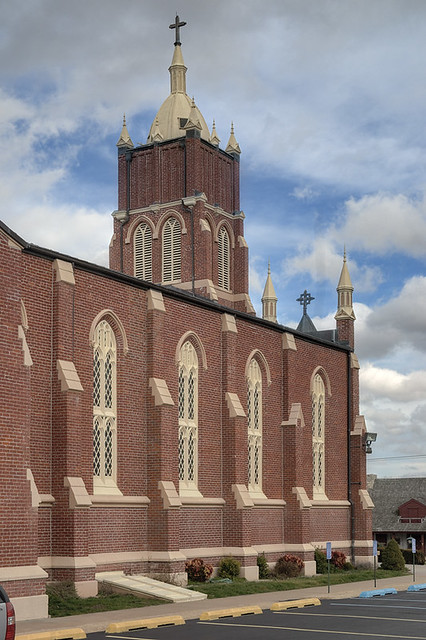
HERE ARE PHOTOS of the old Saint Vincent de Paul Church, in Cape Girardeau, Missouri. A part of the Diocese of Springfield-Cape Girardeau, this is now a chapel of ease in the historic riverfront district of that city. Dating from 1853, this English Gothic Revival church is located about 115 highway miles south of downtown Saint Louis.
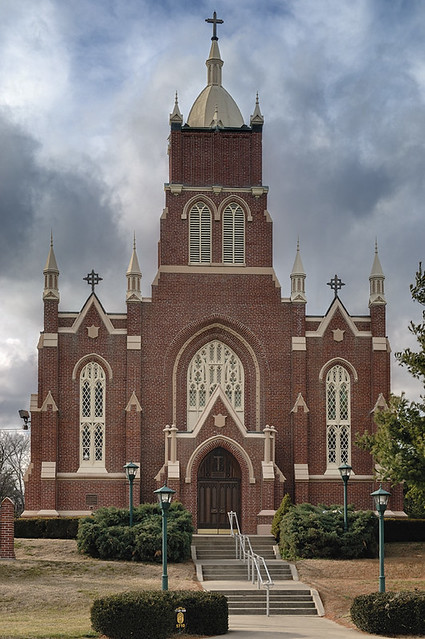
Old Saint Vincent's Catholic Church, in Cape Girardeau, Missouri, USA - exterior front

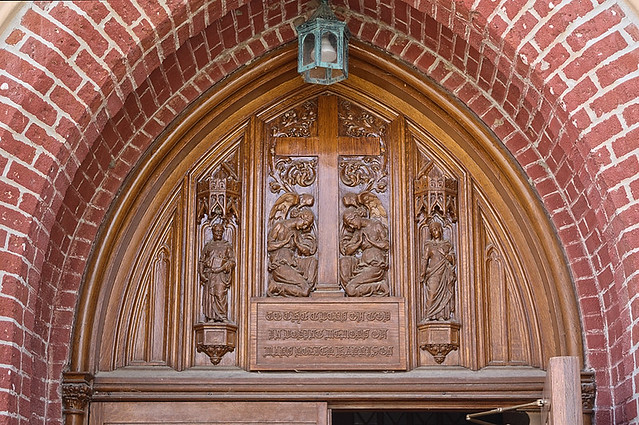
Old Saint Vincent Catholic Church, in Cape Girardeau, Missouri, USA - tympanum above front door

Wood carving over the main entrance.
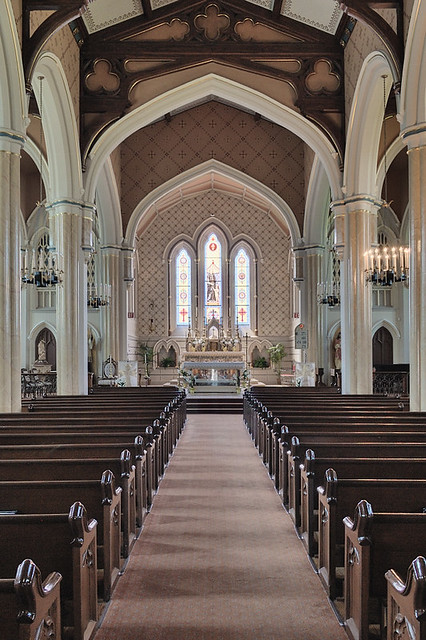
Old Saint Vincent Catholic Church, in Cape Girardeau, Missouri, USA - nave

From the church's website:
1825: Fr. John Timon, A Vincentian priest, was assigned to serve the population of Perry & Cape Girardeau counties.

July 8, 1833: Fr. Timon celebrated Mass in the first temporary church which was a warehouse of Don Louis Lorimier. It was close to the riverfront and near to the Red House, Lorimier's home.

April 30, 1838: Cornerstone of the first church was laid by Bishop Joseph Rosati, C.M. This stone structure distinctly resembled the Old Cathedral on the St. Louis riverfront.

1850: First church of native stone destroyed by a violent tornado.

1851: Within six months construction began on the present church. The stone of the original church was used for the new
foundation. The church was designed by a noted Missouri architect, Thomas Warying Walsh. The church is in the style of Renaissance architecture in which architects refer to the style of the church as English Gothic Revival.

1900: A spire of undetermined height was erected on the occasion of the golden jubilee.

1905: The spire was struck by lightning.

1912: Lightning again strikes the spires and it was destroyed by fire. The present steeple was constructed in 1912.

1926: The vestibule at the front entrance was added sometime after 1900. The shape of the church is cruciform; shape of a cross. There are nine arches intertwined in the choir loft. Architects' speculation is that the arches were designed to support the tall spire in the original design. Pews show evidence of originally having gates (doors) as well a partitions. There was a pedestal which gave evidence of a pulpit near the front of the church.

December 1977: Old St. Vincent Church was declared a Chapel of Ease. Restoration begins. It has remained a place of worship since Father Timon came to this area in 1833.

April 1982: Old St. Vincent Church was placed on the National Register of Historic Places.

1997: Exterior and interior restoration completed.

Present: Old St. Vincent Church continues to serve the Cape Girardeau community as a Religious & Cultural Center.
Fr. Timon, the first parish priest, was a missionary along the Mississippi River and in Texas, and later became Coadjutor Bishop of the Diocese of Saint Louis, then Apostolic Prefect of the Republic of Texas, and then Bishop of Buffalo.

The architect Walsh, who was born in Kilkenny, Ireland, and lived in Saint Louis, also designed the old Cathedral (Saints Peter and Paul) in Alton, Illinois, Du Bourg Hall and Saint Francis Xavier Church at Saint Louis University, and Saint Alphonsus Ligouri Church in Saint Louis.

These interior photos were taken in April of 2012.
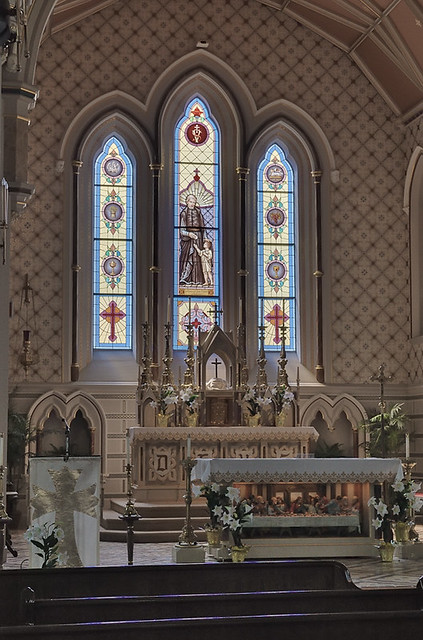
Old Saint Vincent Catholic Church, in Cape Girardeau, Missouri, USA - sanctuary

The stained glass window in the sanctuary depicts Saint Vincent de Paul giving bread to a poor child; the inscription reads “In memory of John Pointer.”
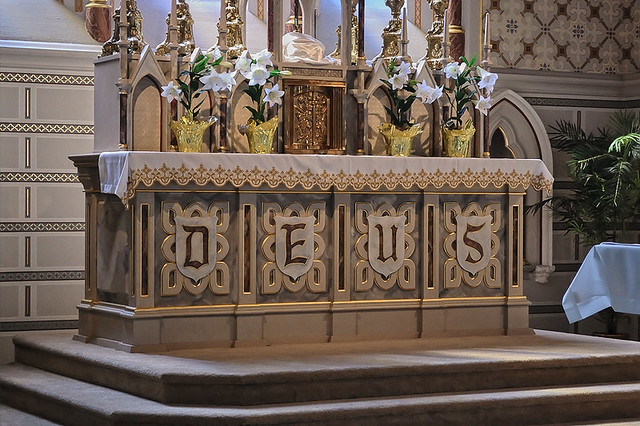
Old Saint Vincent Catholic Church, in Cape Girardeau, Missouri, USA - altar

The old high altar. Deus is Latin for God.
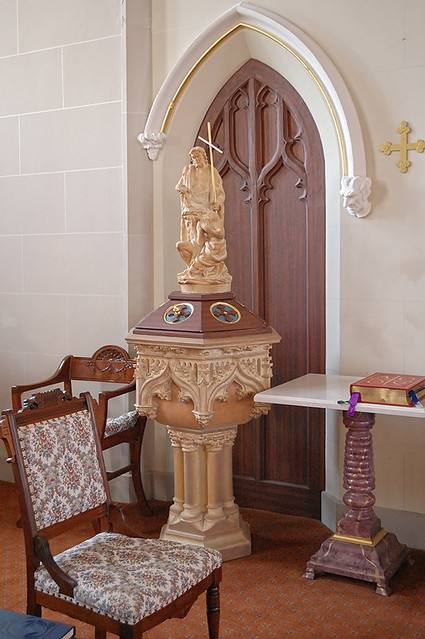
Old Saint Vincent Catholic Church, in Cape Girardeau, Missouri, USA - baptismal font

Baptismal font, with sculpture depicting the baptism of Our Lord in the Jordan River by Saint John the Baptist.
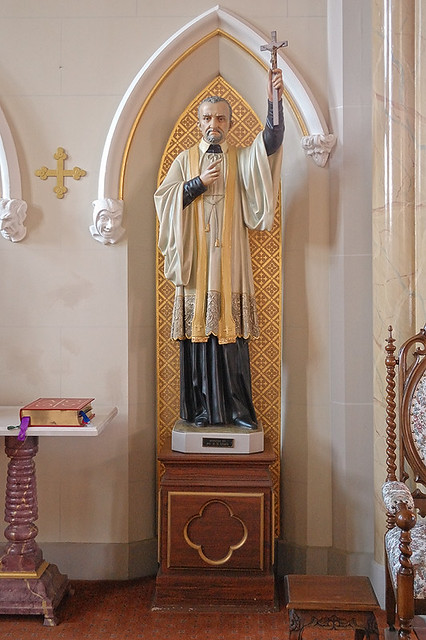
Old Saint Vincent Catholic Church, in Cape Girardeau, Missouri, USA - statue of Saint Vincent de Paul

Statue of Saint Vincent de Paul. He was a French priest, ordained in the year of Our Lord 1600. Captured by pirates, he was sold into slavery but later assisted in the reversion of his apostate master, and succeeded in freeing himself and his fellow slaves. While he was a friend of kings and aristocrats, he worked especially with poor peasants, convicts in slave galleys, and spiritually supporting his fellow priests. He was founder of the Ladies of Charity, co-founder, with St. Louise de Marillac, of the Daughters of Charity, and founded the Congregation of the Mission.
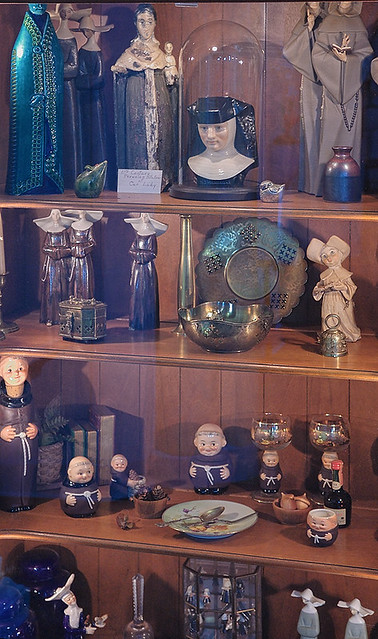
Old Saint Vincent Catholic Church, in Cape Girardeau, Missouri, USA - cabinet with memorabilia

Charming memorabilia.

Old Saint Vincent's Catholic Church, in Cape Girardeau, Missouri, USA - exterior side

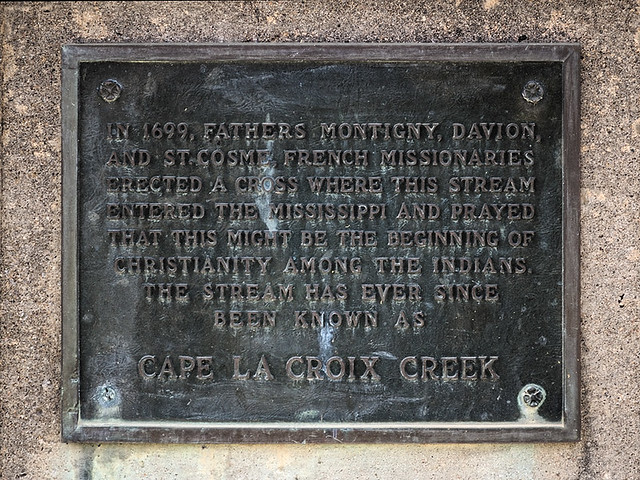
Old Saint Vincent Catholic Church, in Cape Girardeau, Missouri, USA - "Cape La Croix Creek" monument

This monument is near the church.
In 1699, Fathers Montigny, Davion,
and St. Cosme, French missionaries
erected a cross where this stream
entered the Mississippi and prayed
that this might be the beginning of
Christianity among the Indians.
The stream has ever since
been known as

CAPE LA CROIX CREEK

Across the street from the church is Murtaugh Park, “named for Rev. James A. Murtaugh, C.M., commemorating his civic efforts,” and the Red House, a fairly recent building, constructed to resemble the French colonial architecture of this region, and commemorating Louis Lorimier, an early settler who set up a trading post here:
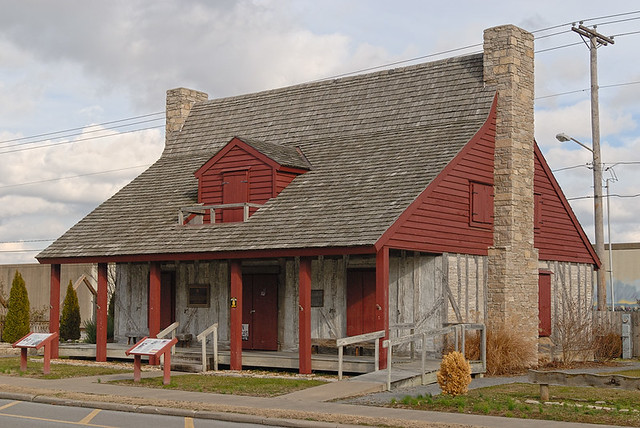
Old Red House, in Cape Girardeau, Missouri, USA

The former B’Nai Israel Synagogue, which has an unusual Spanish-Moorish design, is located next door to the church.

Address:
William and Main Streets
Cape Girardeau, Missouri 63703

Thursday, March 07, 2013

Ornament at the Cathedral Basilica of Saint Louis

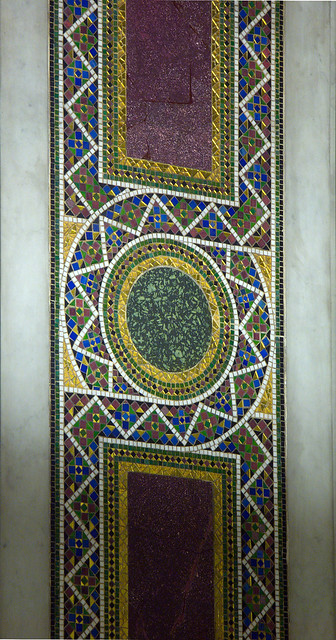
, in Saint Louis, Missouri, USA - mosaic details 2

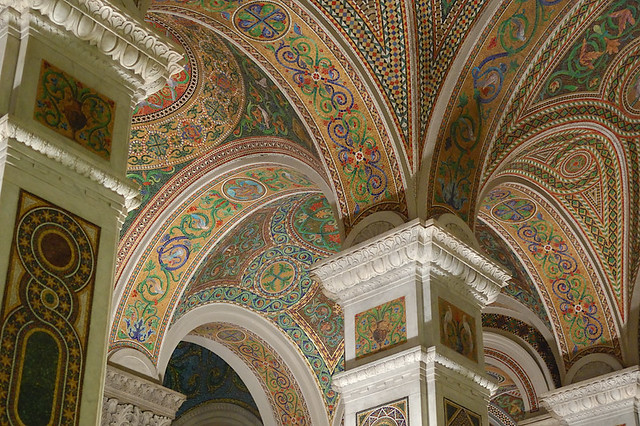
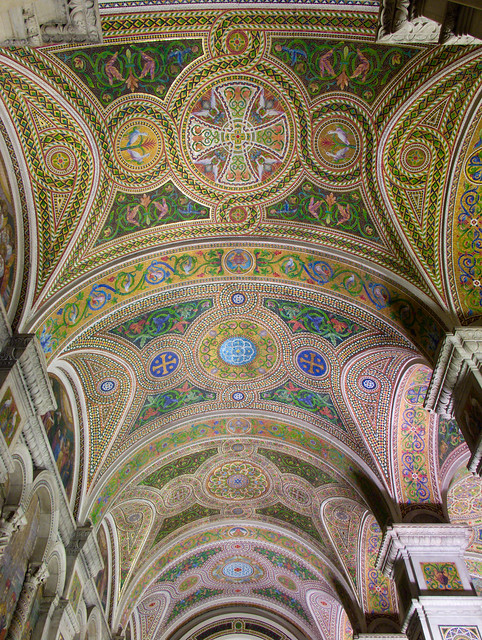
Ornament at the Cathedral Basilica of Saint Louis.

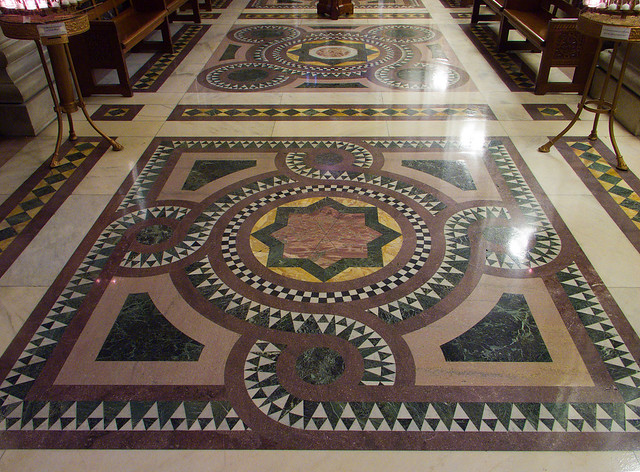
Architectural ornament was for decades a lost art in the West, which is a shame because it is beautiful, giving rest and pleasure to the eye, and it links us to cultures far into the past and across the continents. This loss is also unwarranted, because the principles of making traditional ornament are actually relatively simple — at least compared to figurative art. But perhaps the most important consideration is that the beauty of ornament flows from the underlying truth that it expresses, and so ornament can lift our minds upward towards more spiritual things.

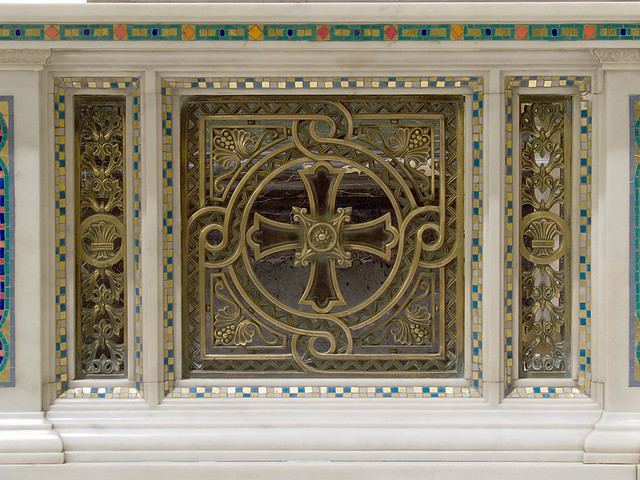
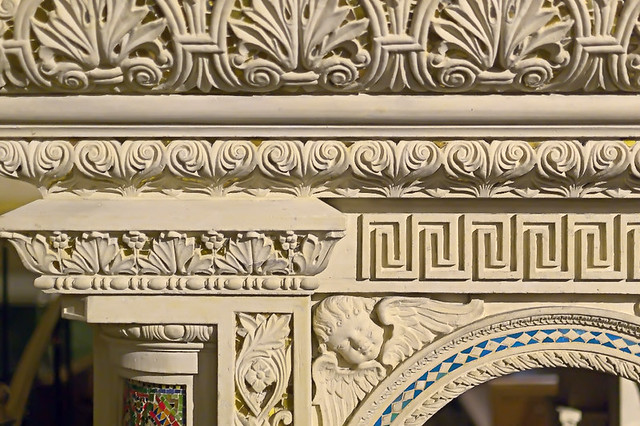
Cathedral Basilica of Saint Louis, in Saint Louis, Missouri - communion rail detail.jpg

I've long wanted to do an in-depth photo essay of the ornament at the Cathedral, largely because it is close to ground level and so easy to photograph. The figurative icons that are located 50 feet or more above are hard to capture because they are usually seen at odd angles from the floor, and so would likely need expensive equipment and intrusive camera work to photograph well. My problem was that the ornament here is found in such a bewildering variety that I had little idea as to how to approach it.

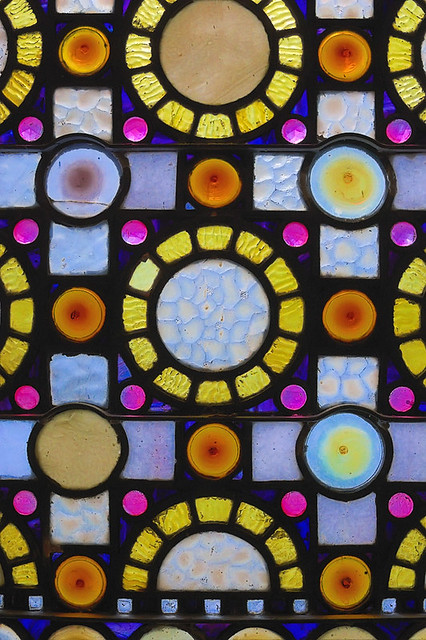
Cathedral Basilica of Saint Louis, in Saint Louis, Missouri, USA - decorative stained glass window detail, in west transept

Fortunately, I found out that there is a mathematical classification of ornament based on its symmetry. These designs can be classified into groups, including symmetries of reflection about a line, rotation around point; frieze groups which exhibit symmetries along a line; wallpaper groups which have symmetries across a surface, helical symmetry on a cylinder, and so forth, in a logical, understandable, and orderly framework.

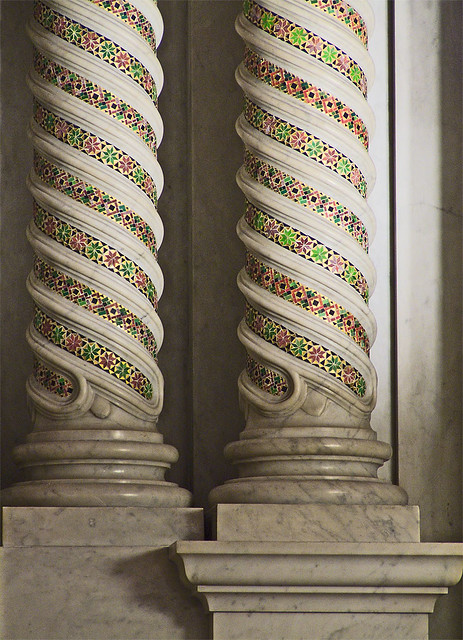
Cathedral Basilica of Saint Louis, in Saint Louis, Missouri - Our Lady's Chapel - column detail.jpg

Nowadays, mathematics and art are opposed to each other — “drawing on different sides of the brain” according to a popular but discredited theory. But at one time it was not so.

It is surprising, perhaps, to learn that ancient and medieval art has a mathematical foundation, which reflects the mathematical order of the cosmos. Recovering this mathematical understanding is needed before we can recover the good use of ornament in architecture, based on first principles and not mere copying.

Cathedral Basilica of Saint Louis, in Saint Louis, Missouri

Dr. Brian Clair, who teaches mathematics and computer science at Saint Louis University, has web pages at http://euler.slu.edu/~clair/cathedral, which illustrates the various classes of symmetries of ornament found at the Cathedral Basilica. Please note that the classification is quite abstract, and ignores the specific colors and the materials used in the ornament, but instead emphasizes their form. Recall Aristotle's four causes: the most important are the formal cause, or design of an object, and the final cause or purpose for the object; modernity, on the other hand, emphasizes the material and efficient causes, which relate to the composition of an object and how it is made. It is easy to see how the modern emphasis can overlook ornament and its importance.

Cathedral Basilica of Saint Louis, in Saint Louis, Missouri, USA - pulpit detail

I frequently attend Mass and Confession at the Cathedral Basilica, and typically there are numbers of visitors there, for it is a popular tourist attraction. Invariably, these people are awe-struck at the massiveness and beauty of the interior, and we should not be surprised, because Catholic churches  are intended to edify the masses.

These tourists snap innumerable snapshots, but alas, their photos are likely to be disappointing. In my early days of photographing the cathedral, I learned two important lessons in photography: subtracting out the color of the lighting from the image, and harmonizing the position and orientation of the camera with the subject. Some of these photos are old and aren't quite as harmonious as I would like.

Cathedral Basilica of Saint Louis, in Saint Louis, Missouri - Our Lady's Chapel - ambulatory ceiling 1.jpg

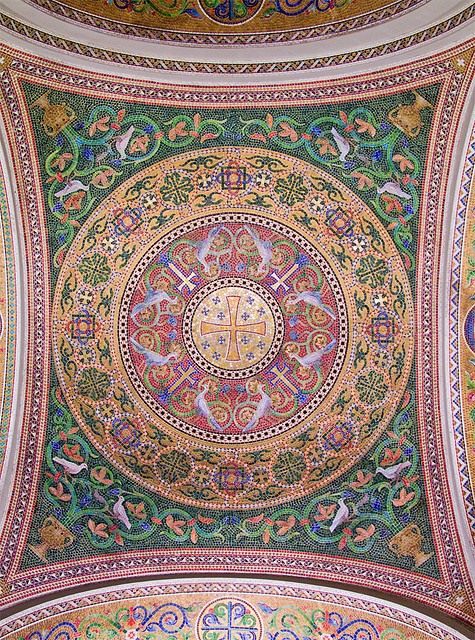
The Jewish Temple in Jerusalem had lush vegetative ornament, being reminiscent of Eden and the promised restoration of the garden of paradise at the world's consummation. Ancient synagogues often followed this pattern, as did the early Christian churches.  Here we see peacocks, symbols of immortality, and two doves at a fountain in each corner, which among other things is a symbol of fidelity and baptism. We also have crosses.

Cathedral Basilica of Saint Louis, in Saint Louis, Missouri - Our Lady's Chapel - windows.jpg

Plainness and lack of ornament is associated with unorthodox sects, from radical denominations to Wahabbism in Islam, which tend to deny the value of the intellect and beauty, or which denigrate the value of the material world. Plain meeting-houses offer nothing for visitors, other than implying “Begone! There is nothing for you here.” Their churches are necessarily uninviting, and they have few willing converts, for they do not “Go into the whole world and proclaim the gospel to every creature.”

But a traditional church is inviting, asking visitors to stay for awhile, perhaps to pray, or even only to contemplate the beauty within, and so such a church ought to be open to visitors at all times.

Cathedral Basilica of Saint Louis, in Saint Louis, Missouri - Our Lady's Chapel - mosaic detail on altar.jpg

Mathematics is traditionally seen as an important step towards enlightenment. Recognizing the underlying unity, order, and causes of things, rather than merely the immediate appearances of things is essential for intellectual — and ultimately spiritual — development. Expressing the mathematical order in works of art inspires not merely the passions, as is found in so much of contemporary art, but also inspires and helps to form the intellect.

Cathedral Basilica of Saint Louis, in Saint Louis, Missouri - Our Lady's Chapel - chapel ceiling 3.jpg

The ornamentation at the Cathedral Basilica has a logical arrangement. The parts of the nave nearest to the main entrance and closest to ground level are more worldly, abstract, and more local, while as we rise upwards, and towards the sanctuary, the ornament is more heavenly, theological, and Christological. Finally the eye is drawn towards the high altar, depicting Christ suffering on the Cross, our salvation. But visitors to the nave are first presented with patterned geometric art, which lifts them above the mundane, ever-changing world, but in a manner that is perhaps gentler than Christ's battered and bloody corpus.

Cathedral Basilica of Saint Louis, in Saint Louis, Missouri, USA

Ornament serves many uses. As the most important church in the archdiocese, it is fitting that it is most richly ornamented, and we would also expect fine ornament in a pilgrimage church, and so the amount and complexity of the ornament tells us of a building's importance. The ornament — including the iconic art — specifically tells us what this building is, that it is a place of Christian worship. The ornament is festive and solemn, reflecting the liturgy offered here.

Cathedral Basilica of Saint Louis, in Saint Louis, Missour

Mosaic work is a popular craft, but it is often done these days in a primitive style, lacking in geometric precision. Adding a basic knowledge of the various orders of symmetry, coupled with good skill in measurement and layout could easily restore this art, at least on a basic level.

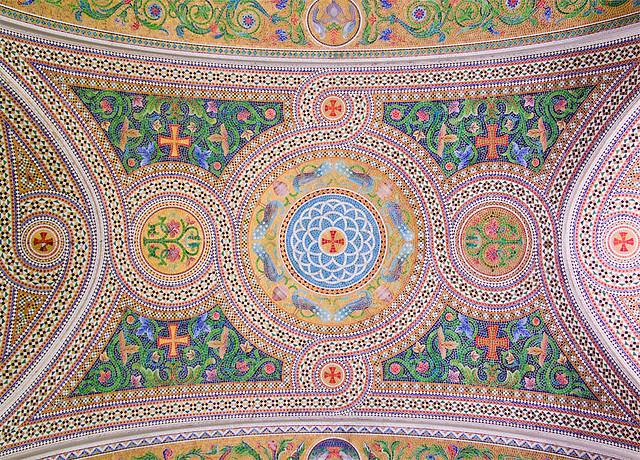
More complex figures, such as the vegetative ornament as seen here, require a knowledge of proportion that is hard to find these days, and this may tempt artists to merely copy existing forms for new work. The problem with simple copying is that some designs, especially those that are highly ordered, are largely specific to the surface upon which they ornament. A different proportion of wall, for example, will require a different design pattern to keep a harmonious appearance, even if the basic elements of the design remains the same. The ability to adapt a type of pattern to new circumstances would require greater knowledge than the simple symmetries mentioned here. See the article Abstraction and the “Grammar of Ornament” for some clues on how to do this.

Tuesday, March 05, 2013

Relic of Saint Mary Magdelen to visit Saint Louis

MARY MAGDALEN — whose titles include Myrrhbearer, Equal of the Apostles, and Apostle to the Apostles — is not only famed in the New Testament, but also, according to tradition, was a missionary to the Roman province of Gaul, or modern-day France.

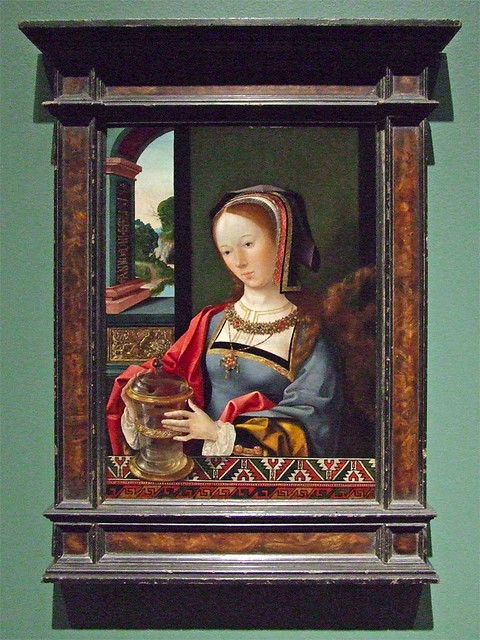
Saint Louis Art Museum, in Saint Louis, Missouri - painting of Saint Mary Magdalene.jpg

Painting of Saint Mary Magdalen, at the Saint Louis Art Museum.

The Saint's missionary journey has not ended, for a major relic of the Magdelen will be visiting Saint Louis. From an article in the Saint Louis Review, here are the locations for public veneration of the Saint:
Thursday, March 21:

• St. Mary Magdalen, 4924 Bancroft Ave. in south St. Louis; 7:50 a.m. candlelight procession carrying the relic into the church, followed by Mass; 9:15 a.m. Chaplet and Litany; 9:30-10:30 a.m. spiritual talk; 11:30 a.m. Mass; 1 p.m. relic departs. Call (314) 352-2111.

• St. Mary Magdalen, 2618 South Brentwood Blvd. in Brentwood; 2 p.m. candlelight procession carrying the relic into the church; 2:15-3 p.m. Confessions, followed by Mass; 4-6 p.m. Confessions; 4:30 p.m. Chaplet and Litany; 5 p.m. Rosary; 5:30-6:30 p.m. Blessed Sacrament exposed for spiritual talk, followed by 7 p.m. Mass; relic departs at 8 p.m. Call (314) 961-8400.

Friday, March 22:

• St. Dominic Priory, 3407 Lafayette Ave. in St. Louis; 8 a.m. Morning Prayer with preaching; 11 a.m. Mass, with veneration throughout the day; 2 p.m. Rosary or Chaplet to St. Mary Magdalene; 4:30 p.m. Evening Prayer with preaching. Call (314) 678-9427 for more information.
WITH THE heartbreak of Benedict's abdication, and the excitement of the upcoming conclave, it is easy to forget that it is still Lent.

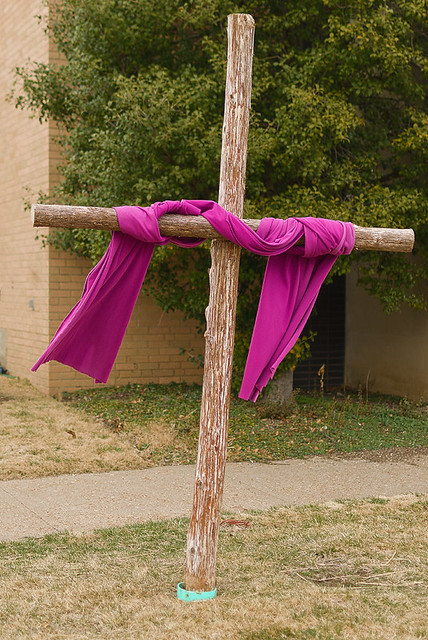
Saint Joan of Arc Roman Catholic Church, in Saint Louis, Missouri, USA - cross draped in violet

Let us not forget the spiritual desert and the suffering of the cross.

Photo taken at Saint Joan of Arc Church in Saint Louis.

Friday, March 01, 2013

ON THE WEBSITE of the Holy See is a little 'photo book' of the pontificate of Benedict XVI, which includes numerous photos as well as his significant speeches:

http://www.vatican.va/bxvi/omaggio/index_en.html