The shrine is in the charming and beautiful old part of Saint Charles, and contributes to the rich colonial and pioneer history and character of this neighborhood.
 This is a view of the Shrine from the south; note the change in brick color: this shrine was originally going to have a four-armed Cross form, but was not completed. The church is a tau cross, with the sanctuary in what would have been the transept. But even in its current form, the shrine still has a beautiful exterior. Click on the photos for a larger image.
 A view of the shrine from the east. Over the door is a mosaic of Saint Louis, King of France, the coat of arms of Cardinal Glennon, and the inscription "I am a soldier of Christ". Although the grass in these pictures is rather yellowed, due to the typical summer drought experienced in the region, the surrounding rose gardens are well-watered and beautiful.
 A view of the shrine from the west. Over the door is a mosaic of Saint Peter, the papal arms of Pope Pius XII, and the inscription, "The work of justice is peace". Next to the door is the cornerstone with the inscription:
PIUS XII - POPE
JOSEPH E. RITTER - ARCHBISHOP
MARIE T. de LESCURE - SUPR. GENERAL
ANGELA McCABE - SUPR. VICAR
ANNO DOMINI - 1952
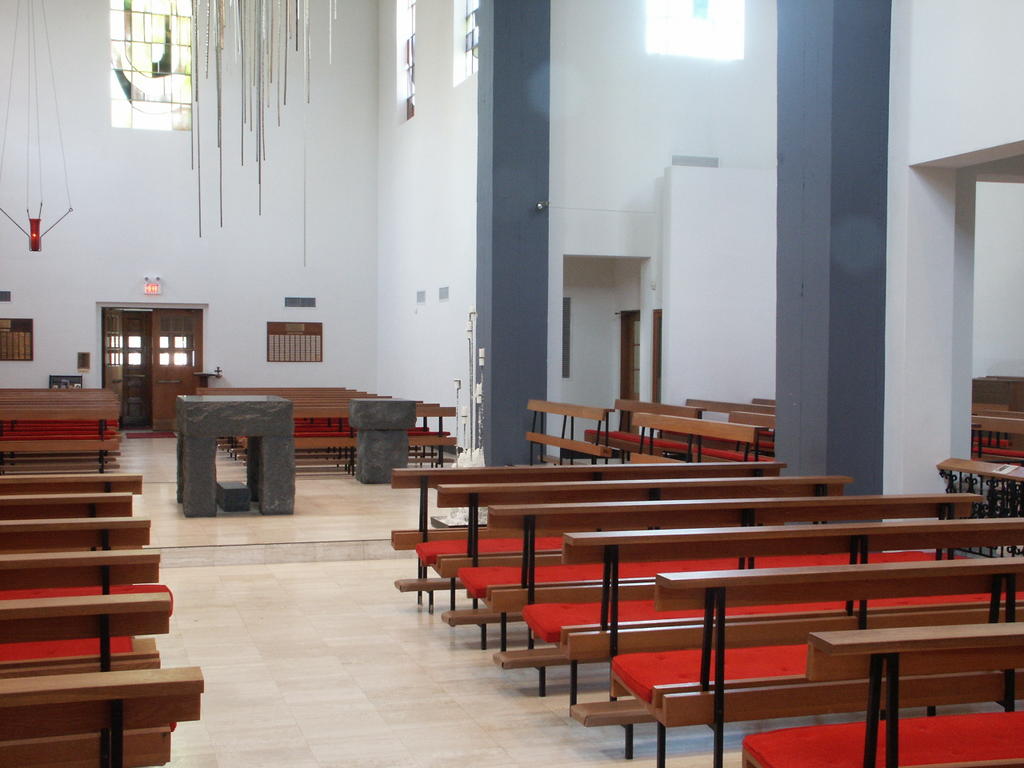 Here is the interior of the Shrine. It is Modernist, designed in 1964 by William Schickel. He is known for having designed the first versus populum (towards the people) altar in the United States, and, in collaboration with Thomas Merton and others, redesigned the Trappist Monastery at Gethsemani in a Modernist style; he later did work that reflected American religious pluralism, including Christian Totem Poles. To the right of the photo is the alcove where Saint Duschesne is entombed.
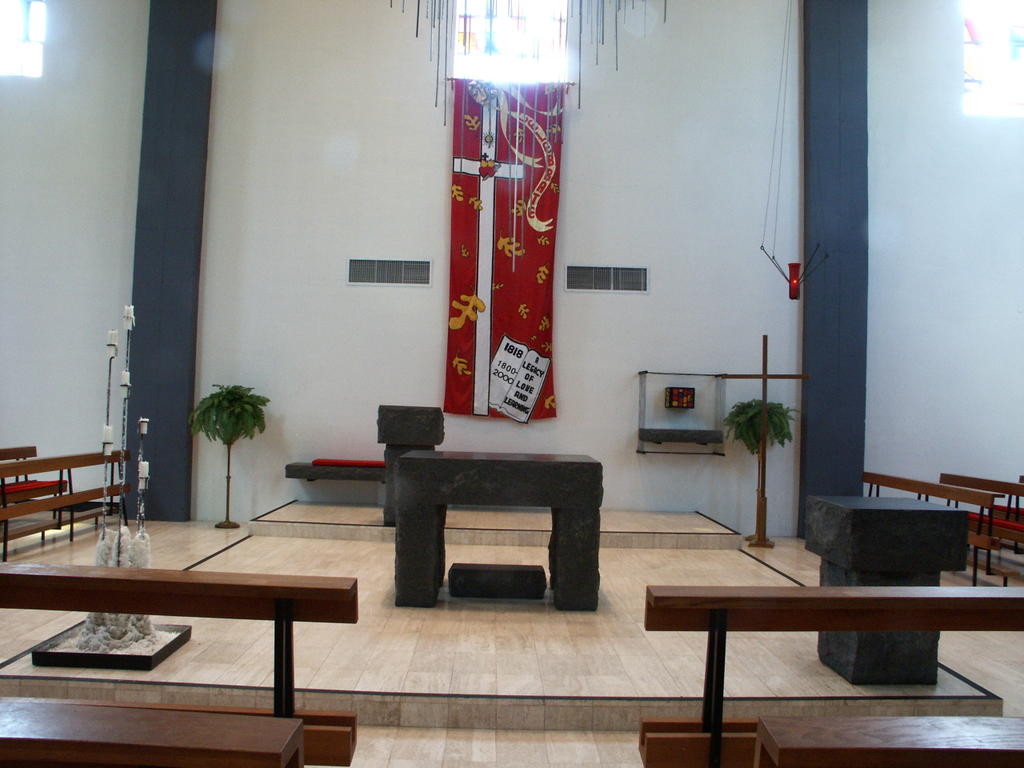 Here is the sanctuary. The rough, black, Missouri granite of the furnishings symbolizes the hard life of the pioneers. On the wall is a small, colorful tabernacle which contains the Blessed Sacrament.
 The alcove contains the tomb of the Saint and a historic crucifix . The enscription on the base of the cross is "O BON IESVS CRVCIFIÉ POVR NOUS SAVUEZ NOUS" This cross once was in the Visitation school in Grenoble, France, that was attended by Saint Duschesne. This alcove has a kneeler in front and a prayer card for the faithful.
 This marble sarcophagus is the tomb of the Saint. It says simply MOTHER DUCHESNE.
 Adjacent to the Shrine is this little building, which formerly held the grave of Mother Duschesne. This little shrine is in the middle of a lovely garden, and is next to the site where Mother Duschesne's log school house was located. A notice inside of the building states:
The Round House
This little shrine, actually octogonal in shape, was built in the early 1850s to honor Our Lady of the Pillar (in thanksgiving for preservation from a fire that threatened to take the convent).
When Mother Duchesne's body -- three years in the grave --was exhumed and found to be miraculously intact, it was removed and laid to rest in this structure. Through the years, the floor construction evolved to its present state. The inscribed marble plate that covers the tomb was added in 1911 and later modified to cite the Beatification in 1940.
In 1951 the Beata's remains were removed to be placed in the large Shrine on this property. The "Round House" was abandoned then but never ceased to be a cherished landmark on this campus.
We are grateful to the many who have contributed to its restoration efforts, which were completed in 1994.
 Inside of the Round House is this tombstone, which marks the former grave of the Saint. The stone is enscribed in Latin, and the English translation is thus:
PHILIPPINE DUCHESNE
FAITHFUL VIRGIN AND MEMBER OF THE SOCIETY OF THE SACRED HEART OF JESUS, WHO MODELED HER LIFE AFTER THE VIRTUES OF SAINT MADELEINE SOPHE BARAT, FOUNDRESS AND MOTHER GENERAL OF THE ORDER.
ACCORDING TO GOD'S PLAN, SHE CAME IN 1818 TO THE UNITED STATES OF AMERICA. WHERE SHE ENDURED ALL MANNER OF LABOR, POVERTY, HARDSHIP AND PRIVATION WITH A BENEVOLENT SPIRIT.
EVER GENTLE WITH OTHERS, SHE WAS, AT THE SAME TIME, VERY DEMANDING OF HERSELF, BY HER HOLY DEATH SHE IS GLORIOUSLY CROWNED IN HEAVEN AND ON EARTH.
BORN AUGUST 29, 1769
DIED NOVEMBER 18, 1852
BEATIFIED MAY 12, 1940
The Shrine is located in the Frenchtown neighborhood of Saint Charles, Missouri, about 23 highway miles northwest of downtown Saint Louis.
619 North Second St.
St. Charles, MO 63301
Map
Tour Hours:
Tuesday, Thursday, Friday: 9-11 a.m. and 1-3 p.m.
Saturday: 10 a.m. to 12 p.m. and 1-3 p.m.
Sunday: 12-3 p.m.
The Shrine is open daily from 9 a.m. to 4 p.m.
Shrine web site: http://www.ash1818.org/shrine.htm
Phone: (636) 946-6127
Catholic Encyclopedia article


Ugh. That's nasty! At least they didn't strip her and dress her in modernist clothing, like they did to poor St. John Neumann.
ReplyDeleteI worked here for many years and i hung the red banner behind the sanctuary.Sadly the Shrine was never completed as planned in the early 1950s. Then came the changes brought about by Vatican II. An architect was hired to design the interior with these changes in mind in the late 1960s and this is what you have today. This man also renovated the nearby St. Charles Borromeo. Frankly and to be honest and this is a sentiment shared by many that this has to be one of the ugliest Catholic shrines in the midwest if not the entire United States. It is cold and sterile and devoid of any beauty and is a perfect example of the excesses of so much post Vatican II worship space design. I can not help but compare it to my former home at Old St.Ferdinand Shrine in Florissant. Hopefully in the future the shrine will be completed as planned and it will present a beautiful and worthy resting place for St. Philippine Duchesne.
ReplyDeleteThe reason for the austerity as explained to me is that it reflects the harsh reality of a simple life of want and need as experienced by Mother Duchesne on the frontier. I would argue that Mother Duchesne had a very fulfilling life well lived and that her life was filled with color and beauty and the joy of serving others. While at certain times her life may had been difficult we all are called to struggle and sacrifice and she did so willingly. She had the opportunity to live in a fine home in Florissant. It had all the amenities of its time and it had a beautiful church attached to it. She was able to live in another fine home at a school known as the City House in St. Louis. Yes she did spend a year at the Pottowatomi reservation but soon returned to St. Charles in 1840 and spent the next twelve years in another fine home for its day in St. Charles. This convent home also had the amenities of the rock church of St. Charles Borromeo attached to it. Perhaps Mother Duchesnes finest attribute was her life of Faith that never broke despite the difficulties she faced and that can be an example to us.
DeleteBy the late 1980s this little 'round house' was in deplorable shape. One wall had basically fallen in the yard, the roof leaked like a sieve, the floor tiles were all coming up and the plaster and all the fine stenciling was ruined. decades of neglect had taken its toll, and I believe the city of St. Charles had threatened to condemn it for safety reasons. Fortunately concerned people stepped up and with the canonization of Philippine in 1988 a renewed interest was shown in it and efforts were underway to rebuild and restore this fine asset to the Academy. This efford was lead by the Board of Directors and the Business manager of the school, Ms. Cindy Croft with help from the RSCJs and Mrs. Carol Pfitzinger. Although it is not in its original appearance it is close and fortunately it was saved.
ReplyDeleteWhen this 'round house' was restored it was decided not to reuse the original etched glass found in the windows. I was given this glass and I put it to good use. For me to get an occupancy permit from the city of Florissant to live at Old St. Ferdinands Shrine, one of many things I had to repair were the four panes of glass around the doors of the rectory. They were held together with scotch tape. I replaced these with four pieces of etched glass and they make a wonderful historical connection with St. Charles and Florissant.
ReplyDelete