FOLLOWING ARE PHOTOS of
Pope Saint Pius V Church, located in south Saint Louis, Missouri, about four miles southwest of downtown.
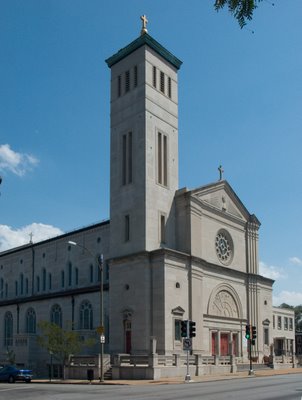
This photo above was taken in July, 2006. The following photos were taken on January 7
th, 2007.

Above the door are milestones and achievements of
Pope St. Pius V:
Born Michael Ghisleri 1504
Ordained to Holy Priesthood 1528
Consecrated Cardinal 1557
Elected Pope 1566
Died 1572
Canonized 1712
The Keys to Heaven
Valiantly Defended the Faith Against Heresies and Schisms
Organized Defense Against the Saracens
Commemorates the Divine Intercession in the Battle of Lepanto
Added to Litany of Our Lady "Help of Christians"
Organized the Propagation of the Faith - Sent First Missionaries to the New World
Instituted the Feast of the Most Holy Rosary 1571
Freed 15,000 Christian Slaves

Nave of the church.

Main altar, decorated for the Christmas season, with tabernacle and crucifix, flanked by the Greek letters, Alpha and Omega.

Detail of mosaics above the altar.

Baptismal font in sanctuary.

Saint Joseph's altar.

View to side of nave.

Stained glass window of the Annunciation.
The Angel of the Lord declared unto Mary, "Hail, full of grace, the Lord is with thee."
ETERNAL REST
GIVE THEM O LORD
Shrine to the holy souls.
 Whose Sins You Shall Forgive, They Are Forgiven Them....and whose sins you shall retain, they are retained.
Click
here for a good science fiction story about a priest who inadvertently retained sins.
The confessional is a Catholic church's spiritual sewer treatment plant.

IX
th Station of the Cross—Jesus Falls the Third Time
Consider how Jesus Christ fell for the third time. He was extremely weak and the cruelty of His executioners was excessive; they tried to hasten His steps though He hardly had strength to move.
Pipe organ.


Old baptistery.


View of the old school building.

THIS STONE
BLESSED AND LAID
FOR THE GLORY OF GOD
IN HONOR OF
ST. PIUS. V.
SUNDAY NOV. 5, 1916

Mass times.
Church history, from the
parish website:
St. Pius V began humbly a century ago as an Irish immigrant church, but by World War II had grown to be one of the largest, most prestigious parishes in the Archdiocese of St. Louis. The post-war baby boom swelled its membership and school enrollment, and prompted expansion and improvements of the church and grounds by the mid-1950s.
But by the 1970s, south St. Louis' ethnic makeup was beginning to change again as middle-class whites fled for the suburbs. Blacks, and Asian and African immigrants and refugees took their place in the 1980s. The dramatic demographic shift during the 1980s and '90s created social tension and demanded a response. In the '90s, parishioners were mobilized to advocate for social change, a value still held today.
If St. Pius' members are fewer today, they are more diverse - a mix of old, young, refugee, immigrant, longtime neighborhood residents and suburbanites. In the '90s, the 10 a.m. liturgy became more vital with warmer hospitality, livelier music and more dynamic preaching. St. Pius' ministries to the elderly, homebound, immigrant and poor grew. Parish finances were stabilized; stewardship was emphasized.
As St. Pius neared its centennial, it took the painful step of closing its school and merging with another in 2003 to form St. Frances Cabrini Academy. In late 2004, St. Pius learned it would close as part of a realignment of south-side parishes. The parish strenuously defended its viability and purpose and the archbishop allowed it to remain open.
A century after its founding, St. Pius V finds itself at a crossroads. It must grow in numbers and continue proving its purpose, or risk being shuttered. It remains one of the smallest territorial parishes in south St. Louis and made only a small net gain in membership from the recent parish consolidations. St. Pius must seize the opportunity to demonstrate it was the right choice for staying open and attract new members from the city and suburbs.
Address:3310 S. Grand Boulevard
St. Louis, MO 63118
 which includes the story Leaf by Niggle.


