Pages

Friday, July 06, 2012

“Don’t hate me because I’m beautiful...”

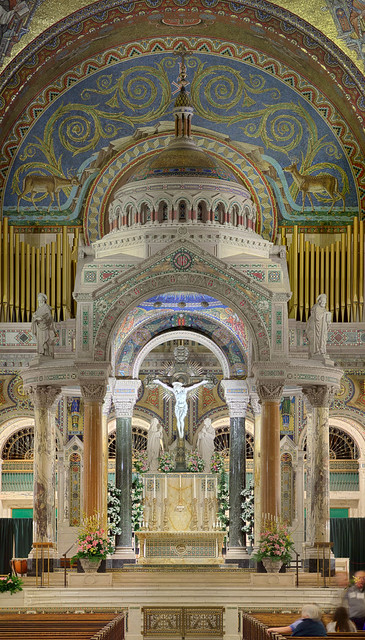
Cathedral Basilica of Saint Louis, in Saint Louis, Missouri, USA - large view of high altar 4

Photo taken at the Cathedral Basilica of Saint Louis.

Click for the article Don’t Hate Me Because I’m Beautiful… over at the Crescat.

Jewish law is well known for having many precise rubrics for the sacramentals of their rites, and Catholicism, which came from this tradition, retains many of these sacramental principles. But simply fulfilling the basic minimum requirements, a utilitarian sense of only observing the bare essentials of these rites, shows a certain meanness of spirit. In Jewish theology, there is the principle of “hiddur mitzvah,” which states that generosity towards the Lord is shown when an extra effort, especially a sense of beauty, is added to the rites. According to one source:
Beauty enhances the mitzvoth [commandments] by appealing to the senses. Beautiful sounds and agreeable fragrances, tastes, textures, colors, and artistry contribute to human enjoyment of religious acts, and beauty itself takes on a religious dimension. The principle of enhancing a mitzvah through aesthetics is called Hiddur Mitzvah.
Historically, this principle, although largely unwritten, was a core part of Catholicism as evidenced by the huge number of elaborate and beautiful churches.  Until our current age, the Church made a great effort in making the liturgy beautiful. The incorporation of Greek philosophy into Catholicism also gives us a solid reason for knowing why beauty has a religious dimension, for the Lord is beauty itself.

Essentialism and utilitarianism has become a part of our culture, and since they say “beauty is in the eye of the beholder” and so subjective, the Beautiful has been excluded from large numbers of our churches, and indeed in life in general.

As the Crescat says, you shouldn’t give a toilet plunger to your beloved on Saint Valentine’s Day, no matter how much it is needed or how useful it is.

Wednesday, July 04, 2012

Chesterton On America

OBERSERVATIONS ON the United States, from the famed English writer and Catholic convert G.K. Chesterton (1874-1936), from his book What I Saw in America (1922):
America is the only nation in the world that is founded on a creed. That creed is set forth with dogmatic and even theological lucidity in the Declaration of Independence; perhaps the only piece of practical politics that is also theoretical politics and also great literature. It enunciates that all men are equal in their claim to justice, that governments exist to give them that justice, and that their authority is for that reason just. It certainly does condemn anarchism, and it does also by inference condemn atheism, since it clearly names the Creator as the ultimate authority from whom these equal rights are derived. Nobody expects a modern political system to proceed logically in the application of such dogmas, and in the matter of God and Government it is naturally God whose claim is taken more lightly. The point is that there is a creed, if not about divine, at least about human things.
flag
But citizenship is still the American ideal; there is an army of actualities opposed to that ideal; but there is no ideal opposed to that ideal. American plutocracy has never got itself respected like English aristocracy. Citizenship is the American ideal; and it has never been the English ideal. But it is surely an ideal that may stir some imaginative generosity and respect in an Englishman, if he will condescend to be also a man... 
But the point is not that nothing exists in America except this idea; it is that nothing like this idea exists anywhere except in America. This idea is not internationalism; on the contrary it is decidedly nationalism. The Americans are very patriotic, and wish to make their new citizens patriotic Americans. But it is the idea of making a new nation literally out of any old nation that comes along. In a word, what is unique is not America but what is called Americanisation. We understand nothing till we understand the amazing ambition to Americanise the Kamskatkan and the Hairy Ainu. We are not trying to Anglicise thousands of French cooks or Italian organ-grinders. France is not trying to Gallicise thousands of English trippers or German prisoners of war. America is the one place in the world where this process, healthy or unhealthy, possible or impossible, is going on. And the process, as I have pointed out, is not internationalisation. It would be truer to say it is the nationalisation of the internationalised. It is making a home out of vagabonds and a nation out of exiles...
Chesterton, however, saw that the United States in his age was already corrupted:
But when I say that the Republic of the Age of Reason is now a ruin, I should rather say that at its best it is a ruin. At its worst it has collapsed into a death-trap or is rotting like a dunghill. What is the real Republic of our day as distinct from the ideal Republic of our fathers, but a heap of corrupt capitalism crawling with worms; with those parasites, the professional politicians? I was re-reading Swinburne's bitter but not ignoble poem, 'Before a Crucifix,' in which he bids Christ, or the ecclesiastical image of Christ, stand out of the way of the onward march of a political idealism represented by United Italy or the French Republic. I was struck by the strange and ironic exactitude with which every taunt he flings at the degradation of the old divine ideal would now fit the degradation of his own human ideal. The time has already come when we can ask his Goddess of Liberty, as represented by the actual Liberals, 'Have you filled full men's starved-out souls; have you brought freedom on the earth?' For every engine in which these old free-thinkers firmly and confidently trusted has itself become an engine of oppression and even of class oppression. Its free parliament has become an oligarchy. Its free press has become a monopoly. If the pure Church has been corrupted in the course of two thousand years, what about the pure Republic that has rotted into a filthy plutocracy in less than a hundred?
O, hidden face of man, whereover
The years have woven a viewless veil,
If thou wert verily man's lover
What did thy love or blood avail?
Thy blood the priests make poison of;
And in gold shekels coin thy love.
Which has most to do with shekels to-day, the priests or the politicians? Can we say in any special sense nowadays that clergymen, as such, make a poison out of the blood of the martyrs? Can we say it in anything like the real sense, in which we do say that yellow journalists make a poison out of the blood of the soldiers?

But I understand how Swinburne felt when confronted by the image of the carven Christ, and, perplexed by the contrast between its claims and its consequences, he said his strange farewell to it, hastily indeed, but not without regret, not even really without respect. I felt the same myself when I looked for the last time on the Statue of Liberty....

Monday, June 25, 2012

Dominicans Make Vows at Old Cathedral

EARLIER THIS MONTH, three men made solemn vows to the Order of Friar Preachers (the Dominicans), at the Basilica of Saint Louis, King of France.

This happened at the “Old Cathedral,” once the cathedral church for half of the United States, an edifice which once was one of the most highly indulgenced churches in the world, located near the base of the Gateway Arch, in downtown Saint Louis, Missouri.

For photos, see the article Three Brothers Take Solemn Vows, from the website of the Dominican Brothers of the Province of St. Albert the Great.

Founded by Saint Dominic, the Order of Preachers is an active order devoted to preaching, being of one heart and mind in the Lord, and the salvation of souls. The modern university system developed from the work of the Dominicans in the Middle Ages, who according to their constitutions, were to devote much time in study. The Dominican Order was one of the earliest groups to have formed a constitutional form of democratic or parliamentary government; because of their broad knowledge and liberality, friars often served in the Inquisition — and so Modernity unfairly castigates them, even though their intent was to moderate the severity of the secular rulers.

Sunday, June 24, 2012

Feast of the Birth of John the Baptist

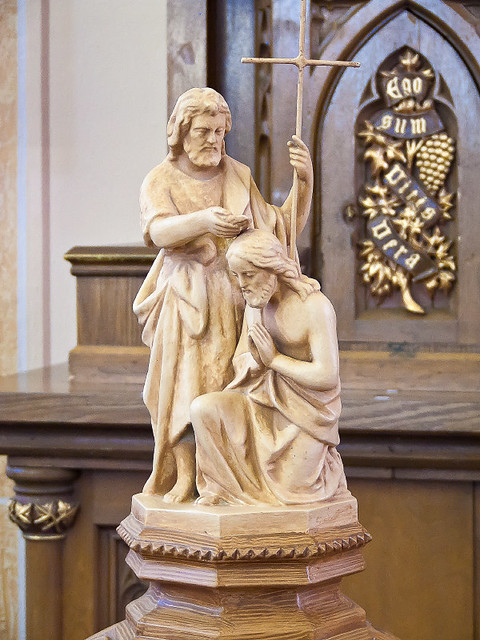
Saint George Catholic Church, in Hermann, Missouri - baptismal font detail - 2

St. John baptizing Jesus, detail on a baptismal font.  At Saint George Church, in Hermann, Missouri. Photo taken in 2006.

Wednesday, June 20, 2012

A New Architecture Blog...

...THE SACRED LANDSCAPE, by Catholic architect Steven Schloeder, PhD, AIA, can be found at http://thesacredlandscape.blogspot.com. He writes:
I soon discovered that while everyone talked about "architecture", no one was really ready to talk about what it really was.  Now if one were to ask a professor of biology what it was that he studied, he might well reply "the study of living organisms", and if asked of an economics professor she might tell you that "economics concerns the production, distribution and consumption of goods and services", or "how people work within markets to get what they want given the problems of scarcity and competition", or even "how money works".  Yet in asking my architecture professors "what is architecture", I would get the most opaque and pretentious answers:

Architecture is the masterly, correct and magnificent play of masses brought together in light. 
 Architecture is frozen music.
The reality of the tea cup is the space within.
Architecture is the art of doing the common uncommonly well.
Architecture is a matter of taste, and our job is to tell you what you should like. 
Architecture is commodity, firmness and delight -- (this last definition seemed more applicable to the young ladies in whom I was interested than to what I was designing).  

In short, none of them could give a reasonable working definition of architecture, and yet were mercilessly dogmatic in our juried crits as to whether the student achieved ARCHITECTURE or not. It was entirely subjective as best as I could make out: Architecture depended on the caprice of the professor. Platitudes were thrown about; definitive judgments made without recourse to any defined standards; the architect was supposed to be some sort of prophet and priest telling others how to live, shaping buildings and whole cities that would shaped peoples' lives for better or for worse, yet with no fixed goals. The study of architectural history concerned what the buildings looked like, what were the defining features of the historical style, but never the 'why were they designed thus and so' question.  There were no objective standards for evaluation (apart from the purely technical and vital aspects of structural stability and how the building responded climatically), no reflection on what it means to be a human being, what it means to live in society, what it means to order raw nature for human habitation, the question of beauty, and how architecture addresses the aspirations of humanity.
 
He just started the blog, but perhaps you can pay it a visit to encourage him?