Thy birth, O Virgin Mother of God,— Hymn from the Divine Office
heralded joy to all the world.
For from thou hast risen the Sun of justice,
Christ our God.
Destroying the curse, He gave blessing;
and damning death, He bestowed on us
life everlasting.
Blessed art thou among women
and blessed is the fruit of thy womb.
For from thou hast risen of Sun of justice,
Christ our God.

Saturday, September 08, 2012
Feast of the Nativity of the Blessed Virgin Mary


Wednesday, September 05, 2012
The Abolition of Woman
THE BOOK, “The Abolition of Man,” by C.S. Lewis, starts with his criticism of the fashionable intellectual view that values are purely subjective. This debunking of values — which were largely shared by most great civilizations and religions — leads, almost inevitably, to a dystopian future: a political and economic system with the aim of universal genocide. That book comes originally from scholarly lectures, and so may not be easily readable; Lewis also fictionalized his observations in his novel, That Hideous Strength.
Some may consider this to be an antiquated opinion, surely contemporary thinkers want nothing more than a better life for us all? But perhaps a hundred million people were killed in the 20th century by revolutionary regimes who also claimed to want build a better future. But consider the aims of “deep” environmentalists: they believe that the world’s population must be quickly eliminated, with needed deaths in the billions. A bad intellectual fashion can have a huge body count: ideas matter.
I am not being alarmist, for the same intellectual trends continue today, and politicians have eagerly taken up the cause.
Recently, the influential feminist Shulamith Firestone was found dead at age 67. She was famed for her 1970 book The Dialectic of Sex: The Case for Feminist Revolution. Quoting from the book:
So that just as to assure elimination of economic classes requires the revolt of the underclass (the proletariat) and, in a temporary dictatorship, their seizure of the means of production, so to assure the elimination of sexual classes requires the revolt of the underclass (women) and the seizure of control of reproduction: not only the full restoration to women of ownership of their own bodies, but also their (temporary) seizure of control of human fertility - the new population biology as well as all the social institutions of child-bearing and child-rearing. And just as the end goal of socialist revolution was not only the elimination of the economic class privilege but of the economic class distinction itself, so the end goal of feminist revolution must be, unlike that of the first feminist movement, not just the elimination of male privilege but of the sex distinction itself: genital differences between human beings would no longer matter culturally. (A reversion to an unobstructed pansexuality Freud's 'polymorphous perversity' - would probably supersede hetero/homo/bi-sexuality.) The reproduction of the species by one sex for the benefit of both would be replaced by (at least the option of) artificial reproduction: children would born to both sexes equally, or independently of. either, however one chooses to look at it; the dependence of the child on the mother (and vice versa) would give way to a greatly shortened dependence on a small group of others in general, and any remaining inferiority to adults in physical strength would be compensated for culturally. The division of labour would be ended by the elimination of labour altogether (through cybernetics). The tyranny of the biological family would be broken.Although it was written decades after Lewis’ books, The Dialectic of Sex continues the same themes in surprisingly close detail: the need for a revolution via force or the threat of force, the institution of a totalitarian government, the aggressive use of new technology, the promise of utopia, all leading to universal genocide, or in her words, “the elimination of labour altogether.” Under Firestone’s system, women would not be free to be women, and eventually they may not be allowed to exist at all. Man, and Woman, would be abolished.
Underlying this is a hatred of biology: the revolution would be complete when “The tyranny of the biological family would be broken.” Likewise, Lewis’ antagonists in That Hideous Strength have an extreme hatred of biology. Should we decry the tyranny of the ant colony, or two birds in a nest with their eggs? Why then the hatred of the natural human family, imperfect as it is?
Underlying much of the contemporary agenda is a Gnostic-like hatred of the material world, which has bad consequences. See the article, Rapture and the Gnostic Tendency: this kind of thinking ultimately leads to the desire for genocide. How many millions of unborn children have been abolished because of Firestone’s influence?
But slippery slope arguments are logical fallacies. Arguing thusly with someone can get them to actually want genocide. Be aware that very many people support the basic aims of Firestone’s program, but few know the radical goals of those who actually are implementing it. What alternative can we offer? According to Blessed Teresa of Calcutta, “The child is God’s gift to the family. Each child is created in the special image and likeness of God for greater things - to love and to be loved.” Clearly there is a difficult road ahead of us.
Tuesday, September 04, 2012


Monday, September 03, 2012
Photos from a Night Hike
“GUMBO FLATS” is the rather homely name for the floodplain of the Missouri River in western Saint Louis County, and its dark, gumbo-like soil was highly regarded as the most fertile in the region, famed for growing cantaloupes, pumpkins, and other water-craving produce. After the devastating flood of 1993, high levies were built around the edges of this floodplain — now called by the more fashionable name of Chesterfield Valley — and a two-mile long strip mall, athletic fields, and high-tech industry replaced the farmland where German prisoners-of-war and Japanese internees once labored.
A few farms can still be found in Gumbo Flats, but beyond the levies, on the margins of the greatest river in North America, is a remaining wilderness that had been otherwise lost from the rest of the valley for over a century.
Hiking is good exercise filled with photo opportunities, but during this exceptionally hot summer, I either bring along large amounts of fluid, or preferably, I go out during the evening. The Missouri Department of Conservation areas are typically open until 10:00 p.m., while National Fish and Wildlife areas are open 24 hours a day, making these parks excellent for late-night adventuring.
Here are photos I took recently at the Big Muddy National Fish and Wildlife Refuge — Boone's Crossing Unit, in Chesterfield Valley. Located just north of Interstate 64 and some ball fields, the sound of vehicles and the cheer of crowds break the illusion of remoteness, but it is still pleasant walking through a dark forest:
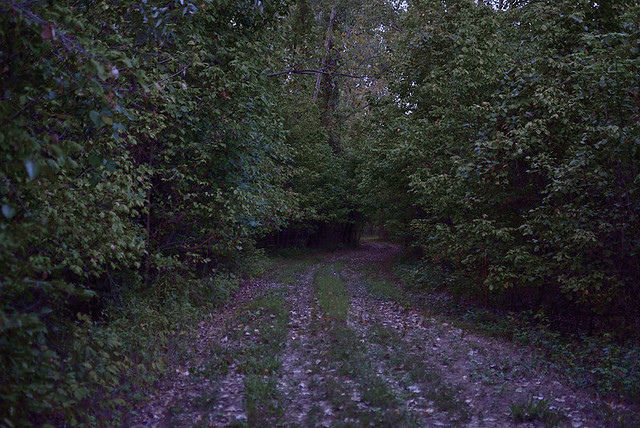
Is it pleasant, or frightening, in the dark? Perhaps both? We live in an age where nervous parents overly-protect their children, to the point where children become fearful and sickly because they are not exposed to the dangers of life — but this age also promotes exceptionally risky behaviors. Moral theologians instead remind us that the virtue of courage is built up by habitually taking measured risks, while never being either a coward nor foolhardy. Clearly, although the greatest dangers come from our fellow human beings, stumbling around in a forest at night has its own danger, not the least is poison ivy, which is seen growing here on both sides of the trail.
But it also has its own beauties. Even the commonplace becomes mysterious as dusk deepens.

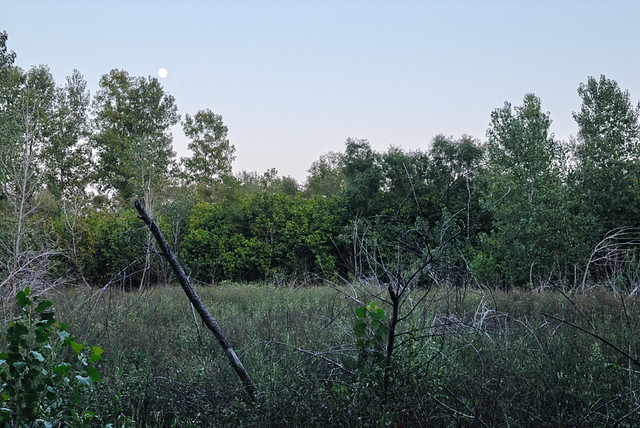
The full moon rises over a small clearing.
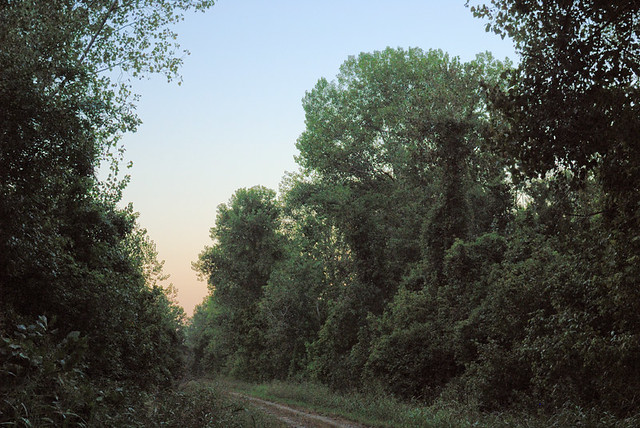
Wild grape vines climb into the trees here, near the river. On the opposite side of the river, in Saint Charles County, there are numerous wineries that take advantage of the good grape-growing conditions found hereabouts.
The problem with night photography is that the camera diligently works to make a well-exposed photo, and the results will likely look like broad daylight and not dusk — if, that is, you can get a photo at all due to the darkness. A tripod or special low-light camera gear can help. The human eye has a special low-light adaptation which gives a different appearance of tonality and color than does a camera. I've done some manipulation on these images to simulate that effect, which I describe in technical detail here, here, and here.
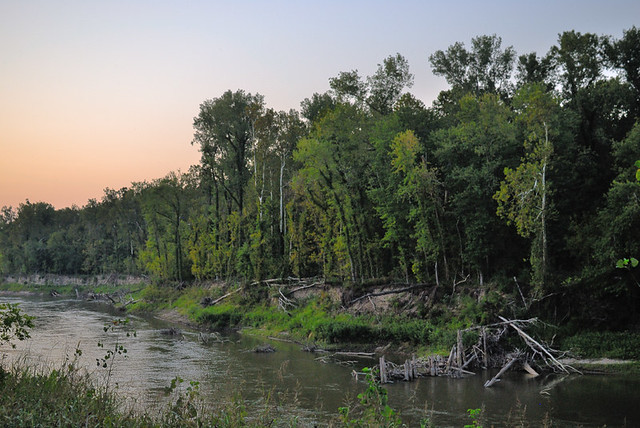
The river, after more than a mile's hike, with the remaining sunset giving a warm color to the sky.
This is — as far as I know — an unnamed chute, with Johnson Island in the background. Access to the island is only by boat from across the river, and you have to cross the rather treacherous Missouri River. Because the river has shifted in course since these areas were surveyed by the Spanish Crown, part of the island is in Saint Louis County, and other parts are in Saint Charles. There are several areas nearby where you can walk between the counties on land.

In the background is the main channel of the river.

On the way back to the tiny parking area, these trees were illumined by the last bit of dusk and by lights from a sports field a half mile to the south.
The Howell Island Conservation Area is located nearby. Access to the island is by a low-water causeway, which was recently reconstructed. These photos were taken on the causeway, showing Centaur Chute, and the scene was illumined by moonlight and by distant city lights illumining the sky:

The stillness of this low water is contrasted by the rapids formed here during spring flooding.

A restful scene to complete the evening.
Subscribe to:
Posts (Atom)
