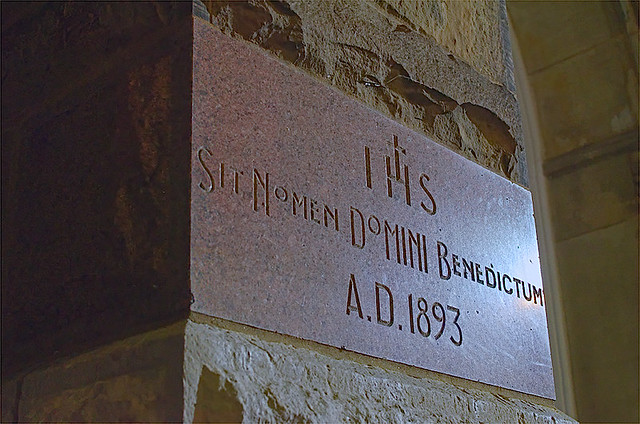
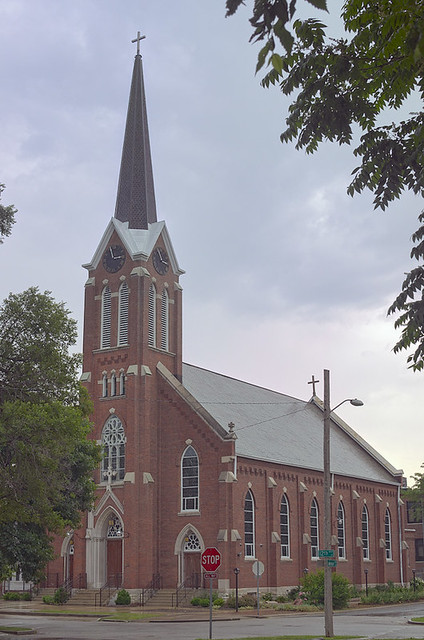
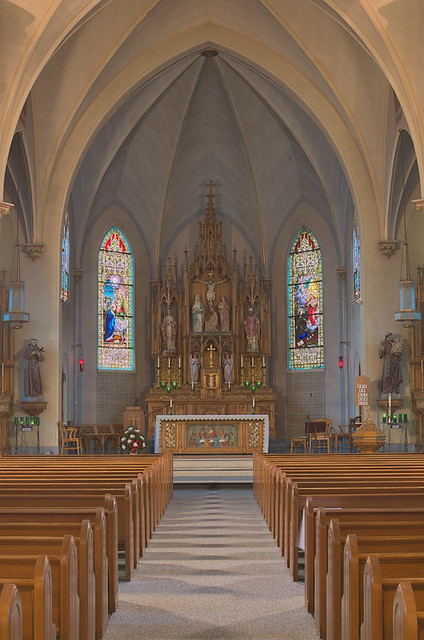
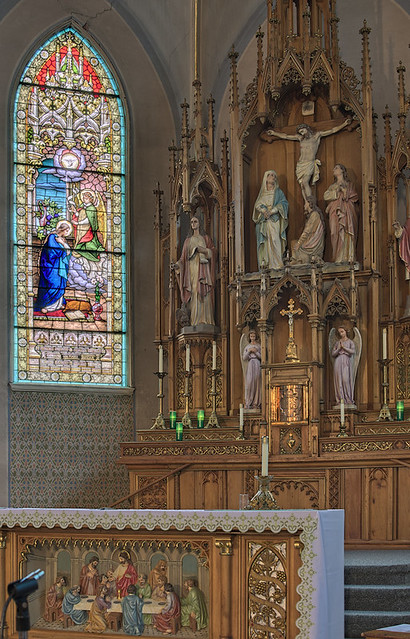
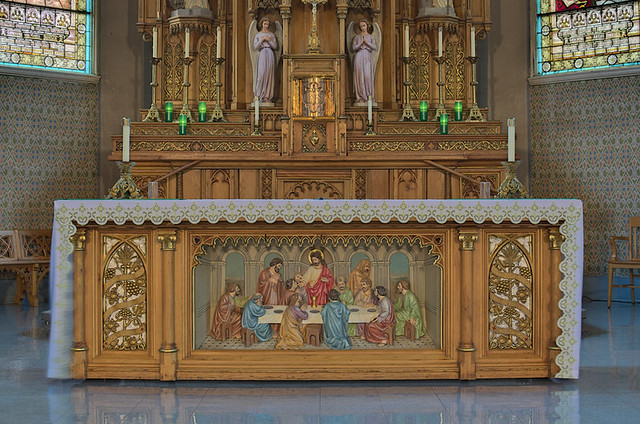
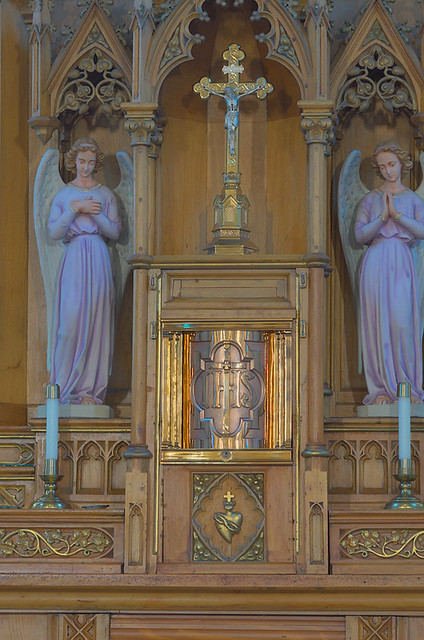
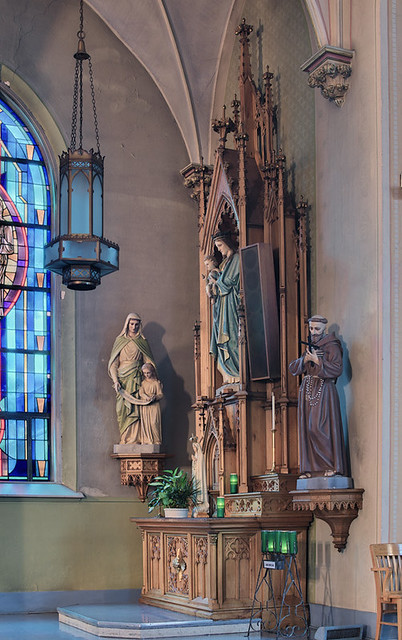
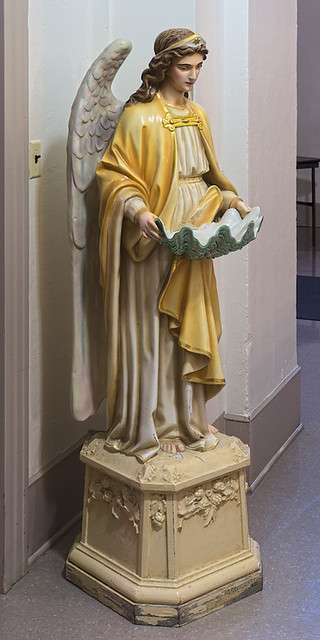
At Saint Mary’s Church, in Alton, Illinois.



FIRST, I would like to offer again my congratulations and my love to my parents on the occasion of their 60th anniversary of marriage, which occurred on July 10th. We had a fine celebration this week.
THERE SEEMS TO BE a common idea floating around that the rites of the church, and church buildings themselves, ought to be plain and simple, that the opulent art of the Church somehow goes against the teachings of Christ. This is sometimes followed by the idea that the Church ought to sell her art in order to feed the poor.
“Very rightly the fine arts are considered to rank among the noblest activities of man’s genius, and this applies especially to religious art and to its highest achievement, which is sacred art. These arts, by their very nature, are oriented toward the infinite beauty of God which they attempt in some way to portray by the work of human hands; they achieve their purpose of redounding to God’s praise and glory in proportion as they are directed the more exclusively to the single aim of turning men’s minds devoutly toward God.”The calls for plainness and nullity in the rites and buildings of the Church does not come from within the mind of the Church.
4. Nor, perchance did the fact which We now recall take place without some design of divine Providence. Precisely at the epoch when the American colonies, having, with Catholic aid, achieved liberty and independence, coalesced into a constitutional Republic the ecclesiastical hierarchy was happily established amongst you; and at the very time when the popular suffrage placed the great Washington at the helm of the Republic, the first bishop was set by apostolic authority over the American Church. The well-known friendship and familiar intercourse which subsisted between these two men seems to be an evidence that the United States ought to be conjoined in concord and amity with the Catholic Church. And not without cause; for without morality the State cannot endure — a truth which that illustrious citizen of yours, whom We have just mentioned, with a keenness of insight worthy of his genius and statesmanship perceived and proclaimed. But the best and strongest support of morality is religion. She, by her very nature, guards and defends all the principles on which duties are founded, and setting before us the motives most powerful to influence us, commands us to live virtuously and forbids us to transgress. Now what is the Church other than a legitimate society, founded by the will and ordinance of Jesus Christ for the preservation of morality and the defence of religion? For this reason have We repeatedly endeavored, from the summit of the pontifical dignity, to inculcate that the Church, whilst directly and immediately aiming at the salvation of souls and the beatitude which is to be attained in heaven, is yet, even in the order of temporal things, the fountain of blessings so numerous and great that they could not have been greater or more numerous had the original purpose of her institution been the pursuit of happiness during the life which is spent on earth.Pope Leo reiterates the core fact of civic life, that a government cannot be good unless those who govern, and those who are governed, are also good — a happy state of affairs which is best found if all have religion. Democracy does not automatically produce a good government, if the people are wicked, but rather, virtue can flourish if left unencumbered by the State, since far too often grasping leaders wish to control all things, including religion.
5. That your Republic is progressing and developing by giant strides is patent to all; and this holds good in religious matters also. For even as your cities, in the course of one century, have made a marvellous increase in wealth and power, so do we behold the Church, from scant and slender beginnings, grown with rapidity to be great and exceedingly flourishing. Now if, on the one hand, the increased riches and resources of your cities are justly attributed to the talents and active industry of the American people, on the other hand, the prosperous condition of Catholicity must be ascribed, first indeed, to the virtue, the ability, and the prudence of the bishops and clergy; but in so slight measure also, to the faith and generosity of the Catholic laity. Thus, while the different classes exerted their best energies, you were enabled to erect unnumbered religious and useful institutions, sacred edifices, schools for the instruction of youth, colleges for the higher branches, homes for the poor, hospitals for the sick, and convents and monasteries. As for what more closely touches spiritual interests, which are based upon the exercise of Christian virtues, many facts have been brought to Our notice, whereby We are animated with hope and filled with joy, namely, that the numbers of the secular and regular clergy are steadily augmenting, that pious sodalities and confraternities are held in esteem, that the Catholic parochial schools, the Sunday-schools for imparting Christian doctrine, and summer schools are in a flourishing condition; moreover, associations for mutual aid, for the relief of the indigent, for the promotion of temperate living, add to all this the many evidences of popular piety.
6. The main factor, no doubt, in bringing things into this happy state were the ordinances and decrees of your synods, especially of those which in more recent times were convened and confirmed by the authority of the Apostolic See. But, moreover (a fact which it gives pleasure to acknowledge), thanks are due to the equity of the laws which obtain in America and to the customs of the well-ordered Republic. For the Church amongst you, unopposed by the Constitution and government of your nation, fettered by no hostile legislation, protected against violence by the common laws and the impartiality of the tribunals, is free to live and act without hindrance. Yet, though all this is true, it would be very erroneous to draw the conclusion that in America is to be sought the type of the most desirable status of the Church, or that it would be universally lawful or expedient for State and Church to be, as in America, dissevered and divorced. The fact that Catholicity with you is in good condition, nay, is even enjoying a prosperous growth, is by all means to be attributed to the fecundity with which God has endowed His Church, in virtue of which unless men or circumstances interfere, she spontaneously expands and propagates herself; but she would bring forth more abundant fruits if, in addition to liberty, she enjoyed the favor of the laws and the patronage of the public authority.


