UNION IN DISTINCTION makes order; order produces agreement; and proportion and agreement, in complete and finished things, make beauty. An army has beauty when it is composed of parts so ranged in order that their distinction is reduced to that proportion which they ought to have together for the making of one single army. For music to be beautiful, the voices must not only be true, clear, and distinct from one another, but also united together in such a way that there may arise a just consonance and harmony which is not unfitly termed a discordant harmony or rather harmonious discord.— Treatise on the Love of God, by Saint Francis de Sales (1567-1622)
Now as the angelic S. Thomas, following the great S. Denis, says excellently well, beauty and goodness though in some things they agree, yet still are not one and the same thing: for good is that which pleases the appetite and will, beauty that which pleases the understanding or knowledge; or, in other words, good is that which gives pleasure when we enjoy it, beauty that which gives pleasure when we know it. For which cause in proper speech we only attribute corporal beauty to the objects of those two senses which are the most intellectual and most in the service of the understanding—namely, sight and hearing, so that we do not say, these are beautiful odours or beautiful tastes: but we rightly say, these are beautiful voices and beautiful colours.
The beautiful then being called beautiful, because the knowledge thereof gives pleasure, it is requisite that besides the union and the distinction, the integrity, the order, and the agreement of its parts, there should be also splendour and brightness that it may be knowable and visible. Voices to be beautiful must be clear and true; discourses intelligible; colours brilliant and shining. Obscurity, shade and darkness are ugly and disfigure all things, because in them nothing is knowable, neither order, distinction, union nor agreement; which caused S. Denis to say, that "God as the sovereign beauty is author of the beautiful harmony, beautiful lustre and good grace which is found in all things, making the distribution and decomposition of his one ray of beauty spread out, as light, to make all things beautiful," willing that to compose beauty there should be agreement, clearness and good grace.
Certainly, Theotimus, beauty is without effect, unprofitable and dead, if light and splendour do not make it lively and effective, whence we term colours lively when they have light and lustre.
Tuesday, January 29, 2013
Saint Francis de Sales on Beauty


Saturday, January 26, 2013
Newsletter from the Oratory
| View this as a web page. | ||||||
|



Thursday, January 24, 2013
Downton Abbey Presentation at the Belleville Cathedral
From Saint Peter's Cathedral in Belleville, Illinois:
"Downton Abbey"
and
Christian Morality,
Christian Family
and Christian Society
Presentation and Discussion
with selected scenes from the series
Thursday January 31
7:00 pm to 8:30 pm
in the Undercroft
of St. Peter's Cathedral, Belleville
Monsignor John T. Myler, Rector:
"There are many, many fans of 'Downton Abbey' in our parishes and congregations. And although there is very little discussion of God in the series -- maybe a little praying or an occasional wedding in a church -- the stories seem to be a reflection of tested faith and hope in times of hopelessness: world war ... unjust imprisonment ... the loss of job or fortune ... the complexities of family life."Free admission. Open to all.
"The stories of the characters 'upstairs' and 'downstairs', the stories of their personal struggles, of upheavals in the family and in society, all demonstrate what a modern-day crisis-of-faith is often like."
"I think that's why so many people around the world find 'Downton Abbey' so interesting."
Part of the Cathedral's on-going "Adult Faith Formation" series.
Wednesday, January 16, 2013
On Analogy
THERE ARE SEVERAL common modes of human reason, which includes the familiar processes of inductive and deductive reasoning, as well as abductive reasoning, hypothetical reasoning, and others.
But one of the most powerful modes of reasoning — if not the most precise — is analogical reasoning, where you compare and contrast one sort of thing to another. Inductive and deductive methods are rather precise, but can be slow, plodding, expensive, or difficult, and we can often end up with trivial results such as “Oceans are determined to be very large and full of water.” However, analogical reasoning takes the full capacity of the human imagination to quickly jump from one thing to another, which may lead to unexpected and novel results. For example, Niels Bohr developed a model of the atom, analogizing it with the solar system, which led to a new understanding of nature. Some think that analogical reasoning is the base or primary mode of reasoning of the human intellect, since it contains within it aspects of all the other modes of reason. Analogical reasoning is very fruitful: it proposes, and the other more precise modes of reasoning fills in the details; perhaps deduction and induction are not possible without first making the analogy.
Examples, parts, or close relations of analogy include:
...exemplification, comparisons, metaphors, similes, allegories, and parables, ... association, ... correspondence, mathematical and morphological homology, homomorphism, iconicity, isomorphism, ... resemblance, and similarity....In the field of artificial intelligence, it was originally thought that computer systems based on pure deductive reasoning would lead to a human level of intelligence, but this did not work out in practice, and it seems that research on this has been moribund since the 1980s. However, a newer computer algorithm, the Vector Space Model, uses analogical reasoning and has nearly achieved the average human level of performance on the College Board's SAT multiple-choice analogy test. Analogical reasoning is used effectively in Google Search, which often produces surprising yet reasonable Internet search results.
Some of the powerful analogies include arguments from symmetry and proportion. Indeed, the English word “analogy” derives from the ancient Greek ἀναλογία, analogia, meaning “proportion”. We say that the proportions 3:2 and 6:4 are analogous since they have the same ratio of 1.5, and likewise we can analogize by saying that fingers are to the hand as toes are to the foot. The Greek philosopher Plato used his allegories as analogical arguments, as did Our Lord in His parables. Analogy is particularly important in the figurative arts, where we associate daubs of paint on a canvas with say, a human face. Biologists use analogy extensively when comparing the anatomy of various species, and have thereby discovered the principle of convergence.
Good analogical reasoning not only compares similarities between two things, but also contrasts their differences. When Bohr developed his atomic model, he reasoned that the tiny electrons orbit around a large nucleus, as the planets orbit around the sun. But on the atomic scale, quantum effects predominate, and so the analogy breaks down a bit, since it is hard to claim that the electrons are actually orbiting, and so this needed a better mathematical model. But one of the great benefits of analogical reasoning is that the things that we learn about a new unfamiliar system (such as the atom) can shed light back upon the old familiar system (such as the solar system): some of the newer mathematics that explained the atom, in turn, can be analogously used to more fully explain the solar system.
Some claim that analogies are methods used by those in power to impose meaning, and this could happen, and so analogies have to be made intelligently to be truthful and fruitful. An old model of the atom, called the ‘plum pudding model,’ did not bear (or even contain) fruit, although it does sound tasty: but it is an absurd analogy. A good analogy must highlight any differences that exist, as well as similarities, otherwise it indeed is an imposition of meaning. It seems that a good analogy must start with something baser, and then go by analogy to something higher. Modern political discourse will often attempt to analogize a current political issue with something Biblical, such as the Jews' exodus from Egypt. Since this is an inversion of the hierarchy of importance, this trivializes scripture and tells us nothing new, and so we aren't learning anything: where, according to the politicians, are the Commandments of God? Lest we forget, new knowledge is the goal of reasoning. Our Lord's parable of the Prodigal Son indeed starts with something common — a father's forgiveness towards his wayward son — but instead points to the greater meaning of God's forgiveness for our sins; while this analogy tells us something about the relationship between human fathers and sons, that is not the main point of the parable, which mainly reveals to us knowledge of God.
Analogy is of great importance in Catholic and Orthodox Biblical exegesis — the interpretation of scripture — and this forms the basis of what is called Biblical typology. A ‘type’ in ancient Greek is a small model which is made by an artist in preparation for his larger final work of art (we still use this sense in the English word prototype), and so what God made in the Old Testament can seen as types, figures, or models for what we find fulfilled in the New Testament. We find many striking similarities in events and persons between the Old and New Testaments, and by using analogical reasoning, we can compare and contrast these, seeing the Old Testament types as models or foreshadowings of what is to come. We often find that something in the Old Testament reveals something in the New, and that what is found in the New Testament more fully explains the Old. We are told, explicitly, that the lamb slaughtered on Passover is a type of Christ, and in turn, Christ reveals more clearly the meaning of the Passover. The lovers in the Song of Songs analogously show the relationship between God and the human soul, which is something that was long recognized by the ancient rabbis, but can also be seen as a type of the relationship between Christ and the Church, and the Holy Spirit with the Virgin Mary. Through analogy, we see that Eve is a type of Mary, and so the Virgin is called the New Eve, and the main contrast illuminated by the analogy is that Mary succeeded where Eve failed.
Analogical reasoning applied to sacred scripture is also used in moral theology as well as in eschatology. We also find much analogy in the liturgy: the Old Testament reading at the Mass often prefigures the Gospel reading, and the Roman Canon explicitly mentions various Old Testament figures:
Be pleased to look upon these offerings with a serene and kindly countenance, and to accept them, as once you were pleased to accept the gifts of your servant Abel the just, the sacrifice of our Abraham, our father in faith, and the offering of your high priest Melchizedek, a holy sacrifice, a spotless victim.
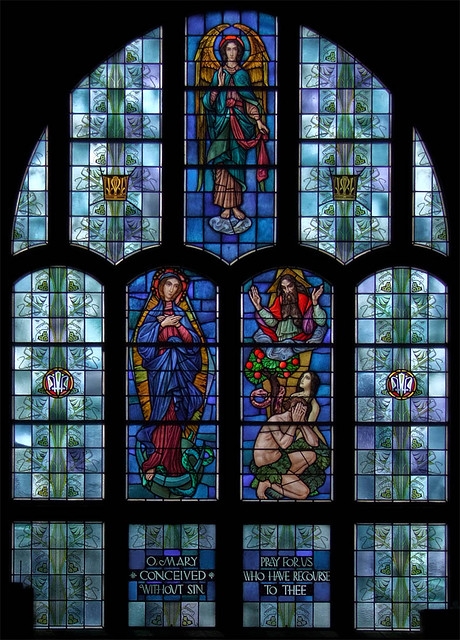
A stained glass window depicting Mary and Eve, at Immaculate Conception Church in Union, Missouri, illustrates the typology of Mary being the New Eve.
These analogies are of great importance to understanding Catholicism in general, and even when understanding Catholic art, where we might see the sacrifice of Abraham juxtaposed with the Crucifixion, or Melchizedek juxtaposed with the Last Supper. A flat, exclusively literal reading of sacred scripture — while not being denied by the Church, which is very important — tends to be dull, plodding, and disconnected. Reading the analogies in scripture brings it to life. Also, analogous reasoning can also be applied to nature, where natural objects such as water and light (which can be used to wash us or to light our way) give us spiritual insights, and in turn, we find that natural things such as water can have a sacramental role as in baptism.
We also find that analogical-typological reasoning can be useful for analyzing secular works. In the novel The Lord of the Rings, the characters of Gandalf, Frodo, and Aragorn, are each seen to be Christ types, being analogous to Christ's threefold office of prophet, victim-priest, and king respectively, and the plot of the novel can be better understood in this light. Analogies between secular Roman works on love and sacred scripture have also proved to be fruitful: the Romans discovered that jealousy is necessarily found in a lover, otherwise he does not love, and this shows to us the Biblical claim that God is jealous is likewise necessary, otherwise He does not love us; the Faith then more fully illuminates the classical notion that love has a Divine source.
In general, failure to observe analogous situations tends to set up an intellectual opposition between things, leading to ideologies. Scientism, for example, is an ideology that claims that the inductive method is the only valid form of reasoning, and this in turn ends up denying cause and effect. In religion, some see the Old and New Testaments as being in opposition to each other, which is core idea behind Gnosticism and ideological anti-Semitism; but this makes analogy impossible and so destroys the full Christian understanding and has unfortunate implications. Without good analogizing, things are seen in conflict which ends in destruction, and indeed we find a great distrust of analogy in Marxism, which is the ideology responsible for the greatest shedding of blood in human history. Analogy, on the other hand, tends to unify knowledge, and so in turn may help unify and harmonize society.
Starting on Wednesday, January 23rd, 2013, Dr. Lawrence Feingold will deliver a series of lectures at the Cathedral Basilica of Saint Louis, “Typology: How the Old Testament Prefigures the New,” where he will demonstrate the fruits of the Church's typological understanding of sacred scripture. More information can be found here, and the outline (and eventually, God willing, audio recordings) of the lectures can be found here. Some of Dr. Feingold's previous lectures on typology can be found here and here.
Also, you might want to visit the exhibit Federico Barocci: Renaissance Master at the Saint Louis Art Museum, which runs through January 20th, 2013. The exhibit is free on Friday. In addition to devotion-inspiring large religious paintings by a little-known but excellent artist, the exhibit includes many fine drawings that are models or types that Barocci used before making his finished work.
Subscribe to:
Posts (Atom)
