Pages

Thursday, July 25, 2013

Photos of Saint Clement of Rome Church, in Des Peres, Missouri

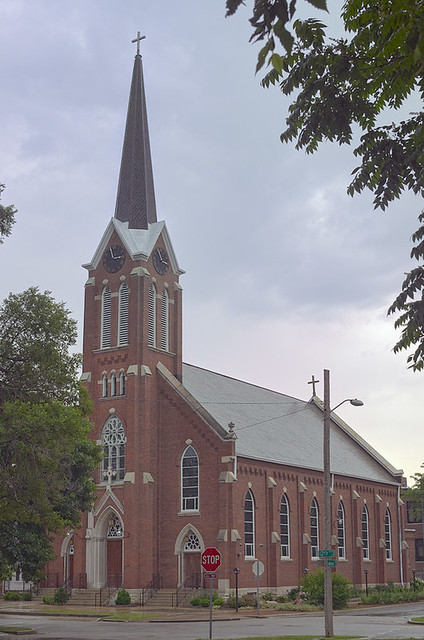
HERE ARE PHOTOS of Saint Clement of Rome Church, located about 16 highway miles due west of downtown Saint Louis, in the suburban Saint Louis County town of Des Peres, Missouri.

Saint Clement of Rome Church, in Des Peres, Missouri, USA - exterior (reduced size)

From the church's website:
St. Clement Parish was founded on March 19, 1952, when Archbishop Joseph Ritter assigned Father Luke Naes as pastor. The six acres purchased by the Archdiocese of St. Louis from the Deutschmann family in 1951 were augmented by an additional three and one-half acres in 1955.

Initially, Mass was celebrated at St. Agnes Home on Manchester and Warson Roads on Sundays and Holy Days and at the temporary rectory at 1134 Bopp Road on weekdays. Ground was broken on July l9, 1953, for the first structure on the premises: the eight classroom school, the cafeteria, and the temporary church. Within a few years, an eight-room addition was added to the school and the rectory was built.

By 1959, the parish had grown to 400 families and the school enrollment peaked at 683 students. The Sisters of the Most Precious Blood (O'Fallon), who staffed the school, had been living in quarters within the school building, and the decision was made to construct a convent. The sisters took up residence in their new quarters on Passion Sunday 1960. In 1965, the church was built and the former church was converted into a gymnasium…
According to the 2012 Status Animarum, or ecclesiastical census, the parish has 4,256 members.

The name of the church’s city, Des Peres — French for ‘of the fathers’ derives its name from the River des Peres, a watercourse that has or had its headwaters in this area. The river itself gets its name from a Jesuit mission to the Kaskaskia tribe, who founded a temporary settlement in 1700 at the river's mouth.

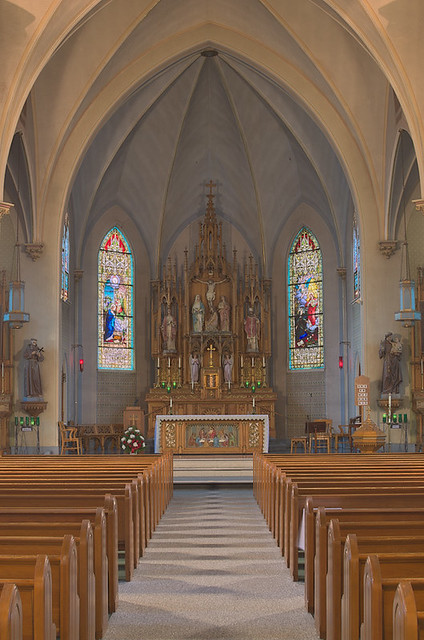
Saint Clement of Rome Church, in Des Peres, Missouri, USA - altar (reduced size)

Saint Clement of Rome — Pope Clement I — ascended to the throne of Peter in A.D. 92 and — like all of the early Popes — died a martyr's death in A.D. 99. He is mentioned in the Roman Canon of the Mass, and his feast is celebrated on November 23rd in the Roman calendar. His writings can be found here (Latin) and here (English). He is a patron to sailors, stone cutters, and sick children.

See also: Chapel at Saint Clement of Rome.

Address:
1510 Bopp Road
Des Peres, Missouri 63131

Friday, July 19, 2013

Photos of Sacred Heart Church, in Springfield, Illinois

HERE ARE PHOTOS of Sacred Heart Church, in Springfield, Illinois, located about 97 highway miles north-by-northeast of downtown Saint Louis. Together with Saint Patrick’s, also in Springfield, this church is a part of the Saint Katharine Drexel Parish of the Diocese of Springfield in Illinois.

Sacred Heart Roman Catholic Church (Saint Katharine Drexel Parish), in Springfield, Illinois, USA - exterior

Sacred Heart Parish was organized in 1884, while the Gothic Revival church dates from 1895. At the time of this church’s founding, the episcopal see of this diocese was in Alton, Illinois. Originally a German parish, the church now celebrates the Holy Mass in English and Spanish. According to the Diocese, the combined parish includes 480 parishioners in 290 families.

Sacred Heart Roman Catholic Church (Saint Katharine Drexel Parish), in Springfield, Illinois, USA - nave

The church features finely carved wood altars.

These are the first photos here taken with a new camera; this, coupled with new computer software, allows for a far more subtle — and theoretically, more visually accurate — rendering of colors; however, because of my inexperience with this new technology, there is a bit of inconsistency among the photos.

Sacred Heart Roman Catholic Church (Saint Katharine Drexel Parish), in Springfield, Illinois, USA - sanctuary detail

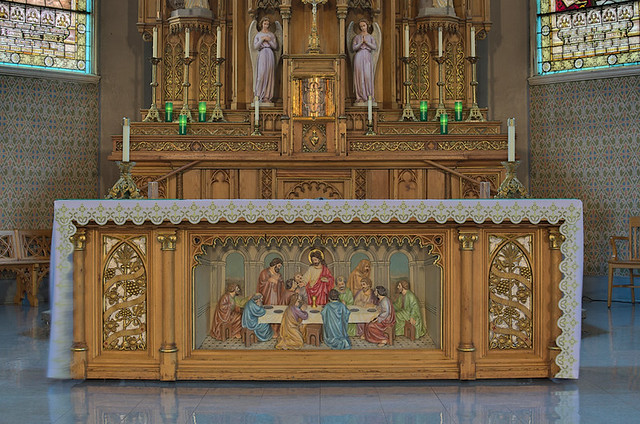
The freestanding altar depicts the Last Supper, while the Annunciation is depicted in the stained glass window. The reredos provides a great backdrop and a setting for the tabernacle.

Sacred Heart Roman Catholic Church (Saint Katharine Drexel Parish), in Springfield, Illinois, USA - altar

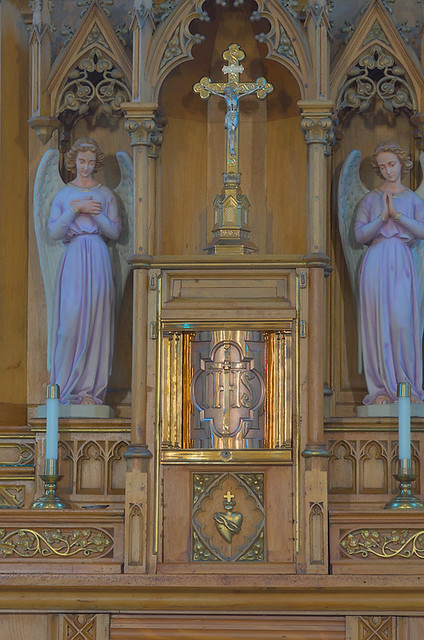
Sacred Heart Roman Catholic Church (Saint Katharine Drexel Parish), in Springfield, Illinois, USA - tabernacle and crucifix

A closer view of the tabernacle, flanked by angels — a configuration inspired by the original Ark of the Covenant of the Old Testament — with a small Crucifix above and a symbol of the Sacred Heart of Jesus below. As the heart is a symbol of love, the thorns around the heart illustrate how our sins wound God’s love for us.

Sacred Heart Roman Catholic Church (Saint Katharine Drexel Parish), in Springfield, Illinois, USA - Infant Jesus and Virgin of Guadalupe

Located to the right of the altar, here are statues of the Infant Jesus and the Virgin of Guadalupe.

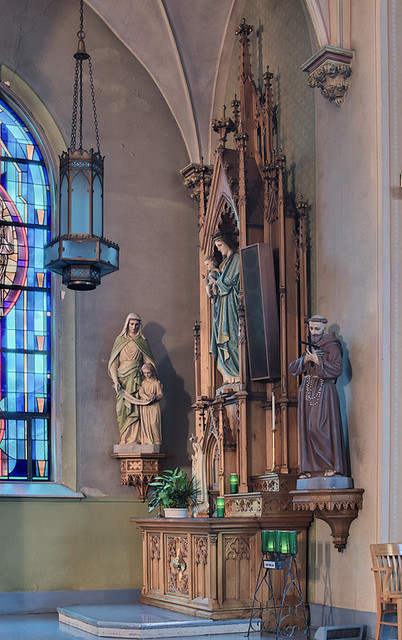
Sacred Heart Roman Catholic Church (Saint Katharine Drexel Parish), in Springfield, Illinois, USA - Mary's altar

The altar of the Blessed Virgin Mary is on the left.

Sacred Heart Roman Catholic Church (Saint Katharine Drexel Parish), in Springfield, Illinois, USA - side of nave

A view to the left aisle; here we see the Stations of the Cross and some of the stained glass windows.

Sacred Heart Roman Catholic Church (Saint Katharine Drexel Parish), in Springfield, Illinois, USA - painting of Christ the Priest

Above the Gothic arches in the nave are paintings of the offices of Christ; here we see Christ the Priest.

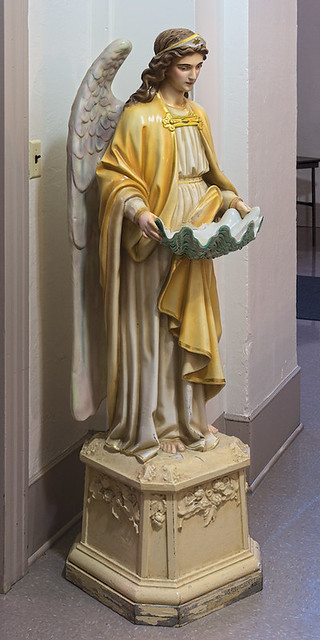
Sacred Heart Roman Catholic Church (Saint Katharine Drexel Parish), in Springfield, Illinois, USA - angel holy water font

A holy water font.

Address:
730 South Twelfth Street
Springfield, IL 62703

Friday, July 12, 2013

Acknowledgments

FIRST, I would like to offer again my congratulations and my love to my parents on the occasion of their 60th anniversary of marriage, which occurred on July 10th. We had a fine celebration this week.

I would also like to recall my entrance into the Church, on Trinity Sunday, ten years ago. This has been a blessing to me, although I admit to my shame that I hardly ever acknowledge those blessings. I have new crosses to bear, but also the grace to carry them. Perhaps like what was said of the ancient Irish, my songs are now sad but my battles are happy.

I spent the months of May and June working on processing photos for a new book, which should be out this autumn, and so I haven’t blogged much here lately. Like my other Reedy Press books, this will be a full-color coffee-table photo book featuring scenes from around Saint Louis, and will be available at local bookstores as well as online booksellers.  I would also like to acknowledge my long-suffering friend Tina, who drove me thousands of miles for this book, in brutal winter weather, often in the dead of night, in the cold and snow, and who constantly cajoled me to complete my task even though I was ill at the time and could hardly walk.

While I do have other urgent tasks that I ought to take care of in the near future, I am also looking for future topics for photo books and am open to suggestions. I have two titles currently under development, but would like to fill up the pipeline, so to speak, with more works.  I would like to find writers who are open to doing collaborations: if you are a good writer, diligent, able to meet deadlines, good at public speaking, and are willing to work on speculation — please understand that the first royalty check might appear a year after completing the work — please contact me. My major limitation in doing photography is travel expenses, and would be delighted to find donors or organizations who would be willing to underwrite my travel costs, in exchange for sharing in the income of the resulting books.

I would also like to acknowledge my father, and my patroness Laura Rogers, who recently gave me a camera for my birthday. It has a quiet shutter and can take excellent pictures even in dimly lit churches.

If you are on Facebook, you might want to ‘like’ two pages that I manage there:

  • St. Louis Parks features my photography and supports the book of the same name by Reedy Press; you can purchase a copy of the book by clicking the button on the sidebar.
  • Catholic Art Theory features quotes on the arts from artists, philosophers, theologians, and magisterial documents, which help explain the meaning, theory, and importance of the arts in the Church and in general. 

Wednesday, July 10, 2013

On Liturgical Beauty

THERE SEEMS TO BE a common idea floating around that the rites of the church, and church buildings themselves, ought to be plain and simple, that the opulent art of the Church somehow goes against the teachings of Christ. This is sometimes followed by the idea that the Church ought to sell her art in order to feed the poor.

But the Old Testament clearly shows that the Tabernacle — the tent of meeting which held the Ark of the Covenant — was extremely elaborate, and that God Himself dictated how it was to be designed.

Also beautiful was the Temple in Jerusalem, which in Our Lord’s time was the largest and likely most elaborate religious structure in the entire Empire. Psalms praise the beauty of the Temple, as a place better than anywhere else. It was there that Christ frequently taught, and which was so holy that He drove out the moneychangers from it. Early Christians worshipped at the Temple until its destruction. Consider that Our Lord foretold that its destruction would be such a traumatic event that people would beg to be killed. Is it not fitting that with the New Testament, we now have a new Temple in every city of the world? And that these symbolic New Jerusalems are likewise elaborate and fitting for God’s glory?

Synagogues, where early Christians also worshiped, according to archaeological evidence, were highly ornate, as well as were the house churches in Rome. So were the catacombs.

One of the laws of Judaism is the ‘hiddur mitzvah’, which commands that the rites must be ornamented with extra effort and beauty in honor of the glory of God. Simply doing the bare minimum, taking a utilitarian view of the sacramental life, or only doing what is essential, ultimately may show a meanness of spirit. Clearly the idea of hiddur mitzvah was inherited by the early Christians, and this principle seems to be strongly rejected in our current utilitarian age.

If the Church sells off her art to feed the poor, wouldn’t the buyers of the art be in a far better position to feed the poor, since apparently they must have a great excess of disposable income to buy what is for them merely an aesthetic object, devoid of authentic spiritual value? Consider that the Church bought the art relatively inexpensively by hiring people to make it, and it has great value now merely due to great age. How about the rich simply giving the Church the money, so that she can feed the poor, as she has always done? Anyone can see church art simply by visiting churches: consider the spiritual harm that can come if that art is decontextualized and secularized — which, I suspect, is what a lot of folks actually want.

The Church has declared that iconoclasm is a heresy, that our churches are to be decorated ‘as a bride for her wedding’, as can be found in the Second Council of Nicaea and the Council of Trent. The Second Vatican Council affirms this:
“Very rightly the fine arts are considered to rank among the noblest activities of man’s genius, and this applies especially to religious art and to its highest achievement, which is sacred art. These arts, by their very nature, are oriented toward the infinite beauty of God which they attempt in some way to portray by the work of human hands; they achieve their purpose of redounding to God’s praise and glory in proportion as they are directed the more exclusively to the single aim of turning men’s minds devoutly toward God.”
The calls for plainness and nullity in the rites and buildings of the Church does not come from within the mind of the Church.